Showing posts with label Review. Show all posts

Tuesday, June 13, 2023

Prehistoric Planet Season 2

To the delight of many, Prehistoric Planet came back this year for a second season. Much of the praise that was lavished on the first season is equally applicable to this one, so I think it's fair to cut to the chase and dive into the specifics of its maniraptoran portrayals. Season 2 follows its predecessor in focusing on life during the Maastrichtian Age of the Late Cretaceous, and with this setting comes a whole cast of both new and returning maniraptoran taxa.

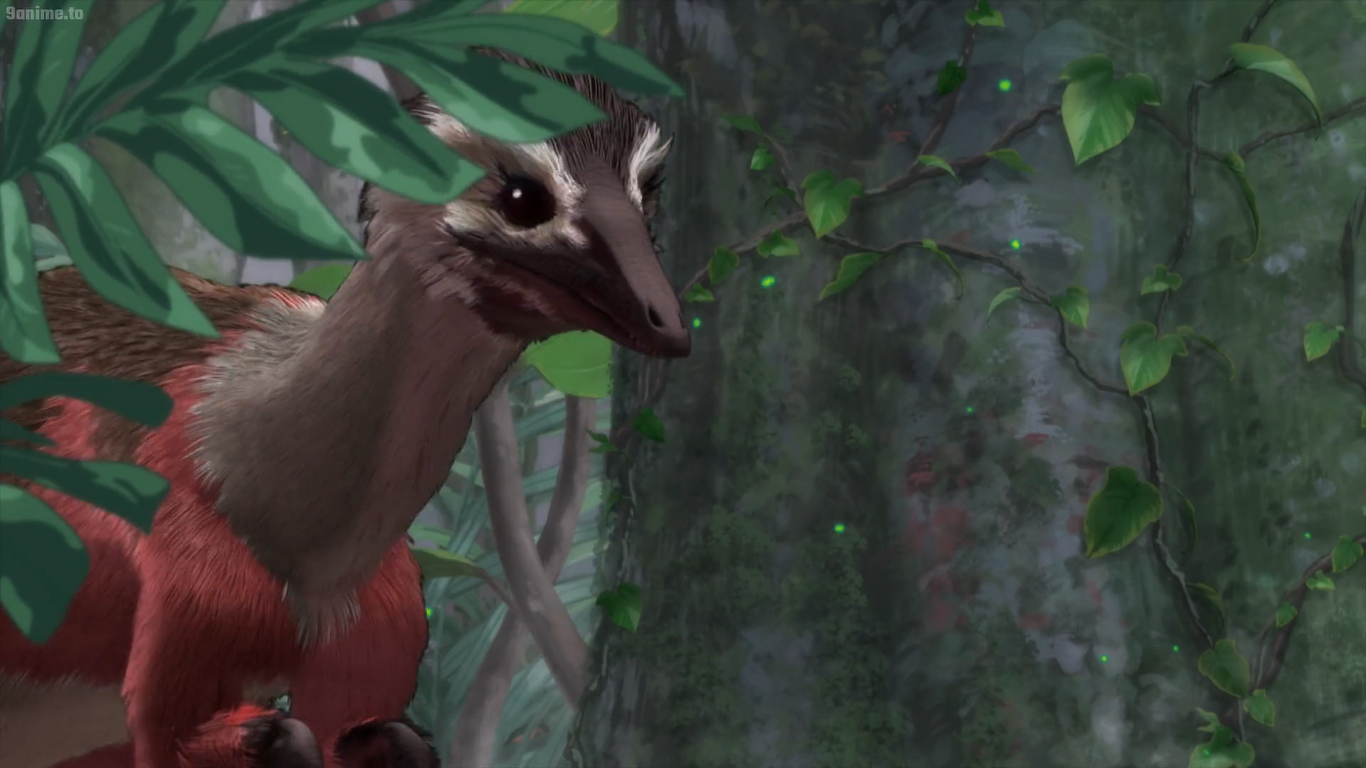
One of these returning maniraptorans is the oviraptorosaur Corythoraptor from the Nanxiong Formation of China, this time shown in a nesting colony. From an aesthetic standpoint, I'm very much a fan of the Corythoraptor model in this series, so it was fantastic to see it get some airtime besides becoming tyrannosaurid chow. This segment was also a great opportunity to showcase the relatively large amount of data we have on oviraptorid reproduction. Sharp-eyed viewers might notice that the Corythoraptor eggs have a rough surface texture composed of numerous tubercles and are arranged in multiple superimposed, partially buried rings with their narrower ends pointing outward and inclined downward, all of which are traits that have been observed in preserved oviraptorid nests. The narration informs us that male Corythoraptor are responsible for tending to the nests, a behavior that has been suggested for oviraptorids based on several lines of evidence. The posture of the nesting Corythoraptor and the presence of a central opening in the nest for them to sit in are also inspired by known oviraptorid specimens.

A Corythoraptor inspects its nest.

There are a few details in this depiction that may be controversial. One scene shows a Corythoraptor moving one of its eggs to a different spot in the nest, but it has been argued that most Mesozoic pennaraptorans likely did not manipulate their eggs after they were laid. In fact, a few studies have disputed the popular idea that oviraptorids incubated their own eggs at all, primarily on the basis of their nest architecture, though recent experimental evidence indicating that such eggs would have still benefited from the body heat of a parent and the absence of any obvious alternative means of incubation currently suggests to me that some level of contact incubation in these dinosaurs is more plausible. I was surprised that the Corythoraptor eggs were not colored blue-green following the inference of such coloration in eggs referred to Heyuannia. This is not a demonstrable inaccuracy (as egg coloration can be highly variable in closely related modern birds), but it seems like the type of scientific detail that Prehistoric Planet has otherwise fallen over itself to include.

Like nest-guarding animals of today, the Corythoraptor in the show have to contend with potential nest raiders. There is an irony to oviraptorids (once interpreted as specialist "egg thieves") being shown suffering from egg predation themselves. In this case, the main threat that appears is the dromaeosaurid Kuru, an unexpected choice given that this dinosaur was named in 2021 (almost certainly well into the production of the series) and is not known to have occurred at the same locality as Corythoraptor, instead having been discovered in the Barun Goyot Formation of Mongolia. I wasn't particularly bothered by this—if these taxa overlapped in time (which is a possibility given that the ages of many Upper Cretaceous fossil-bearing rock units in Asia are far from well constrained), it's entirely plausible that they had geographic ranges larger than their current fossil record would suggest. The Kuru is depicted using the cover of darkness to target the Corythoraptor nests, likely based on evidence from scleral ring anatomy that some dromaeosaurids, including the closely related Velociraptor, may have been primarily nocturnal. 

Speaking of Velociraptor, it is another returning face from the first season. In this season's outing, a family of Velociraptor are portrayed using steep terrain to their advantage while hunting the pachycephalosaur Prenocephale. It's a nice sequence that further showcases the potential diversity of hunting strategies in dromaeosaurids, and includes some cute baby Velociraptor to boot. New to the series (and to paleontology documentaries in general, as far as I'm aware) is the bizarre giant unenlagiine dromaeosaurid Austroraptor from the Allen Formation of Argentina, which is shown preying on fish, as has been hypothesized based on its long snout containing numerous conical teeth.

An Austroraptor dismembers a gar.

The final dromaeosaurid genus to appear in this season is Pyroraptor from southeastern France, with a few juveniles briefly showing up on a shoreline to eat some stranded ammonoid larvae. I'll admit, it did enter my head that Asteriornis* would have been an excellent fit for the geographic location and ecological role demanded by this scene, but I understand that reusing the existing juvenile dromaeosaurid model was undoubtedly much easier for the filmmakers than designing an entirely new animal for such a minor part.

*I'd originally assumed that Asteriornis, having been described in 2020, did not have a chance of being included in either season of Prehistoric Planet. However, the second season does extensively feature the Malagasy mammaliaform Adalatherium, which was described about a month after Asteriornis was.

Moving away from dromaeosaurids (probably), this season also depicts Imperobator from the Snow Hill Island Formation of Antarctica. Imperobator was a large paravian of unclear affinities, and unlike dromaeosaurids, its second toe on each foot was not specialized for being raised off the ground, which Prehistoric Planet portrays correctly. In one scene, several Imperobator are shown as though they were filmed using a thermal imaging camera, and later on, the group attempts to hunt the ornithopod Morrosaurus. Coincidentally, the events in this segment bear some resemblance those of to a fan-made storyboard sequence by Denver Humphries and Ilari Pätilä.

A pair of Imperobator catch their breath on the surface of a frozen lake.

Troodontids are represented in a couple of scenes. Several individuals investigate a fresh Alamosaurus carcass, but, consistent with studies on the structure and wear patterns of troodontid teeth, they are unable to penetrate its thick hide until a Tyrannosaurus opens it up. That troodontids coexisted with these larger dinosaurs is not in doubt, given that their teeth have been found in the Ojo Alamo Formation (or Kirtland Formation, depending on your terminology) of the southwestern United States. Pectinodon from the Lance and Hell Creek Formations further north appears in a separate segment, in which a group visits an alkaline lake to feed on swarms of brine flies, a behavior probably inspired by some extant gulls. The Pectinodon family here consists of a male and its offspring, reflecting the fact that male parental care has been inferred in troodontids for the same reasons that it has in oviraptorids.

Not content with only the flies as a food source, the adult Pectinodon is shown preying on some other paravians that have gathered at the lake, a flock of presbyornithids. An unusual decision was made here to refer to the presbyornithids by a name that has yet to be formally published, originally used for some undescribed pectoral girdle bones from the Hell Creek Formation. Regardless, the anatomy of the presbyornithids, like that of essentially all the other prehistoric animals in the show, is depicted very solidly. Details such as the webbed feet and the flattened, hook-tipped bill lined with keratinous plates for filter feeding were evidently referenced from more completely known Cenozoic presbyornithid fossils. In the interest of full disclosure, I should mention that conversations I've had with Darren Naish, the main scientific consultant on the series, were used to inform these presbyornithid restorations. So that's my informal and infinitesimally minuscule contribution to Prehistoric Planet, and I'm relieved that I no longer have to keep the existence of Season 2 a secret!

The flamingo-duck's smile.

Having said that, my most severe criticism of this season concerns this segment. After the presbyornithids are introduced, the narration follows up with, "Dinosaurs, are here, too" as an segue to the arrival of the Pectinodon, thus implying that the presbyornithids are not also dinosaurs! This is not only flat-out inaccurate, but not mentioning that birds are themselves a group of dinosaurs seems like a major missed educational opportunity, especially considering that Prehistoric Planet has not shied away from showing non-avialan dinosaurs with bird-like appearances and behaviors (including in this very same segment). Darren has hinted that wording more explicitly recognizing the dinosaurian nature of birds was met with pushback from other forces during show production, which I think is incredibly unfortunate given that Walking with Dinosaurs had no issue with referring to avialans as "flying dinosaurs" in 1999.

That's not to end on a dour note, however. There is one more maniraptoran featured in the series left to discuss: the flightless marine euornithean Hesperornis, probably one of the most aquatically-adapted dinosaurs ever to have lived. The best known fossils of Hesperornis are between Coniacian–Campanian in age, but undescribed specimens from the Hell Creek Formation have been mentioned in scientific literature. Having been named in 1872, Hesperornis is no stranger to science, nor to appearances in popular media. However, I feel reasonably secure in saying that the Hesperornis in this series is the most scientifically rigorous depiction of this taxon ever animated in a work of this genre. In Prehistoric Planet, Hesperornis has a beak occupying distinct parts of its jaws from its teeth (despite the narration incorrectly stating that it had a "beak full of [...] teeth"), sprawling hindlimbs with the shins held close to the body, and a rudder-like tail fan (suggested by its broad, flat tail vertebrae), all features that are commonly overlooked in artistic restorations.

A Hesperornis terrorizes a school of fish.

Last but not least, it should be said that Prehistoric Planet Season 2 goes a long way towards addressing both of my main concerns about the first season: the near-absence of tetrapods that weren't non-avialan dinosaurs, pterosaurs, or large marine reptiles, and the limited disclosure about the science behind creative decisions made for the show. This season not only includes two avialan species (the presbyornithids and Hesperornis), but also the crocodylomorphs Simosuchus and Shamosuchus, the snake Madtsoia, the mammaliaform Adalatherium, and (returning from the previous season) the large frog Beelzebufo in prominent roles. On a related note, though ammonoids were not tetrapods, Prehistoric Planet must also be commended again for highlighting the diversity and life history of these key players in Mesozoic marine ecosystems, in a way that no other paleontology documentary has done before.

As for scientific content, twice as many "Uncovered" videos explaining the scientific backing behind the series were produced for this season compared to the last. Half of these segments are also directly attached to the main series episodes (instead of only being available as separate videos), likely allowing them to reach a wider audience. Furthermore, a Prehistoric Planet podcast was released, explaining additional details about the show's creative process. These are welcome additions to the lineup of official Prehistoric Planet media, but they probably still just barely unveil the curtain on the substantial effort and decision-making that assuredly went into the series. I for one would be eager to see even more behind-the-scenes material.

Whether there's more in store from Prehistoric Planet, only time will tell. However, for now I wouldn't be too upset if this were all we ever got. The two seasons of this show have been a veritable triumph, representing by far the most scientifically grounded and up to date portrayal of life in the latest Cretaceous that's currently available as a documentary series.

Monday, December 19, 2022

Gadget Cat in the Past: Paleontology in Doraemon

If I'm not careful, I'll start a new tradition on here of blogging about anime in December. In this post, I'll be looking at another staple of my childhood, Doraemon. This time though, there is a connection to paleontology!

Most people living in predominantly English-speaking countries might not be familiar with Doraemon. However, it would be difficult to overstate how much of a cultural icon the title character is in East Asia (we're talking about Mickey-Mouse-levels of recognition here), and I've heard that Doraemon is also widely known in parts of continental Europe and Latin America. In light of that, it is downright bizarre how obscure the franchise is in most English-speaking regions by comparison.

The character Doraemon is a robotic cat from the 22nd Century who keeps a vast array of futuristic gadgets in a portable pocket dimension (note the pocket on his belly). The premise of the series is that Doraemon has traveled back in time to help a schoolboy named Nobita, who is meant to be a complete failure at almost everything. The typical formula of a Doraemon story involves Nobita having a problem, begging Doraemon for a gadget to solve the problem, misusing the gadget for selfish reasons, and receiving some form of comeuppance, though many other types of storylines have been explored across the franchise's long history.

The gadget cat himself.

Doraemon has spawned all manner of media over the years, but for this post I will be focusing on the works that can be considered the "core" of the franchise:

  • The original manga by Fujiko F. Fujio, which ran from 1969 until Fujio's death in 1996
  • The 1979 anime series that aired until 2005
  • The 2005 anime reboot that continues to this day

(An earlier anime adaptation aired in 1973, but was produced by a different company from the 1979 and 2005 series, and very little surviving footage from it has been released to the public.)

Given that Doraemon and his gadgets are depicted as products of future technology, it may come as no surprise that science is a common recurring theme in Doraemon, and it so happens that more than a few stories in the franchise have taken inspiration from paleontology. One of the earliest and best known examples is "Nobita's Dinosaur", which started as a standard-length manga chapter in 1975 before being substantially extended into a long-form manga and adapted into Doraemon's first feature-length film in 1980. Since then, Doraemon films have been released almost annually, with most of the entries between 1980–1997 being based on volume-length stories from the manga.

In all versions of "Nobita's Dinosaur", Nobita discovers a fossilized egg that he restores to its pre-fossilization state using one of Doraemon's gadgets, and it ends up hatching into a baby Futabasaurus. Nobita names the baby Piisuke and takes care of him for a while, but Piisuke eventually grows too big to remain hidden, so Nobita makes the difficult decision to release the plesiosaur into the Cretaceous.

Interestingly, though Futabasaurus was discovered in 1968, it was not given a scientific name until 2006, so Doraemon probably introduced countless audience members to an obscure prehistoric animal that had not even been scientifically described at the time. In "Nobita's Dinosaur", it is referred to by the popularized name "Futaba Suzuki Ryu". Scientific understanding of plesiosaurs has changed a lot since "Nobita's Dinosaur" first came out: they are now known to have given live birth instead of hatching from eggs, and they most likely could not move comfortably on land or hold their necks in a swan-like posture as Piisuke is shown doing. (Also, no one in the story points out that plesiosaurs are not dinosaurs.)

The film version of Nobita's Dinosaur additionally features quite an incredible fight between a Tyrannosaurus and a Brontosaurus.

In 2006, a movie remake of Nobita's Dinosaur was released. Mirroring the original movie's status as the first film in the franchise, this remake was the first movie to come out of the rebooted 2005 anime series. Whether by accident or by design, Nobita's Dinosaur (2006) came out during the same year that Futabasaurus was formally named. For most part, minimal changes were made to the storyline in the remake, though there are some interesting visual modifications. The film still retains the inaccuracies about plesiosaur biology from the original story, but many of the other prehistoric creatures received updated designs.

Ornithomimus is now shown with feathers, for example.

This movie is a mixed bag as goes the scientific accuracy of its animal designs though. These Pteranodon still look quite old-school.

In a line added to the remake, Doraemon is unfortunately shown to be a BANDit. (He's warning Nobita that the egg he revived isn't necessarily a dinosaur egg. Well, he's actually right about that part...)

Biological evolution is a topic that comes up fairly often in Doraemon, with Doraemon discussing the evolution of horses and elephants in the 1982 manga chapter "変身ドリンク" (approximate translation: "Transformation Drink"), and the 1983 movie Nobita and the Castle of the Undersea Devil includes a sequence explaining the origin of life in the ocean as well as the secondary adaptation to aquatic life by some land vertebrates. However, one story that centers around evolution specifically is "進化退化放射線源" (approximate translation: "Evolution-devolution Ray"), first printed in 1975. True to its name, the titular Evolution-devolution Ray is a ray gun that can "evolve" or "devolve" any organism (or even inanimate object) that it shines upon. As is regularly the case in fiction, this is not a very accurate representation of evolution (particularly in implying that evolution operates along a predetermined path), but there are interesting paleontology references to be found here, too. At one point, Nobita uses the gadget to "devolve" a rat into the last common ancestor of all rodents, then the last common ancestor of mammals, then a dicynodont, and finally... a pareiasaur (presumably a stand-in for the ancestral amniote, but probably not a very appropriate one).


Whereas this evolutionary sequence was shown faithfully in the 1979 anime series, it was changed in the reboot series' 2006 adaptation of the story, in which the rat is instead "devolved" into a Estemmenosuchus. Still not strictly accurate, but Estemmenosuchus can at least claim to be a stem member of a lineage that rats belong to.

The episode also adds a scene where Nobita tries to "devolve" a cat to deal with the "devolved" rat, only to end up with a second Estemmenosuchus. Nobita realizes that since rats and cats are both mammals, they would have shared a common ancestor at that point in their evolutionary history. A surprisingly complex concept for a children's show, especially articulated by a character normally portrayed as not very bright! Unfortunately, when the same story was adapted again in 2018*, it went back to showing pareiasaurs as being ancestral to mammals.

*If it weren't evident already, the Doraemon anime is fond of adapting the same story more than once. It's probably one of the ways in which the franchise has maintained its longevity.

The 2006 version of this story adds another scene where a sparrow is "devolved" into a non-avialan theropod. Doraemon even mentions that birds evolved from dinosaurs. Character development...? Well, this episode actually aired before Nobita's Dinosaur (2006) was released. Read on, however...

When Nobita finds some marine fossils near his home in the 1977 manga chapter "大むかし漂流記" (approximate translation: "Prehistoric Castaway Story"), he comes to the conclusion that fishes and mollusks originated on land before colonizing the ocean. Doraemon informs him that this was not the case; instead, the fossils formed at a time when the area that would become Tokyo was underwater. The two visit the Cretaceous Period to see for themselves, and they run into prehistoric fishes and an ichthyosaur (a mosasaur in some anime adaptations) before getting stranded on the back of what is apparently an Archelon... with teeth.

These fishes look more characteristic of the Paleozoic than of the Mesozoic though.

Archelon attack!

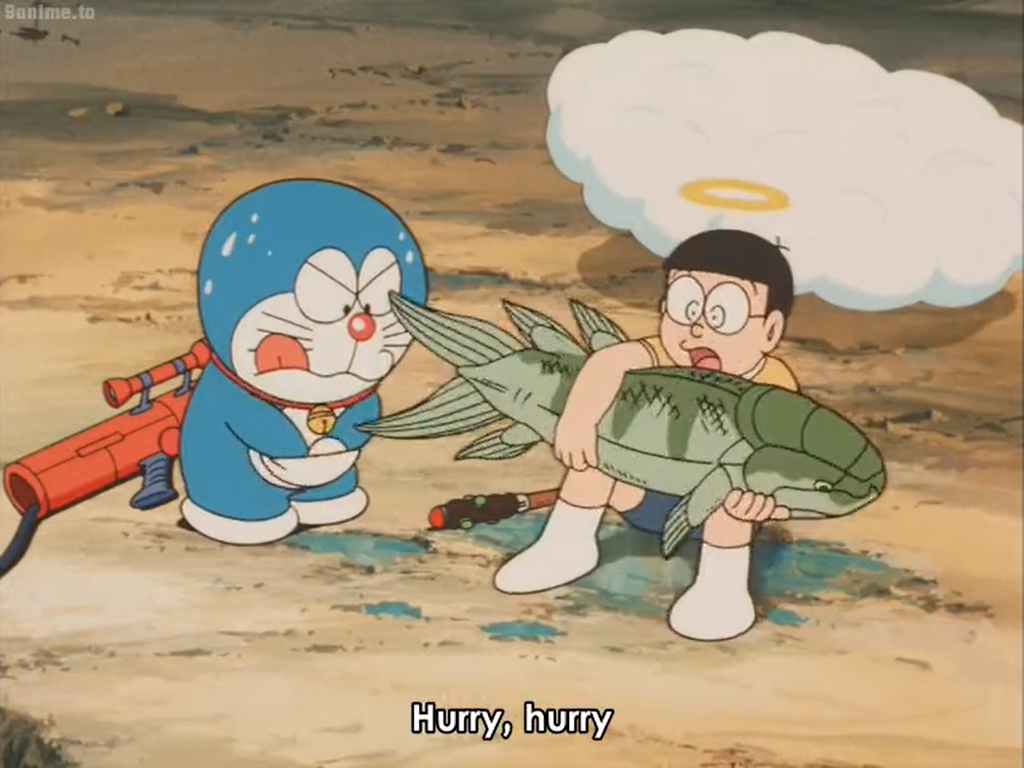
More recently extinct life also gets some representation in Doraemon. The 1978 manga chapter "モアよドードーよ、永遠に" (approximate translation: "Moa and Dodos Forever") has Doraemon and Nobita using time travel to try and save certain animals from extinction, including giant moa, dodos, and passenger pigeons. An interesting addition to the lineup were black wildebeest, which are no longer considered threatened now, but were nearly hunted to extinction in the 19th Century.

Doraemon is off trying to catch the wildebeest.

This story inspired the 2012 Doraemon movie Nobita and the Island of Miracles, which additionally featured several other extinct Cenozoic animals, including relatively unknown taxa such as Paraceratherium, Chalicotherium, and Ceratogaulus. (Sadly, I also think it is one of the worst Doraemon movies I've ever seen and cannot recommend it in good conscience.)

Promotional image for Nobita and the Island of Miracles showing some of the main characters and extinct animals appearing in the movie.

Popping back into the Mesozoic, there's the 1981 manga chapter "恐竜さん日本へどうぞ" (approximate translation: "Dinosaurs, Please Come to Japan"). In this story, Nobita is upset about the lack of dinosaur fossils in Japan, so he and Doraemon visit the Mesozoic of China and feed various dinosaurs (and a pterosaur) tablets that compel them to travel to Nobita's house—or where it will be tens of millions of years in the future, at least. The two then remember that Japan was mostly underwater during the Mesozoic and are horrified by the thought that they've consigned the dinosaurs to a watery grave. Fortunately, the tablets work by being broken in half, with one piece left in the location one intends others to visit, and they lose their effect if the halves left in place are moved. Nobita's mother tidying up his room removed their effect, so all the dinosaurs turned back before they reached the ocean.

The first dinosaurs that Doraemon and Nobita seek out are Tsintaosaurus and Tuojiangosaurus. (That's an interesting choice of crest shape for the Tsintaosaurus and I'm not sure what it's based on.)

Dsungaripterus and Yangchuanosaurus join the party.

The protagonists in awe of Mamenchisaurus.

There is a curious case of anachronism in this story, as not only do Nobita and Doraemon find all of these different Mesozoic reptiles in the same time period, but they are also specifically stated to have traveled to the Early Cretaceous. In reality, the only one of the aforementioned genera they would've been likely to encounter at this time would be Dsungaripterus, with Tsintaosaurus being from the Late Cretaceous and the remaining taxa being from the Late Jurassic. Nobita actually points this out at the beginning of their adventure, to which Doraemon responds that species can have time ranges beyond those indicated by their fossil record. Although Doraemon is proven right in the story, individual vertebrate species persisting for tens of millions of years is generally not very plausible based on our current understanding.

Nobita would probably be happy to find out that many Mesozoic dinosaur fossils are now known from Japan. In the anime reboot's 2006 adaptation of this chapter, the line that Japan lacks dinosaur fossils is not said, and Nobita is instead simply envious of how spectacular the Chinese dinosaurs are (at least if Chinese subtitles are to be believed). The episode also adds an Oviraptor to the list of dinosaurs that Nobita and Doraemon come across, though it does not receive an invitation to Japan. It is portrayed with feathers, but is in need of wings.

Furthermore, the episode takes the time to showcase some more recent Chinese dinosaur discoveries, such as Dilong and Microraptor, though these taxa don't appear in the flesh, so to speak. (The Chinese subtitles here misidentify Microraptor as Archaeopteryx, but it is said to be Microraptor in the original Japanese dialogue.)

Fujio evidently paid attention to recent scientific ideas of his time, as shown by the 1987 Doraemon movie Nobita and the Knights on Dinosaurs. In this film, Nobita and his friends meet an underground civilization of sapient dinosaurs directly based on Dale Russell's dinosauroid, a thought experiment that was first published in 1982. The dinosauroids in the movie even identify Stenonychosaurus as their Cretaceous ancestor. A bolide impact is also depicted as the cause of the end-Cretaceous mass extinction, a hypothesis that was still being actively debated in the 1980s.

The next Doraemon movie to address prehistory came in 1989 with Nobita and the Birth of Japan, in which Nobita and his friends all independently choose to run away from home. After running afoul of property ownership laws, they decide to travel back 70,000 years to the Late Pleistocene, when humans (and property laws) were not yet present in Japan. As their adventure unfolds, they learn about the dispersal of humans around the world and the glacial periods of ice ages, among other topics. This movie got a remake in 2016, which I happen to think is really solid and may actually be one of my favorite Doraemon movies.

A visualization of human dispersal across the globe. (This scene comes from the 2016 remake.)

Naturally, the main characters also run into some Pleistocene fauna. They marvel at the abundance of crested ibises, which were very rare in Japan when the original movie was released, and locally extinct in the wild by the time of the remake. In addition, they get on the wrong side of a woolly rhinoceros and a crocodile, though the remake has them encounter a bison and a giant salamander instead. This change may have been a deliberate effort to avoid anachronisms; rhinos and crocodylians are known from the Pleistocene of Japan, but don't appear to have survived into the Late Pleistocene in the region. However, a Pleistocene giant salamander large enough to see children as prey is, to my knowledge, fictitious.

You might not be able to get a sense of the scale in this shot, but this salamander is very big.

The 1992 movie Nobita and the Kingdom of Clouds also features some notable appearances from extinct animals. In this one, Nobita and his friends find another hidden civilization, this time started by sky people living in the clouds. The sky people are shown to have established a sanctuary for species thought extinct by the people on the ground, including thylacines, Glyptodon, and Phorusrhacos (which is depicted with classic Burian-esque coloration).

The entry coming up next is one in which Doraemon does not appear at all. Instead, it stars his younger sister, Dorami. (Yes, they are siblings even though they're robots. The lore is that their motor oil came from the same canister.) Dorami is a recurring character in the main Doraemon series, but she's also taken center stage in a few spin-off short films. One of these is Dorami-chan: Hello, Dynosis Kids!!, which was made as a pre-movie short accompanying the Doraemon film of 1993 (Nobita and the Tin Labyrinth). "Dynosis" is presumably a play on the word "dinosaur", though I don't know why it's translated that way.

Dorami spends most of her time in the 22nd Century, looking after Nobita's great-great grandson, Sewashi. To settle an argument among Sewashi and his friends about whether birds evolved from dinosaurs (guess that still won't be common knowledge in the 22nd Century!), Dorami takes them to the Cretaceous. As far as I'm aware, this is the oldest work in the Doraemon franchise to acknowledge the dinosaurian origin of birds. When the film was made, birds being dinosaurs was gaining mainstream scientific acceptance, but feathers in non-avialan dinosaurs were still unknown, so the filmmakers apparently decided to illustrate bird origins using… Maiasaura. After all, it cared for its young, "just like birds"! 

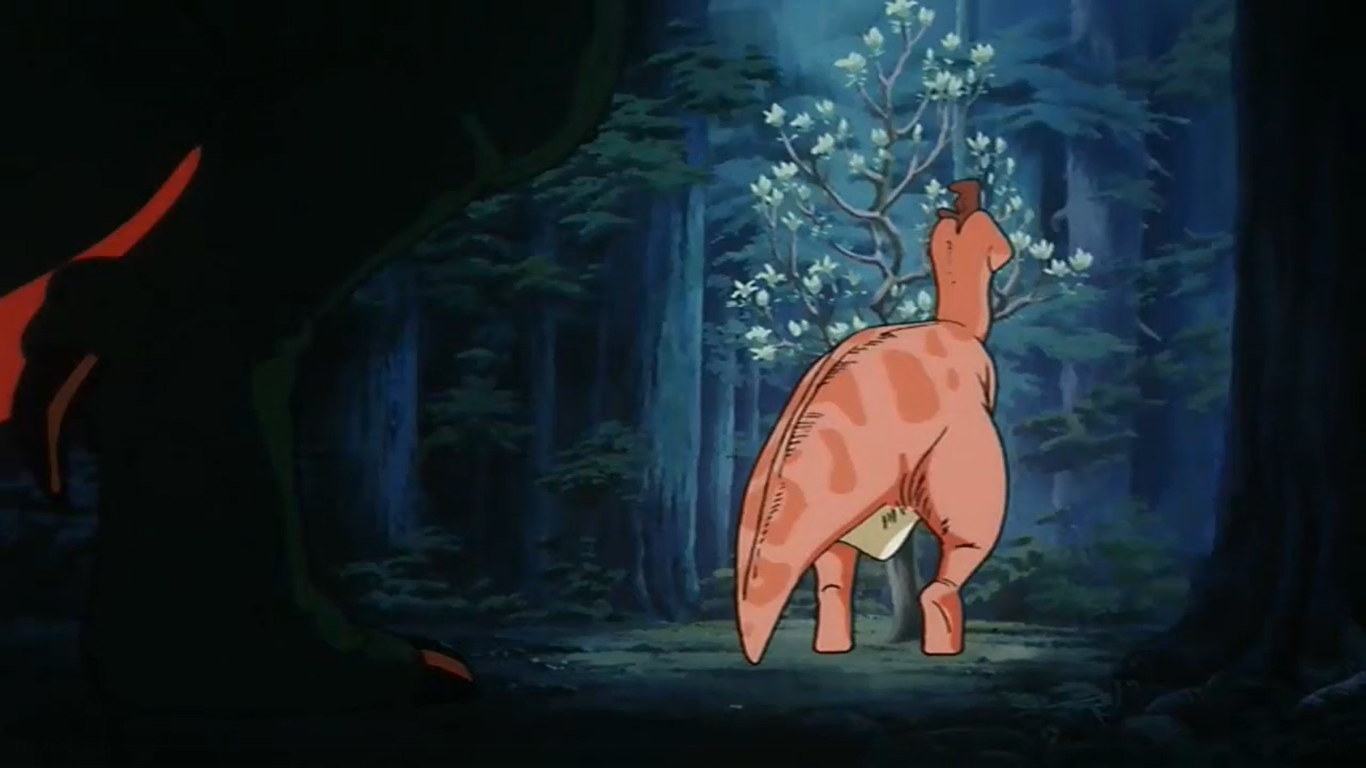
This short includes a sequence in which a hadrosaurid is killed by a Tyrannosaurus while browsing on flowers at night, in what I suspect is almost certainly a homage to Phil Tippett's 1984 short film Prehistoric Beast!

Like in Nobita's Dinosaur, Tyrannosaurus fights a sauropod here, though this time the sauropod is said to be an "Ultrasauros". Despite updated dinosaur designs, there are clear parallels in the fight choreography. (Ironically, the nostril position of the sauropod in the 1980 movie is more in line with what is typically thought likely today.)

Paleontology and deep time got another nod in the 1995 Doraemon movie Nobita's Diary on the Creation of the World. To help Nobita with his summer homework, Doraemon brings out a gadget that allows one to create and design their own universe. Nobita's project ends up closely paralleling the history of our universe and the Earth, originating its own dinosaurs, humans, and even paleontologists. (Yep, Doraemon has gadgets that can just casually create new universes, complete with sapient life forms...) A similar plot was previously used for the 1973 manga chapter "地球製造法" (approximate translation: "Making the Earth").

Nobita is eager to see dinosaurs and humans on his planet, so Doraemon helps him fish up a Eusthenopteron and accelerates its evolution. The Evolution-devolution Ray makes a return here.

So far, I've mostly brought up the ongoing anime reboot series to discuss its remakes of older Doraemon stories. However, it also contains completely new stories with no counterpart in the manga. One that provides an interesting look at how much the franchise has kept up with the march of science is the 2017 episode "雪と恐竜" (approximate translation: "Snow and Dinosaurs"). Doraemon takes Nobita and his friends on yet another Cretaceous trip, this time to the region that will become Alaska. The kids are surprised to find Mesozoic dinosaurs in the snow, and they see the usual suspects from the Prince Creek Formation, including Edmontosaurus, Pachyrhinosaurus, and troodontids.

They also help a baby feathered theropod reunite with its parent, which turns out to be a tyrannosaurid.

The children are baffled by all the feathered dinosaurs they keep coming across, so Doraemon references Mesozoic avialan diversity and explains to them that birds are a surviving lineage of dinosaurs! Doraemon is no longer a BANDit.

The attention to scientific detail continues in the 2020 Doraemon movie, Nobita's New Dinosaur. Although it shares similarities with and could be considered a spiritual successor to Nobita's Dinosaur, it is overall another original story not based on the manga. Like in Nobita's Dinosaur, the movie starts with Nobita reviving a fossilized egg and incubating it. In this case, it's a double-yolked egg that hatches into two feathered theropods belonging to a species unknown to science.


This is one of the first lines in the movie. Things have changed a lot since "Dinosaurs, Please Come to Japan"!

One of the feathered dinosaurs that Nobita raises is (SPOILERS) revealed to be the ancestor of modern birds that survived the end-Cretaceous mass extinction. It must be said that this is not accurate to the real-world timeline of bird evolution, given that modern-type birds had already appeared before the Cretaceous ended. However, I have to give the movie props for integrating the dinosaurian origin of birds into the storyline, and having Nobita’s desire to see a living dinosaur essentially answered by "actually, dinosaurs did not go extinct" is certainly appropriate for a modernized take on the same premise as Nobita’s Dinosaur

Something I didn’t expect was how big Nobita’s feathered dinosaurs turned out to be. Based on the movie poster (and the evolutionary history of actual birds), I thought they’d remain shoulder pets for the entire film, but they end up growing big enough for a child to ride.

The designs of the other prehistoric animals in the movie are actually pretty good, for the most part, especially by mainstream film standards. (Your mileage may vary on the CGI.)

Stegosaurs in the Late Cretaceous? Well... that's a plot point, actually.

Tapejarid pterosaurs (which could use larger keratinous extensions to their crests) and Olorotitan.

The Mesozoic pennaraptorans in this film have wing feathers now (even if they still have naked hands).

I was particularly excited to see this alvarezsaur make an appearance! (They’re obscured in this image, but in more distant shots it clearly has alvarezsaurid forelimbs.)

They evidently copied the Sinoceratops from the Jurassic World series (complete with the unlikely holes in the parietal fenestrae) though, oops.

By far the most fanciful prehistoric creature design in the movie is this ginormous azhdarchid-inspired pterosaur.

The tracks it leaves behind are clearly based on real pterosaur tracks, however! The filmmakers did their homework.

They even use the up-to-date figure of 66 million years ago for the end of the Cretaceous, unlike some other recent dinosaur movies that shall not be named.

This is not a complete list of paleontology references in Doraemon by any means, but I think it will have to do as a highlights reel. I have, however, tried to compile a catalogue of Doraemon manga chapters and episodes related to paleontology elsewhere. It is meant to be reasonably comprehensive, so even fairly minor references to extinct or prehistoric life are included. Being such a long-running franchise with somewhat spotty online availability, Doraemon contains numerous works that I have not seen myself, so I have no doubt that there are some relevant entries I have forgotten about or missed. If you notice any errors or omissions, let me know!

Now hypothetically, let's say an English speaker's curiosity in Doraemon has been piqued. How would they be able to experience the franchise if they don't understand Japanese (nor any of the other languages that the series has been widely released in)? Well... it's certainly not impossible to do so in many cases, but it can be tricky.

  • Most of the manga chapters (including the volume-length stories that the earlier movies were based on) have been released in English... but only on Kindle... and on top of that, only in North America.
  • Two series containing a smaller selection of manga chapters (including "Moa and Dodos Forever" and the short version of "Nobita's Dinosaur") have been released in bilingual (English–Japanese) format, and are available as hardcopies.
  • A short-lived English dub of the 2005 reboot series aired in the USA between 2014–2015. It has not been officially released on home media or streaming services, but can be found archived online. It should be noted that this dub contains numerous edits meant to "Americanize" the content.
  • A different short-lived English dub of the 2005 reboot series aired in the UK between 2015–2016. It includes some episodes that were not adapted for the American dub (and vice versa). It also contains far fewer edits to the original material. However, it has not been released on home media either and many of the episodes are currently lost, which I find surprising given how recently it was on air.
  • Two of the movies, Stand by Me Doraemon and Stand by Me Doraemon 2, are currently on American and British Netflix with English dubs and subtitling available. These two movies are unusual among the Doraemon films in that they use a 3D-animated art style and have narratives compiled from some of the best-known slice-of-life chapters from the manga, instead of the usual "Doraemon and friends go on a long adventure" storyline.
  • Fanmade English subtitles for the remaining Doraemon movies and a select number of episodes from both the 1979 and 2005 series are out there... if you know where to look. Be warned that the quality of the translations and subtitling can be... highly variable.

So... good luck! If nothing else, I hope this was an interesting look at a media giant that ironically gets little attention in English-speaking spaces. Considering how frequently paleontology has come up in Doraemon, it's probably only a matter of time before the franchise revisits the subject again. I think we can expect Doraemon to continue inspiring young paleontology enthusiasts around the world for a long time to come.

This image is here just because I really love the end credits artwork for Nobita and the Birth of Japan (2016).

Sunday, June 12, 2022

Prehistoric Planet

The talk of the town (or at least of the online paleontology community) lately has been Prehistoric Planet, a new documentary series now available for streaming on Apple TV+. This show has been eagerly anticipated ever since it was first publicly revealed in 2019 to have been in production, not least because paleontology documentaries have been thin on the ground in the last decade. The dearth of content has been especially true regarding series that portray prehistoric life as though it had been filmed in the wild, a premise popularized by Walking with Dinosaurs in 1999.

Despite the inevitable comparisons to Walking with Dinosaurs, however, Prehistoric Planet borrows more from recent BBC documentaries that focus on the modern biosphere, such as The Blue Planet, Planet Earth, and their sequels. Regular viewers of nature documentaries will likely notice stylistic choices and even specific film sequences in these shows that inspired elements of Prehistoric Planet (including its title). Unlike Walking with Dinosaurs, the series is organized by habitat, with each episode being composed of several vignettes that take place in multiple locations, instead of revolving around an extended narrative about one specific individual animal or ecosystem. In addition, all of the segments in Prehistoric Planet are set within a fairly narrow window of geologic time (the Maastrichtian Age of the Late Cretaceous), not spread across the entire Mesozoic.

Now that the show has been released, it appears that most responses to Prehistoric Planet have been overwhelmingly positive, and the acclaim is well deserved in my book. The considerable advances in both technology and paleontological science since Walking with Dinosaurs are more than evident throughout the series, and others have already commented repeatedly on the spectacular visual effects as well as the naturalistic, scientifically plausible depictions of extinct animals. Instead of heaping on more of the same (albeit justified) general praise, I'd like to take a closer look specifically at the show's portrayals of maniraptoran dinosaurs. This is a maniraptoran blog, after all.

There is quite a bit to cover, for maniraptors are featured extensively in Prehistoric Planet. Most exciting to me was the fact that there is a whole segment dedicated to an alvarezsaurid, namely Mononykus from the Nemegt Formation of Mongolia! This sequence has to rank among my favorites in the show, not only because I am extremely biased in favor of alvarezsaurids, but also because I was very impressed by how much scientific knowledge about alvarezsaurid biology it incorporated. Traveling for long distances on foraging excursions? Sensitive hearing for detecting prey? Using the specialized thumb claw as an excavation tool? Feeding on wood-dwelling termites instead of mound-building ones? Whereas some segments of Prehistoric Planet revolve around behaviors widespread in modern animals that were transplanted onto select prehistoric species as (generally reasonable) speculation, almost everything Mononykus is shown doing was based directly on research into alvarezsaurid anatomy, function, and ecology.

What's more, this depiction of Mononykus appears to have resonated strongly with audiences. From what I've seen, it's probably fair to consider Mononykus one of the breakout stars of Prehistoric Planet, with even executive producers Jon Favreau and Mike Gunton identifying it as one of their favorite dinosaurs in the series. Alvarezsaurids have made a surprisingly large number of documentary appearances considering their relative obscurity (BBC's Chased by Dinosaurs in 2002 and Discovery Channel's Dinosaur Planet in 2003 come to mind), but none of those previous shows spent much time highlighting what makes these dinosaurs strange and interesting. Thanks to Prehistoric Planet's approach, it seems that Mononykus is well on its way to becoming a household dinosaur name, and I couldn't be happier about that.

Paleoartist Ilari Pätilä has proposed calling the Mononykus from Prehistoric Planet "Dolores", after a character from the Disney film Encanto who has the power of super-sensitive hearing. I approve, though the production team behind Prehistoric Planet reportedly has their own internal nickname for her.

Therizinosaurs are represented in Prehistoric Planet by the largest of them all, Therizinosaurus. Another maniraptor known from the Nemegt Formation, Therizinosaurus first appears in the background visiting a watering hole alongside other Nemegt dinosaurs (including Mononykus), but is not acknowledged by the narration at this point. A later scene, however, features a group of juvenile Therizinosaurus as its protagonists. This segment has the distinction of being, to my knowledge, the only one in the series for which visual elements were neither given away in promotional material nor publicly described by reviewers who'd seen the show early, which made it especially enjoyable to watch for the first time.

The way in which the Therizinosaurus are shown using their beaks and claws for feeding is supported by published research on therizinosaurs, as is their precocial nature. Their attempt to reach a bees' nest for honey by climbing with their beaks, claws, and flaps of their forelimbs is more speculative, but well within the realm of possibility. It is furthermore a fun potential nod to a discredited hypothesis that therizinosaurs might have had arboreal ancestors, while at the same time showing that most flightless Mesozoic theropods probably weren't particularly good climbers (which might not have stopped some from occasionally trying to climb anyway).

A juvenile Therizinosaurus has a go at wing-(and-beak-and-claw-)assisted incline climbing.

Despite their efforts, the young Therizinosaurus are quickly dissuaded by bee stings. They are eventually rewarded, however, when an adult Therizinosaurus shows up. Undeterred by the bees, it knocks the nest to the ground with a single swat from one of its clawed hands, and leaves behind enough leftovers for the youngsters to savor. This was a great way to convey the power and majesty of the adult Therizinosaurus without placing it in a stereotypically violent scenario. There is a minor error in the narration for this sequence: the adult is mistakenly described as 30 ft tall instead of 30 ft long. That being said, lead scientific consultant Darren Naish has pointed out that it is not inconceivable for a large Therizinosaurus to have been able to rear to heights approaching 30 ft.

Oviraptorosaurs appear in the form of the tall-crested Corythoraptor from the Nanxiong Formation of China. They do not play a major role beyond serving as would-be prey for the tyrannosaurid Qianzhousaurus, but they have a lovely design that makes it clear that just as much research and care went into their depiction as for those of the other computer-generated creatures in the show. In fact, the segment that they appear in is perhaps among the most aesthetically pleasing and atmospheric in the entire series. It was also neat to see the Corythoraptor feeding on ginkgo fruits and using their wings for balance while running, in a manner similar to ostriches. (As an aside: I'm not a stickler for the pronunciation of scientific names, but as someone who knows Mandarin, hearing narrator Sir David Attenborough pronounce Qianzhousaurus correctly was a plus.) 

A flock of foraging Corythoraptor makes for pretty dinosaurs in a pretty forest.

The function of feathers in flightless maniraptors is spotlighted dramatically in one of two segments starring the dromaeosaurid Velociraptor. Strictly speaking, the "Velociraptor" in Prehistoric Planet were based on indeterminate velociraptorines from Maastrichtian fossil deposits, with Velociraptor proper having only been found in the Djadochta Formation and possibly the Wulansuhai Formation, which are generally considered Campanian in age. As others have noted, however, there is enough ambiguity in the dating of Late Cretaceous rock units from central Asia that the Djadochta and Nemegt Formations may in fact have been laid down in different environments that coexisted at approximately the same time. In any case, the presence of Velociraptor-like dromaeosaurids in the Maastrichtian of central Asia is readily justifiable.

Velociraptor is introduced with a pair of them trying to prey on an unspecified lizard, which is in turn feeding on carrion flies drawn in by some dozing Tarbosaurus (an obvious homage to footage of agamid lizards hunting for flies near lions, as shown on BBC's Africa in 2013). Where Velociraptor truly gets to shine though is in its second appearance, which depicts a trio stalking azhdarchid pterosaurs on a sheer cliff face, perhaps partly inspired by fossil evidence that Velociraptor at least fed on azhdarchids occasionally. The Velociraptor are portrayed as agile hunters, using wing-assisted locomotion to boost their jumps, control descents, and even survive dangerous falls on difficult terrain. These maneuvers are reminiscent not only of locomotor strategies seen in modern birds, but also observations of polar bears and especially snow leopards hunting on cliffsides. Somewhat surprisingly, the famous "raptor prey restraint" model (which proposes that dromaeosaurids used their wings to stabilize themselves while restraining prey with their feet) is not explicitly shown in Prehistoric Planet, though this may have been deliberate given that the bloodier aspects of predation are noticeably downplayed in the imagery of this series.

This may not be the version that mainstream popular culture is most familiar with, but Velociraptor was undoubtedly a skilled predator.

Another dromaeosaurid that shows up is an unspecified polar species, presumably based on dromaeosaurid teeth from the Prince Creek Formation of Alaska. A group of these dromaeosaurids is featured cooperating to hunt hadrosaurids larger than themselves. Dromaeosaurids being shown bringing down unrealistically large prey items is a long-standing pet peeve of mine, but here the predator–prey relationship is portrayed much more believably: it is stated that the polar dromaeosaurids are targeting juvenile hadrosaurids rather than adults, and the one they eventually feed on is not directly killed by them, instead dying from being swept away in its panic by a fast-flowing river.

Even in depicting an animal known only from fragmentary remains, Prehistoric Planet draws heavily from fossil evidence. The polar dromaeosaurids have a frond of tail feathers restricted to the back half of the tail and with two especially elongate feathers at its tip, probably inspired by the tail feathering found in one specimen of Microraptor. One is also shown sleeping in a curled-up pose, based on the posture preserved in two specimens of the troodontid Mei, and leaving functionally two-toed tracks in the snow, based on actual fossil trackways made by dromaeosaurids.

A soundly sleeping polar dromaeosaurid.

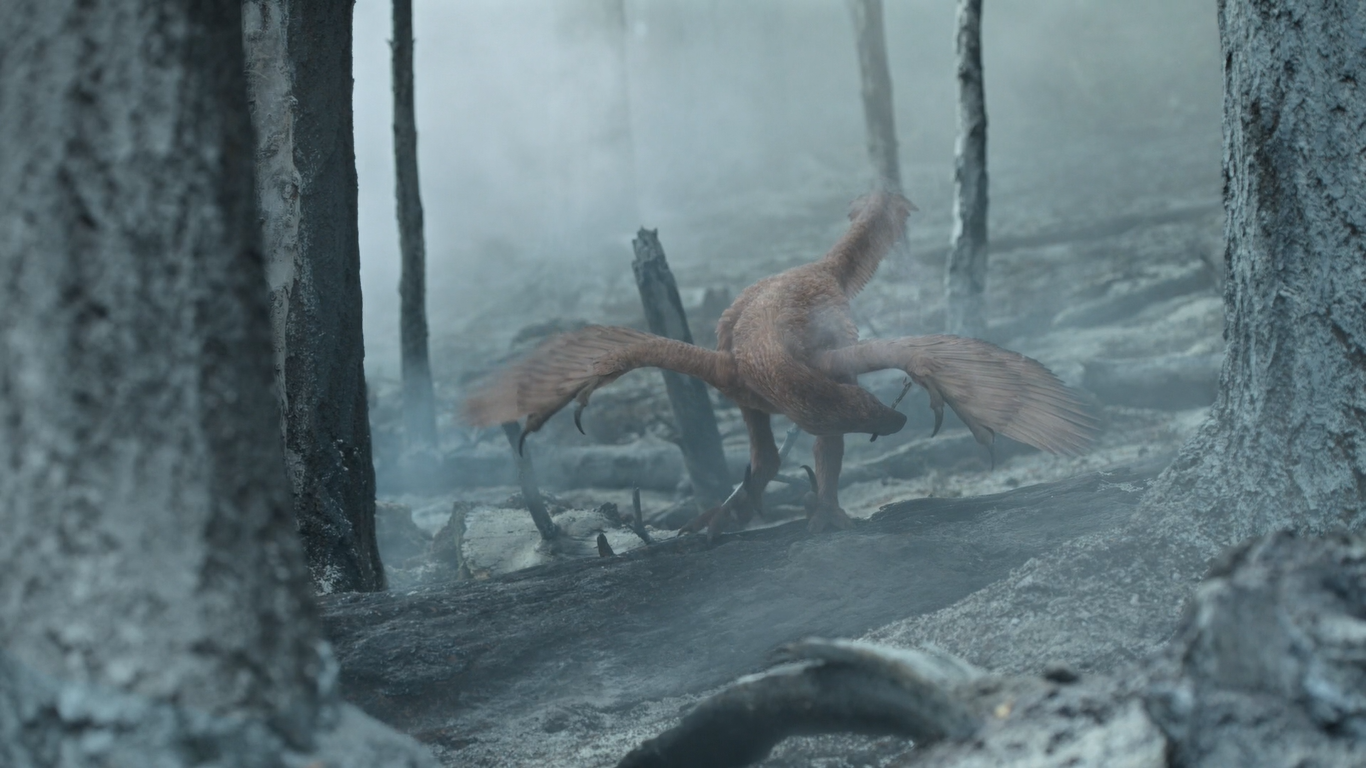
Two separate but thematically similar segments portray possible interactions Mesozoic paravians might have had with wildfires, modeled after interesting behaviors exhibited by modern birds. One features a third dromaeosaurid taxon, Atrociraptor from the Horseshoe Canyon Formation of Canada, picking up a burning stick to fumigate its feathers, in an allusion to similar activities that have been documented in corvids. In another, an unspecified troodontid (presumably a member of the taxonomic tangle that is the Late Cretaceous troodontids of North America) actively spreads burning vegetation to drive prey into the open, as has been reported for some Australian kites and falcons. These scenarios are speculative, and it seems unlikely that direct evidence for them could ever be ascertained from the fossil record, but dromaeosaurids and troodontids were probably versatile predators with relative brain-to-body ratios within the range of (albeit not exceptionally large relative to) those seen in modern birds, so it's certainly not out of the question that they could have practiced such behaviors.

An Atrociraptor reaps the rewards of a forest fire.

There is one major group of maniraptors that gets the short end of the stick in Prehistoric Planet, however, and it's avialans. They are not completely absent: enantiornitheans show up in a few scenes and various bird-like forms are sometimes visible as set-dressing in the background or in wide shots, but they never feature as protagonists in the individual segments nor even as the focus of any close-ups. In fact, if I had any notable criticism of the series, it would be the apparent neglect of the smaller tetrapods in Late Cretaceous ecosystems. Only a single mammal species appears on the show, unmentioned and unnamed, and its sole role is to be killed by the aforementioned troodontid. It also nearly beggars belief that a time-traveling documentary crew would film a whole episode on freshwater habitats in the Maastrichtian and fail to include any footage of crocodyliforms or turtles.

In practice, of course, resources to create and animate digital models of prehistoric life for a series like this are limited, so it is understandable that the production team prioritized particularly strange and spectacular fauna over more "mundane-looking" ones. I would contend though there likely is substantial audience interest in learning about the origins of modern animals, which increased spotlight on taxa more closely related to extant forms would have provided opportunities for. Furthermore, the Mesozoic diversity and disparity of "microvertebrates" is regularly underappreciated. Leaving aside recent Maastrichtian avialan discoveries like Asteriornis and Falcatakely, which were almost certainly published too late to be incorporated into the show, it probably would not have been difficult to come up with engaging storylines featuring the bizarre, island-dwelling Balaur or enantiornithean nesting colonies (both of which, as a bonus, have been the focus of Darren's own research).

Even without adding or replacing any of the existing narratives in Prehistoric Planet, I would have liked to see at least some split-second close-ups of the enantiornitheans, considering that the team had evidently gone to the trouble of making digital models for them. Such "incidental" shots are a regular component of modern wildlife documentaries and probably would have made the ecosystems portrayed feel even more vibrant and immersive. As it is, the show already spends time (and occasionally narration) on shots of crustaceans, fishes, fungi, plants, and other organisms in "non-starring" roles, not to mention an entire segment on ammonoids (arguably one of the highlights of the entire series), so I have no doubt that a few extra seconds of microvertebrate footage could have been used to great effect.

Probably the closest we get to an in-focus shot of an enantiornithean on Prehistoric Planet: one is perched in the upper right corner here as the giant ornithomimosaur Deinocheirus prepares to use its tree as a scratching post.

Another concern about Prehistoric Planet I've seen from some viewers is that it generally does not clarify which aspects are speculation and which are based on direct evidence. This is not a new discussion regarding paleontology documentaries of this sort; very similar arguments were had with respect to Walking with Dinosaurs. To their credit, Walking with Dinosaurs and its sequel series Walking with Beasts had tie-in websites with extensive sections explaining the scientific backing behind their creative decisions, and the former also had a companion book on the same subject (co-authored by Darren, as it happens). Prehistoric Planet, meanwhile, currently has 5-minute videos (available for free on the Apple TV YouTube channel) accompanying each episode that feature interviews with paleontologists and delve into the science behind the series. These "Uncovered" videos, as they are called, are quite good for what they are, but each of them focuses only on a single narrow topic (e.g., how we know Velociraptor had feathers), leaving a great majority of what is shown in the episodes unaddressed. The production of additional "Uncovered" videos is allegedly being considered, and I very much hope that it comes to pass. If anything, a lack of transparency does a disservice to the tremendous amount of thought and research that clearly went into this show.

These critical comments, however, do not undermine the excellence that Prehistoric Planet has achieved. The series is outstanding in nearly every way possible, setting a new and extremely high standard for works of this genre, and the fact that my biggest issues largely amount to a desire for more is very much a testament to its success. Given the positive reception so far, I feel hopeful that we will eventually see future seasons of Prehistoric Planet and, with luck, maybe even a whole new age of paleontology-inspired media.