Thursday, October 28, 2010
Puggles Part I
A puggle is an occasionally-used term for baby monotreme, by the way. It appears that it was originally used for baby echidnas, and some websites I've read say that since baby echidnas and platypuses don't look alike it's erroneous to use it for platypuses. But since echidnas appear to be essentially terrestrial platypuses, I'll use it either way.
Warm and Fuzzy
I can never figure out how to get Ostrom's head right.
But the champion of art evolution on this blog has to be Skull! Just compare his first appearance in the "theme song" with the way he looks in the Balaur bondoc song.
Sunday, October 10, 2010
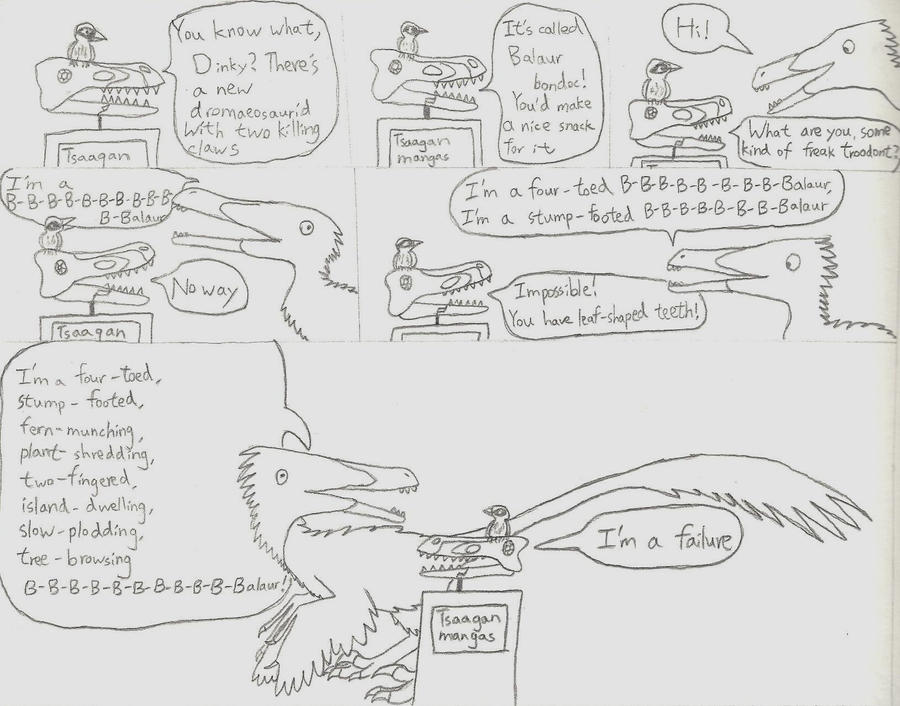
Guest: Balaur
Parody of the P-p-platypus.
Thank goodness for scanners. I no longer have to awkwardly type up the script. I still apologize if my handwriting is in any way hard to read*, but at least the image is quite clear.
*If so, all you have to do is ask!
I chose to adopt the thought-provoking hypothesis that Balaur bondoc was a strange herbivorous dromaeosaurid instead of the conventional double-bladed superpredator image, because it's funnier. And, frankly, more interesting.
Friday, October 8, 2010
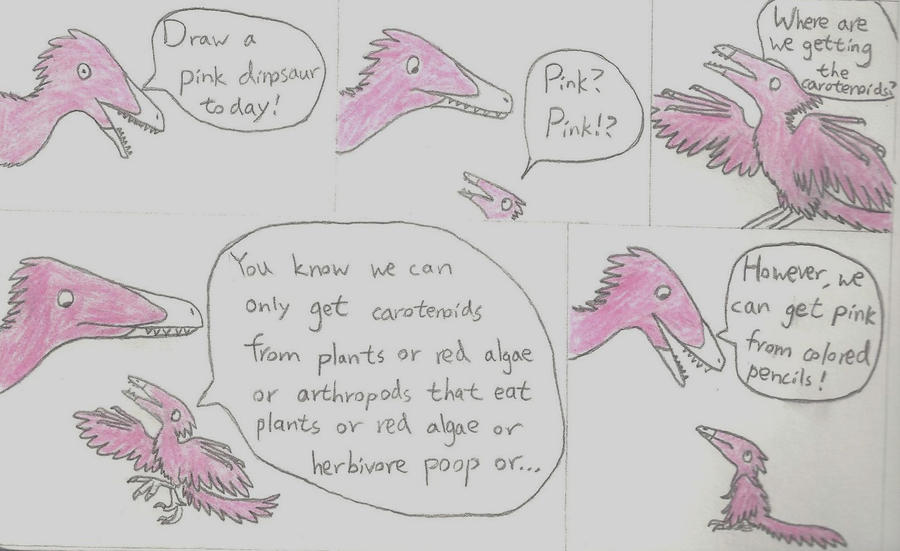
Maniraptors in Pink
Over at ArtEvolved, they're organizing a fundraising event based on paleo art! All through October, you can draw and send in pink dinosaurs. They'll donate one dollar to cancer research for every pink dinosaur drawn. If you're not so comfortable with drawing, no pressure. You can also support the event by donating directly here.

Traditionally, dino artists have always been free to take liberties with dinosaur colors. After all, just about all of our dinosaur books make a point of how it's impossible to tell colors from dinosaur fossils. However, that's beginning to change. Thanks to exciting new developments in the examination of fossils, it is now possible to identify some types of color pigments in fossilized integument. So it is very possible that many of our speculations on dinosaur colors, particularly of those that have their skin and skin coverings preserved with them, will be proven wrong.
But we are still allowed to take liberties with prehistoric beasts that haven't or won't have their colors revealed, right?
Well, not exactly, especially concerning feathered dinosaurs like maniraptors.
There are several ways feathers get their colors. Blue is the result of light being scattered through microscopic structures within integument. The pennaceous feathers* of deinonychosaurs and oviraptorosaurs certainly have the potential to be blue, but we're not so sure about protofeathers. Superficially, protofeathers look a lot like mammalian hair, which cannot be blue. (Which explains why there are mammals with blue skin but not blue fur, even in groups that have fairly good color vision.) And fossilized iridescent feathers usually restrict their iridescence to the barbules, which protofeathers don't have. However, protofeathers, being homologous to pennaceous feathers, had an internal structure more like pennaceous feathers than like hair. So blue protofeathers might still be possible.
*Deinonychosaurs, oviraptorosaurs, and basal birds have pennaceous feathers only on the wings and tail, or (in deinonychosaurs at least) occasionally on the head and parts of the body, the rest of the body being covered in protofeathers. For a more detailed description of feather distribution in the derived maniraptors, see here.
Most other colors are produced through color pigments. Melanins are responsible for different shades of gray and brown, and a lack of melanin will result in white. Combined with structural color, melanins can also produce full-on black. So far, fossilized dinosaur colors have been deduced by examining their preserved melanin pigments.
Another group of pigments is the carotenoids. These are responsible for bright reds, yellows, and oranges in not only feathers but skin, yolk*, and scales. They can also combine with structural color to make green. Dinosaurs can't make carotenoids by themselves. They must eat plants, or fish and invertebrates that eat plants. Because of this, carnivorous dinosaurs don't have much choice in feather colors and generally make do with just structural colors and melanins, unless they feed on herbivorous fish or insects. (Duller reds are okay for carnivores though, as they can be produced by melanins.) There are exceptions to this, like Egyptian vultures which have bright yellow faces, but that's because they feed on herbivore poop.
*Many birds use flavins for yolk instead.
There are also the porphyrins, which probably don't fossilize, but luckily the colors they produce (mostly browns and reds) can probably be deduced through just melanin. Interestingly, they have a role in insulation, so perhaps feathered dinosaurs that were active in colder temperatures had a few extra splashes of reddish brown. There are other types of color pigments out there, and many bird groups have evolved their own unique pigments, but these are the main ones.
For a much more comprehensive and detailed guide, go to DinoGoss!
Now, how did an announcement about a fundraising event turn into this?
Traditionally, dino artists have always been free to take liberties with dinosaur colors. After all, just about all of our dinosaur books make a point of how it's impossible to tell colors from dinosaur fossils. However, that's beginning to change. Thanks to exciting new developments in the examination of fossils, it is now possible to identify some types of color pigments in fossilized integument. So it is very possible that many of our speculations on dinosaur colors, particularly of those that have their skin and skin coverings preserved with them, will be proven wrong.
But we are still allowed to take liberties with prehistoric beasts that haven't or won't have their colors revealed, right?
Well, not exactly, especially concerning feathered dinosaurs like maniraptors.
There are several ways feathers get their colors. Blue is the result of light being scattered through microscopic structures within integument. The pennaceous feathers* of deinonychosaurs and oviraptorosaurs certainly have the potential to be blue, but we're not so sure about protofeathers. Superficially, protofeathers look a lot like mammalian hair, which cannot be blue. (Which explains why there are mammals with blue skin but not blue fur, even in groups that have fairly good color vision.) And fossilized iridescent feathers usually restrict their iridescence to the barbules, which protofeathers don't have. However, protofeathers, being homologous to pennaceous feathers, had an internal structure more like pennaceous feathers than like hair. So blue protofeathers might still be possible.
*Deinonychosaurs, oviraptorosaurs, and basal birds have pennaceous feathers only on the wings and tail, or (in deinonychosaurs at least) occasionally on the head and parts of the body, the rest of the body being covered in protofeathers. For a more detailed description of feather distribution in the derived maniraptors, see here.
Most other colors are produced through color pigments. Melanins are responsible for different shades of gray and brown, and a lack of melanin will result in white. Combined with structural color, melanins can also produce full-on black. So far, fossilized dinosaur colors have been deduced by examining their preserved melanin pigments.
Another group of pigments is the carotenoids. These are responsible for bright reds, yellows, and oranges in not only feathers but skin, yolk*, and scales. They can also combine with structural color to make green. Dinosaurs can't make carotenoids by themselves. They must eat plants, or fish and invertebrates that eat plants. Because of this, carnivorous dinosaurs don't have much choice in feather colors and generally make do with just structural colors and melanins, unless they feed on herbivorous fish or insects. (Duller reds are okay for carnivores though, as they can be produced by melanins.) There are exceptions to this, like Egyptian vultures which have bright yellow faces, but that's because they feed on herbivore poop.
*Many birds use flavins for yolk instead.
There are also the porphyrins, which probably don't fossilize, but luckily the colors they produce (mostly browns and reds) can probably be deduced through just melanin. Interestingly, they have a role in insulation, so perhaps feathered dinosaurs that were active in colder temperatures had a few extra splashes of reddish brown. There are other types of color pigments out there, and many bird groups have evolved their own unique pigments, but these are the main ones.
For a much more comprehensive and detailed guide, go to DinoGoss!
Now, how did an announcement about a fundraising event turn into this?
Wednesday, September 22, 2010
Sunday, September 12, 2010
Savape and the Avian Style Meme
I actually have five new comics in my sketchbook, I just haven't scanned them yet. On a more productive note, I've started using Blogger's pages function to put up some introductory info about this blog as well as a blogroll.
Those of you who follow me on Deviant ART have probably seen this before. I meant to put it up here as well, but didn't do it until now. The original template is by lizkay.

I originally wanted to use a dromaeosaurid for this, but decided to use Savape: close enough in anatomy, but (probably) lying on the avian* fork in the maniraptor family tree.
Either way, combining the traits of a cartoony basal bird and pop culture caricatures of modern birds was fun to do. I had to cope with Savape's visible wing claws, long tail, retractable toe, and lack of an alula, tertials, or beak, for instance.
Personal - Savape (and nearly all the other characters in Raptormaniacs) was drawn using minimal references. As cartoony as my drawings are, I usually still use references to get the basics done, but with Raptormaniacs being even less serious than usual I just drew my own perception of each character.
Marahute - This one turned out well; a lot better than I anticipated. It was the first one other than the personal style I drew, so I wasn't sure if I was any good at this.
Pokemon - I used Fearow as a base for this one, as its build and general personality are more in line with Savape's.
Jeremy - I found it hard to get good full-body shots of Jeremy, and a lot of his images showed him being comically tied up in string. Appropriate for him, perhaps, but not for the generally more dignified Savape. Fortunately, I discovered a nice picture of him standing guard on a wooden post.
Kehaar - I really like this one. Perhaps it's that Kehaar's aggressive streak fits and so the rest just caught on; I don't really know.
Quest for Camelot - It wasn't too hard to compensate for the differences between Savape and modern birds, a six-limbed partly mammalian gryphon was trouble. So I just did the head. Besides, I couldn't find full-body shots for this one.
Asterix - I don't know anything about this web comic, but I just went with what I had. I used mainly the rooster as a base because the body shape fits better, even though Savape is female.
Family Guy - I also happen not to know anything about this show, either, perhaps surprisingly. I don't watch much television. That weird fight with the chicken I watched on Youtube (to get some inkling of what I was supposed to be drawing) was more random than Freakazoid!, so I wasn't exactly impressed, although I won't judge on the basis of that one clip. Either way, I think I did okay with this one.
For the Birds - Couldn't really do much with this. The Pixar birds are just round things with eyes and beaks, so I responded in kind. Not that it's a bad thing; I love Pixar as much as everyone else.
Iago - Yikes, toothy neornithines and feather fingers really freak me out. I was extremely bothered by feather fingers when I was younger, so I blatantly avoided this trope as much as I could. Whenever I wanted to draw a neornithine holding something I would always have it use its feet or beak. That still holds true today. Luckily, Savape is able to circumvent these pet peeves of mine. As an Archaeopteryx lithographica, she naturally has teeth as well as functional fingers.
The Animals of Farthing Wood - I found a good image of the shrike and used that. Savape is rather predacious. Wouldn't put it past her to impale her victims on thorns or some such.
Griff - No full body shot again, but being a gryphon character that's no handicap. I only needed the head.
*That's Aves, semi-broadly defined. Some authorities use the narrower Aves which includes only modern birds and anything descended from their last common ancestor. Following this usage Archaeopteryx lithographica isn't an avian, although it's still (probably) closer to modern birds than to dromaeosaurids.
Those of you who follow me on Deviant ART have probably seen this before. I meant to put it up here as well, but didn't do it until now. The original template is by lizkay.
I originally wanted to use a dromaeosaurid for this, but decided to use Savape: close enough in anatomy, but (probably) lying on the avian* fork in the maniraptor family tree.
Either way, combining the traits of a cartoony basal bird and pop culture caricatures of modern birds was fun to do. I had to cope with Savape's visible wing claws, long tail, retractable toe, and lack of an alula, tertials, or beak, for instance.
Personal - Savape (and nearly all the other characters in Raptormaniacs) was drawn using minimal references. As cartoony as my drawings are, I usually still use references to get the basics done, but with Raptormaniacs being even less serious than usual I just drew my own perception of each character.
Marahute - This one turned out well; a lot better than I anticipated. It was the first one other than the personal style I drew, so I wasn't sure if I was any good at this.
Pokemon - I used Fearow as a base for this one, as its build and general personality are more in line with Savape's.
Jeremy - I found it hard to get good full-body shots of Jeremy, and a lot of his images showed him being comically tied up in string. Appropriate for him, perhaps, but not for the generally more dignified Savape. Fortunately, I discovered a nice picture of him standing guard on a wooden post.
Kehaar - I really like this one. Perhaps it's that Kehaar's aggressive streak fits and so the rest just caught on; I don't really know.
Quest for Camelot - It wasn't too hard to compensate for the differences between Savape and modern birds, a six-limbed partly mammalian gryphon was trouble. So I just did the head. Besides, I couldn't find full-body shots for this one.
Asterix - I don't know anything about this web comic, but I just went with what I had. I used mainly the rooster as a base because the body shape fits better, even though Savape is female.
Family Guy - I also happen not to know anything about this show, either, perhaps surprisingly. I don't watch much television. That weird fight with the chicken I watched on Youtube (to get some inkling of what I was supposed to be drawing) was more random than Freakazoid!, so I wasn't exactly impressed, although I won't judge on the basis of that one clip. Either way, I think I did okay with this one.
For the Birds - Couldn't really do much with this. The Pixar birds are just round things with eyes and beaks, so I responded in kind. Not that it's a bad thing; I love Pixar as much as everyone else.
Iago - Yikes, toothy neornithines and feather fingers really freak me out. I was extremely bothered by feather fingers when I was younger, so I blatantly avoided this trope as much as I could. Whenever I wanted to draw a neornithine holding something I would always have it use its feet or beak. That still holds true today. Luckily, Savape is able to circumvent these pet peeves of mine. As an Archaeopteryx lithographica, she naturally has teeth as well as functional fingers.
The Animals of Farthing Wood - I found a good image of the shrike and used that. Savape is rather predacious. Wouldn't put it past her to impale her victims on thorns or some such.
Griff - No full body shot again, but being a gryphon character that's no handicap. I only needed the head.
*That's Aves, semi-broadly defined. Some authorities use the narrower Aves which includes only modern birds and anything descended from their last common ancestor. Following this usage Archaeopteryx lithographica isn't an avian, although it's still (probably) closer to modern birds than to dromaeosaurids.
Tuesday, July 20, 2010
Vancouver Aquarium
A slight deviation from the usual fare, but I'll try to get more comics up soon.
On the second week of July, I went to the Vancouver Aquarium. Here are some photos I took there. Ironically, I couldn't get many good photographs of fish; they tended to move around too much.
My favorite part of this aquarium is probably the Amazon Gallery. To get there you have to go through the Tropic Gallery first, which has many tropical fish from both the sea and freshwater, but I didn't take any pictures. It's quite hot and humid in the Amazon Gallery to emulate the tropics, but you can see some pretty neat animals and exhibits. There are Amazonian fish, of course, and a fruit bat exhibit. The main portion of the gallery is an aviary-type area with a wooden walkway. There are many types of animals in this area and you can have lots of fun trying to find them all. My record was pretty poor this time, but I've gotten close in the past. There are many types of butterflies, river turtles, red-footed tortoises, scarlet ibises, three species of parrots, three species of tanagers, whistling ducks, two-toed sloths, and plumed basilisks, the last of which are probably the hardest to look for. Out of all the times I've been to the Vancouver Aquarium, I've only seen a basilisk twice. I didn't get to see any sloths or ducks or blue-gray tanagers this time, either. In fact, nearly all the animals I saw this time were those that you were bound to see either way and didn't take much searching. Disappointing, I guess, but it's part of the fun.
Other animals from the gallery I really wanted to see but didn't were an emperor tamarin and a pygmy marmoset. The two tiny monkeys are kept in a exhibit separated by netting from the aviary area, and it's really neat to watch their dynamic. Once I saw the two species grooming each other. Interspecies interactions are cool, I guess.
Here's a red-footed tortoise.
Even though this post isn't a comic, there'd better be some maniraptors, right? These hyacinth macaws are very big and striking. However, the one thing I don't like about them is their calls, which are very loud and raucous and very hard on the ears.
A nice picture I got of a scarlet ibis feeding from a feeding basket
Some pictures of a river turtle.
Other than big fish tanks and the aviary area, the gallery also has many terrariums for various reptiles, amphibians, and arthropods. This is an emerald tree boa.
A matamata turtle. It's made of 100% turtle power.
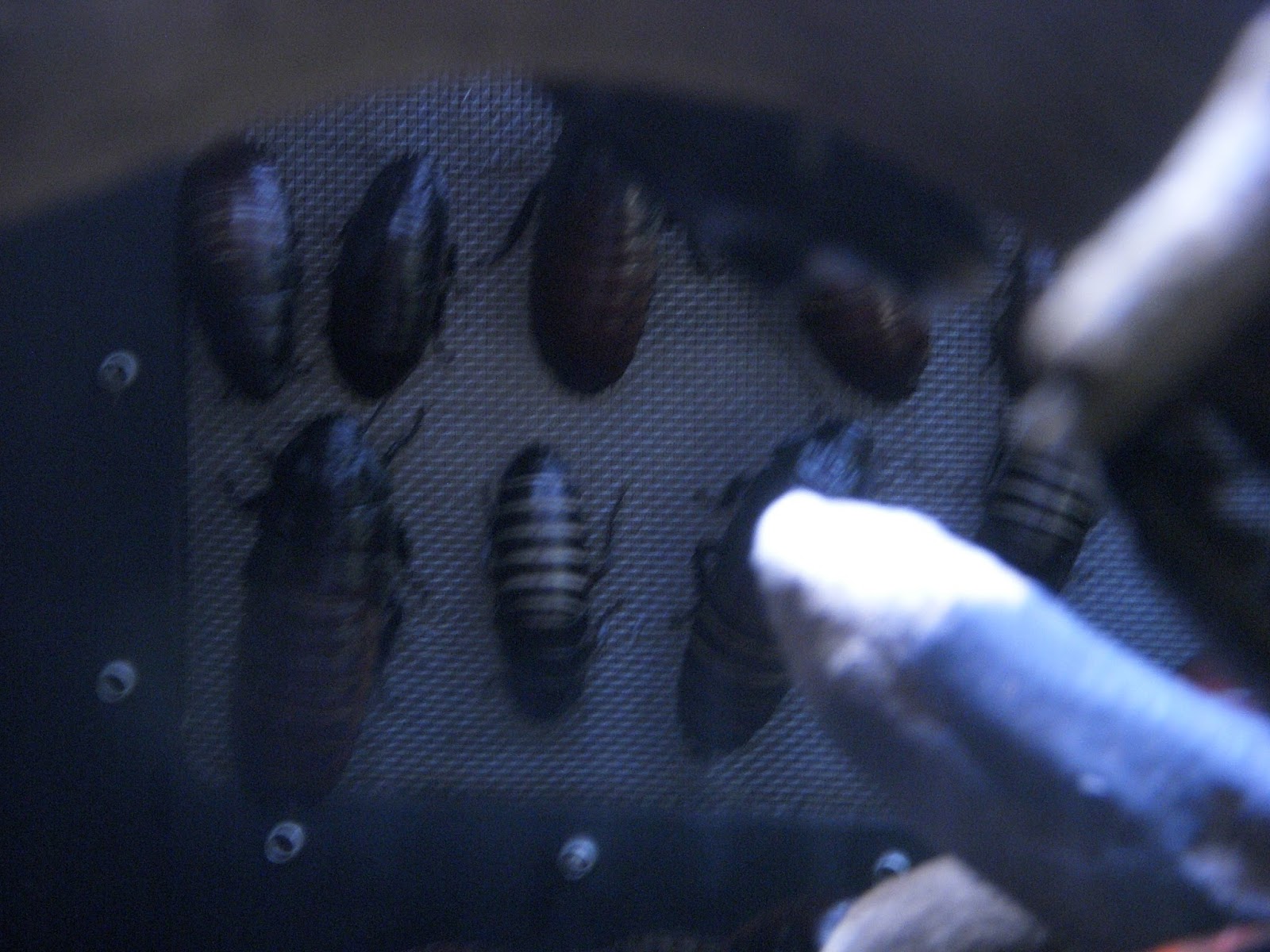
Some Madagascar hissing cockroaches. Not from the Amazon.
A spectacled caiman.
Another part of the aquarium I really like is on their lower floor. (When you enter the aquarium, you're on their upper floor.) There's a huge, impressive-looking tank full of West Coast sea life down there (which you can view from above on the upper floor), but I'm talking about the amphibian exhibits. And it was about at this point where my photography skills became slightly better.
This is a Hong Kong warty newt.
The aquarium also houses caecilians. Which is awesome, to say the least. There's a caecilian among this water weed. Somewhere.
A green tree frog. (No, duh. It's really called that.)
A poison-dart frog. Or dart-poison frog. Or arrow-poison frog. (A frog that by any other name would still be just as lethal.)
Um, these are reed frogs. I think.
Some axolotls. They're cute.
An ornate horned frog, lying in ambush for prey.
Some tree frogs whose name escapes me.
Look at that! It's a golden toad exhibit!
There doesn't appear to be anything inside it. And that's because there isn't. It's "unavailable due to extinction".
A coelacanth. They must have gotten a new one after Traumador the Tyrannosaur rescued the one they had before.
From the lower floor of the aquarium you can reach the underwater viewing area of the dolphin pool. Walk a little further and you're outdoors. This is where most of the marine mammal pools are, but they all have underwater viewing, too. Only the dolphin pool's is actually connected to the main building, however.
This is a seagull I saw near the pools. They hang around here quite a lot, probably to get a share of the food. (As it happens, visitors generally feed here, too.)
A Pacific white-sided dolphin.
A harbor porpoise. The only captive one on the West Coast of North America, I've read, but I may be mistaken. These porpoises sometimes get murdered by bottlenose dolphins in the wild. Either the dolphins are having fun killing stuff or doing practice for murdering baby dolphins. Or both. Really ruins their image, doesn't it?
A sea otter. This is the aquarium that spawned the Youtube video of two sea otters holding hands. One of the otters in the video is dead now, I've heard.
In the belugas' underwater viewing area, there are a few tanks with other Arctic sea life. These are Arctic char. Although I couldn't get good photos of most fish, this one turned out kind of cool. Sadly, I didn't get any beluga pictures.
OMG it's a narwhal! This model makes it quite clear that the narwhal's tusk is a single erupted tooth, so it's off to one side. Sometimes two teeth erupt, resulting in two tusks.
Back inside the main building, I kind of breezed through the BC Coast Gallery.
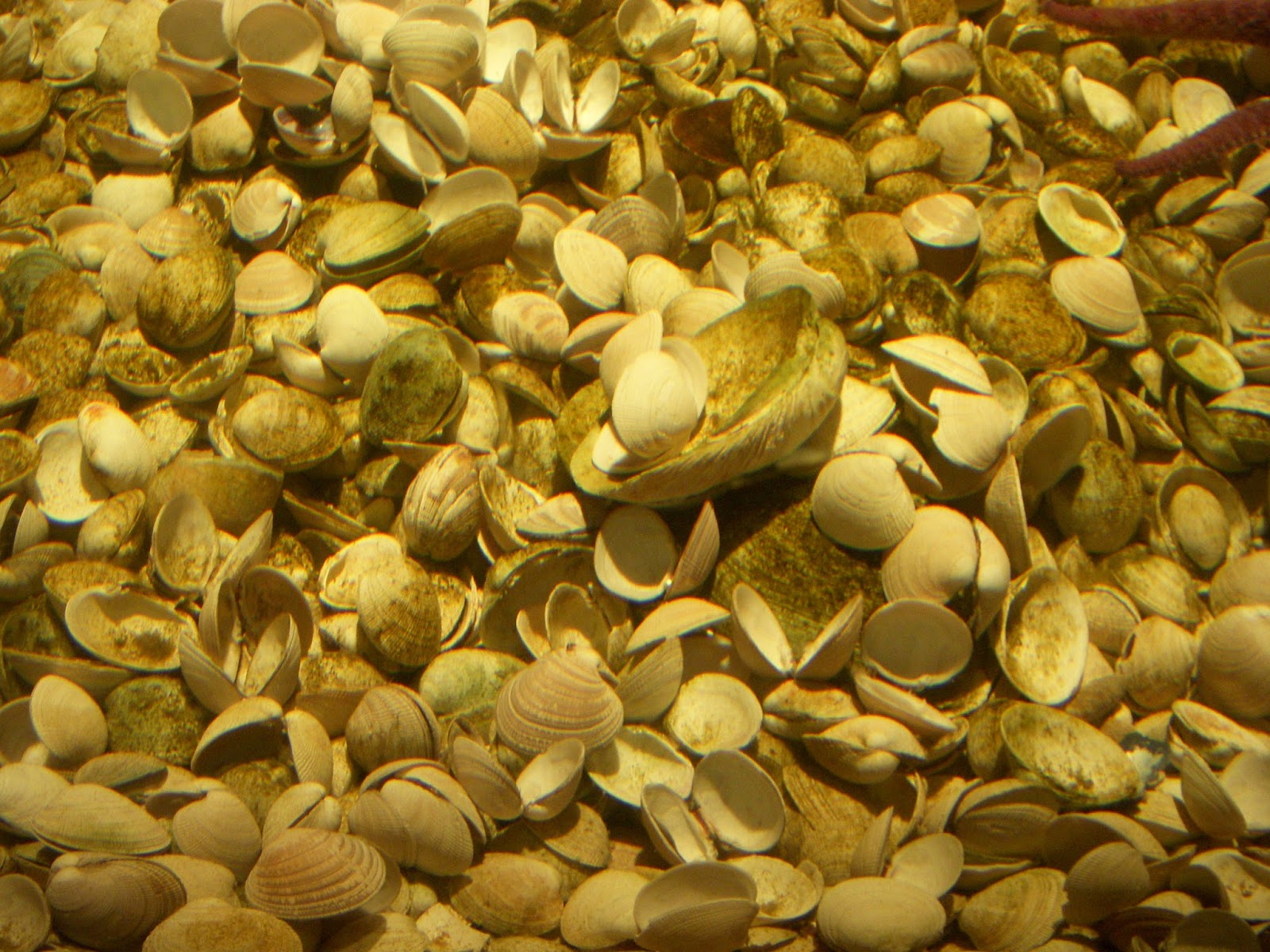
This is a crime scene! A pile of clams have been murdered. It's the work of a sun star. (You can just barely see part of a sun star on the upper right corner.)
Some hagfish. Slimy critters that tie themselves in knots and burrow into dead bodies. They even defend themselves with slime by suffocating their attackers in it. And then they get rid of the excess slime by slipping themselves through one of their own knots.
I didn't dislike the BC Gallery, but what I was really interested in was the part at its end. I don't know the name of this area, but it's a place with many informative, interactive exhibits. You can listen to the static generated by elephantnose fish, view flashlight fish in a dark tank (and watch what happens when you turn on the lights), observe how barnacles cope with swift currents, look at the world through a four-eyed fish's view, rewind and fast forward a live cam of a tank of sea stars to see how they move, and learn how scientists study the ocean. There is a series of jellyfish exhibits at the front, too, which aren't interactive but very nice to look at nonetheless.
A fried egg jellyfish. Is it edible?
I don't know if the fried egg jelly is edible, but the exhibit sign for these blue jellyfish (they're not all blue, however) say these are. They're very active and kind of cute in a jellyfish way. I've actually eaten jellyfish before, though I don't know if it was one of these.
Subadult moon jellyfish. (They had the juveniles and eggs on display, too, but it's hard to get good photos of them.)
And here are the fully grown ones.
An immature lion's mane jellyfish.
A tentacled snake. Nearby was a video you could play that showed how these snakes and other aquatic predators catch their prey.
A dome filled with mosquitoes. An interesting idea for an exhibit, but I wonder what's the white liquid they fill it with. They played sounds of mosquitos buzzing inside the dome, so it was kind of irritating.
The sanddab exhibit was split into two halves with different-colored substrate. When a sanddab settled in one half, it would change color to match it.
Do u leik mudkipz? I've always thought that mudkip was an aquatic salamander like an axolotl or mudpuppy with fish traits, but it appears it's actually a mudskipper with salamander traits. Go fig.
Just a roadkilled mole I found on the parking lot...
On the second week of July, I went to the Vancouver Aquarium. Here are some photos I took there. Ironically, I couldn't get many good photographs of fish; they tended to move around too much.
My favorite part of this aquarium is probably the Amazon Gallery. To get there you have to go through the Tropic Gallery first, which has many tropical fish from both the sea and freshwater, but I didn't take any pictures. It's quite hot and humid in the Amazon Gallery to emulate the tropics, but you can see some pretty neat animals and exhibits. There are Amazonian fish, of course, and a fruit bat exhibit. The main portion of the gallery is an aviary-type area with a wooden walkway. There are many types of animals in this area and you can have lots of fun trying to find them all. My record was pretty poor this time, but I've gotten close in the past. There are many types of butterflies, river turtles, red-footed tortoises, scarlet ibises, three species of parrots, three species of tanagers, whistling ducks, two-toed sloths, and plumed basilisks, the last of which are probably the hardest to look for. Out of all the times I've been to the Vancouver Aquarium, I've only seen a basilisk twice. I didn't get to see any sloths or ducks or blue-gray tanagers this time, either. In fact, nearly all the animals I saw this time were those that you were bound to see either way and didn't take much searching. Disappointing, I guess, but it's part of the fun.
Other animals from the gallery I really wanted to see but didn't were an emperor tamarin and a pygmy marmoset. The two tiny monkeys are kept in a exhibit separated by netting from the aviary area, and it's really neat to watch their dynamic. Once I saw the two species grooming each other. Interspecies interactions are cool, I guess.
Here's a red-footed tortoise.
Even though this post isn't a comic, there'd better be some maniraptors, right? These hyacinth macaws are very big and striking. However, the one thing I don't like about them is their calls, which are very loud and raucous and very hard on the ears.
A nice picture I got of a scarlet ibis feeding from a feeding basket
Some pictures of a river turtle.
Other than big fish tanks and the aviary area, the gallery also has many terrariums for various reptiles, amphibians, and arthropods. This is an emerald tree boa.
A matamata turtle. It's made of 100% turtle power.
Some Madagascar hissing cockroaches. Not from the Amazon.
A spectacled caiman.
Another part of the aquarium I really like is on their lower floor. (When you enter the aquarium, you're on their upper floor.) There's a huge, impressive-looking tank full of West Coast sea life down there (which you can view from above on the upper floor), but I'm talking about the amphibian exhibits. And it was about at this point where my photography skills became slightly better.
This is a Hong Kong warty newt.
The aquarium also houses caecilians. Which is awesome, to say the least. There's a caecilian among this water weed. Somewhere.
A green tree frog. (No, duh. It's really called that.)
A poison-dart frog. Or dart-poison frog. Or arrow-poison frog. (A frog that by any other name would still be just as lethal.)
Um, these are reed frogs. I think.
Some axolotls. They're cute.
An ornate horned frog, lying in ambush for prey.
Some tree frogs whose name escapes me.
Look at that! It's a golden toad exhibit!
There doesn't appear to be anything inside it. And that's because there isn't. It's "unavailable due to extinction".
A coelacanth. They must have gotten a new one after Traumador the Tyrannosaur rescued the one they had before.
From the lower floor of the aquarium you can reach the underwater viewing area of the dolphin pool. Walk a little further and you're outdoors. This is where most of the marine mammal pools are, but they all have underwater viewing, too. Only the dolphin pool's is actually connected to the main building, however.
This is a seagull I saw near the pools. They hang around here quite a lot, probably to get a share of the food. (As it happens, visitors generally feed here, too.)
A Pacific white-sided dolphin.
A harbor porpoise. The only captive one on the West Coast of North America, I've read, but I may be mistaken. These porpoises sometimes get murdered by bottlenose dolphins in the wild. Either the dolphins are having fun killing stuff or doing practice for murdering baby dolphins. Or both. Really ruins their image, doesn't it?
A sea otter. This is the aquarium that spawned the Youtube video of two sea otters holding hands. One of the otters in the video is dead now, I've heard.
In the belugas' underwater viewing area, there are a few tanks with other Arctic sea life. These are Arctic char. Although I couldn't get good photos of most fish, this one turned out kind of cool. Sadly, I didn't get any beluga pictures.
OMG it's a narwhal! This model makes it quite clear that the narwhal's tusk is a single erupted tooth, so it's off to one side. Sometimes two teeth erupt, resulting in two tusks.
Back inside the main building, I kind of breezed through the BC Coast Gallery.
This is a crime scene! A pile of clams have been murdered. It's the work of a sun star. (You can just barely see part of a sun star on the upper right corner.)
Some hagfish. Slimy critters that tie themselves in knots and burrow into dead bodies. They even defend themselves with slime by suffocating their attackers in it. And then they get rid of the excess slime by slipping themselves through one of their own knots.
I didn't dislike the BC Gallery, but what I was really interested in was the part at its end. I don't know the name of this area, but it's a place with many informative, interactive exhibits. You can listen to the static generated by elephantnose fish, view flashlight fish in a dark tank (and watch what happens when you turn on the lights), observe how barnacles cope with swift currents, look at the world through a four-eyed fish's view, rewind and fast forward a live cam of a tank of sea stars to see how they move, and learn how scientists study the ocean. There is a series of jellyfish exhibits at the front, too, which aren't interactive but very nice to look at nonetheless.
A fried egg jellyfish. Is it edible?
I don't know if the fried egg jelly is edible, but the exhibit sign for these blue jellyfish (they're not all blue, however) say these are. They're very active and kind of cute in a jellyfish way. I've actually eaten jellyfish before, though I don't know if it was one of these.
Subadult moon jellyfish. (They had the juveniles and eggs on display, too, but it's hard to get good photos of them.)
And here are the fully grown ones.
An immature lion's mane jellyfish.
A tentacled snake. Nearby was a video you could play that showed how these snakes and other aquatic predators catch their prey.
A dome filled with mosquitoes. An interesting idea for an exhibit, but I wonder what's the white liquid they fill it with. They played sounds of mosquitos buzzing inside the dome, so it was kind of irritating.
The sanddab exhibit was split into two halves with different-colored substrate. When a sanddab settled in one half, it would change color to match it.
Do u leik mudkipz? I've always thought that mudkip was an aquatic salamander like an axolotl or mudpuppy with fish traits, but it appears it's actually a mudskipper with salamander traits. Go fig.
Just a roadkilled mole I found on the parking lot...
Subscribe to:
Posts (Atom)