Showing posts with label Trip. Show all posts

Tuesday, December 26, 2023

TetZooCon 2023

TetZooCon keeps growing and growing, and it's fair to say that this year's was the biggest yet in terms of both the number of events and attendees. I would be lying if I said that I didn't have some prior apprehension about how smoothly the convention would go given this dramatic expansion, but I found it to be brilliantly run, and the organizers adapted admirably to some unexpected (though memorable) technical difficulties beyond their control. 

Extinct marine reptiles featured heavily at TetZooCon this year to accompany the publication of Darren Naish's new book Ancient Sea Reptiles, and one of the stars of the show was Flip the robotic plesiosaur, designed for Luke Muscutt's research on plesiosaur swimming biomechanics. Although I was able to view (and briefly operate) Flip while it was being displayed in the exhibition hall at the convention, I had to miss Muscutt's talk (which has fortunately since been posted online), because it was held in parallel with the two presentations on birds at this year's TetZooCon.

The two bird talks—one by Jennifer Campbell-Smith on studying corvid cognition and the other by Todd Green about his research on cassowaries—did not disappoint, being both informative and entertaining in equal measure. These were followed by a panel discussion among Todd, Darren, and their colleagues Kerrie and AJ Dodd about their involvement with an upcoming documentary about cassowaries, which is currently seeking crowdfunding support.

Also a highlight of this year's TetZooCon for me was Darren leading an event centered around Prehistoric Planet. Those of us in attendance were requested not to publicly divulge the details of what was discussed there, but it was very insightful regarding the creative process and production behind the series. Another eagerly anticipated presentation related to natural history filmmaking was the talk by Nigel Marven, who is probably best known in the paleontology community for hosting the mockumentary series Chased by Dinosaurs, Sea Monsters, and Prehistoric Park. He shared numerous humorous anecdotes about his experiences working with wildlife (both live and CGI) as well as with people.

A model of the tyrannosauroid Juratyrant by Dougal Dixon, on display at TetZooCon.

Artwork of fossil birds (and Dr. Doofenshmirtz from Phineas and Ferb holding a stem-platypus) gifted to me at TetZooCon by my friend Ilari Pätilä.

With each successive TetZooCon, I assume that my chances of placing top three in the challenging TetZooCon quiz will diminish, but I managed to score well again this year, coming in second place (tied with Kelvin Britton). I ended up selecting a Palaeoplushies rendition of the ankylosaur Polacanthus as my prize.

The day after the main events concluded, I joined the TetZooCon field trip to the London Zoo. I didn't wind up taking many photos (partly because I'd already been to this zoo more than once, and partly because I couldn't be bothered to fish my camera out of my packed bag), but it was an excellent visit. We witnessed some very interesting species and behaviors, including gorillas mating, a juvenile scarlet ibis investigating Darren's shoes with its tactile bill, and a two-toed sloth passing just above our heads to drink from a sprinkler. TetZooCon remains a unique experience that I'd wholeheartedly recommend to all lovers of natural history should they get an opportunity to attend.

Tuesday, November 21, 2023

Cincinnati Zoo

As mentioned previously, the organizers of this year's SVP had arranged free entry to the Cincinnati Zoo for conference attendees. I ended up going to the zoo twice during the conference period just so I could see (almost) everything. I was quite impressed; the Cincinnati Zoo isn't massive, but it boasts a large diversity of species (many of which I'd rarely or never seen in other zoos) housed in generally well-designed exhibits.

One of the highlights for me was this expansive grassy habitat in the African section of the zoo, which features multiple species of large African birds (as well as lesser kudu). Here are just a few of the inhabitants, starting with a flock of pink-backed pelicans.

A gray crowned crane.

A lappet-faced vulture.

Some Rüppell's vultures.

Some eastern crested guineafowl.

A good look at the two-toed feet of a common ostrich.

Something I noticed about several of the exhibits at the Cincinnati Zoo was that they had mirrors placed within them, presumably as enrichment for the animals.

Another exhibit nearby is home to African wild dogs.

As avian paleontologists, my labmates and I were naturally eager to check out the bird house. Just outside of it is a habitat for Cape Barren goose, an unusual-looking Australian waterfowl.

A salmon-crested cockatoo perched above.

Unfortunately, I did not get many satisfactory photos inside the bird house itself, as wire mesh, wet glass, and the fast movements of the birds themselves made it challenging to do so. However, I very much enjoyed what I saw. Highlights included two walk-in aviaries (one containing Neotropical birds, the other birds of Southeast Asia and Australia), as well as several seabird exhibits with underwater viewing.

It was quite surreal to see these Inca terns perched on a branch and exhibited in a tropical rainforest setup.

A tawny frogmouth. I will always stop for strisoreans.

A helmeted hornbill.

In addition to a nice bird collection, the Cincinnati Zoo also houses a diverse range of primates. Here are some Coquerel's sifakas, also known to North Americans of a certain age as Zoboomafoo.

The zoo has a building dedicated to wildlife from the wetlands of the Southeastern United States with Florida manatees as the centerpiece, one of the few places outside of Florida where America's afrotheres can be seen. The open-mouthed (probably prey-luring) pose of this alligator snapping turtle was quite striking.

Just outdoors are some exhibits for hoofed mammals, such as these Visayan warty pigs.

A pair of bongo antelope.

Several displays near the entrance of the zoo provided homes for large raptors, including this Andean condor.

The reptile (and amphibian) house also had a nice selection of species, including these Titicaca water frogs. They are able to breathe through their baggy skin in the cold water where they live.

A juvenile Komodo dragon, having mostly lost its hatchling coloration but still far from full size.

At the center of the reptile house is an open-topped habitat for this Chinese alligator.

One of my favorite exhibits at the zoo overall was probably the nocturnal house, but photographing the inhabitants in the dark was of course difficult. I had to try and get a picture of this aardwolf though, this being the first time I've seen this species. It is the smallest of all extant hyenas and feeds almost entirely on termites. Hmm, I wonder why that might be of interest to me...

Most of the outdoor exhibits next to the nocturnal house featured wild cats (including mountain lions, tigers, and snow leopards), which we got some excellent views of. However, I was unsurprisingly most taken by this Eurasian eagle owl.

As the site where the last passenger pigeon and Carolina parakeet passed away, the Cincinnati Zoo has dedicated a poignant memorial to these species.


The insect house is quite large and contains more than just arthropods. It also displays, for example, these Solomon Island leaf frogs (eyeing a feeder cricket).

A black-breasted leaf turtle. According to exhibit signage, this species can rotate each of its eyes independently, similar to a chameleon.

There is no lack of actual arthropod displays in the insect house though. Here is a Baja whipspider.

Some giant water bugs (including males carrying eggs).

A Peruvian firestick, apparently a poisonous stick insect that has evolved bright colors to warn predators of its toxicity.

Another building nearby is primarily dedicated to exhibiting lizards, such as this quince monitor.

The star of the show here is this adult Komodo dragon. It lives in perhaps one of the most unexpected mixed-species zoo habitats I've seen, sharing its exhibit with zebra finches. Presumably, they are too small and quick to be seen as worthwhile prey. They certainly didn't seem too bothered from what I saw of them, actively fluttering to the exhibit floor to collect nesting material.

Sunday, December 11, 2022

TetZooCon 2022

SVP was not the only event to return to in-person gatherings this year. For one, 2022 also marked the reestablishment of a physical meeting for TetZooCon. To accommodate its ever-growing list of attendees, this year the convention moved to a new setting (for the second time in its history), Bush House at King's College London. The venue itself was excellent, though I should mention that I found locating affordable nearby accommodation challenging-to-impossible, and based on comments I'd seen leading up to the convention, I was not the only attendee who encountered that problem. Everything worked out in the end though, at least for me. That's a note to make for next year: book things as early as possible!

Even years after we stopped updating TetZoo Time, it was nice to see it remembered at TetZooCon.

As usual for TetZooCon, I enjoyed all the talks I attended, but I thought the multiple panel discussions covering a range of topics were particularly fun. Three panel discussions were held this year: one where the authors of All Yesterdays (John Conway, Memo Kösemen, and Darren Naish) reflected on the ten years since the book's publication, one focused on pterosaurs (with Natalia Jagielska, Liz Martin-Silverstone, Mark Witton, and John Conway), and one on designing fictional aliens (with Gert van Dijk, Jennifer Colbourne, Joschua Knüppe, Adrian Tchaikovsky, Dougal Dixon, and Memo Kösemen).

This year, I participated in the paleoart workshop, which consisted of several activities: Chris Manias soliciting the audience for ideas on how to design a paleoart exhibition, Mark Witton encouraging us to restore Tanystropheus based on his skeletal diagram of the animal, and Rhys Griffin giving a presentation on 3D-scanning the Crystal Palace dinosaur statues. Already being familiar with Witton's thoughts on the ecology of Tanystropheus (at least, his thoughts circa 2015), I chose to go with a more whimsical take on his prompt.

I lamented this at the last in-person TetZooCon, but after years of doing digital art, I find myself increasingly unaccustomed to drawing with pencil and paper...

We also saw the return of the notoriously difficult TetZooCon trivia quiz. Once again, I wondered whether this year's increased attendance would dash my chances of performing as well on the quiz as I had historically. Much to my surprise, nope... first place!

Is it okay to take (let alone win) the TetZooCon quiz if you're a potential quiz answer? My friend Emilio Río Rodríguez and I both wondered. (I was not the correct answer to the quiz question.)

Even though there was a vast selection of fantastic quiz prizes to pick from, the choice for me was obvious, thanks to Natee Himmapaan donating a print of their incredible rendition of the Mononykus from Prehistoric Planet.

Natee was even kind enough to show me the original illustration! With digital art, I'm used to working on a big canvas that is shrunk down to display the completed work. Natee's finely detailed art is remarkable in how it retains its high quality when enlarged as a print, despite its small physical size.

Special thanks as well to Darren Naish for holding the sketchbook.

I'm normally very frugal about spending money at conferences and conventions, but I knew I also had to get a print of Joanna Kobierska's depiction of Asteriornis!

The type specimen of Asteriornis was recently returned to the Maastricht Natural History Museum (along with the type specimen of the newly named Janavis), so TetZooCon happened just in time for those of us at the Field Palaeobiology Lab to include Kobierska's print in a farewell photoshoot we did for the fossil!

Asteriornis with a selection of the artwork it has inspired. Clockwise from bottom: works by Joanna Kobierska, Phillip Krzeminski, David Orr, myself, Katrina van Grouw, and Michael Rothman, with a life-sized 3D print of the skull in the center painted by Juan Benito Moreno.

The day after the main event, some of us embarked on a field trip to see the Crystal Palace Dinosaurs (and other prehistoric animals). Even though I've lived in the UK for over six years at this point (how?!), I'd never had the chance to visit these historic statues, so I was excited to join. I'm glad I did. The weather was nice (other than a brief period of light rain), there were lots of birds to see, and Darren provided a highly informative guided tour going over the history of the statues and the animals they were based on.

As discussed by Mark Witton and Ellinor Michel in their talk at TetZooCon, the Xiphodon statue in the foreground below had been moved from its original location and presumed lost. During the preparation of their book, The Art and Science of the Crystal Palace Dinosaurs, Michel rediscovered the statue, which had long been misidentified as a "Megaloceros fawn".

Of course, I needed to get at least one photo of the classic Iguanodon statues (though they were modeled after fossils no longer classified as Iguanodon).

A living theropod perched on top of a classic interpretation of an extinct theropod. It might be hard to get more poetic than that.

Thursday, December 8, 2022

SVP 2022

In-person conferences?! What are those? After two years of online conferencing, this year's SVP convened in Toronto, Canada (while still maintaining a parallel virtual platform). Right off the bat, the conference organizers should be commended for establishing a masking mandate: though some attendees reported testing positive for COVID-19 during and after the event, this policy appears to have been largely effective in limiting the spread of the virus.

I certainly had a great time. The welcome reception this year was held at the Royal Ontario Museum (ROM), which I was excited to visit as I'd never been there before. The first to greet us at the museum was a mounted cast of the titanosaur Futalognkosaurus.

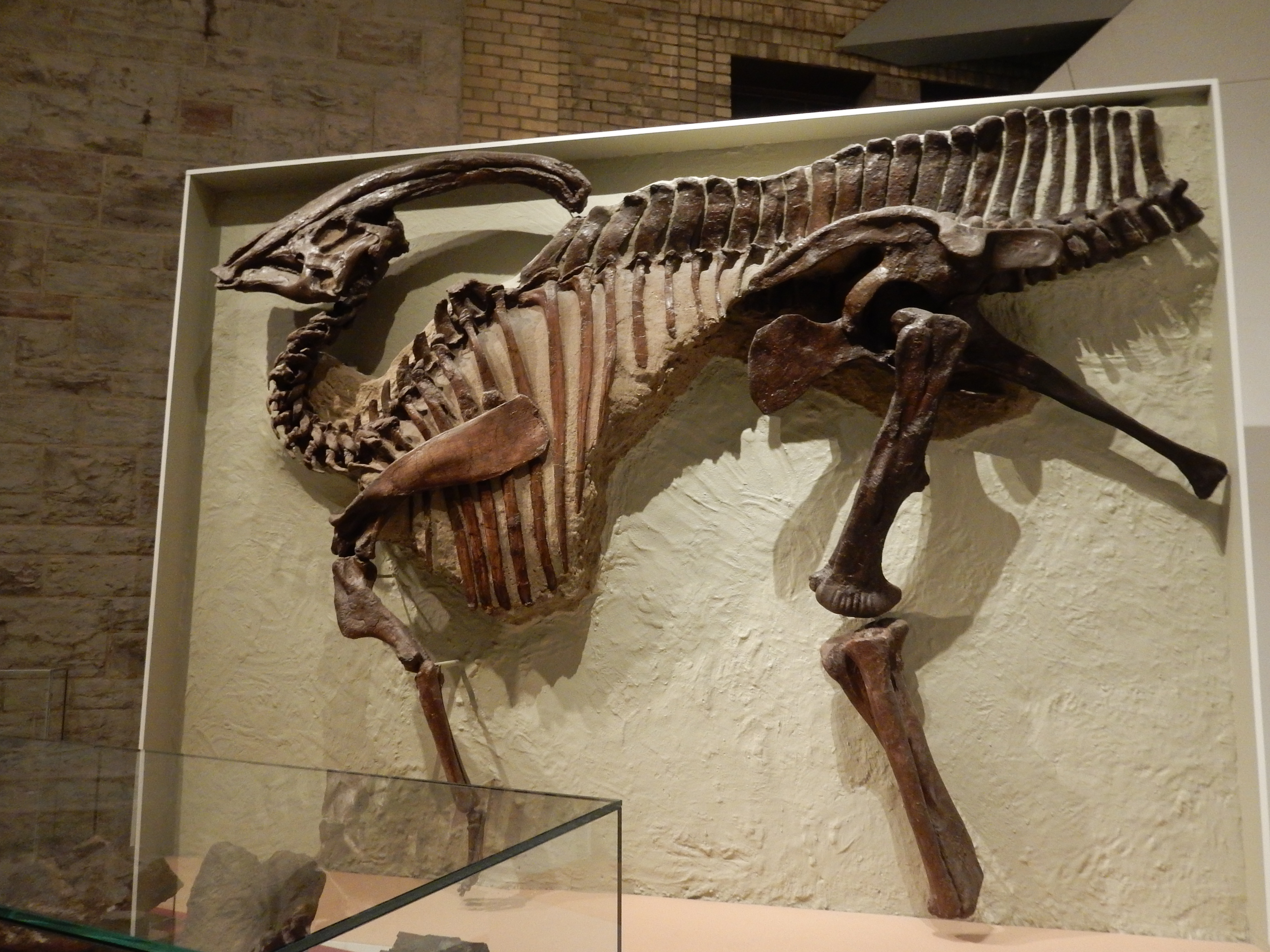
Dinosaur-wise, one of the star attractions of the ROM is the holotype specimen of Parasaurolophus.

However, the skull displayed with the Parasaurolophus holotype is a cast. To see the original skull, one has to visit the museum collections. I managed to join a behind-the-scenes tour where we got to do just that!

Parasaurolophus is not the only one here. The ROM houses holotype specimens of many hadrosaurids.

The museum is not bad when it comes to extant dinosaurs either, for it has quite a nice exhibit of taxidermied birds. This potoo caught my eye.

I'm not really a stranger to presenting at SVP anymore, but seeing some of my labmates present their first in-person SVP talks was pretty special. The last time SVP happened in person, my supervisor and one of my labmates were the only other members of our lab to attend. This time, members of the lab gave nearly half of the talks in the bird session (and our supervisor didn't even come this year)! Speaking of which, the bird talks took place on the afternoon of the last day of the conference, and my talk was one of the last talks in the session, so I'm very grateful to everyone who stuck around to attend it. I won't lie: I've grown a bit weary of presenting on my PhD research at this point, and I'm looking forward to having something fresh to talk about the next time SVP rolls around. However, the feedback I received was all very positive. Most unexpected were the comments from a young fan who came up afterward to tell me that my comics helped inspire their interest in paleontology! That's a treasured memory I won't be forgetting for a long time.

As always, there were numerous fascinating presentations at SVP. I was especially excited to see Chris Torres's talk on a nearly complete skull of Vegavis. However, perhaps the most surprising breakout stars were small(-ish) ornithischians: I thought Cary Woodruff's talk on pachycephalosaur vertebrae, Clint Boyd's talk on a new specimen of Thescelosaurus, and Zakaria Hannebaum's talk on the taphonomy of Orodromeus were all extremely interesting.

The return to in-person conferencing meant seeing friends I hadn't seen in person for a long time (or even ever). My friend John D'Angelo took the chance to show me an illustration he'd made in celebration of me passing my PhD viva. He'd sent me a scan of it before, but getting to see the original was a real treat.

One friend who I'd known online but had never met up with before was Ilari Pätilä, a paleoartist and fellow fossil bird enthusiast. To commemorate the occasion, he presented me with his wonderful depiction of an adzebill.

It was also a pleasure to meet the mysterious artist known mostly as "StygimolochSpinifer" or "Perpetualartistsblock" for the first time. I've long been a fan of his artwork, and we ended up having some great conversations. He even gifted me with one of his sketches after I completed my talk!

I had some time to kill on the day after the conference ended, so I spent the morning visiting the nearby Ripley's Aquarium of Canada with Darren Naish. Darren took many more photos than I did, but below is a picture I got of a peacock mantis shrimp. Most memorable to me were probably the lampreys; I don't remember having seen any live specimens before. Afterward, Darren and I went for a walk on the Toronto waterfront in search of urban wildlife. I particularly appreciated seeing long-tailed ducks, though we also spotted double-crested cormorants, black-capped chickadees, and other North American species that I've missed very much.

What more can I say? SVP was great, and I hope to see everyone again next year!