Showing posts with label Conference. Show all posts

Sunday, August 31, 2025

DinoCon 2025

The first annual DinoCon was at once both new and familiar. As Darren Naish put it, DinoCon is "the anagenetic descendant of TetZooCon". I'd been to quite a few TetZooCons, and like I mentioned in my report of the last one, I'd been anticipating its rebranding as DinoCon with both excitement and trepidation. Would DinoCon successfully preserve and build on what made TetZooCon such an enjoyable event? I'm happy to report that, for most part, it did!

Don't be surprised to spot an Allosaurus walking down the street at DinoCon.

Whereas TetZooCon took place at various locations in London, this year's DinoCon was hosted by the University of Exeter (though it has been announced that it will change venues next year). I'd never properly visited Exeter before, but I was quite taken by the university campus. The grounds were beautiful, with large areas of green space that are apparently home to a good diversity of wildlife. In fact, the one experience I feel like I really missed out on was seeing a wild badger, which multiple other DinoCon attendees had reported doing after dark. All of the buildings in use for the convention were within easy access of one another (though I imagine that Exeter students get a pretty decent workout hiking up and down the hill that the university is built on).

It was a pleasure to spend my lunchtime on the first day of DinoCon with this dinosaur (Erithacus rubecula) on the university campus.

I spent most of DinoCon attending the numerous oral presentations that were held throughout the event. Continuing the streak maintained by TetZooCon, every talk I attended was excellent, but if I had to pick a favorite it'd probably be the one delivered by David James Armsby on the making of his animated series Dinosauria. It was impossible (for me) to remain unmoved by Armsby's descriptions of his personal background and his experience at the convention. As it turns out, this was his first ever public appearance, and he'd never met a fan of his animated work in person prior to DinoCon. In the span of one weekend, he'd met hundreds, and his presentation received a well-deserved standing ovation. A few other talks that I found especially memorable include the one on fossil preparation by Hillary McLean and those on sauropods by Mike Taylor and Matt Wedel of SV-POW.

A tradition carried over from TetZooCon was the quiz. Befitting of its slightly different focus on paleontology (instead of tetrapod zoology), the questions at the DinoCon quiz were largely focused specifically on Mesozoic dinosaurs and popular culture related to them. I personally found it to be somewhat easier than the average TetZooCon quiz, which is perhaps backed up by the fact that though I was able to place second with a score of 27/30, I was tied with numerous other attendees!

Another tradition retained from TetZooCon was having a paleoart exhibition. Shown here is part of a series of works by Diane d'Erceville and Clémence Dupont depicting the history of life.

Speaking of DinoCon's new focus, from an attendee's perspective I'd consider this to probably be its biggest loss in the transition from TetZooCon. Paleontology has always been a major part of the Tet Zoo "brand" (Darren is a paleontologist, after all), but the presentations on extant species at TetZooCon were frequently just as well represented and fascinating as those on extinct ones. That being said, there are plenty of ways to tie extant animals to topics in paleontology (as capably demonstrated this year by George Hancock's talk on visual ecology and how it can be applied to extinct species), so I have no doubt that there will be room for DinoCon to diversify its coverage as it grows and evolves. 

In terms of providing a fun, unique, and welcoming experience for all those with a passion for paleontology (not solely academics), I think this first DinoCon was an amazing success. It was also very cool to learn that it had been put on the map (so to speak) on the collaborative pixel art website Wplace

Monday, October 7, 2024

TetZooCon 2024

The year has really flown by for me, and before long, it was time for another TetZooCon.

Joschua Knüppe's impressive display of postcards in the paleoart gallery at TetZooCon. Can you guess my favorite?

This TetZooCon was very dinosaur-heavy, and nearly every talk I attended focused on dinosaurs in some way, including Darren Naish on refuting Brian Ford's aquatic dinosaurs hypothesis, Mary Colwell on curlew conservation, Jonathan Meiburg on caracaras, Kai Caspar on inferring the intelligence of extinct dinosaurs, Dave Hone on his new book about dinosaur behavior, and Katrina van Grouw on the next version of The Unfeathered Bird, currently in production.

If you have 3D skeletal models of any of the fossil taxa listed on this slide (or know someone who does), Katrina would be interested in hearing from you! They would be a great help in preparing the new version of The Unfeathered Bird.

Furthermore, reference photos for the specimens listed here would be helpful too!

I also popped into the paleoart workshop for a presentation by the hosts of the Love in the Time of Chasmosaurs podcast, Natee Himmapaan, Gemma Hazeborg, and Marc Vincent. Titled "An Ode to Bad Palaeoart", the presenters discussed what qualifies as "bad" paleoart, with several of their examples eliciting laughs from the audience. At the same time, they emphasized how even some of the "worst" human-made paleoart has value and admirable qualities when examined carefully. Afterward, those of us in attendance were encouraged to make our own "bad" paleoart. I had a go at drawing Asteriornis and Ichthyornis while trying to forget everything I knew about theropod anatomy. Unlearning what one knows can be quite a challenge!


It had to happen sometime... this was the year that my track record of placing top 3 in the TetZooCon quiz was finally broken. Instead, I came in fourth place (tied with Richard Hing), which was apparently still good enough for a prize. I was happy to secure a newly-published print compilation of Sean Hennessy's delightful Speed Thief comics. Their juxtaposition of realistically-drawn animal characters with slice-of-life humor and storylines reminds me a lot of Joshua Barkman's False Knees, but with a distinct paleo flavor. Be sure to check out Speed Thief if you haven't already!

Although the writing had been on the wall for a while, John Conway still shocked us at the beginning of the convention by announcing that this would be the final TetZooCon. The organizers elaborated on this further at the end of the event: starting next year, TetZooCon would be rebranded as DinoCon! Aside from the new name, the inaugural DinoCon will be held in Exeter instead of London, and Conway will be stepping down from organizational duties.

As nice as it is to see the convention expand in scale (and for Conway to get some well-deserved rest), I am a little sad to say goodbye to this rendition of TetZooCon, and there has understandably been some apprehension about what other changes the rebranding might bring. However, Darren's assurance that the name "DinoCon" is primarily for promotional purposes and that the event would not lose sight of other topics covered under the scope of Tetrapod Zoology has gone a long way towards addressing my own concerns, at least. It has also been revealed that DinoCon is planned to take place in different locations every year instead of sticking to a single venue, which is very intriguing. I am excited to find out what DinoCon has in store!

Following the main events this year was the first ever TetZooTour, a multi-day trip to the Horniman Museum, the Lyme Regis coast, and Howletts Wild Animal Park. Due to cost and time constraints, I was not able to join this tour, but social media posts appear to indicate that it was great fun and a resounding success. Darren has expressed interest in running similar events in the future, so sounds like that will be something else for TetZoo/DinoCon attendees to look forward to in the coming years.

Tuesday, December 26, 2023

TetZooCon 2023

TetZooCon keeps growing and growing, and it's fair to say that this year's was the biggest yet in terms of both the number of events and attendees. I would be lying if I said that I didn't have some prior apprehension about how smoothly the convention would go given this dramatic expansion, but I found it to be brilliantly run, and the organizers adapted admirably to some unexpected (though memorable) technical difficulties beyond their control. 

Extinct marine reptiles featured heavily at TetZooCon this year to accompany the publication of Darren Naish's new book Ancient Sea Reptiles, and one of the stars of the show was Flip the robotic plesiosaur, designed for Luke Muscutt's research on plesiosaur swimming biomechanics. Although I was able to view (and briefly operate) Flip while it was being displayed in the exhibition hall at the convention, I had to miss Muscutt's talk (which has fortunately since been posted online), because it was held in parallel with the two presentations on birds at this year's TetZooCon.

The two bird talks—one by Jennifer Campbell-Smith on studying corvid cognition and the other by Todd Green about his research on cassowaries—did not disappoint, being both informative and entertaining in equal measure. These were followed by a panel discussion among Todd, Darren, and their colleagues Kerrie and AJ Dodd about their involvement with an upcoming documentary about cassowaries, which is currently seeking crowdfunding support.

Also a highlight of this year's TetZooCon for me was Darren leading an event centered around Prehistoric Planet. Those of us in attendance were requested not to publicly divulge the details of what was discussed there, but it was very insightful regarding the creative process and production behind the series. Another eagerly anticipated presentation related to natural history filmmaking was the talk by Nigel Marven, who is probably best known in the paleontology community for hosting the mockumentary series Chased by Dinosaurs, Sea Monsters, and Prehistoric Park. He shared numerous humorous anecdotes about his experiences working with wildlife (both live and CGI) as well as with people.

A model of the tyrannosauroid Juratyrant by Dougal Dixon, on display at TetZooCon.

Artwork of fossil birds (and Dr. Doofenshmirtz from Phineas and Ferb holding a stem-platypus) gifted to me at TetZooCon by my friend Ilari Pätilä.

With each successive TetZooCon, I assume that my chances of placing top three in the challenging TetZooCon quiz will diminish, but I managed to score well again this year, coming in second place (tied with Kelvin Britton). I ended up selecting a Palaeoplushies rendition of the ankylosaur Polacanthus as my prize.

The day after the main events concluded, I joined the TetZooCon field trip to the London Zoo. I didn't wind up taking many photos (partly because I'd already been to this zoo more than once, and partly because I couldn't be bothered to fish my camera out of my packed bag), but it was an excellent visit. We witnessed some very interesting species and behaviors, including gorillas mating, a juvenile scarlet ibis investigating Darren's shoes with its tactile bill, and a two-toed sloth passing just above our heads to drink from a sprinkler. TetZooCon remains a unique experience that I'd wholeheartedly recommend to all lovers of natural history should they get an opportunity to attend.

Monday, November 6, 2023

SVP 2023

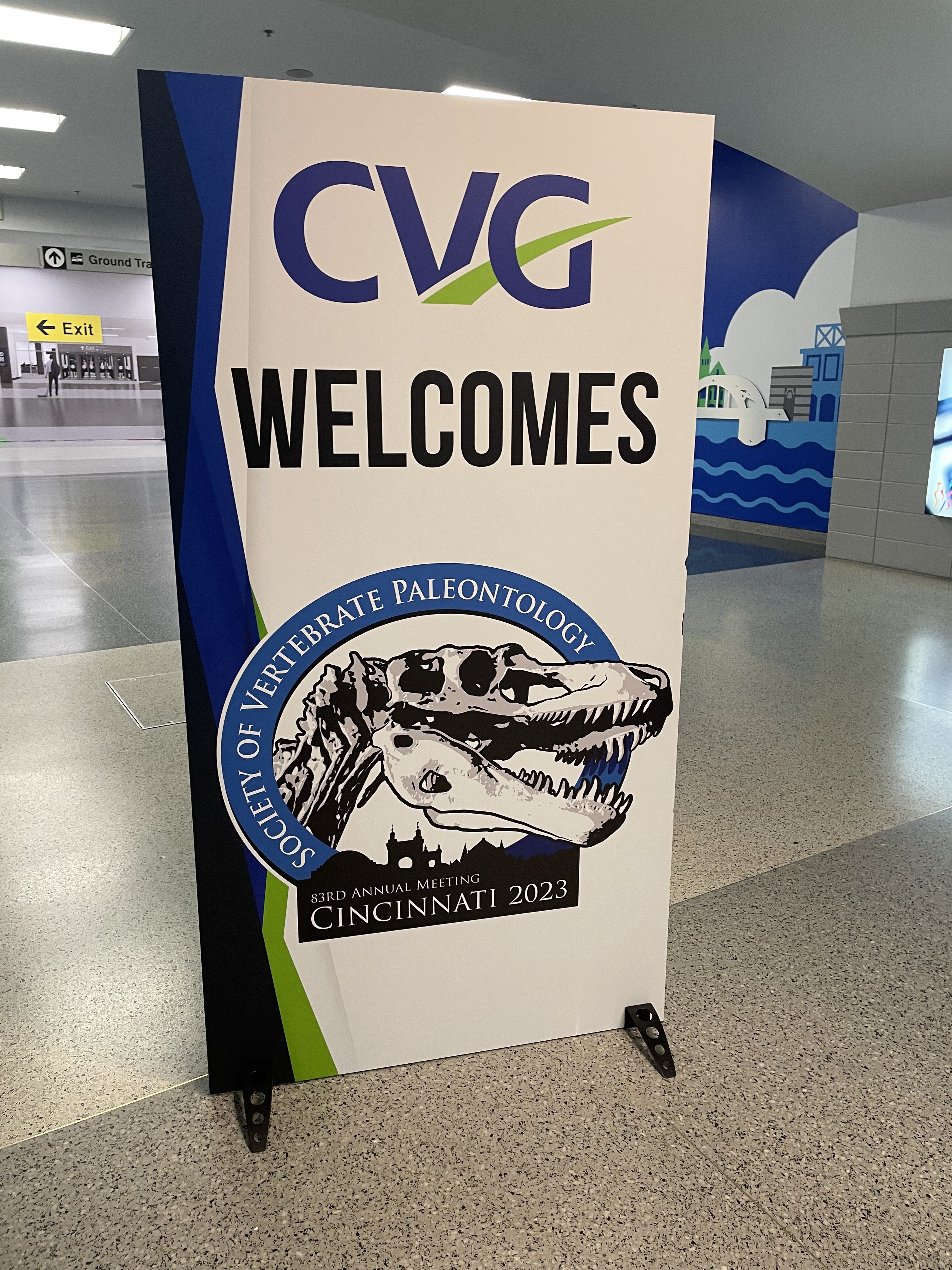
Despite those of us on international flights being made to go through security twice, SVP attendees received a warm welcome in Cincinnati, Ohio this year.

The welcome reception was held at the Cincinnati Museum Center, which proved to be an excellent venue, being spacious enough that it generally didn't feel too crowded even with about 1000 paleontologists crammed inside. The Cincinnati Museum Center is composed of several museums and other facilities, but for me going through just the Museum of Natural History and Science took up most of the evening. Here is the skull of Apatosaurus (with some other sauropod parts).

Two large theropods from the Morrison Formation are mounted side by side, the megalosauroid Torvosaurus and the allosauroid... Allosaurus. The Cincinnati Museum of Natural History and Science apparently has the world's only Torvosaurus mount on display, and it was certainly an impressive sight.

Nearby is the tyrannosaurid Daspletosaurus.

You know you study birds though when one of the theropod mounts you were most excited about was a chicken skeleton...

It wouldn't be a vertebrate paleontology trip to Ohio without saying hi to Dunkleosteus!

I'd had no idea that stem-amniote tracks had been found in Ohio. These ones are Carboniferous in age.

The museum has an excellent Pleistocene exhibit, including this cabinet of North American carnivoran skulls. These species lived alongside each other during the Pleistocene, but only half of them are still extant today.

To drive the point home, part of the gallery consists of a model Pleistocene forest where restorations of extinct and extant North American organisms are exhibited side by side. I noticed that the museum signage was remarkably up to date, for example reflecting the recent reclassification of the dire wolf in the genus Aenocyon, distinct from Canis.

Not every extinct species shown in this gallery died out thousands of years ago, as it also includes models of passenger pigeons, which went extinct in the early 20th Century. Imagery depicting passenger pigeons is not difficult to come by in Cincinnati—the Cincinnati Zoo was where the last one died. Speaking of which, SVP deserves props for organizing free entry to the zoo for conference attendees, an amenity that I made sure to capitalize on. That should probably be the subject of its own post though.

This year's SVP had no fewer than six talk sessions focused on dinosaurs. It would have been possible for one to attend almost nothing but dinosaur sessions and still be present at the conference throughout the entire time that talks were being held. As with last year, my labmates and I represented a large proportion of the speakers in the bird session (to the point where other speakers this year joked about it). 

We were also graced by the presence of a very special attendee. Session moderator Meig Dickson had brought along eir green-cheeked parakeet Ellie, making this the only time in SVP history I'm aware of that a dinosaur has helped moderate a talk session. Ellie was remarkably well behaved throughout the conference, for most part only vocalizing during audience applause. In any case, my own talk went well and received Ellie's blessing.

As others have written about, the Cincinnati/Northern Kentucky International Airport plays host to several skeletal mounts of Pleistocene megafauna, including a mastodon, the "stag-moose" Cervalces, and the ground sloth Megalonyx. I'd missed these on my way in to Cincinnati, but got to see them during my departure.


All in all, I had a lot of fun at SVP this year, but I know that not everyone came away from it so fortunate. As of the time of writing, the proportion of attendees who have reported contracting COVID-19 during or after the conference has been twice as high this year as it was in 2022. Notably, no masking mandate was in place for this SVP, and I hope the organization reconsiders this policy at future meetings. I managed to avoid the disease this time, but having caught it for the first time myself during SAPE earlier in the year, it's not an experience that I'm eager to repeat again, nor would I wish it on anyone else.

Tuesday, May 16, 2023

SAPE 2023

I'd never been to a SAPE (Society of Avian Paleontology and Evolution) conference before, partly because one hadn't happened for years. This year's meeting in Málaga had originally been scheduled for 2020, which would have been while I was studying for my PhD. The COVID-19 pandemic, however, had other plans, and ended up delaying the conference for three years.

This was not only my first SAPE, but also my first time in Spain, so I wasn't quite sure what to expect. However, almost everything went reasonably smoothly for me, other than the fact that I am still recovering from a post-conference ailment—that's one thing I didn't miss about in-person meetings! As far as the conference itself was concerned, I found it very well organized, with a variety of planned activities and enough downtime in between to make it eventful without being hectic. It probably helped that it was a fairly small conference, allowing the talks to be spread out enough that one could attend all of them without feeling overwhelmed.

It was also nice to see this familiar face on Spanish television.

Speaking of talks, I gave another version of my presentation from last year's SVP, summarizing the results of my PhD research. Even more so than SVP last year, my labmates represented a large contingent among the attendees. In fact, the session I spoke in consisted almost exclusively of presentations by members of my supervisor's lab group! Many jokes were made about how we were essentially holding our weekly lab meeting at SAPE. Outside of my labmates' work though, some presentations I especially enjoyed included Phoebe McInerney's talk on dromornithid cranial anatomy, Jacob Blokland's talk on the phylogeny of Australian fossil ralloids, and Anaïs Duhamel's talk on studying the migratory behavior of fossil birds.

To me, one of the perks of traveling someplace new is of course the opportunity to see birds and other wildlife that I haven't seen before. The rich biodiversity of Spain was promising in this regard, and the organizers of SAPE this year did very well to capitalize on it by arranging two field trips with ample birding opportunities. First, there was a half-day excursion to Desembocadura del Guadalhorce, a nature reserve dedicated to conserving the estuary of the Guadalhorce river. The other spanned a full day, visiting El Caminito del Rey (a hiking trail along the side of a narrow gorge) in the morning and, after a surprisingly lengthy lunch, Laguna de Fuente de Piedra (a large saline lagoon) in the evening. In total, I saw over 70 species of birds in Spain, more than 30 of which I'd not seen in the wild previously. A few of my favorite sightings included greater flamingos, Eurasian griffon vultures, and endangered white-headed ducks.

Most of these birds were seen from a fair distance, so I didn't take many bird photos. However, here is a pair of Kentish plovers we spotted on the beach at Desembocadura del Guadalhorce.

Rock pigeons along El Caminito del Rey. It almost felt strange to encounter this species in such a naturalistic setting, but their mastery of this environment was immediately evident. You haven't truly seen rock pigeons unless you've seen them acrobatically catching updrafts along sheer cliffs like these.

A non-avian resident of the gorge, an Iberian ibex.

A distant view of Laguna de Fuente de Piedra. At the time of our visit, most of the water had dried up (as it does every so often), concentrating a decent number of flamingos, waterfowl, and shorebirds.

Sunday, December 11, 2022

TetZooCon 2022

SVP was not the only event to return to in-person gatherings this year. For one, 2022 also marked the reestablishment of a physical meeting for TetZooCon. To accommodate its ever-growing list of attendees, this year the convention moved to a new setting (for the second time in its history), Bush House at King's College London. The venue itself was excellent, though I should mention that I found locating affordable nearby accommodation challenging-to-impossible, and based on comments I'd seen leading up to the convention, I was not the only attendee who encountered that problem. Everything worked out in the end though, at least for me. That's a note to make for next year: book things as early as possible!

Even years after we stopped updating TetZoo Time, it was nice to see it remembered at TetZooCon.

As usual for TetZooCon, I enjoyed all the talks I attended, but I thought the multiple panel discussions covering a range of topics were particularly fun. Three panel discussions were held this year: one where the authors of All Yesterdays (John Conway, Memo Kösemen, and Darren Naish) reflected on the ten years since the book's publication, one focused on pterosaurs (with Natalia Jagielska, Liz Martin-Silverstone, Mark Witton, and John Conway), and one on designing fictional aliens (with Gert van Dijk, Jennifer Colbourne, Joschua Knüppe, Adrian Tchaikovsky, Dougal Dixon, and Memo Kösemen).

This year, I participated in the paleoart workshop, which consisted of several activities: Chris Manias soliciting the audience for ideas on how to design a paleoart exhibition, Mark Witton encouraging us to restore Tanystropheus based on his skeletal diagram of the animal, and Rhys Griffin giving a presentation on 3D-scanning the Crystal Palace dinosaur statues. Already being familiar with Witton's thoughts on the ecology of Tanystropheus (at least, his thoughts circa 2015), I chose to go with a more whimsical take on his prompt.

I lamented this at the last in-person TetZooCon, but after years of doing digital art, I find myself increasingly unaccustomed to drawing with pencil and paper...

We also saw the return of the notoriously difficult TetZooCon trivia quiz. Once again, I wondered whether this year's increased attendance would dash my chances of performing as well on the quiz as I had historically. Much to my surprise, nope... first place!

Is it okay to take (let alone win) the TetZooCon quiz if you're a potential quiz answer? My friend Emilio Río Rodríguez and I both wondered. (I was not the correct answer to the quiz question.)

Even though there was a vast selection of fantastic quiz prizes to pick from, the choice for me was obvious, thanks to Natee Himmapaan donating a print of their incredible rendition of the Mononykus from Prehistoric Planet.

Natee was even kind enough to show me the original illustration! With digital art, I'm used to working on a big canvas that is shrunk down to display the completed work. Natee's finely detailed art is remarkable in how it retains its high quality when enlarged as a print, despite its small physical size.

Special thanks as well to Darren Naish for holding the sketchbook.

I'm normally very frugal about spending money at conferences and conventions, but I knew I also had to get a print of Joanna Kobierska's depiction of Asteriornis!

The type specimen of Asteriornis was recently returned to the Maastricht Natural History Museum (along with the type specimen of the newly named Janavis), so TetZooCon happened just in time for those of us at the Field Palaeobiology Lab to include Kobierska's print in a farewell photoshoot we did for the fossil!

Asteriornis with a selection of the artwork it has inspired. Clockwise from bottom: works by Joanna Kobierska, Phillip Krzeminski, David Orr, myself, Katrina van Grouw, and Michael Rothman, with a life-sized 3D print of the skull in the center painted by Juan Benito Moreno.

The day after the main event, some of us embarked on a field trip to see the Crystal Palace Dinosaurs (and other prehistoric animals). Even though I've lived in the UK for over six years at this point (how?!), I'd never had the chance to visit these historic statues, so I was excited to join. I'm glad I did. The weather was nice (other than a brief period of light rain), there were lots of birds to see, and Darren provided a highly informative guided tour going over the history of the statues and the animals they were based on.

As discussed by Mark Witton and Ellinor Michel in their talk at TetZooCon, the Xiphodon statue in the foreground below had been moved from its original location and presumed lost. During the preparation of their book, The Art and Science of the Crystal Palace Dinosaurs, Michel rediscovered the statue, which had long been misidentified as a "Megaloceros fawn".

Of course, I needed to get at least one photo of the classic Iguanodon statues (though they were modeled after fossils no longer classified as Iguanodon).

A living theropod perched on top of a classic interpretation of an extinct theropod. It might be hard to get more poetic than that.

Thursday, December 8, 2022

SVP 2022

In-person conferences?! What are those? After two years of online conferencing, this year's SVP convened in Toronto, Canada (while still maintaining a parallel virtual platform). Right off the bat, the conference organizers should be commended for establishing a masking mandate: though some attendees reported testing positive for COVID-19 during and after the event, this policy appears to have been largely effective in limiting the spread of the virus.

I certainly had a great time. The welcome reception this year was held at the Royal Ontario Museum (ROM), which I was excited to visit as I'd never been there before. The first to greet us at the museum was a mounted cast of the titanosaur Futalognkosaurus.

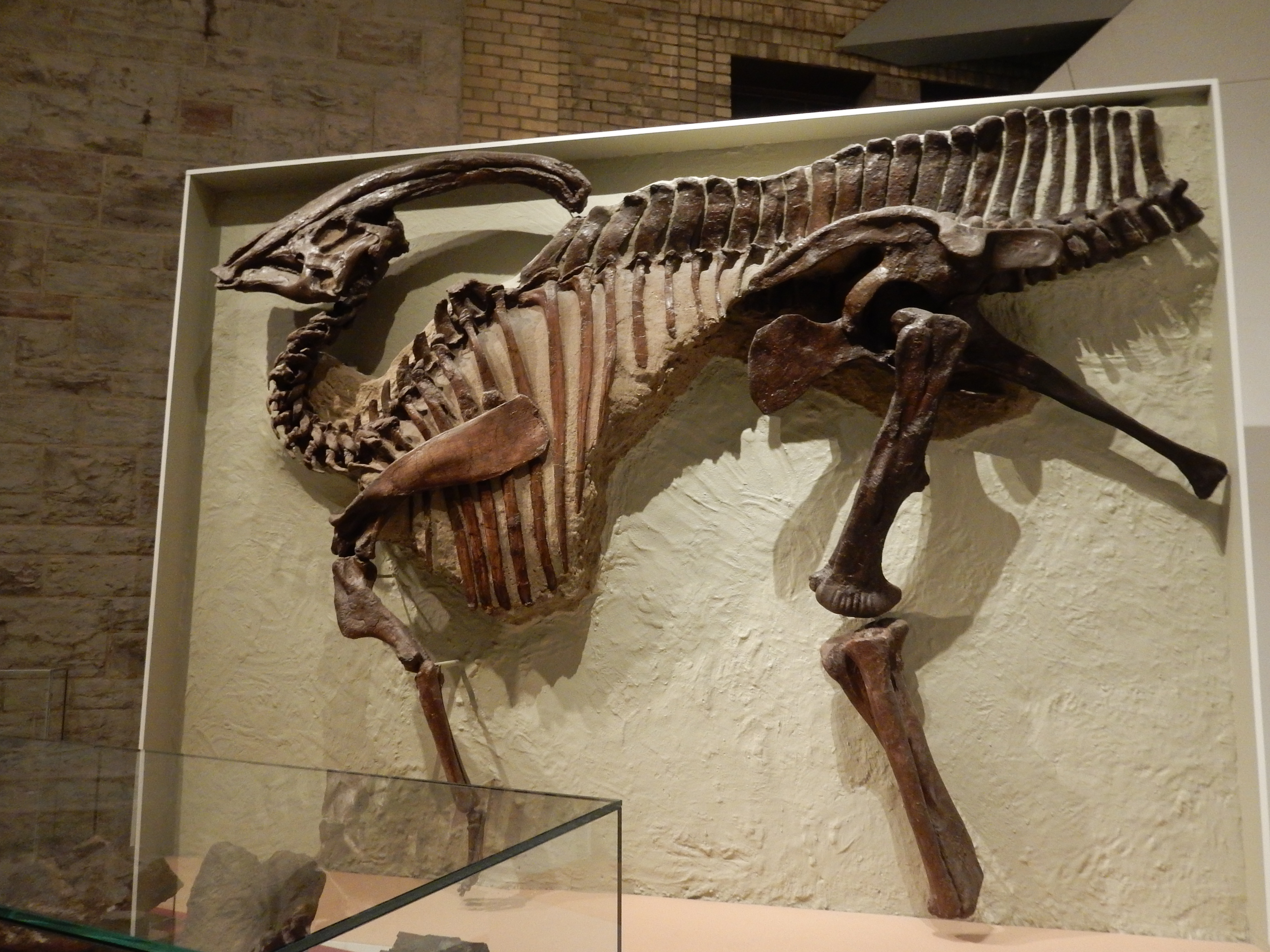
Dinosaur-wise, one of the star attractions of the ROM is the holotype specimen of Parasaurolophus.

However, the skull displayed with the Parasaurolophus holotype is a cast. To see the original skull, one has to visit the museum collections. I managed to join a behind-the-scenes tour where we got to do just that!

Parasaurolophus is not the only one here. The ROM houses holotype specimens of many hadrosaurids.

The museum is not bad when it comes to extant dinosaurs either, for it has quite a nice exhibit of taxidermied birds. This potoo caught my eye.

I'm not really a stranger to presenting at SVP anymore, but seeing some of my labmates present their first in-person SVP talks was pretty special. The last time SVP happened in person, my supervisor and one of my labmates were the only other members of our lab to attend. This time, members of the lab gave nearly half of the talks in the bird session (and our supervisor didn't even come this year)! Speaking of which, the bird talks took place on the afternoon of the last day of the conference, and my talk was one of the last talks in the session, so I'm very grateful to everyone who stuck around to attend it. I won't lie: I've grown a bit weary of presenting on my PhD research at this point, and I'm looking forward to having something fresh to talk about the next time SVP rolls around. However, the feedback I received was all very positive. Most unexpected were the comments from a young fan who came up afterward to tell me that my comics helped inspire their interest in paleontology! That's a treasured memory I won't be forgetting for a long time.

As always, there were numerous fascinating presentations at SVP. I was especially excited to see Chris Torres's talk on a nearly complete skull of Vegavis. However, perhaps the most surprising breakout stars were small(-ish) ornithischians: I thought Cary Woodruff's talk on pachycephalosaur vertebrae, Clint Boyd's talk on a new specimen of Thescelosaurus, and Zakaria Hannebaum's talk on the taphonomy of Orodromeus were all extremely interesting.

The return to in-person conferencing meant seeing friends I hadn't seen in person for a long time (or even ever). My friend John D'Angelo took the chance to show me an illustration he'd made in celebration of me passing my PhD viva. He'd sent me a scan of it before, but getting to see the original was a real treat.

One friend who I'd known online but had never met up with before was Ilari Pätilä, a paleoartist and fellow fossil bird enthusiast. To commemorate the occasion, he presented me with his wonderful depiction of an adzebill.

It was also a pleasure to meet the mysterious artist known mostly as "StygimolochSpinifer" or "Perpetualartistsblock" for the first time. I've long been a fan of his artwork, and we ended up having some great conversations. He even gifted me with one of his sketches after I completed my talk!

I had some time to kill on the day after the conference ended, so I spent the morning visiting the nearby Ripley's Aquarium of Canada with Darren Naish. Darren took many more photos than I did, but below is a picture I got of a peacock mantis shrimp. Most memorable to me were probably the lampreys; I don't remember having seen any live specimens before. Afterward, Darren and I went for a walk on the Toronto waterfront in search of urban wildlife. I particularly appreciated seeing long-tailed ducks, though we also spotted double-crested cormorants, black-capped chickadees, and other North American species that I've missed very much.

What more can I say? SVP was great, and I hope to see everyone again next year!