Showing posts with label Shock horror a non maniraptor. Show all posts

Tuesday, November 21, 2023

Cincinnati Zoo

As mentioned previously, the organizers of this year's SVP had arranged free entry to the Cincinnati Zoo for conference attendees. I ended up going to the zoo twice during the conference period just so I could see (almost) everything. I was quite impressed; the Cincinnati Zoo isn't massive, but it boasts a large diversity of species (many of which I'd rarely or never seen in other zoos) housed in generally well-designed exhibits.

One of the highlights for me was this expansive grassy habitat in the African section of the zoo, which features multiple species of large African birds (as well as lesser kudu). Here are just a few of the inhabitants, starting with a flock of pink-backed pelicans.

A gray crowned crane.

A lappet-faced vulture.

Some Rüppell's vultures.

Some eastern crested guineafowl.

A good look at the two-toed feet of a common ostrich.

Something I noticed about several of the exhibits at the Cincinnati Zoo was that they had mirrors placed within them, presumably as enrichment for the animals.

Another exhibit nearby is home to African wild dogs.

As avian paleontologists, my labmates and I were naturally eager to check out the bird house. Just outside of it is a habitat for Cape Barren goose, an unusual-looking Australian waterfowl.

A salmon-crested cockatoo perched above.

Unfortunately, I did not get many satisfactory photos inside the bird house itself, as wire mesh, wet glass, and the fast movements of the birds themselves made it challenging to do so. However, I very much enjoyed what I saw. Highlights included two walk-in aviaries (one containing Neotropical birds, the other birds of Southeast Asia and Australia), as well as several seabird exhibits with underwater viewing.

It was quite surreal to see these Inca terns perched on a branch and exhibited in a tropical rainforest setup.

A tawny frogmouth. I will always stop for strisoreans.

A helmeted hornbill.

In addition to a nice bird collection, the Cincinnati Zoo also houses a diverse range of primates. Here are some Coquerel's sifakas, also known to North Americans of a certain age as Zoboomafoo.

The zoo has a building dedicated to wildlife from the wetlands of the Southeastern United States with Florida manatees as the centerpiece, one of the few places outside of Florida where America's afrotheres can be seen. The open-mouthed (probably prey-luring) pose of this alligator snapping turtle was quite striking.

Just outdoors are some exhibits for hoofed mammals, such as these Visayan warty pigs.

A pair of bongo antelope.

Several displays near the entrance of the zoo provided homes for large raptors, including this Andean condor.

The reptile (and amphibian) house also had a nice selection of species, including these Titicaca water frogs. They are able to breathe through their baggy skin in the cold water where they live.

A juvenile Komodo dragon, having mostly lost its hatchling coloration but still far from full size.

At the center of the reptile house is an open-topped habitat for this Chinese alligator.

One of my favorite exhibits at the zoo overall was probably the nocturnal house, but photographing the inhabitants in the dark was of course difficult. I had to try and get a picture of this aardwolf though, this being the first time I've seen this species. It is the smallest of all extant hyenas and feeds almost entirely on termites. Hmm, I wonder why that might be of interest to me...

Most of the outdoor exhibits next to the nocturnal house featured wild cats (including mountain lions, tigers, and snow leopards), which we got some excellent views of. However, I was unsurprisingly most taken by this Eurasian eagle owl.

As the site where the last passenger pigeon and Carolina parakeet passed away, the Cincinnati Zoo has dedicated a poignant memorial to these species.


The insect house is quite large and contains more than just arthropods. It also displays, for example, these Solomon Island leaf frogs (eyeing a feeder cricket).

A black-breasted leaf turtle. According to exhibit signage, this species can rotate each of its eyes independently, similar to a chameleon.

There is no lack of actual arthropod displays in the insect house though. Here is a Baja whipspider.

Some giant water bugs (including males carrying eggs).

A Peruvian firestick, apparently a poisonous stick insect that has evolved bright colors to warn predators of its toxicity.

Another building nearby is primarily dedicated to exhibiting lizards, such as this quince monitor.

The star of the show here is this adult Komodo dragon. It lives in perhaps one of the most unexpected mixed-species zoo habitats I've seen, sharing its exhibit with zebra finches. Presumably, they are too small and quick to be seen as worthwhile prey. They certainly didn't seem too bothered from what I saw of them, actively fluttering to the exhibit floor to collect nesting material.

Monday, November 6, 2023

SVP 2023

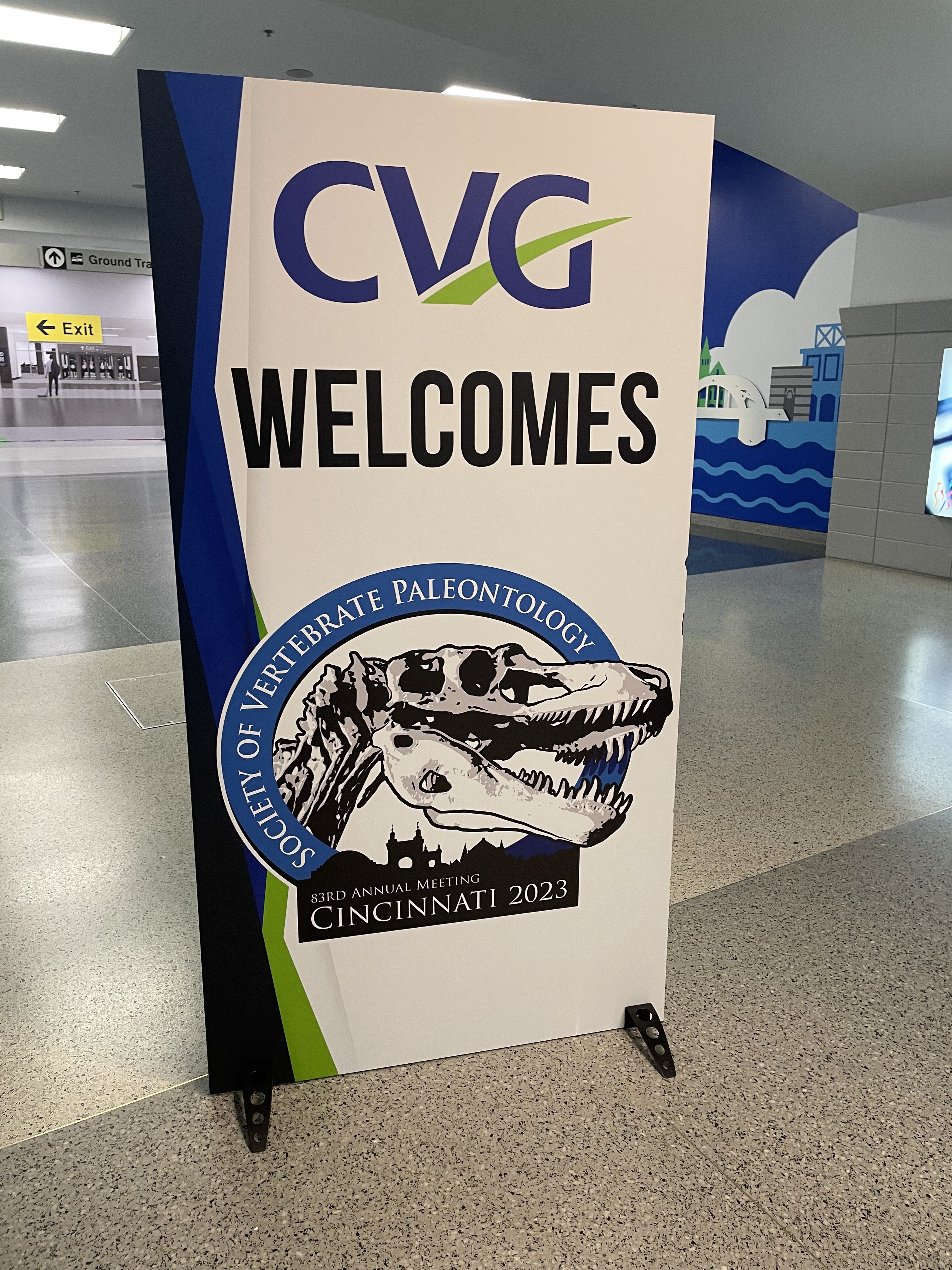
Despite those of us on international flights being made to go through security twice, SVP attendees received a warm welcome in Cincinnati, Ohio this year.

The welcome reception was held at the Cincinnati Museum Center, which proved to be an excellent venue, being spacious enough that it generally didn't feel too crowded even with about 1000 paleontologists crammed inside. The Cincinnati Museum Center is composed of several museums and other facilities, but for me going through just the Museum of Natural History and Science took up most of the evening. Here is the skull of Apatosaurus (with some other sauropod parts).

Two large theropods from the Morrison Formation are mounted side by side, the megalosauroid Torvosaurus and the allosauroid... Allosaurus. The Cincinnati Museum of Natural History and Science apparently has the world's only Torvosaurus mount on display, and it was certainly an impressive sight.

Nearby is the tyrannosaurid Daspletosaurus.

You know you study birds though when one of the theropod mounts you were most excited about was a chicken skeleton...

It wouldn't be a vertebrate paleontology trip to Ohio without saying hi to Dunkleosteus!

I'd had no idea that stem-amniote tracks had been found in Ohio. These ones are Carboniferous in age.

The museum has an excellent Pleistocene exhibit, including this cabinet of North American carnivoran skulls. These species lived alongside each other during the Pleistocene, but only half of them are still extant today.

To drive the point home, part of the gallery consists of a model Pleistocene forest where restorations of extinct and extant North American organisms are exhibited side by side. I noticed that the museum signage was remarkably up to date, for example reflecting the recent reclassification of the dire wolf in the genus Aenocyon, distinct from Canis.

Not every extinct species shown in this gallery died out thousands of years ago, as it also includes models of passenger pigeons, which went extinct in the early 20th Century. Imagery depicting passenger pigeons is not difficult to come by in Cincinnati—the Cincinnati Zoo was where the last one died. Speaking of which, SVP deserves props for organizing free entry to the zoo for conference attendees, an amenity that I made sure to capitalize on. That should probably be the subject of its own post though.

This year's SVP had no fewer than six talk sessions focused on dinosaurs. It would have been possible for one to attend almost nothing but dinosaur sessions and still be present at the conference throughout the entire time that talks were being held. As with last year, my labmates and I represented a large proportion of the speakers in the bird session (to the point where other speakers this year joked about it). 

We were also graced by the presence of a very special attendee. Session moderator Meig Dickson had brought along eir green-cheeked parakeet Ellie, making this the only time in SVP history I'm aware of that a dinosaur has helped moderate a talk session. Ellie was remarkably well behaved throughout the conference, for most part only vocalizing during audience applause. In any case, my own talk went well and received Ellie's blessing.

As others have written about, the Cincinnati/Northern Kentucky International Airport plays host to several skeletal mounts of Pleistocene megafauna, including a mastodon, the "stag-moose" Cervalces, and the ground sloth Megalonyx. I'd missed these on my way in to Cincinnati, but got to see them during my departure.


All in all, I had a lot of fun at SVP this year, but I know that not everyone came away from it so fortunate. As of the time of writing, the proportion of attendees who have reported contracting COVID-19 during or after the conference has been twice as high this year as it was in 2022. Notably, no masking mandate was in place for this SVP, and I hope the organization reconsiders this policy at future meetings. I managed to avoid the disease this time, but having caught it for the first time myself during SAPE earlier in the year, it's not an experience that I'm eager to repeat again, nor would I wish it on anyone else.

Tuesday, May 16, 2023

SAPE 2023

I'd never been to a SAPE (Society of Avian Paleontology and Evolution) conference before, partly because one hadn't happened for years. This year's meeting in Málaga had originally been scheduled for 2020, which would have been while I was studying for my PhD. The COVID-19 pandemic, however, had other plans, and ended up delaying the conference for three years.

This was not only my first SAPE, but also my first time in Spain, so I wasn't quite sure what to expect. However, almost everything went reasonably smoothly for me, other than the fact that I am still recovering from a post-conference ailment—that's one thing I didn't miss about in-person meetings! As far as the conference itself was concerned, I found it very well organized, with a variety of planned activities and enough downtime in between to make it eventful without being hectic. It probably helped that it was a fairly small conference, allowing the talks to be spread out enough that one could attend all of them without feeling overwhelmed.

It was also nice to see this familiar face on Spanish television.

Speaking of talks, I gave another version of my presentation from last year's SVP, summarizing the results of my PhD research. Even more so than SVP last year, my labmates represented a large contingent among the attendees. In fact, the session I spoke in consisted almost exclusively of presentations by members of my supervisor's lab group! Many jokes were made about how we were essentially holding our weekly lab meeting at SAPE. Outside of my labmates' work though, some presentations I especially enjoyed included Phoebe McInerney's talk on dromornithid cranial anatomy, Jacob Blokland's talk on the phylogeny of Australian fossil ralloids, and Anaïs Duhamel's talk on studying the migratory behavior of fossil birds.

To me, one of the perks of traveling someplace new is of course the opportunity to see birds and other wildlife that I haven't seen before. The rich biodiversity of Spain was promising in this regard, and the organizers of SAPE this year did very well to capitalize on it by arranging two field trips with ample birding opportunities. First, there was a half-day excursion to Desembocadura del Guadalhorce, a nature reserve dedicated to conserving the estuary of the Guadalhorce river. The other spanned a full day, visiting El Caminito del Rey (a hiking trail along the side of a narrow gorge) in the morning and, after a surprisingly lengthy lunch, Laguna de Fuente de Piedra (a large saline lagoon) in the evening. In total, I saw over 70 species of birds in Spain, more than 30 of which I'd not seen in the wild previously. A few of my favorite sightings included greater flamingos, Eurasian griffon vultures, and endangered white-headed ducks.

Most of these birds were seen from a fair distance, so I didn't take many bird photos. However, here is a pair of Kentish plovers we spotted on the beach at Desembocadura del Guadalhorce.

Rock pigeons along El Caminito del Rey. It almost felt strange to encounter this species in such a naturalistic setting, but their mastery of this environment was immediately evident. You haven't truly seen rock pigeons unless you've seen them acrobatically catching updrafts along sheer cliffs like these.

A non-avian resident of the gorge, an Iberian ibex.

A distant view of Laguna de Fuente de Piedra. At the time of our visit, most of the water had dried up (as it does every so often), concentrating a decent number of flamingos, waterfowl, and shorebirds.

Sunday, December 11, 2022

TetZooCon 2022

SVP was not the only event to return to in-person gatherings this year. For one, 2022 also marked the reestablishment of a physical meeting for TetZooCon. To accommodate its ever-growing list of attendees, this year the convention moved to a new setting (for the second time in its history), Bush House at King's College London. The venue itself was excellent, though I should mention that I found locating affordable nearby accommodation challenging-to-impossible, and based on comments I'd seen leading up to the convention, I was not the only attendee who encountered that problem. Everything worked out in the end though, at least for me. That's a note to make for next year: book things as early as possible!

Even years after we stopped updating TetZoo Time, it was nice to see it remembered at TetZooCon.

As usual for TetZooCon, I enjoyed all the talks I attended, but I thought the multiple panel discussions covering a range of topics were particularly fun. Three panel discussions were held this year: one where the authors of All Yesterdays (John Conway, Memo Kösemen, and Darren Naish) reflected on the ten years since the book's publication, one focused on pterosaurs (with Natalia Jagielska, Liz Martin-Silverstone, Mark Witton, and John Conway), and one on designing fictional aliens (with Gert van Dijk, Jennifer Colbourne, Joschua Knüppe, Adrian Tchaikovsky, Dougal Dixon, and Memo Kösemen).

This year, I participated in the paleoart workshop, which consisted of several activities: Chris Manias soliciting the audience for ideas on how to design a paleoart exhibition, Mark Witton encouraging us to restore Tanystropheus based on his skeletal diagram of the animal, and Rhys Griffin giving a presentation on 3D-scanning the Crystal Palace dinosaur statues. Already being familiar with Witton's thoughts on the ecology of Tanystropheus (at least, his thoughts circa 2015), I chose to go with a more whimsical take on his prompt.

I lamented this at the last in-person TetZooCon, but after years of doing digital art, I find myself increasingly unaccustomed to drawing with pencil and paper...

We also saw the return of the notoriously difficult TetZooCon trivia quiz. Once again, I wondered whether this year's increased attendance would dash my chances of performing as well on the quiz as I had historically. Much to my surprise, nope... first place!

Is it okay to take (let alone win) the TetZooCon quiz if you're a potential quiz answer? My friend Emilio Río Rodríguez and I both wondered. (I was not the correct answer to the quiz question.)

Even though there was a vast selection of fantastic quiz prizes to pick from, the choice for me was obvious, thanks to Natee Himmapaan donating a print of their incredible rendition of the Mononykus from Prehistoric Planet.

Natee was even kind enough to show me the original illustration! With digital art, I'm used to working on a big canvas that is shrunk down to display the completed work. Natee's finely detailed art is remarkable in how it retains its high quality when enlarged as a print, despite its small physical size.

Special thanks as well to Darren Naish for holding the sketchbook.

I'm normally very frugal about spending money at conferences and conventions, but I knew I also had to get a print of Joanna Kobierska's depiction of Asteriornis!

The type specimen of Asteriornis was recently returned to the Maastricht Natural History Museum (along with the type specimen of the newly named Janavis), so TetZooCon happened just in time for those of us at the Field Palaeobiology Lab to include Kobierska's print in a farewell photoshoot we did for the fossil!

Asteriornis with a selection of the artwork it has inspired. Clockwise from bottom: works by Joanna Kobierska, Phillip Krzeminski, David Orr, myself, Katrina van Grouw, and Michael Rothman, with a life-sized 3D print of the skull in the center painted by Juan Benito Moreno.

The day after the main event, some of us embarked on a field trip to see the Crystal Palace Dinosaurs (and other prehistoric animals). Even though I've lived in the UK for over six years at this point (how?!), I'd never had the chance to visit these historic statues, so I was excited to join. I'm glad I did. The weather was nice (other than a brief period of light rain), there were lots of birds to see, and Darren provided a highly informative guided tour going over the history of the statues and the animals they were based on.

As discussed by Mark Witton and Ellinor Michel in their talk at TetZooCon, the Xiphodon statue in the foreground below had been moved from its original location and presumed lost. During the preparation of their book, The Art and Science of the Crystal Palace Dinosaurs, Michel rediscovered the statue, which had long been misidentified as a "Megaloceros fawn".

Of course, I needed to get at least one photo of the classic Iguanodon statues (though they were modeled after fossils no longer classified as Iguanodon).

A living theropod perched on top of a classic interpretation of an extinct theropod. It might be hard to get more poetic than that.