Showing posts with label Research. Show all posts

Monday, November 6, 2023

SVP 2023

Despite those of us on international flights being made to go through security twice, SVP attendees received a warm welcome in Cincinnati, Ohio this year.

The welcome reception was held at the Cincinnati Museum Center, which proved to be an excellent venue, being spacious enough that it generally didn't feel too crowded even with about 1000 paleontologists crammed inside. The Cincinnati Museum Center is composed of several museums and other facilities, but for me going through just the Museum of Natural History and Science took up most of the evening. Here is the skull of Apatosaurus (with some other sauropod parts).

Two large theropods from the Morrison Formation are mounted side by side, the megalosauroid Torvosaurus and the allosauroid... Allosaurus. The Cincinnati Museum of Natural History and Science apparently has the world's only Torvosaurus mount on display, and it was certainly an impressive sight.

Nearby is the tyrannosaurid Daspletosaurus.

You know you study birds though when one of the theropod mounts you were most excited about was a chicken skeleton...

It wouldn't be a vertebrate paleontology trip to Ohio without saying hi to Dunkleosteus!

I'd had no idea that stem-amniote tracks had been found in Ohio. These ones are Carboniferous in age.

The museum has an excellent Pleistocene exhibit, including this cabinet of North American carnivoran skulls. These species lived alongside each other during the Pleistocene, but only half of them are still extant today.

To drive the point home, part of the gallery consists of a model Pleistocene forest where restorations of extinct and extant North American organisms are exhibited side by side. I noticed that the museum signage was remarkably up to date, for example reflecting the recent reclassification of the dire wolf in the genus Aenocyon, distinct from Canis.

Not every extinct species shown in this gallery died out thousands of years ago, as it also includes models of passenger pigeons, which went extinct in the early 20th Century. Imagery depicting passenger pigeons is not difficult to come by in Cincinnati—the Cincinnati Zoo was where the last one died. Speaking of which, SVP deserves props for organizing free entry to the zoo for conference attendees, an amenity that I made sure to capitalize on. That should probably be the subject of its own post though.

This year's SVP had no fewer than six talk sessions focused on dinosaurs. It would have been possible for one to attend almost nothing but dinosaur sessions and still be present at the conference throughout the entire time that talks were being held. As with last year, my labmates and I represented a large proportion of the speakers in the bird session (to the point where other speakers this year joked about it). 

We were also graced by the presence of a very special attendee. Session moderator Meig Dickson had brought along eir green-cheeked parakeet Ellie, making this the only time in SVP history I'm aware of that a dinosaur has helped moderate a talk session. Ellie was remarkably well behaved throughout the conference, for most part only vocalizing during audience applause. In any case, my own talk went well and received Ellie's blessing.

As others have written about, the Cincinnati/Northern Kentucky International Airport plays host to several skeletal mounts of Pleistocene megafauna, including a mastodon, the "stag-moose" Cervalces, and the ground sloth Megalonyx. I'd missed these on my way in to Cincinnati, but got to see them during my departure.


All in all, I had a lot of fun at SVP this year, but I know that not everyone came away from it so fortunate. As of the time of writing, the proportion of attendees who have reported contracting COVID-19 during or after the conference has been twice as high this year as it was in 2022. Notably, no masking mandate was in place for this SVP, and I hope the organization reconsiders this policy at future meetings. I managed to avoid the disease this time, but having caught it for the first time myself during SAPE earlier in the year, it's not an experience that I'm eager to repeat again, nor would I wish it on anyone else.

Tuesday, May 16, 2023

SAPE 2023

I'd never been to a SAPE (Society of Avian Paleontology and Evolution) conference before, partly because one hadn't happened for years. This year's meeting in Málaga had originally been scheduled for 2020, which would have been while I was studying for my PhD. The COVID-19 pandemic, however, had other plans, and ended up delaying the conference for three years.

This was not only my first SAPE, but also my first time in Spain, so I wasn't quite sure what to expect. However, almost everything went reasonably smoothly for me, other than the fact that I am still recovering from a post-conference ailment—that's one thing I didn't miss about in-person meetings! As far as the conference itself was concerned, I found it very well organized, with a variety of planned activities and enough downtime in between to make it eventful without being hectic. It probably helped that it was a fairly small conference, allowing the talks to be spread out enough that one could attend all of them without feeling overwhelmed.

It was also nice to see this familiar face on Spanish television.

Speaking of talks, I gave another version of my presentation from last year's SVP, summarizing the results of my PhD research. Even more so than SVP last year, my labmates represented a large contingent among the attendees. In fact, the session I spoke in consisted almost exclusively of presentations by members of my supervisor's lab group! Many jokes were made about how we were essentially holding our weekly lab meeting at SAPE. Outside of my labmates' work though, some presentations I especially enjoyed included Phoebe McInerney's talk on dromornithid cranial anatomy, Jacob Blokland's talk on the phylogeny of Australian fossil ralloids, and Anaïs Duhamel's talk on studying the migratory behavior of fossil birds.

To me, one of the perks of traveling someplace new is of course the opportunity to see birds and other wildlife that I haven't seen before. The rich biodiversity of Spain was promising in this regard, and the organizers of SAPE this year did very well to capitalize on it by arranging two field trips with ample birding opportunities. First, there was a half-day excursion to Desembocadura del Guadalhorce, a nature reserve dedicated to conserving the estuary of the Guadalhorce river. The other spanned a full day, visiting El Caminito del Rey (a hiking trail along the side of a narrow gorge) in the morning and, after a surprisingly lengthy lunch, Laguna de Fuente de Piedra (a large saline lagoon) in the evening. In total, I saw over 70 species of birds in Spain, more than 30 of which I'd not seen in the wild previously. A few of my favorite sightings included greater flamingos, Eurasian griffon vultures, and endangered white-headed ducks.

Most of these birds were seen from a fair distance, so I didn't take many bird photos. However, here is a pair of Kentish plovers we spotted on the beach at Desembocadura del Guadalhorce.

Rock pigeons along El Caminito del Rey. It almost felt strange to encounter this species in such a naturalistic setting, but their mastery of this environment was immediately evident. You haven't truly seen rock pigeons unless you've seen them acrobatically catching updrafts along sheer cliffs like these.

A non-avian resident of the gorge, an Iberian ibex.

A distant view of Laguna de Fuente de Piedra. At the time of our visit, most of the water had dried up (as it does every so often), concentrating a decent number of flamingos, waterfowl, and shorebirds.

Thursday, December 8, 2022

SVP 2022

In-person conferences?! What are those? After two years of online conferencing, this year's SVP convened in Toronto, Canada (while still maintaining a parallel virtual platform). Right off the bat, the conference organizers should be commended for establishing a masking mandate: though some attendees reported testing positive for COVID-19 during and after the event, this policy appears to have been largely effective in limiting the spread of the virus.

I certainly had a great time. The welcome reception this year was held at the Royal Ontario Museum (ROM), which I was excited to visit as I'd never been there before. The first to greet us at the museum was a mounted cast of the titanosaur Futalognkosaurus.

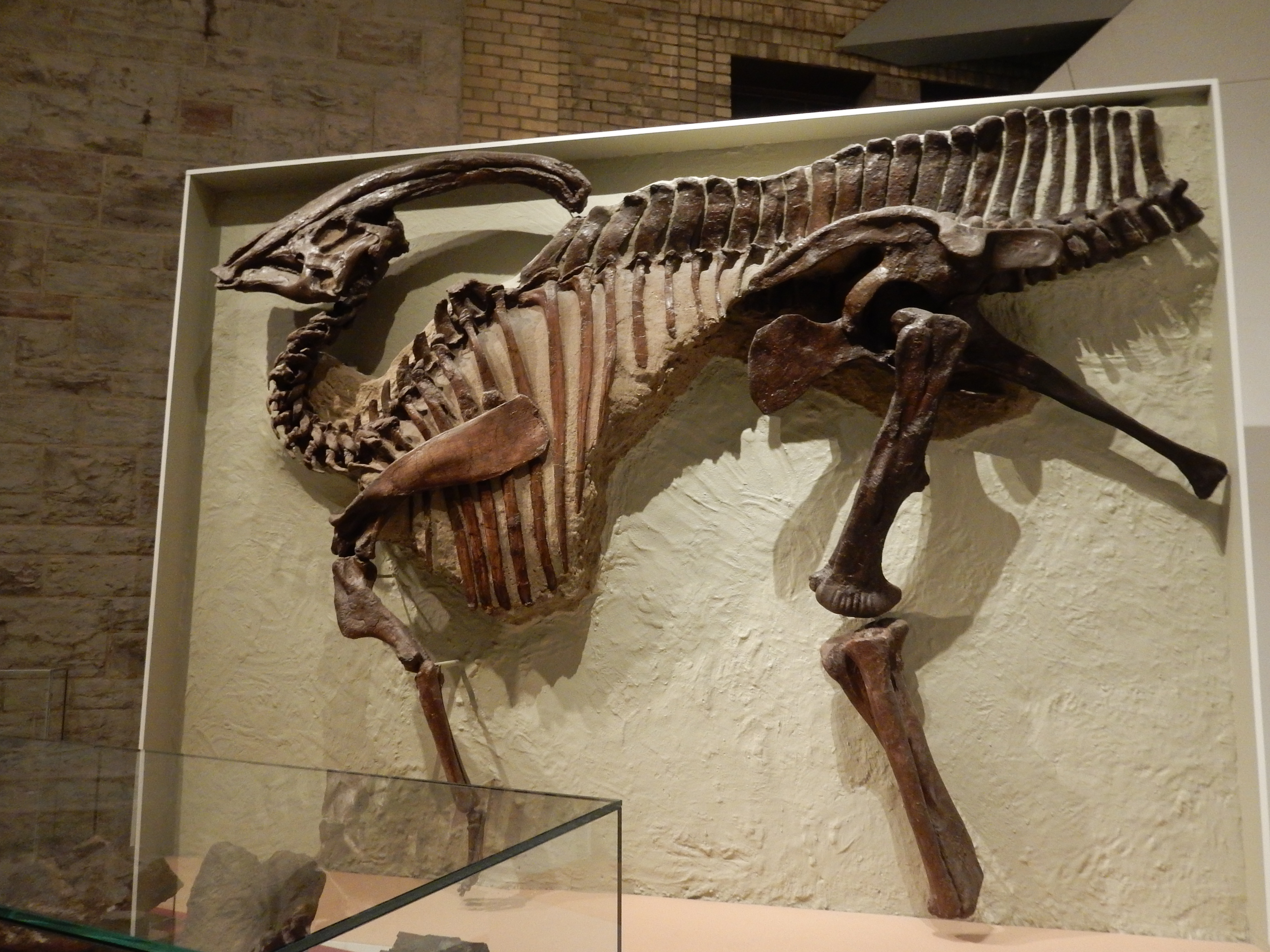
Dinosaur-wise, one of the star attractions of the ROM is the holotype specimen of Parasaurolophus.

However, the skull displayed with the Parasaurolophus holotype is a cast. To see the original skull, one has to visit the museum collections. I managed to join a behind-the-scenes tour where we got to do just that!

Parasaurolophus is not the only one here. The ROM houses holotype specimens of many hadrosaurids.

The museum is not bad when it comes to extant dinosaurs either, for it has quite a nice exhibit of taxidermied birds. This potoo caught my eye.

I'm not really a stranger to presenting at SVP anymore, but seeing some of my labmates present their first in-person SVP talks was pretty special. The last time SVP happened in person, my supervisor and one of my labmates were the only other members of our lab to attend. This time, members of the lab gave nearly half of the talks in the bird session (and our supervisor didn't even come this year)! Speaking of which, the bird talks took place on the afternoon of the last day of the conference, and my talk was one of the last talks in the session, so I'm very grateful to everyone who stuck around to attend it. I won't lie: I've grown a bit weary of presenting on my PhD research at this point, and I'm looking forward to having something fresh to talk about the next time SVP rolls around. However, the feedback I received was all very positive. Most unexpected were the comments from a young fan who came up afterward to tell me that my comics helped inspire their interest in paleontology! That's a treasured memory I won't be forgetting for a long time.

As always, there were numerous fascinating presentations at SVP. I was especially excited to see Chris Torres's talk on a nearly complete skull of Vegavis. However, perhaps the most surprising breakout stars were small(-ish) ornithischians: I thought Cary Woodruff's talk on pachycephalosaur vertebrae, Clint Boyd's talk on a new specimen of Thescelosaurus, and Zakaria Hannebaum's talk on the taphonomy of Orodromeus were all extremely interesting.

The return to in-person conferencing meant seeing friends I hadn't seen in person for a long time (or even ever). My friend John D'Angelo took the chance to show me an illustration he'd made in celebration of me passing my PhD viva. He'd sent me a scan of it before, but getting to see the original was a real treat.

One friend who I'd known online but had never met up with before was Ilari Pätilä, a paleoartist and fellow fossil bird enthusiast. To commemorate the occasion, he presented me with his wonderful depiction of an adzebill.

It was also a pleasure to meet the mysterious artist known mostly as "StygimolochSpinifer" or "Perpetualartistsblock" for the first time. I've long been a fan of his artwork, and we ended up having some great conversations. He even gifted me with one of his sketches after I completed my talk!

I had some time to kill on the day after the conference ended, so I spent the morning visiting the nearby Ripley's Aquarium of Canada with Darren Naish. Darren took many more photos than I did, but below is a picture I got of a peacock mantis shrimp. Most memorable to me were probably the lampreys; I don't remember having seen any live specimens before. Afterward, Darren and I went for a walk on the Toronto waterfront in search of urban wildlife. I particularly appreciated seeing long-tailed ducks, though we also spotted double-crested cormorants, black-capped chickadees, and other North American species that I've missed very much.

What more can I say? SVP was great, and I hope to see everyone again next year!

Wednesday, March 18, 2020

Catch a Falling Star: Meet Asteriornis!

Today marks the publication of a very exciting study that I have been waiting to talk about for a long time. Led by my supervisor Daniel Field, we describe a new species of fossil bird from the Late Cretaceous of Europe, and it's a doozy.

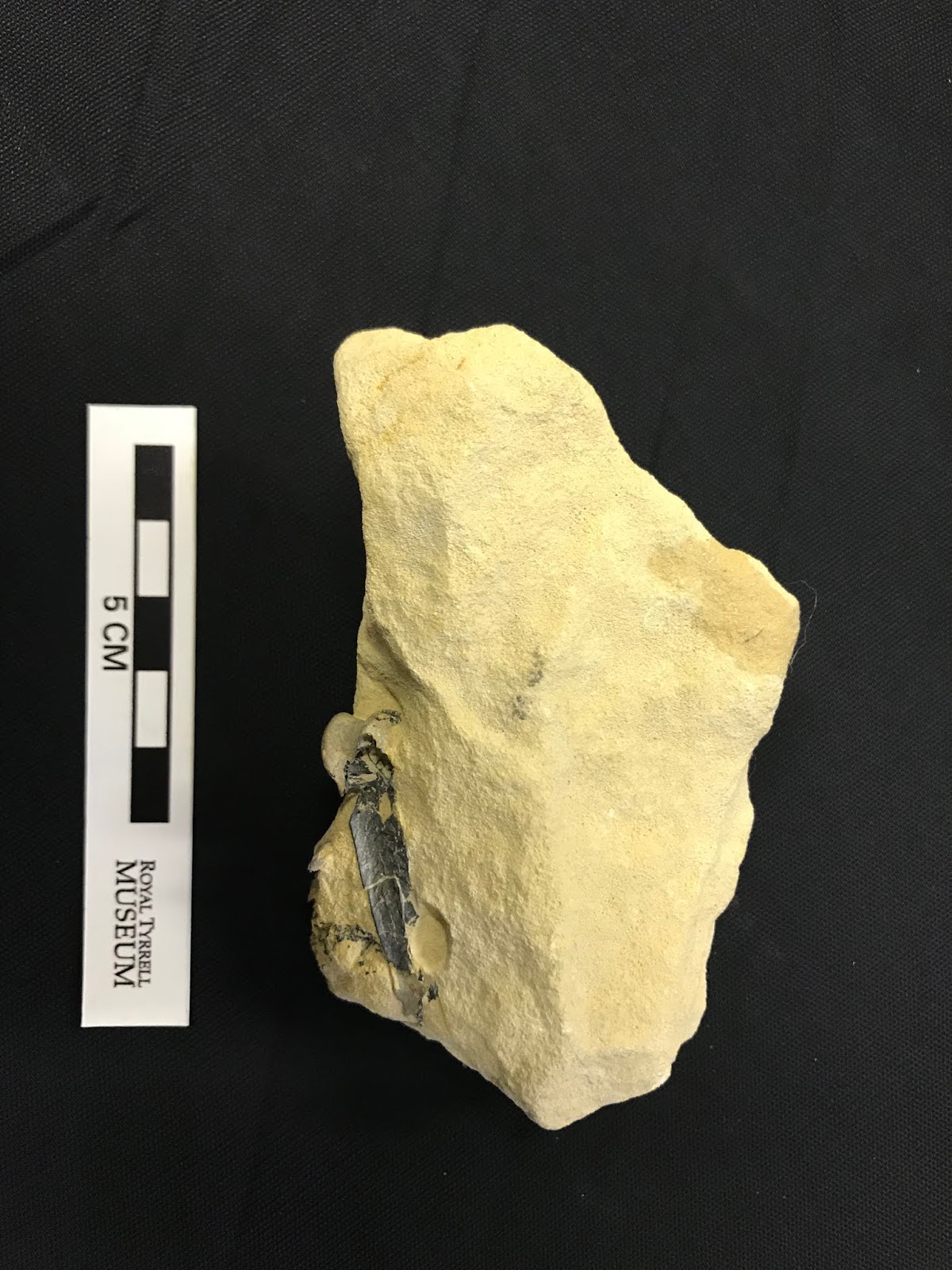
Doesn't look like much, does it? But read on... (Photo by Daniel Field.)

Among the most highly sought-after discoveries in the avian fossil record are specimens of the oldest modern-type birds. Although we now know of numerous bird-like dinosaur fossils that document the evolutionary acquisition of many notable avian features, the origin of the modern bird group (Neornithes) itself remains cryptic.

Molecular clock analyses, which use molecular sequences from different organisms and estimated mutation rates to infer the age of divergence between different lineages, place the origin of modern-type birds in the Cretaceous. For reasons that I won't go into here (lest I wander too far off topic), timing the origin of modern birds is a subject fraught with controversy. However, all recent molecular clock analyses of modern-type birds agree in placing the divergences between the three main extant avian lineages—paleognaths (ostriches, emus, and their kin), galloanserans (chickens, ducks, and their kin), and neoavians (all other living birds)—by the end of the Cretaceous. Despite this, fossil evidence for these hypothetical modern-type birds in the Cretaceous has been limited.

There have been a number of specimens purported to represent Cretaceous modern-type birds, but most of them are so fragmentary that their supposed affinities are best taken with an unhealthy serving of salt. By far the best represented (and probably the most convincing) example of a Mesozoic modern-type bird is Vegavis iaai, known from two partial skeletons from the Late Cretaceous of Antarctica. However, the skull of Vegavis is largely unknown. Furthermore, how Vegavis relates to living birds is not well understood. Although it was originally described as a close relative of modern ducks and geese, this has been questioned by some recent studies.

By the end of the Cretaceous (66 million years ago), modern-type birds had likely diverged into at least three major lineages.

In 2018, Daniel arranged a loan of a fossil bird specimen with the Maastricht Natural History Museum (Natuurhistorisch Museum Maastricht or NHMM) in the Netherlands. My labmate Juan Benito Moreno traveled to Maastricht to borrow the specimen from curator and coauthor John Jagt, who also provided us with information about the geologic setting in which the fossil had been discovered.

The specimen had been recovered from a quarry in Belgium, hailing from the Valkenburg Member of the Maastricht Formation. This site dates to 66.8-66.7 million years old, very close to the end of the Late Cretaceous (66 million years ago). Another fossil from this site had been previously described briefly as an Ichthyornis-like bird. Seeing as it preserves at least one tooth, this previously-studied specimen was certainly not a modern-type bird.

The new specimen is a very unassuming fossil, composed of four blocks of rock matrix that together take up about as much space as a deck of playing cards. In fact, the only reason we paid any attention to it was because one of the blocks (pictured at the beginning of this post) had an avian leg bone exposed on its surface. Bits and pieces of other bones were visible as well, but nothing that looked particularly exciting at a glance. Little did we know what we would find when we took a look inside.

To visualize the fossil material still hidden inside the rock, Daniel and Juan CT-scanned the specimen at the Cambridge Biotomography Centre. Shortly after they'd done so, Juan sent me a photo of what they saw inside the aforementioned block.

Holy fucking shit.

It was the nearly complete skull of a modern-type bird! Although it was distinct from any other bird skull known, we immediately noticed similarities with those of extant galloanserans. For reasons that I will explain near the end of this post, we eventually decided to give this bird the scientific name Asteriornis maastrichtensis. However, while we were in the process of studying the specimen, we called it by the nickname "Wonderchicken", for its suspected galloanseran affinities.

Due to the delicate nature of the fossil, we chose not to physically separate the bones from the surrounding rock. (For some perspective, the preserved length of that skull is less than 5 cm long, shorter than my thumb.) Instead, we spent much of 2019 digitally isolating each of the bones in the CT scans. In addition to the amazing skull, we were able to identify several wing and leg bones contained within the blocks, even though these bones were broken or incomplete.

Once we had digitally extracted the bones, we could look at them more thoroughly and make detailed comparisons with the anatomy of other birds. Here our coauthor Dan Ksepka brought his extensive experience in studying bird skeletons to bear, and we were able to confirm the presence of several features in Asteriornis that are also seen in most galloanserans. These include long, curved retroarticular processes (projections at the back of the lower jaws), narrow, upward-pointing medial processes (projections on the inside of the lower jaws), and a shallow groove along the top of the skull. In addition, the quadrate (a bone at the back of the upper jaw) of Asteriornis closely resembles that of the Paleogene waterfowl Presbyornis.

The skull of Asteriornis in multiple views. Juan spent a copious amount of time preparing the anatomical figures in our paper. This image is Extended Data Fig. 2 from Field et al. (2020).

To test our phylogenetic hypothesis and to give us a better handle on exactly what type of galloanseran Asteriornis might have been, we added Asteriornis to a modified version of the phylogenetic dataset used by Tambussi et al. (2019) in their description of the Paleocene waterfowl Conflicto. (As an aside, the last sentence in my blog post about Conflicto was intended to be an oblique reference to Asteriornis.) This dataset includes a range of extant and extinct galloanserans, and originated from Worthy et al. (2016).

The phylogenetics section of our study was my primary contribution to the description of Asteriornis. I implemented many of the changes to the dataset that we'd agreed to make, set up the phylogenetic analyses, and wrote up our phylogenetic methods and results. (Readers interested in those details are encouraged to check out our 136-page supplementary material. It contains more than just phylogenetics, but my input does take up a pretty big chunk!)

Ultimately, one of our analyses found Asteriornis to have most likely been a stem-galloanseran (more closely related to galloanserans than to any other living group, but not a member of either the landfowl or the waterfowl lineages). However, some of our other analyses found it best supported as an early stem-landfowl (more closely related to chickens than to ducks, but outside of the group uniting all modern landfowl), and we found that an early stem-waterfowl position was potentially plausible as well. This is not terribly surprising; species that retain many ancestral traits of a given group are often very difficult to confidently place on one specific branch or another. Yet regardless of exactly where Asteriornis goes in galloanseran phylogeny, no other fossil has been identified as a better representative for what the ancestral galloanseran probably looked like.

Landfowl and waterfowl have not always been widely accepted to be close relatives. Some previous authors have even provided long lists of anatomical differences between these two groups while expressing skepticism of such a relationship. Although the close ties between landfowl and waterfowl are now strongly supported by more recent studies, the distinct anatomy between the two groups has made it difficult to infer what their ancestral form was like. Asteriornis exhibits a mixture of traits from both lineages. Like landfowl, the bones in its snout are only weakly joined to each other and there is no obvious hinge at the base of its upper beak. On the other hand, its rounded, unhooked bill tip is more commonly found in waterfowl, as are the forward-pointing bony projection behind each eye socket and the hourglass-shaped depression on the top of its skull.

The skull of Asteriornis (with particular focus on the quadrate bone) compared to those of other galloanserans, including an Australian brushturkey (Alectura lathami), an... actual turkey (Meleagris gallopavo), the Eocene waterfowl Presbyornis, the Paleocene waterfowl Conflicto, a southern screamer (Chauna torquata), and a mallard (Anas platyrhynchos). This image is Extended Data Fig. 4 from Field et al. (2020).

We recovered a few additional phylogenetic results that I found especially interesting. First of all, none of our analyses found a particularly close relationship between Vegavis and waterfowl, supporting recent studies that have raised questions about its affinities. In fact, one of our analyses even found it outside of modern-type birds, though support for this result was very weak (and we are pretty skeptical of it). Secondly, in some (but not all) of our analyses, we recovered the extinct, long-legged presbyornithids as stem-waterfowl instead of their more traditional position as extinct members of the modern waterfowl group, similar to the findings of Tambussi et al. (2019). Having seen the similarities between Asteriornis and Presbyornis, I personally feel quite amenable towards the possibility that presbyornithids were stem-waterfowl.

We were also interested in adding two species of pelagornithids to our phylogenetic analyses. These large, extinct seabirds with tooth-like projections in their beaks have been suggested to have been aberrant galloanserans or close relatives thereof, but had not been included in previous versions of the dataset we used. However, our analyses did not find any consistent position for them. Resolving their evolutionary relationships will probably require a detailed study for another time.

The results of one of our phylogenetic analyses. This one recovered Asteriornis as a stem-galloanseran. This image is modified from Extended Data Fig. 9 from Field et al. (2020), and the restorations of Asteriornis were painted by Phillip Krzeminski.

Given that Asteriornis lived near the end of the Cretaceous, it provides us with a potential test of previous ideas about Cretaceous modern-type birds. Recent studies have predicted that the modern-type birds at the end of the Cretaceous were likely small-bodied, ground-dwelling animals, and that these factors may have been critical to their survival across the Cretaceous-Paleogene (K-Pg) mass extinction. To determine the body size of Asteriornis, Daniel used equations for estimating avian body mass from the width of their limb bones, and calculated its body mass at less than 400 g. That's much smaller than the average domestic duck or chicken, falling within the size range of a teal or partridge: relatively small by galloanseran standards.

As for the preferred habitat of Asteriornis, the preserved limb bones in our specimen are mostly incomplete, but enough is present to show that the hindlimbs of Asteriornis were relatively long and slender, well within the expected proportions for a ground-dwelling bird. This, along with the nearshore marine rocks that the specimen was preserved in, may even suggest that it mainly lived and foraged on the beach. Interestingly, the idea that all modern birds evolved from shore-dwelling ancestors has been put forth by other paleontologists in the past. Our current understanding of avian evolution does not support the notion that the group of living birds popularly known as "shorebirds" (Charadriiformes) gave rise to other modern birds, but Asteriornis suggests that a shorebird-like ancestral ecology may well be plausible for at least some modern bird groups.

Finding a single species of modern-type bird from near the end of the Cretaceous that fits these predictions certainly does not demonstrate that these features were widespread in end-Cretaceous modern-type birds, nor that they contributed to avian survival across the K-Pg. However, it is at least consistent with these hypotheses. Here's hoping more well-preserved modern-type bird specimens from Late Cretaceous rocks will be found that can further inform us about this subject!

Wonderful restoration of Asteriornis in what was likely its natural habitat, by Phillip Krzeminski. Two Ichthyornis-like birds squabble over a mosasaur carcass in the background.

One final takeaway from our study that I would like to highlight pertains to where Asteriornis was discovered. Some researchers have proposed that modern-type birds most likely originated in the Southern Hemisphere, largely based on the distribution of bird groups today and seemingly corroborated by the discovery of Vegavis and similar birds from the Cretaceous of Antarctica. Being from Europe, however, Asteriornis shows that modern-type birds were present in the Northern Hemisphere during the Late Cretaceous as well. This does not necessarily indicate that modern-type birds instead arose in the north, but it does warn us that the available data does not unambiguously point to a southern origin.

I promised that I would explain why we named Asteriornis the way we did. The species name, maastrichtensis, naturally reflects the Maastricht Formation in which the fossil had been found. Selecting a genus name, however, was a source of internal debate within our team for some time, until Dan Ksepka, in a stroke of genius, came up with "Asteriornis". This name translates to "Asteria's bird", after the Titaness Asteria from Greek mythology. Asteria relates to our fossil bird in three different ways: she was the goddess of falling stars (referencing the K-Pg asteroid impact that would occur shortly after the time that Asteriornis was alive), in mythology she transformed into a quail (referencing the galloanseran affinities of Asteriornis), and she threw herself into the sea to escape an amorous Zeus (referencing the preservation of Asteriornis in marine rocks).

Fossils from the Maastricht Formation have been collected and studied for over 200 years. That a remarkable find like Asteriornis had gone undiscovered for so long is testament to the fact that even well-excavated fossil sites can continue to surprise us. As for Asteriornis itself, there is still much left to learn about our Wonderchicken and we are excited to continue studying it.

Also... yeah, I suppose I've helped describe a new Mesozoic dinosaur in Nature now.

Reference: Field, D.J., J. Benito, A. Chen, J.W.M. Jagt, and D.T. Ksepka. 2020. Late Cretaceous neornithine from Europe illuminates the origins of crown birds. Nature 579: 397-401. doi: 10.1038/s41586-020-2096-0
Sunday, October 27, 2019

SVP 2019

This year's SVP was held in far-off Brisbane, Australia! (At least, "far-off" from the perspective of the usual majority contingent of North American and European delegates.) Australia has long been a bucket list location for me, so I was thrilled that I was fortunate enough to attend. This was not only my first time in Australia, but also my first time anywhere in the Southern Hemisphere.

It was amazing. Seeing all the Australian wildlife alone made the trip worth it. Before I saw a single rock pigeon in the city parks, I'd already seen seven species of birds I'd never seen previously. One of the most common, of course, was the Australian ibis (locally known as the "bin chicken"). In the background here is a maned duck, also known as the Australian wood duck due to its habit of nesting in trees, though it is not closely related to the North American wood duck.

An Australasian darter drying its wings.

I took one day away from the conference to go on a guided birding tour with my supervisor Daniel Field, my labmate Juan Benito, and fellow paleornithologist Adam Smith. As a group we saw or heard over 100 bird species, which means that I saw more bird species in three days in Australia than I have in three years of being in England.

Among the many birding hotspots we visited near Brisbane were these mangrove forests.

We saw three kingfisher species in or near the mangroves: laughing kookaburra, Torresian kingfisher, and sacred kingfisher (pictured).

A black-faced cuckooshrike. Cuckooshrikes arose from an early split within the clade Corvides, the songbirds more closely related to crows than to sparrows.

I'd been hoping to see woodswallows on the trip, and this white-breasted woodswallow granted my wish. Woodswallows are members of an Australasian radiation of songbirds called the artamids. This group also includes birds such as the Australian "magpie" and currawongs, which we also saw in Brisbane. As their name suggests, woodswallows are convergent on swallows in their ecology, catching insects by skillfully flying through the air.

I was also excited to comb-crested jacanas. We even saw a male leading three chicks around (though it was too far away for my camera).

Here's a flying tetrapod of a different sort. Flying foxes were a common sight throughout much of Brisbane, especially in flowering trees.

The highlight for me though was seeing two young powerful owls! (Daniel got a photo of one of them.) The wild koala was cool, too. Probably the only real mishap we encountered was that we got accidentally locked inside a campground after dark, but that was ultimately more of an inconvenience than anything. Also, the fact that we didn't get to see any wild frogmouths. On the whole though, I consider this year's trip to have been a great success, and I look forward to next year!

Oh, right, I was also there to attend a conference or something...

The conference itself was certainly a good time. The welcome reception took place in the Queensland Museum, where the museum staff brought out some of their live animals (used in their educational programs) for us to see. And though I didn't manage to see frogmouths in the wild on this trip, one of those education animals was a tawny frogmouth!

This wombat proved to be very popular.

In addition to the live frogmouth, there were also these taxidermied specimens on display.

The taxidermy displays in general were quite impressive. Here a barn owl is shown preying on a long-haired rat, a species whose population goes through dramatic boom-and-bust cycles.

A pair of striped possums (ecologically convergent with the Malagasy aye-aye), along with a white-lipped tree frog.

A perentie that had died trying to swallow an echidna. I first learned of this specimen from Tetrapod Zoology.

Befitting the occasion, the Queensland Museum also has a number of paleontological exhibits. Here are some paleontologists mingling near a skeletal mount of Muttaburrasaurus.

The ankylosaur Kunbarrasaurus, known from a nearly complete specimen.

Although I've presented talks at scientific conferences before, this year marks the first time I've given one at SVP. I talked about my recently published work on the phylogenetic relationships within Strisores, the nightjars, swifts, hummingbirds, and their kin. People seemed to like it, or at least everyone who mentioned it to me afterward did. As part of my presentation, I included a parody of the Twitter logo drawn as a nightjar. (I also made a turaco version for Daniel's talk and shared my existing Ichthyornis with Juan.)

As for the talks that I enjoyed, select highlights include the following:
  • Christopher Nedza's talk on changes in melanosome distribution during the decay of fish carcasses
  • Kieren Mitchell's talk on the phylogenetic position of dire wolves
  • Wang Shiying's talk on a new basal pygostylian from the Jehol Group
  • James Neenan's talk on convergent sensory ecologies between alvarezsaurs and owls
  • Patrick O'Connor's talk on an unusual avialan from the Maevarano Formation
  • Todd Green's talk on the development of bony crests in birds
  • Ian Miller's talk on how plants shaped vertebrate ecosystems during the Late Cretaceous and early Paleogene
My guide to paleocolor in dinosaurs had an unexpected presence at the meeting. Firstly, it was featured (and praised!) in Arindam Roy's talk on amniote paleocolor reconstruction. Secondly, my friend Jun-Hyeok Jang showed me a Korean dinosaur book that'd been illustrated with a multitude of entertaining cartoons, among them one that had almost certainly been inspired by my guide!
My original for comparison.

The SVP auction was fun as usual, though I was nodding off by the end of it all thanks to lingering jetlag. This year's auction theme was not any specific pop culture work, but a more generalized theme of "Australia"; thus, the hosts dressed up as kangaroos, cassowaries, and so on.

For the afterparty I'd thought that it would have been a missed opportunity not to play songs by Professor Flint, a science communicator who specializes in singing about Australian paleontology. The organizers more than met my expectations by treating us to a Professor Flint live performance! I got the sense that many attendees were somewhat perplexed by this, but songs with science-related lyrics are my jam, so I was honestly pretty delighted. In any case, Professor Flint's show was soon followed by a more conventional (at least by paleontologist standards) dance party, presumably putting the confused parties at ease. I'm not much of a partier though, so I retired for the night.

I'd enjoyed my time in Australia so much that I almost didn't want to leave, but all good things must come to an end. I do hope that I get to visit again someday. In the meantime, I did have TetZooCon to look forward to!

Hungry paleontologists/paleoartists/paleontology enthusiasts at SVP 2019 looking for food. Individuals represented are Tom Parker (Australovenator), myself (Albertonykus), Darren Naish (Eotyrannus), Jun-Hyeok Jang (Brachiosaurus), Henry Thomas (Zhejiangopterus), William Stout (Parasaurolophus), Joe Nicholson (Dinornis), and Tas (Iguanodon).