Over the past month, Meg Dickson's A Dinosaur A Day has been hosting Dinosaur March Madness to figure out the most popular dinosaurs among her readership. I took the chance to come out of hibernation intermittently to answer questions and have the Raptormaniacs characters comment on the proceedings. The commentary is included in the links below.
-Commentary on Game One.
-Commentary on Game Two.
-Commentary on Game Three.
-Commentary on Game Thirty-One.
-What does Savape's mother think of her cruelty?
-Where are all the non-theropod dinosaurs?
-What tourist destinations are there in the city?
-Does the museum have a Spinosaurus?
-Skull comments on Palaeofail's choice of favorite dromaeosaurid.
-Commentary on results of Round Three.
-Does Zahavi have a power origin story?
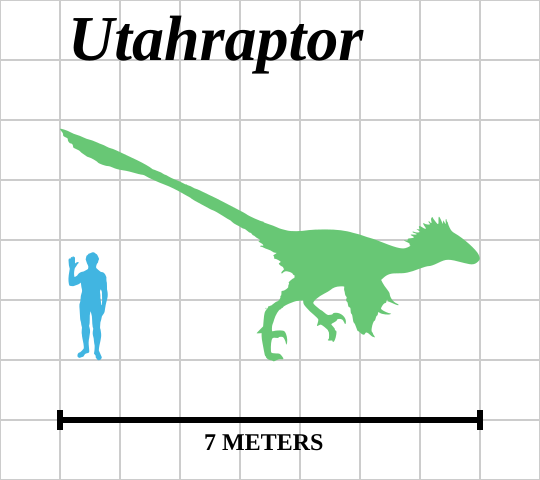
-Thoughts on Utahraptor.
-Does the museum have a Yutyrannus?
-Thoughts on Hyracotherium.
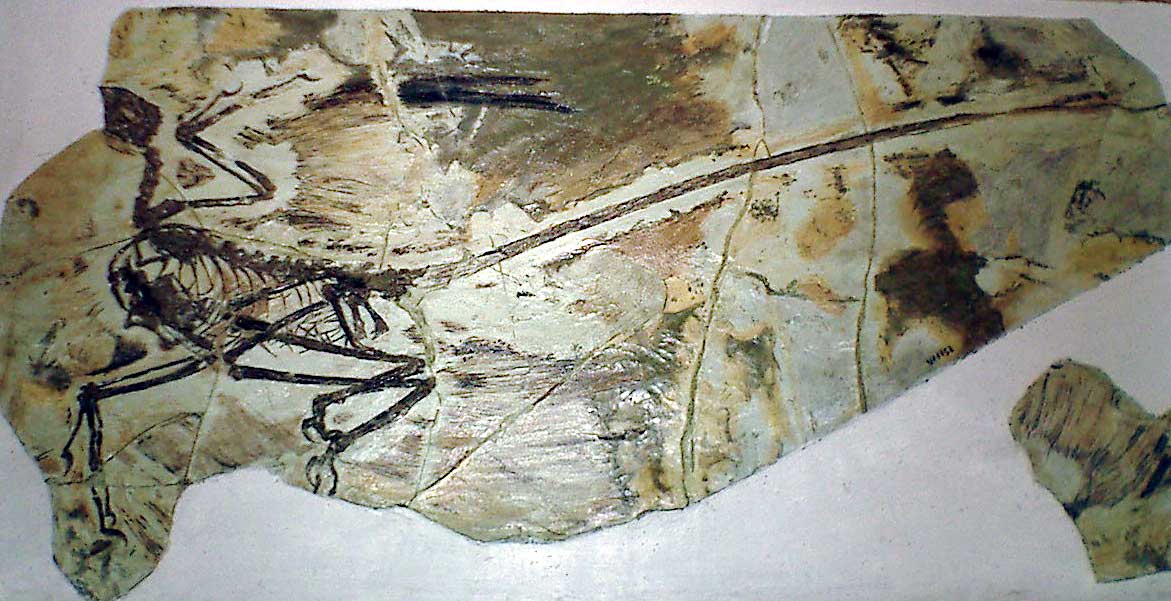
-Is there a Microraptor in the museum?
-Commentary on overall results of Dinosaur March Madness.
Showing posts with label Special presentation. Show all posts
Showing posts with label Special presentation. Show all posts
Thursday, April 7, 2016


Tuesday, March 20, 2012
Happy World Sparrow Day!
March 20 has been designated World Sparrow Day, in recognition of one of the most common, most familiar, and most ubiquitous of all known maniraptors, Passer domesticus, the house sparrow. It is a true sparrow, a passerid, as opposed to American "sparrows", which are actually buntings.
It is the most widespread of all wild birds. Its native range covers much of Eurasia, and it has been introduced to all other continents besides Antarctica. It thrives in urban regions, but it's far from being bound to cities and can survive in any environment save for tundra and dense forests.
The house sparrow is frequently maligned, particularly as an introduced species, as it is an aggressive species that takes over the nesting cavities and feeding stations of native birds, and will even kill off the young (and sometimes the adults) of its competitors.
While often considered pests, endeavors to eradicate sparrows (in this case the Eurasian tree sparrow, not the house sparrow, though closely related and very similar) in China ironically led to massive destruction of crops. Although adult tree and house sparrows feed mainly on seeds, the young are fed a diet of insects (as is often the case for many birds), and grasshoppers, major devourers of crops, are their most abundant prey.
Perhaps surprisingly, for all its adaptability and ubiquity the house sparrow is declining in many parts of the world, especially within its native range. In fact, in the Netherlands it is an endangered species! In North America the house sparrow may be an invasive pest, but as the attempted eradication of Eurasian tree sparrows in China shows, in its native environments the species is as much a key part of the local ecosystems and as deserving of conservation as any other native bird.
I'm sure Dinky here agrees, don't you?
... Dinky?

...

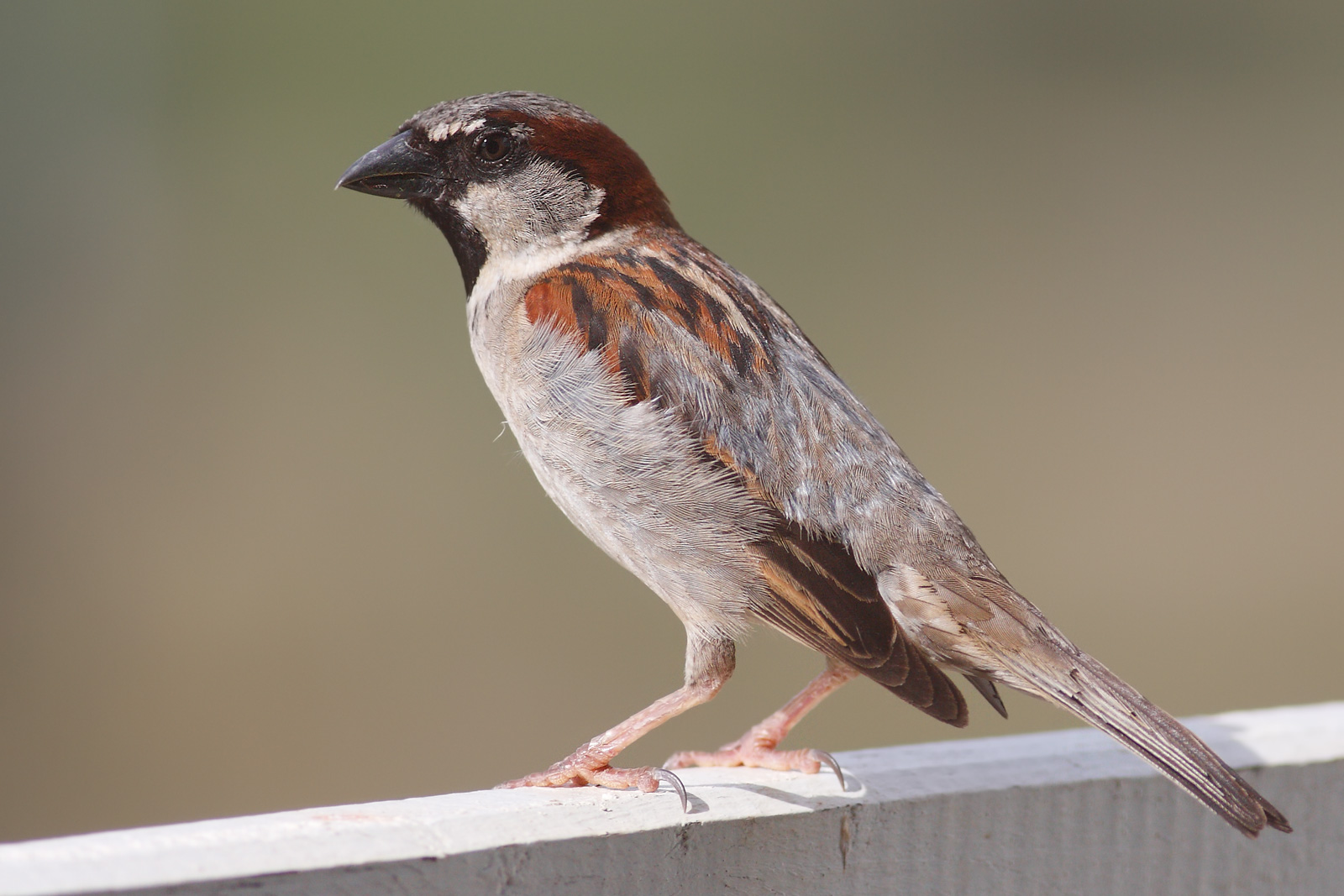 |
| Male Passer domesticus photographed by Fir0002, licensed. |
 |
| Female Passer domesticus photographed by Diliff, licensed. |
It is the most widespread of all wild birds. Its native range covers much of Eurasia, and it has been introduced to all other continents besides Antarctica. It thrives in urban regions, but it's far from being bound to cities and can survive in any environment save for tundra and dense forests.
The house sparrow is frequently maligned, particularly as an introduced species, as it is an aggressive species that takes over the nesting cavities and feeding stations of native birds, and will even kill off the young (and sometimes the adults) of its competitors.
While often considered pests, endeavors to eradicate sparrows (in this case the Eurasian tree sparrow, not the house sparrow, though closely related and very similar) in China ironically led to massive destruction of crops. Although adult tree and house sparrows feed mainly on seeds, the young are fed a diet of insects (as is often the case for many birds), and grasshoppers, major devourers of crops, are their most abundant prey.
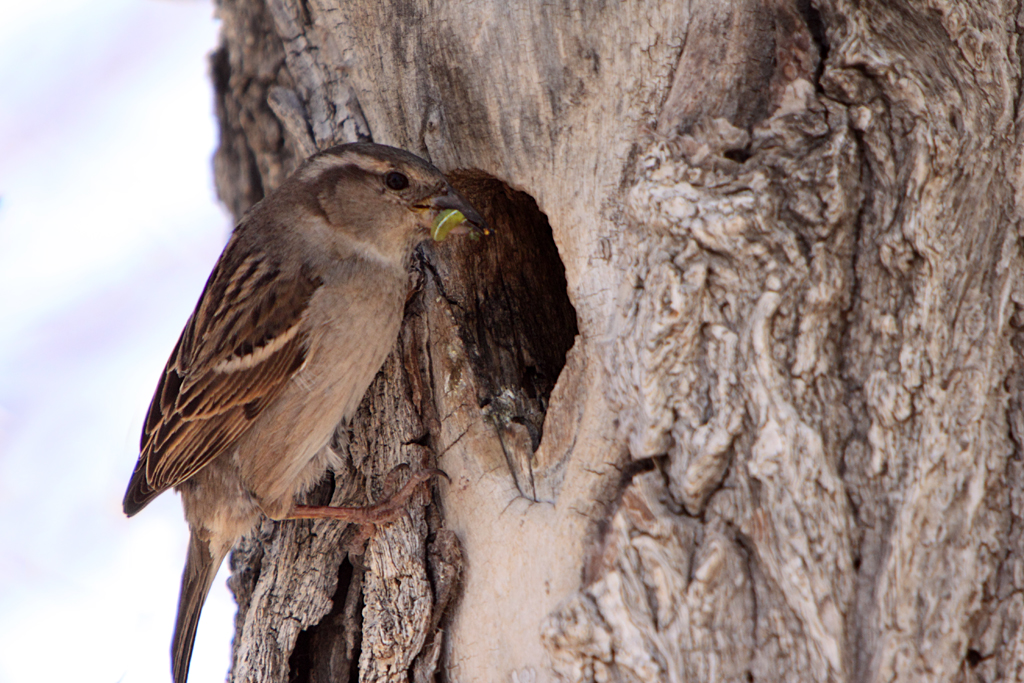 |
| Female Passer domesticus feeding young with a caterpillar photographed by Alan Vernon, licensed. |
Perhaps surprisingly, for all its adaptability and ubiquity the house sparrow is declining in many parts of the world, especially within its native range. In fact, in the Netherlands it is an endangered species! In North America the house sparrow may be an invasive pest, but as the attempted eradication of Eurasian tree sparrows in China shows, in its native environments the species is as much a key part of the local ecosystems and as deserving of conservation as any other native bird.
I'm sure Dinky here agrees, don't you?
... Dinky?

...

Saturday, October 1, 2011
150 Years of Archaeopteryx
This year marks the 150th anniversary for the description of the iconic "first bird" (or not) Archaeopteryx.
First, a quick diversion. Filled with anachronisms and Misplaced Wildlife, but very catchy. Points for getting the term "Maniraptora" into a children's song!
Naturally, I've prepared a special presentation for this special occasion, this time brought to you by resident Archaeopteryx Savape! Eh... so I really have to do this, don't I? I would argue that this is the equivalent of grabbing a human passing by on the street on the such and such anniversary of the description of Homo sapiens and asking it to talk all about the research done on its own species. But part of the joy of being a fictional character is that you come with all the knowledge your creator wishes to grant you, so I might as well proceed. You all know the story. A fossilized feather was unearthed in the Solnhofen Plattenkalk in Germany, described in 1861, and named Archaeopteryx lithographica
A couple of years later an actual skeleton of Archaeopteryx was described. It was preserved with feathers, so it was assumed that this was the type of animal the original feather belonged to, but this is less certain now. First feathered fossil to be discovered! Eat it, Yixian. These days they call this specimen the London Specimen. They really like to keep track of us Archaeopteryx specimens, and all published specimens have been given nicknames like that. These specimens are actually named after the museums they're held at and have nothing to do with where they were discovered. Names like Solnhofen Specimen I and Solnhofen Specimen II just don't stick. (One specimen is called the Solnhofen Specimen, actually. You'll see it later, if nothing has happened to it.)
The specimen that gets all the publicity though is the Berlin Specimen. This is the one you see depicted everywhere. Notice in this historical photo that the specimen preserves nice leg feathers and some long body feathers, but those were destroyed during prep. You never see those in modern photos of the specimen, nor in some of the more mediocre Archaeopteryx depictions.
As is quite common in paleontology, new names were given to new Archaeopteryx specimens left and right. Names like "Jurapteryx", "Archaeornis", Archaeopteryx "bavarica", Archaeopteryx "macrura", and others that almost no one uses anymore. One that you might still see occasionally is Wellnhoferia, and this is the Solnhofen Specimen mentioned earlier. For most part though, the only Archaeopteryx species still commonly in use is the original Archaeopteryx lithographica.
Because Archaeopteryx was the first Mesozoic maniraptor fossil found with feathers, we played a big part in early studies on the evolution of birds. It was noted early on that we had many theropod dinosaur characteristics, and famously in the 1970s Dr. John Ostrom compared the skeletal features of Archaeopteryx and other theropods, providing evidence that birds are theropod dinosaurs.
Due to these significant impacts, Archaeopteryx is often thought of as a "special" fossil, a creature with both "reptile" and "bird" characteristics that shows how modern birds evolved. This concept has led to some awful, awful restorations that depict us as looking something like weird lizard-bird hybrids. But now in 2011, we really aren't that special anymore. It's now known that a lot of other maniraptors (including even things like Velociraptor) had the exact same combination of "reptilian" and "avian" features (feathers, wings, teeth, wing claws, long tail) that we do. As far as Mesozoic paravians go, we're really quite generic, not unusual looking at all. If it had been something like Sinornithosaurus, Microraptor, or Caudipteryx that had been discovered back in the 1800s, they'd have received the same special treatment we do today. But too late for them now.
Even our traditionally held "first bird" status is no longer ours. Mind you, as far as known maniraptors go, 150 million years ago in the Late Jurassic is still quite old. But other paravians (including some probable avialians), such as scansoriopterygids, Pedopenna, Anchiornis, and Xiaotingia, are now known from even older parts of the Late Jurassic. As Archaeopteryx was known to have had feathers early on, when no feathered non-bird dinosaur fossils were known, it was assumed that we must have been avialians (i.e.: closer to modern birds than other types of theropods are). Up until recently, this was still widely considered to be true. But several recent analyses have suggested that we may actually be non-eumaniraptor paravians or even deinonychosaurs. It's worth saying that the latter result in particular only has weak statistic support, but suffice it to say that you guys really don't have any good idea what exactly type of basal paravian we are. Me, I'll enjoy observing the chaos in the next few years. Such confusion is only to be expected. As I hinted earlier, we don't really have that many modern bird traits, at least not much more than definite deinonychosaurs do. Study of one of the latest described Archaeopteryx specimens, the Thermopolis Specimen, even shows that we have a retractable second toe and a barely reversed first toe (contrary to the way many specimens are preserved), similar to definite deinonychosaurs but unlike modern birds. Studies of our forelimb motion and wing feathers suggest that there isn't even any evidence that we were any better at flying than were small definite deinonychosaurs such as Microraptor!
Other recent research has been done on Archaeopteryx, There have been studies of our brain structure, showing that we have a good sense of balance and spatial perception, which makes sense for small gliding and clambering animals like ourselves. Studies of our growth show that we grew slower than modern birds (similar to most other Mesozoic dinosaurs, including many other Mesozoic birds). There has even been study of the possible size and shape of our eyeballs that reveal we were active during the day (like many modern birds but unlike many deinonychosaurs). So there you have it. Archaeopteryx is one of the most significant dinosaur discoveries and has a long, rich history and continues to be studied blah blah blah. Not bad for a pigeon-sized protobird if I say so myself. Last but not least, I must leave a token of my appreciation for the Acme Museum, which has provided me with this wonderful opportunity and put me up to this arduous chore. 

First, a quick diversion. Filled with anachronisms and Misplaced Wildlife, but very catchy. Points for getting the term "Maniraptora" into a children's song!
Naturally, I've prepared a special presentation for this special occasion, this time brought to you by resident Archaeopteryx Savape!

 |
| The feather, photographed by H. Raab, from Wikipedia. |
 |
| The London Specimen, photographed by H. Zell, from Wikipedia. |
 |
| Historical photo of the Berlin Specimen from Vogt, 1880. |
 |
| Wellnhoferia, or the Solnhofen Specimen, photographed by H. Raab, from Wikipedia. |
 |
| Comparison between the hands of the dromaeosaurid Deinonychus (left) and Archaeopteryx (right) by John Conway, from Wikipedia. Not to scale. |
 |
| Modern restoration of Velociraptor by Matt Martyniuk. |
 |
| The Thermopolis Specimen, photographed by "incidencematrix", from Wikipedia. |


Friday, April 1, 2011
A New Method for Inferring the Integument of Extinct Maniraptors
A New and Extremely Inaccurate Method for Inferring the Integument of Extinct Maniraptors
By Alberta Claw and I. M. A. Troll
Email: albertonykus@gmail.com, internettroll@gmail.com
ABSTRACT
Since the description of Sinosauropteryx, a non-avian dinosaur preserved with filamentous feathers, in 1996, there has been a tendency in popular culture for professionals and dinosaur enthusiasts alike to insist on adding feathers to reconstructions of coelurosaurian dinosaurs. They have used subsequent findings of feathered dinosaurs since then to support this notion. In this paper we present a new method for inferring the integument of these dinosaurs and coin a name for this method, SRC (Spewing Random Crap). We also use this method to demonstrate that most non-avian maniraptors didn’t actually have feathers.
KEYWORDS
Maniraptors, feathers, scales, Jurassic Park, random crap, trolling
Introduction
The earliest reconstruction of a feathered non-avian dinosaur was that of a “Syntarsus” (now Megapnosaurus) by Sarah Landry, featured in Robert Bakker’s 1975 article The Dinosaur Renaissance, which we will not cite because neither of us has actually read it. Other early feathered dinosaur restorations were painted by Gregory Paul and Luis Rey, while Bakker also illustrated feathered Deinonychus in his book The Dinosaur Heresies, but we’re not going to cite that either because we’re mad that they turned out to be right.
In 1987, the first direct evidence of feathered non-avian dinosaurs was published in the form of a feather attachment surface found on the forelimb of the oviraptorosaur Avimimus, while in 1996 actual fossilized filamentous feathers were described in the description of the compsognathid Sinosauropteryx. Since then, feathers have been found associated with other non-avian coelurosaurs, such as the compsognathids Juravenator and Sinocalliopteryx and the tyrannosauroid Dilong. Among non-avian maniraptors, feathers have been found associated with the therizinosaur Beipiaosaurus, the alvarezsauroid Shuvuuia, the oviraptorosaurs Protarchaeopteryx, Caudipteryx, and Similicaudipteryx, the raptors deinonychosaurs Sinornithosaurus, Microraptor, Jinfengopteryx, and Anchiornis, and the indeterminate maniraptoran Yixianosaurus, while feather attachment surfaces have been found on the arm or tail bones of the deinonychosaurs Rahonavis and Velociraptor and the oviraptorosaur Nomingia. Almost all preserved maniraptor skin or skin impressions show feathers, while scales are have only been found on limited parts of the body such as the toes, the fingers, or the underside of the tail.
Using certain methods, such as phylogenetic bracketing, which we will ignore in this paper because we haven’t actually bothered to find out how they work, others have determined that it is most parsimonious to suppose that all non-avian maniraptors had feathers, and it is now typical for scientific artists to reconstruct them as such (Fig. 1). This is perfectly logical, but because we don’t think logically we will disregard all that evidence in this paper. The new method that we will introduce here is one that has been used by Internet trolls and stuck-up fanboys all over the World Wide Web, but has regretfully been overlooked by most mainstream scientists.

Figure 1. Scientifically accurate reconstruction of the raptor deinonychosaur Microraptor zhaoianus by Matt Martyniuk.
Materials and Methods
In this paper we will coin a new technical term for the new method utilized in this study, Spewing Random Crap (SRC). SRC is best utilized after one ignores all current evidence that contradicts their position, making it a highly biased objective and useful tool for pseudoscience. This method has been frequently used on the Internet, but, to the best of our knowledge, hasn’t appeared in many major publications until now. SRC consists mostly of committing numerous arbitrary logical and scientific fallacies in attempt to support one’s position and has been proven to be very effective at making the speaker look like a fool. SRC is an extension of the scientific method most commonly used by bad science and high school students, This Is The Conclusion, What Evidence* Can We Find To Support It? (TITCWECWFTSI).
Neither of us has actually studied any maniraptor fossils in person, but we (falsely) believe that we have gleaned enough information from unreliable Internet sources for us to apply SRC to the question of whether extinct maniraptors had feathers. We did so by making a list of arbitrary arguments we thought would not support the notion of feathered maniraptors without considering whether these arguments were accurate, logical, or even relevant. In this paper we shall refer to these arguments as Random Craps (RCs). Afterwards, we compared our results to a reliable source in an attempt to falsify our conclusions.
Specimens Examined
None. Not even photographs.
Results
Contrary to this paper, there’s good evidence that feathers were extensive and widespread among maniraptors (as mentioned in the introduction), and there’s no evidence at all any maniraptor lacked feathers, but, as a prerequisite to the use of SRC, we ignored the obvious conclusion that should have been drawn from that (i.e.: all maniraptors had feathers to some degree). After an hour or so or some other imprecise time interval of desperate thinking, we came up with the following list of RCs.
There is absolutely no evidence that maniraptors had feathers.
This completely contradicts our own introduction, but as the introduction was the only part of this paper for which we actually did any significant research and SRC requires ignorance of all contrary evidence, it was the first RC we were able to come up with.
Non-avian maniraptors with feathers preserved have only been found in Asia, so maniraptors found elsewhere wouldn’t have had feathers.
In reality, this is because soft tissue doesn’t fossilize well anyway and can only be preserved under special conditions that happened to be present in parts of Asia, but we overlooked that. And obviously if we really thought that this was the case we would argue that we shouldn’t reconstruct dinosaurs with eyeballs because eyeballs aren’t usually preserved in the fossil record. Also, by this argument we should also argue that elephant birds (from Madagascar) and terror birds (from the Americas) didn’t have feathers. But we’ll completely ignore that for no reason whatsoever, making this a classic example of an RC.
Maniraptor feathers were useless, so they lost them.
Translation: We couldn’t think of any reason non-avian maniraptors would need feathers, even though if we actually read through the relevant literature we’d know that many plausible functions for feathers have already been proposed.
Feathers are hard to maintain, which would’ve been difficult for non-avian maniraptors to do.
Modern birds can manage just fine, of course, but for no reason at all we assume that other maniraptors couldn’t. Our minds work in bizarre ways.
Saying all maniraptors had feathers is like saying all mammals have lion manes.
Hold on a second. A lion’s mane is a specialized display structure, not a universal characteristic (as the presence of integument usually is). Saying all maniraptors had feathers would be more akin to saying all mammals have hair, which happens to be correct. However, using bad analogies is our specialty. Bad analogies for the win!!!!1!1!1!111eleventy one!**
Maniraptors don’t look scary with feathers.
Duh! Of course, neither of us has actually experienced being nearly disemboweled by a cassowary or chased by a homicidal goose. We find it blindingly obvious that the appearances of living things that lived millions of years ago are directly controlled by personal perceptions of the two of us. Somehow, this counts as a scientific argument, except it doesn’t.
Through these RCs, we predicted that extinct maniraptors didn’t have feathers. We tried to falsify this prediction by watching the movie Jurassic Park about ten times (or maybe eleven times) as a test case. In this movie, the non-avian maniraptor “Velociraptor” (actually Deinonychus, due to the movie using taxonomy proposed by Gregory Paul***) features heavily. In none of these ten (or eleven) viewings did either of us notice any feathered “Velociraptor”. Therefore, we must conclude that our prediction was correct.
Discussion
We suggest that our RCs adequately show that extinct maniraptors didn’t have feathers. This is supported by the “Velociraptor” in Jurassic Park, even though that hardly represents what a living maniraptor looked like, and that movie was made before any non-avian dinosaurs preserved with actual feathers were discovered anyway. We could’ve come up with ten thousand more RCs, each more ridiculous than the last, but we wanted to play video games instead. We also suggest that extinct maniraptors had scales in place of feathers, because things that don’t have feathers obviously always have scales. We highly recommend that, in the future, reconstructions of maniraptors should make them completely scaly as they have always been (Fig. 2).**** We find that the SRC method is a useful method that can be applied to other fringe pseudoscientific problems, and in future publications we’ll use SRC to investigate other strongly-debated scientific concepts, except they aren’t strongly debated at all by mainstream scientists and are only “questioned” by Internet trolls (i.e.: the authors of this paper).
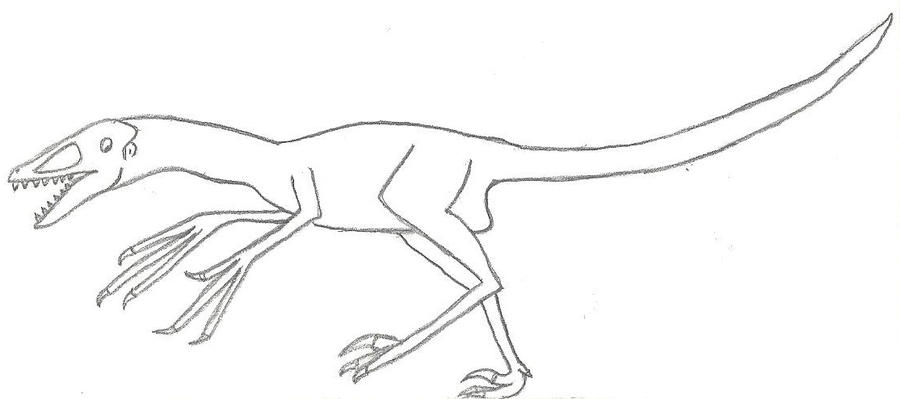
Figure 2. Pseudoscientific reconstruction of the raptor deinonychosaur Microraptor zhaoianus based on SRC by Albertonykus.
Conclusion
We have no clue what we are talking about, although we are very skilled at spouting pseudoscientific mumbo jumbo. This paper fails.
Acknowledgements
Special thanks to two anonymous reviewers who somehow slipped us past peer review, because we definitely couldn’t have made it otherwise. Also thanks to all the random trolls on the Internet for giving us ideas for RCs.
References
We intentionally forgot all our references either because they contradict us or because they’re too unreliable to begin with. If we actually included any references, people could look them up and see that they’ve already been rebutted ten thousand times by others (including in our own paper), so we won’t give them that pleasure.
Note from editor: This paper actually didn’t get past peer review, but we thought it would be instructive to include it.
Last minute note from senior editor: Don’t feed the trolls.
Saturday, April 10, 2010
And Now, a (Very?) Special Presentation...
I started this blog under the premise that everyone knew what a maniraptor was. While I'm quite confident that this is true as far as the people who usually read my blog are concerned, I can't guarantee it. Which is why I now present a (very?) special presentation, brought to you by resident fossil cast of the skull of Tsaagan mangas, Skull!

Greetings! I am Skull, a fossil cast of the skull of the deinonychosaurian maniraptor Tsaagan mangas. That happens to be the only part of Tsaagan mangas known to science aside from a few connected neck vertebrae. But I digress. Albertonykus has enlisted my help in providing a thorough and hopefully comprehensive intro of the group of dinosaurs known as the maniraptors to which this blog slash web comic is dedicated.
What is a maniraptor? As the header of the blog should imply, a maniraptor is any member of the most inclusive clade containing Passer domesticus but not Ornithomimus edmontonicus, but that may be somewhat difficult to understand for some. What it means is that, to qualify as a maniraptor, a creature must share a common ancestor (which would itself be a maniraptor) with a house sparrow that is more recent than the one they share with the Ornithomimus edmonticus. (The house sparrow itself, of course, is also a maniraptor, because it's "closer" to itself than to Ornithomimus edmonticus. That sounds paradoxical, but never mind; it should be understandable enough.)
That's all very well for the definition of "maniraptor", but how do you recognize a maniraptor when you see one? I direct you to the cladogram below (by Dr. Thomas Holtz; used with permission). Find "Maniraptora" circled in blue.
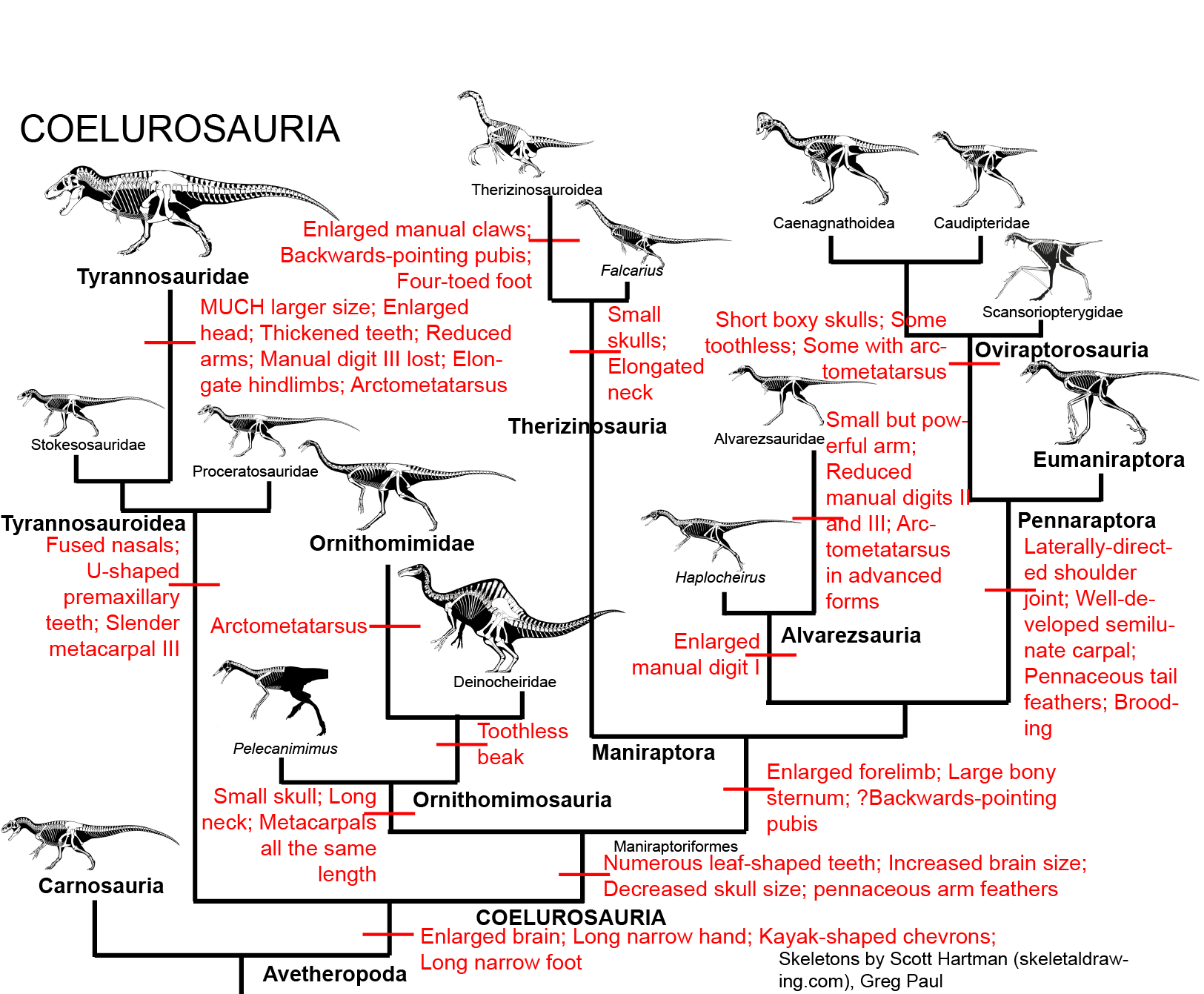
We maniraptors share with each other enlarged forelimbs, large bony sternums (breast bones), and well-developed semilunate carpals (a special bone in the wrist that allows maniraptors to tuck their forelimbs up against our bodies). We might also count backwards-pointing pubes (that's the plural of pubis, which is a hip bone), but, as you'll see in a moment, that story is complicated. Many maniraptors have backwards-pointing pubes, but it's not certain if we all inherited them from our original maniraptor ancestor. Either way, our long folding arms are useful for catching prey and also for keeping our feathers off the ground, preventing them from being soiled. You see, all us maniraptors have feathers, or at least protofeather fuzz, which is a trait we share with the rest of the Coelurosauria (a group that includes compsognathids, tyrannosauroids, ornithomimosaurs, and us; see the cladogram). Another thing special about us is that nearly all of us aren't hunters of big dinosaurs. Many of us eat plants, invertebrates, small vertebrates, or all three. Perhaps I shouldn't have said "us", because the main exception to this among the maniraptors is... well, I'll get to that later.
Enough is known about most maniraptors to split us into several groups, which I'll introduce one by one.
Therizinosaurs
Ebeff the Therizinosaurus cheloniformis is one of these. Therizinosaurs are really freaky-looking dinosaurs, what with their tiny heads on their long necks and gigantic claws on their hands! They are definitely plant eaters, because they are most likely too ponderous and slow to catch other animals, although their large claws would have made nice defensive weapons. Most therizinosaurs we know have backwards-pointing pubes and probably cheeks, both of which are features of other (unrelated) plant-eating dinosaurs. Both of these characteristics help therizinosaurs get the most out of their vegetarian diet: backwards-pointing pubes give them more room for bigger and longer guts (which house micro organisms for digesting plant matter), and cheeks help them retain food in the mouth so it doesn't slop everywhere and go to waste! However, the most basal therizinosaur known from complete remains, Falcarius utahensis, has a forward-pointing pubis and seems to be a decent runner, so it is probably more omnivorous than its derived relatives. As far as their plumage is concerned, therizinosaurs don't have the modern-style true feathers of today's birds. They have long shaggy protofeathers as well as a type of feather probably unique to them called EBFFs, or Elongated Broad Filamentous Feathers. EBFFs resemble porcupine quills and may have a display function. Most known therizinosaurs come from the Cretaceous, but phylogenetic bracketing tells us their origins lie back in the Jurassic. Indeed, an ambiguous lower jaw bone, given the name Eshanosaurus deguchiianus, appears to be that of a really old therizinosaur. Therizinosaurs are sheep- to Tyrannosaurus-rex-sized, making Therizinosaurus cheloniformis the largest known maniraptor.
Alvarezsauroids
This group has always been fairly strange. For one thing, no one really had any idea what they were! The first specimens were thought to be flightless avialians (more on those later), and later it was suggested that they may be more basal maniraptors or related to the ornithomimosaurs (ostrich dinos). But at the beginning of this year the basal alvarezsauroid Haplocheirus sollers was found (back in the Jurassic!), and we now know a good deal more about the history of this group. For a start, they do appear to maniraptors. They started out looking like typical generalist maniraptors with three-fingered hands, long arms, small teeth suitable to an omnivorous diet, and long legs. However, derived alvarezsauroids, the alvarezsaurids, have very short arms and are smaller in body size than their ancestors. Their third and second fingers are tiny and clawless, but they retain a big thumb claw. In spite of their length, those arms are very powerful, and it's been speculated that alvarezsaurids use them to pound into rotting wood and insect nests in search of food. Alvarezsaurids (especially the members of the alvarezsaurid group Parvicursorinae) are very good runners with their long, thin lower legs, and they have weakly backward-pointing pubes. So far, we don't really know what alvarezsauroid plumage was like, because there aren't any good fossils of alvarezsauroids that preserve integument. (To be fair, there's a specimen of Shuvuuia deserti that comes with very badly preserved protofeathers - can't really blame it though, it happened to live in a place that didn't preserve soft tissues well, in contrast to the creatures that wound up on lakebeds in the Yixian.) Alvarezsauroids are typically quite small. Even the larger basal ones are no more than three meters long.
Oviraptorosaurs
Remex the Caudipteryx zoui is one of these. Many of you probably know how the oviraptorosaur Oviraptor philoceratops was discovered on a nest of eggs, earning it a name that means "egg thief, fond of horned dinosaurs", but was later found to have been brooding its own nest. We don't know if earlier maniraptors like alvarezsauroids and therizinosaurs brood, but we know that oviraptorosaurs definitely do. Also, oviraptorosaurs definitely have true feathers. They have their true feathers on the wings and tail. However, oviraptorosaurs can't fly, so what are their feathers for? They can help oviraptorosaurs cover their nests better in the aforementioned brooding behavior. Oviraptorosaurs may also use their feathers for showing off. Caudipteryx zoui, for example, waves little hand flags around - its wing feathers are concentrated on the second finger, while there aren't any true feathers on its arms! Feathers probably aid small oviraptorosaurs in a behavior called WAIR, short for Wing-Assisted Incline Running. By flapping their wings back and forth, small oviraptorosaurs can run up the sides of trees and escape from predators. Basal oviraptorosaurs have a few small teeth, and they eat plants or insects. Derived oviraptorosaurs, however, have no teeth at all, just keratinous beaks. They are most likely omnivores or predators of small vertebrates, as lizards have been found as their stomach contents and remains of smaller maniraptors have been found near their nests, possibly signifying the leftovers of eaten prey. (And, of course, just because they don't cannibalize their own eggs doesn't mean oviraptorosaurs can't eat the eggs of other animals.) Oviraptorosaurs have forward-pointing pubes, and many have adaptations to fast running such as long legs and pinched feet. Oviraptorosaurs range from turkey-sized to as large as the tyrannosauroid Albertosaurus sarcophagus.
Henceforth, all other maniraptors belong to the group Eumaniraptora. Eumaniraptors include deinonychosaurs and avialians, and all the characters (well, almost all) in this web comic were eumaniraptors before Remex and Ebeff showed up. This calls for a more detailed cladogram (again, by Dr. Thomas Holtz; also used with permission).
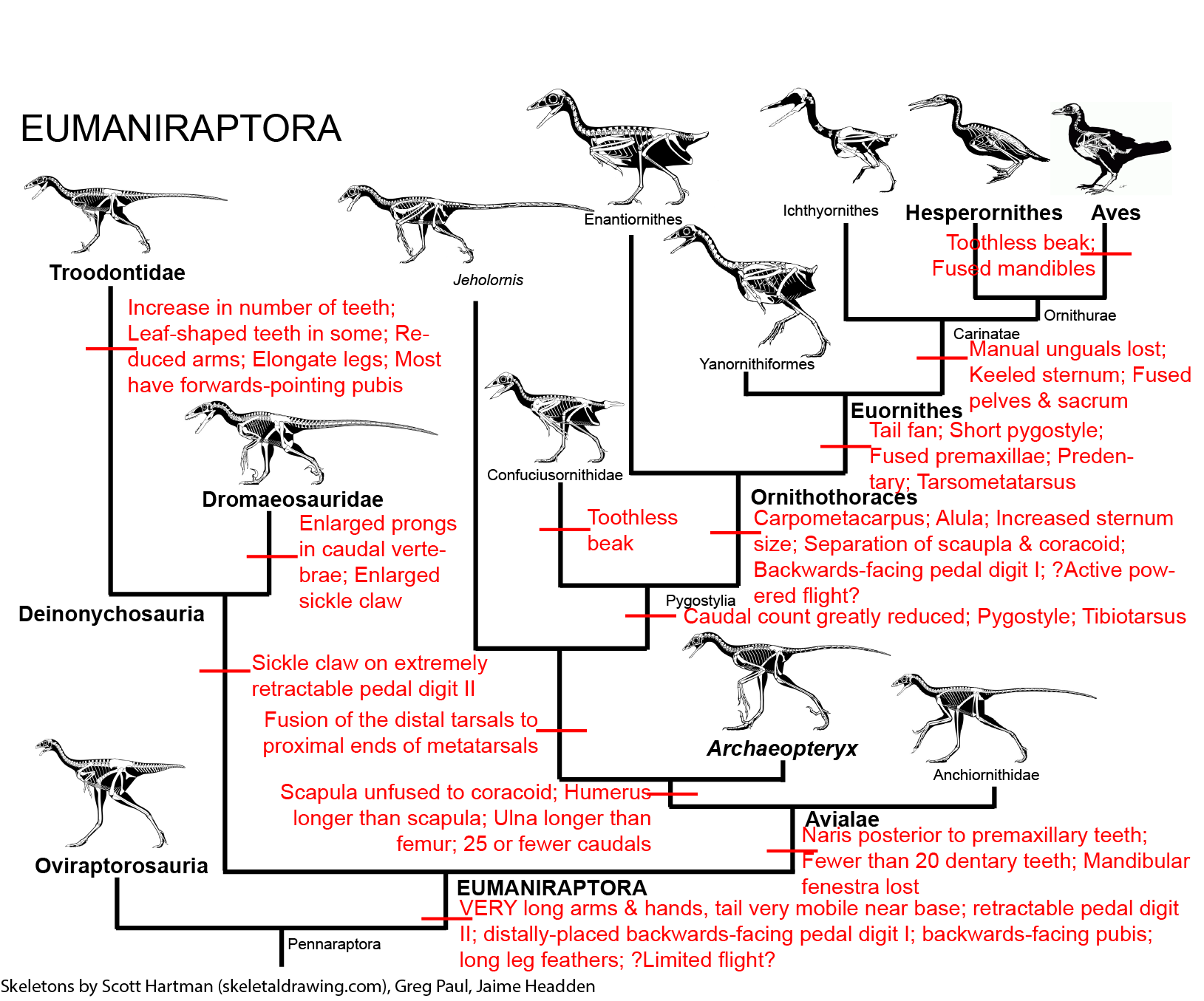
Us eumaniraptors have a first toe placed low on the foot and a retractable second toe we hold off the ground usually when walking. This keeps the second claw nice and sharp, which might be good for climbing (up trees, but some of us began climbing other things later on). (Modern birds don't have retractable toes anymore and instead grab things with a reversed first toe.) We also tend to have backwards-pointing pubes, which might be a result of our knee-driven running. Like oviraptorosaurs, we eumaniraptors have true feathers on the wings and tail, and we use them for similar purposes. However, we also have true feathers on the legs, too (ancestrally, anyways; some of us, again including modern birds, have lost that feature). Furthermore, we can actually fly! It's been suggested that those of us who can't (such as me... well, the species I was modeled after, really) are what is called secondarily flightless, which means we are flightless animals with flighted ancestors with flightless ancestors. The same thing is true of flightless modern birds and many well-known deinonychosaurs... which is the cue for another intro.
Deinonychosaurs
I'm a deinonychosaur, and so are Ostrom the Deinonychus antirrhopus and Zahavi the Jinfengopteryx elegans. The public knows our group quite well as "raptors", especially the members of Dromaeosauridae, which include both me and Ostrom. (Zahavi belongs to the Troodontidae, but you can worry about that later.) The public is more familiar with "typical" dromaeosaurids such as Deinonychus antirrhopus or me (or more likely my close relative Velociraptor mongoliensis, really), but the thing is we are far from being typical eumaniraptors! We can't fly, for example. Also, we attack and eat prey comparable in size to or larger than ourselves, which is something (most) other maniraptors don't do! (It's been suggested that at least some of us did this in groups, no less.) That means we may not be just secondarily flightless, but secondarily carnivorous as well! (As maniraptors belong to the coelurosaurs. Coelurosaurs were ancestrally carnivorous, as evidenced by meat-eating tyrannosauroids and compsognathids.) Some of us "typical" dromaeosaurids have grown so big (like Utahraptor ostrommaysorum) that they can no longer climb trees and use their retractable claws to climb up big plant eaters instead! Other dromaeosaurids can generally still fly and are much smaller than we are, but one group, the unenlagiines, largely returned to the ground after reaching (possibly flying) to the southern hemisphere and diversifying. Unenlagiines have long narrow snouts, so they probably eat fish and other small animals. At least one unenlagiine, Austroraptor cabazai, is nearly as large as Utahraptor ostrommaysorum.
The other main branch of the Deinonychosauria, the Troodontidae, are generally smaller (pigeon- to wolf-size) and faster than us. (Yes, sadly, in spite of media portrayals and the genus name of Velociraptor mongoliensis meaning "fast thief", we "typical" dromaeosaurids are a lot less built for running than troodonts, oviraptorosaurs, alvarezsauroids, or even our own ancestors, the basal dromaeosaurids!) Troodonts might have abandoned flight early on (even the most basal known troodont, Anchiornis huxleyi, shows signs of losing aerial capacity) and they usually have rather short arms. Their teeth are small and serrationless, so their dietry habits are more like that of other maniraptors: plants and small-bodied animals. (Jinfengopteryx elegans, for example, preserves seeds in its stomach.) Finally, the most derived troodonts have pubes that point forward rather than backwards like the rest of us. (That makes their pubes secondarily forward pointing!)
Avialians
Savape the Archaeopteryx lithographica and Dinky the house sparrow are both avialians. And so we come to the last major group of maniraptors. When people say birds, they usually refer to this maniraptor group. All modern birds belong to a group of avialians called the neornithines, but there are many kinds of Mesozoic avialians, many of them quite different from modern ones. The most basal avialians known are the tiny Jurassic scansoriopterygids, which are extremely weird with their elongated third fingers and ribbon-shaped tail feathers. We don't know much about the scansoriopterygids, but we know a lot about a group of Cretaceous birds called confuciusornithids, because there are probably over a thousand confuciusornithid fossils out there. Like modern birds, confuciusornithids have the tips of their tails fused into a bony feather-anchoring base called the pygostyle (which has also been independently evolved by some oviraptorosaurs and the therizinosaur Beipiaosaurus inexpectus). Unlike modern birds, confuciusornithids don't have a feather fan on their tails, but a pair of very long feathers. (Some confuciusornithid specimens do not have the long feathers; this may represent gender or age differences, or simply moulting individuals.) Confuciusornithids have toothless beaks which they use to catch fish as they fly over lakes, but they evolved these separately from modern birds. The enantiornithines were probably the most successful avialian group in the Mesozoic, spanning a wide variety of sizes (from sparrow- to vulture-sized) and habits (fish eaters, birds of prey, seed eaters, insect eaters, and others). Most enantiornithines don't have beaks or tail fans (but there are exceptions in both cases) and most retain teeth, protruding wing claws, and leg feathers, but they do have an alula, a feather on the thumb (also present in modern birds) that helps in steering and a fully backwards-pointing first toe. (Which isn't turned backwards in the most basal avialians and not fully reversed in confuciusornithids.) Most enantiornithines had two long tail feathers like confuciusornithids, but not to the same degree. Hesperornithines are diving birds, most of which have lost their forelimbs and are flightless. Although they have teeth, they do have tail fans and are closer to neornithines than any of the other groups mentioned so far. Hesperornithines swam with lobed feet like modern grebes instead of webbed ones. Neornithines also seem to have started out as waterfowl. When the K/Pg extinction struck, the neornithines alone among all dinosaurs survived the ensuing disaster, spawning the myriad forms we see now.
That's it for this presentation! I hope you had fun reading that, whether or not it was new to you. Next time, we return to comics, this time starring Remex and Ebeff!

Greetings! I am Skull, a fossil cast of the skull of the deinonychosaurian maniraptor Tsaagan mangas. That happens to be the only part of Tsaagan mangas known to science aside from a few connected neck vertebrae. But I digress. Albertonykus has enlisted my help in providing a thorough and hopefully comprehensive intro of the group of dinosaurs known as the maniraptors to which this blog slash web comic is dedicated.
What is a maniraptor? As the header of the blog should imply, a maniraptor is any member of the most inclusive clade containing Passer domesticus but not Ornithomimus edmontonicus, but that may be somewhat difficult to understand for some. What it means is that, to qualify as a maniraptor, a creature must share a common ancestor (which would itself be a maniraptor) with a house sparrow that is more recent than the one they share with the Ornithomimus edmonticus. (The house sparrow itself, of course, is also a maniraptor, because it's "closer" to itself than to Ornithomimus edmonticus. That sounds paradoxical, but never mind; it should be understandable enough.)
That's all very well for the definition of "maniraptor", but how do you recognize a maniraptor when you see one? I direct you to the cladogram below (by Dr. Thomas Holtz; used with permission). Find "Maniraptora" circled in blue.
We maniraptors share with each other enlarged forelimbs, large bony sternums (breast bones), and well-developed semilunate carpals (a special bone in the wrist that allows maniraptors to tuck their forelimbs up against our bodies). We might also count backwards-pointing pubes (that's the plural of pubis, which is a hip bone), but, as you'll see in a moment, that story is complicated. Many maniraptors have backwards-pointing pubes, but it's not certain if we all inherited them from our original maniraptor ancestor. Either way, our long folding arms are useful for catching prey and also for keeping our feathers off the ground, preventing them from being soiled. You see, all us maniraptors have feathers, or at least protofeather fuzz, which is a trait we share with the rest of the Coelurosauria (a group that includes compsognathids, tyrannosauroids, ornithomimosaurs, and us; see the cladogram). Another thing special about us is that nearly all of us aren't hunters of big dinosaurs. Many of us eat plants, invertebrates, small vertebrates, or all three. Perhaps I shouldn't have said "us", because the main exception to this among the maniraptors is... well, I'll get to that later.
Enough is known about most maniraptors to split us into several groups, which I'll introduce one by one.
Therizinosaurs
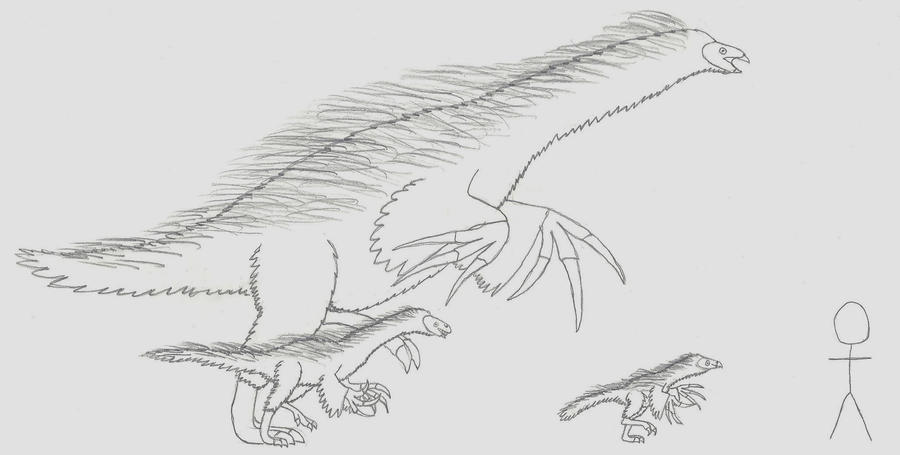 |
| From shortest to longest: Beipiaosaurus inexpecticus, Falcarius utahensis, and Therizinosaurus cheloniformis. |
Ebeff the Therizinosaurus cheloniformis is one of these. Therizinosaurs are really freaky-looking dinosaurs, what with their tiny heads on their long necks and gigantic claws on their hands! They are definitely plant eaters, because they are most likely too ponderous and slow to catch other animals, although their large claws would have made nice defensive weapons. Most therizinosaurs we know have backwards-pointing pubes and probably cheeks, both of which are features of other (unrelated) plant-eating dinosaurs. Both of these characteristics help therizinosaurs get the most out of their vegetarian diet: backwards-pointing pubes give them more room for bigger and longer guts (which house micro organisms for digesting plant matter), and cheeks help them retain food in the mouth so it doesn't slop everywhere and go to waste! However, the most basal therizinosaur known from complete remains, Falcarius utahensis, has a forward-pointing pubis and seems to be a decent runner, so it is probably more omnivorous than its derived relatives. As far as their plumage is concerned, therizinosaurs don't have the modern-style true feathers of today's birds. They have long shaggy protofeathers as well as a type of feather probably unique to them called EBFFs, or Elongated Broad Filamentous Feathers. EBFFs resemble porcupine quills and may have a display function. Most known therizinosaurs come from the Cretaceous, but phylogenetic bracketing tells us their origins lie back in the Jurassic. Indeed, an ambiguous lower jaw bone, given the name Eshanosaurus deguchiianus, appears to be that of a really old therizinosaur. Therizinosaurs are sheep- to Tyrannosaurus-rex-sized, making Therizinosaurus cheloniformis the largest known maniraptor.
Alvarezsauroids
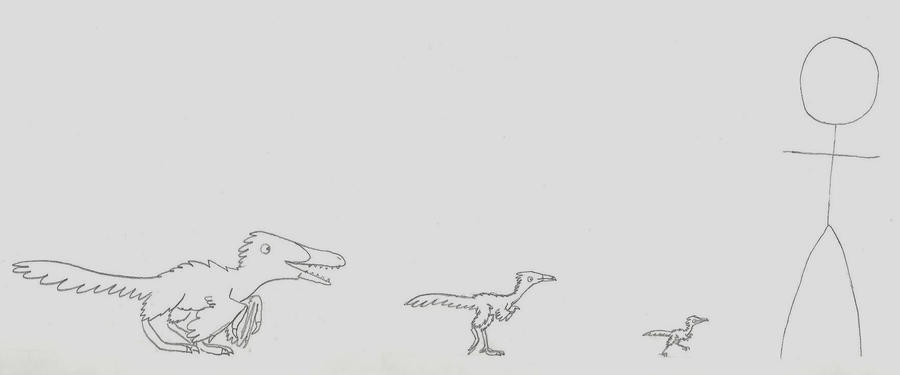 |
| From shortest to longest: Parvicursor remotus, Albertonykus borealis, and Haplocheirus sollers. |
This group has always been fairly strange. For one thing, no one really had any idea what they were! The first specimens were thought to be flightless avialians (more on those later), and later it was suggested that they may be more basal maniraptors or related to the ornithomimosaurs (ostrich dinos). But at the beginning of this year the basal alvarezsauroid Haplocheirus sollers was found (back in the Jurassic!), and we now know a good deal more about the history of this group. For a start, they do appear to maniraptors. They started out looking like typical generalist maniraptors with three-fingered hands, long arms, small teeth suitable to an omnivorous diet, and long legs. However, derived alvarezsauroids, the alvarezsaurids, have very short arms and are smaller in body size than their ancestors. Their third and second fingers are tiny and clawless, but they retain a big thumb claw. In spite of their length, those arms are very powerful, and it's been speculated that alvarezsaurids use them to pound into rotting wood and insect nests in search of food. Alvarezsaurids (especially the members of the alvarezsaurid group Parvicursorinae) are very good runners with their long, thin lower legs, and they have weakly backward-pointing pubes. So far, we don't really know what alvarezsauroid plumage was like, because there aren't any good fossils of alvarezsauroids that preserve integument. (To be fair, there's a specimen of Shuvuuia deserti that comes with very badly preserved protofeathers - can't really blame it though, it happened to live in a place that didn't preserve soft tissues well, in contrast to the creatures that wound up on lakebeds in the Yixian.) Alvarezsauroids are typically quite small. Even the larger basal ones are no more than three meters long.
Oviraptorosaurs
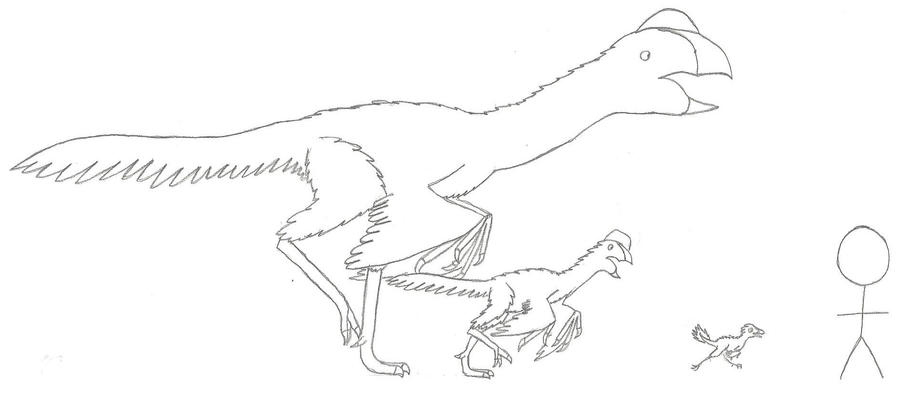 |
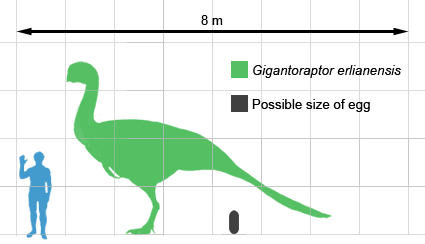
| From shortest to longest: Caudipteryx zoui, Citipati osmolskae, and Gigantoraptor erlianensis. |
Remex the Caudipteryx zoui is one of these. Many of you probably know how the oviraptorosaur Oviraptor philoceratops was discovered on a nest of eggs, earning it a name that means "egg thief, fond of horned dinosaurs", but was later found to have been brooding its own nest. We don't know if earlier maniraptors like alvarezsauroids and therizinosaurs brood, but we know that oviraptorosaurs definitely do. Also, oviraptorosaurs definitely have true feathers. They have their true feathers on the wings and tail. However, oviraptorosaurs can't fly, so what are their feathers for? They can help oviraptorosaurs cover their nests better in the aforementioned brooding behavior. Oviraptorosaurs may also use their feathers for showing off. Caudipteryx zoui, for example, waves little hand flags around - its wing feathers are concentrated on the second finger, while there aren't any true feathers on its arms! Feathers probably aid small oviraptorosaurs in a behavior called WAIR, short for Wing-Assisted Incline Running. By flapping their wings back and forth, small oviraptorosaurs can run up the sides of trees and escape from predators. Basal oviraptorosaurs have a few small teeth, and they eat plants or insects. Derived oviraptorosaurs, however, have no teeth at all, just keratinous beaks. They are most likely omnivores or predators of small vertebrates, as lizards have been found as their stomach contents and remains of smaller maniraptors have been found near their nests, possibly signifying the leftovers of eaten prey. (And, of course, just because they don't cannibalize their own eggs doesn't mean oviraptorosaurs can't eat the eggs of other animals.) Oviraptorosaurs have forward-pointing pubes, and many have adaptations to fast running such as long legs and pinched feet. Oviraptorosaurs range from turkey-sized to as large as the tyrannosauroid Albertosaurus sarcophagus.
Henceforth, all other maniraptors belong to the group Eumaniraptora. Eumaniraptors include deinonychosaurs and avialians, and all the characters (well, almost all) in this web comic were eumaniraptors before Remex and Ebeff showed up. This calls for a more detailed cladogram (again, by Dr. Thomas Holtz; also used with permission).
Us eumaniraptors have a first toe placed low on the foot and a retractable second toe we hold off the ground usually when walking. This keeps the second claw nice and sharp, which might be good for climbing (up trees, but some of us began climbing other things later on). (Modern birds don't have retractable toes anymore and instead grab things with a reversed first toe.) We also tend to have backwards-pointing pubes, which might be a result of our knee-driven running. Like oviraptorosaurs, we eumaniraptors have true feathers on the wings and tail, and we use them for similar purposes. However, we also have true feathers on the legs, too (ancestrally, anyways; some of us, again including modern birds, have lost that feature). Furthermore, we can actually fly! It's been suggested that those of us who can't (such as me... well, the species I was modeled after, really) are what is called secondarily flightless, which means we are flightless animals with flighted ancestors with flightless ancestors. The same thing is true of flightless modern birds and many well-known deinonychosaurs... which is the cue for another intro.
Deinonychosaurs
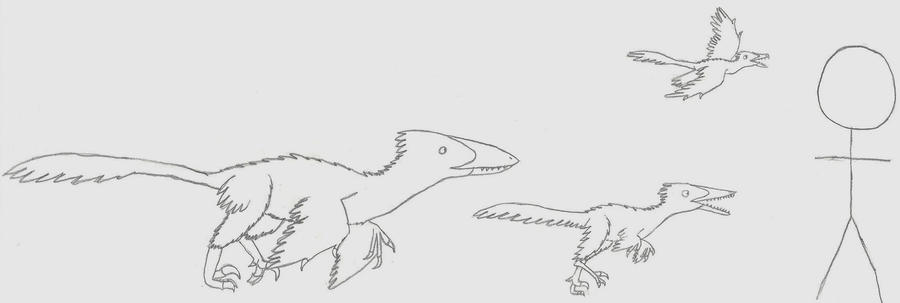 |
| From shortest to longest: Microraptor zhaoianus, Troodon formosus, and Deinonychus antirrhopus. |
I'm a deinonychosaur, and so are Ostrom the Deinonychus antirrhopus and Zahavi the Jinfengopteryx elegans. The public knows our group quite well as "raptors", especially the members of Dromaeosauridae, which include both me and Ostrom. (Zahavi belongs to the Troodontidae, but you can worry about that later.) The public is more familiar with "typical" dromaeosaurids such as Deinonychus antirrhopus or me (or more likely my close relative Velociraptor mongoliensis, really), but the thing is we are far from being typical eumaniraptors! We can't fly, for example. Also, we attack and eat prey comparable in size to or larger than ourselves, which is something (most) other maniraptors don't do! (It's been suggested that at least some of us did this in groups, no less.) That means we may not be just secondarily flightless, but secondarily carnivorous as well! (As maniraptors belong to the coelurosaurs. Coelurosaurs were ancestrally carnivorous, as evidenced by meat-eating tyrannosauroids and compsognathids.) Some of us "typical" dromaeosaurids have grown so big (like Utahraptor ostrommaysorum) that they can no longer climb trees and use their retractable claws to climb up big plant eaters instead! Other dromaeosaurids can generally still fly and are much smaller than we are, but one group, the unenlagiines, largely returned to the ground after reaching (possibly flying) to the southern hemisphere and diversifying. Unenlagiines have long narrow snouts, so they probably eat fish and other small animals. At least one unenlagiine, Austroraptor cabazai, is nearly as large as Utahraptor ostrommaysorum.
The other main branch of the Deinonychosauria, the Troodontidae, are generally smaller (pigeon- to wolf-size) and faster than us. (Yes, sadly, in spite of media portrayals and the genus name of Velociraptor mongoliensis meaning "fast thief", we "typical" dromaeosaurids are a lot less built for running than troodonts, oviraptorosaurs, alvarezsauroids, or even our own ancestors, the basal dromaeosaurids!) Troodonts might have abandoned flight early on (even the most basal known troodont, Anchiornis huxleyi, shows signs of losing aerial capacity) and they usually have rather short arms. Their teeth are small and serrationless, so their dietry habits are more like that of other maniraptors: plants and small-bodied animals. (Jinfengopteryx elegans, for example, preserves seeds in its stomach.) Finally, the most derived troodonts have pubes that point forward rather than backwards like the rest of us. (That makes their pubes secondarily forward pointing!)
Avialians
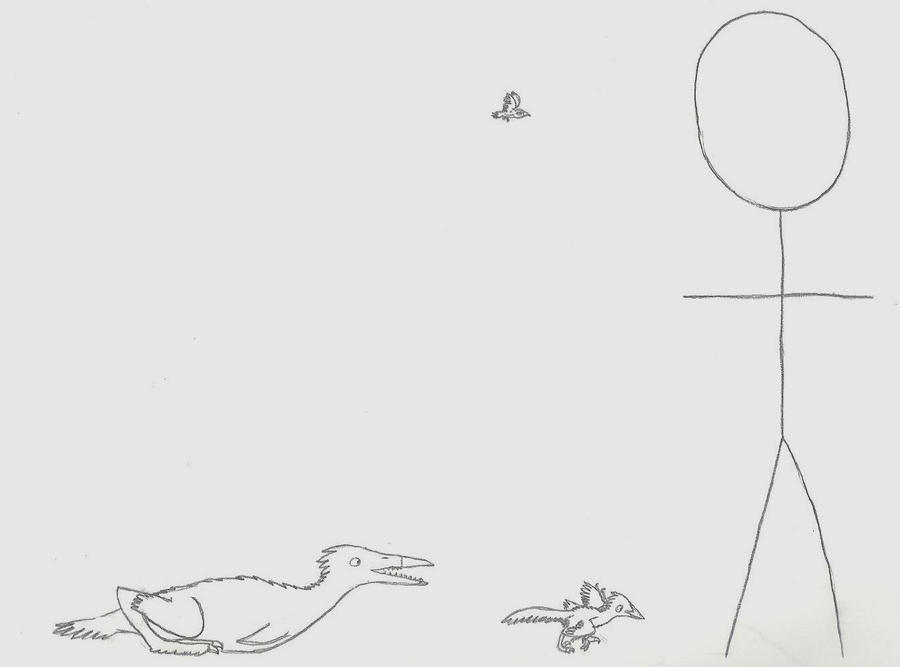 |
| From shortest to longest: Passer domesticus, Archaeopteryx lithographica, and Hesperornis regalis. |
Savape the Archaeopteryx lithographica and Dinky the house sparrow are both avialians. And so we come to the last major group of maniraptors. When people say birds, they usually refer to this maniraptor group. All modern birds belong to a group of avialians called the neornithines, but there are many kinds of Mesozoic avialians, many of them quite different from modern ones. The most basal avialians known are the tiny Jurassic scansoriopterygids, which are extremely weird with their elongated third fingers and ribbon-shaped tail feathers. We don't know much about the scansoriopterygids, but we know a lot about a group of Cretaceous birds called confuciusornithids, because there are probably over a thousand confuciusornithid fossils out there. Like modern birds, confuciusornithids have the tips of their tails fused into a bony feather-anchoring base called the pygostyle (which has also been independently evolved by some oviraptorosaurs and the therizinosaur Beipiaosaurus inexpectus). Unlike modern birds, confuciusornithids don't have a feather fan on their tails, but a pair of very long feathers. (Some confuciusornithid specimens do not have the long feathers; this may represent gender or age differences, or simply moulting individuals.) Confuciusornithids have toothless beaks which they use to catch fish as they fly over lakes, but they evolved these separately from modern birds. The enantiornithines were probably the most successful avialian group in the Mesozoic, spanning a wide variety of sizes (from sparrow- to vulture-sized) and habits (fish eaters, birds of prey, seed eaters, insect eaters, and others). Most enantiornithines don't have beaks or tail fans (but there are exceptions in both cases) and most retain teeth, protruding wing claws, and leg feathers, but they do have an alula, a feather on the thumb (also present in modern birds) that helps in steering and a fully backwards-pointing first toe. (Which isn't turned backwards in the most basal avialians and not fully reversed in confuciusornithids.) Most enantiornithines had two long tail feathers like confuciusornithids, but not to the same degree. Hesperornithines are diving birds, most of which have lost their forelimbs and are flightless. Although they have teeth, they do have tail fans and are closer to neornithines than any of the other groups mentioned so far. Hesperornithines swam with lobed feet like modern grebes instead of webbed ones. Neornithines also seem to have started out as waterfowl. When the K/Pg extinction struck, the neornithines alone among all dinosaurs survived the ensuing disaster, spawning the myriad forms we see now.
That's it for this presentation! I hope you had fun reading that, whether or not it was new to you. Next time, we return to comics, this time starring Remex and Ebeff!
Subscribe to:
Posts (Atom)