It's been an interesting year for this blog. The number of blog posts on here has continued the pattern of dwindling each successive year. This was in part because I have been busier than usual over the last third of 2013, but even prior to that, I hadn't done much on here. That includes the fact that I still haven't written up the reviews and reports I said I would; at this point I have doubts that I ever will myself. I'm consistently impressed by other bloggers who are able to almost constantly produce high-quality content at a fairly regular pace, and have done so for many years at that. Many of them must live even busier lives than mine; the fact that they are still able to make time for blogging is almost magical (though I'm aware that in reality they're probably taking a large chunk of what little excess time they have that they could otherwise be using to get extra sleep and such in order to achieve that - so rock on, all you superbloggers out there).
Despite my inactivity, the year hasn't been a complete waste as far as the blog is concerned. Most importantly, I started drawing comics for it again, which is a big plus in my book. More specifically, I transitioned to digital art and
updated the characters to be more scientifically accurate and reflective of my current artistic style. I also started using a
Tumblr to increase my production of new material for the comic. Although I haven't been able to maintain activity during busier periods, I've still been drawing these far more frequently than I did over the previous two years, so I'll consider the Tumblr experiment a success, with hopes that it'll continue to be so (if irregularly) in the future. A few other odds and ends I posted included a few
trip reports, finished a
meme I said I'd fill out years ago, and the requisite
April Fools' joke. I also received another piece of
fan art this year, and I won't lie, as much as creative endeavors should be done of one's own accord, knowing that people like your output is a great motivator.
 |
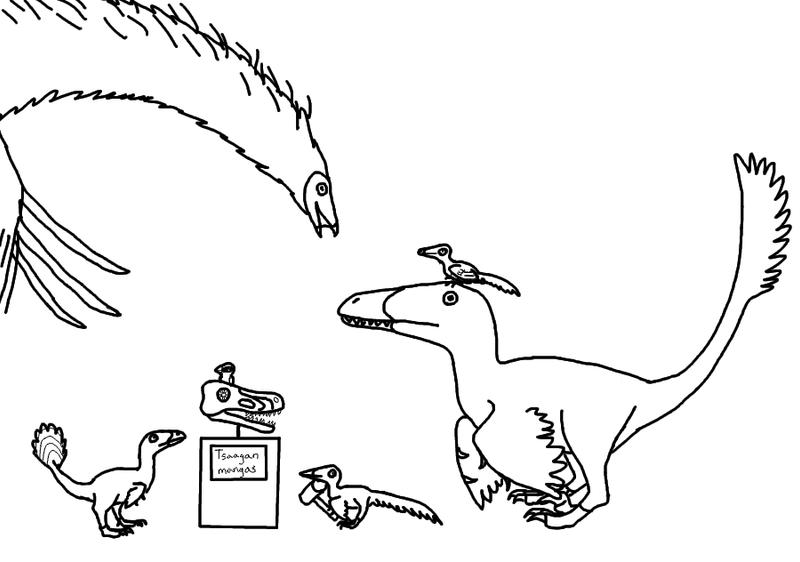
| A digitized and revamped dramatis personae of the characters on Raptormaniacs. |
Living in the golden age of dinosaur discoveries as we are, it's no surprise there was plenty of new research on maniraptors being churned out the past year. In January, new studies came out on tail function in
dromaeosaurids and
oviraptorosaurs. The
osteology of the oviraptorosaur
Khaan was described in detail.
New specimens of the Cretaceous euornithine
Archaeorhynchus were published. The songbird syrinx was
visualized in 3D. The
correlation between flightlessness and cranial morphology in birds was established. Some
Confuciusornis specimens that lacked long retrices were
confirmed female, as had been long suspected.
Multivariate analysis was done on Late Cretaceous small theropod (mostly maniraptor) teeth. Other studies were done on the
lack of friendships in chickens, navigation in
king penguin chicks and
pigeons,
genomic diversity in pigeons, the
benefits of pheomelanin for birds, and
cultural evolution in the songs of savannah sparrows. Newly-named maniraptors included the enantiornithine
Sulcavis geeorum, the basal paravian
Eosinopteryx brevipenna, the Oligocene anseriform
Saintandrea chenoides, and the oviraptorosaur
Yulong mini, the last known only from juvenile specimens. 2013 was a good year for oviraptorosaurs, although I wouldn't be surprised to see some of the newly coined names to become synonymized with one another in the future. And alas, we did not get the long-awaited large Hell Creek oviraptorosaur. 2014 maybe?
 |
| Reconstruction of the tail musculature of Ajancingenia, from Persons et al., 2013. |
In February, evidence was presented that Eurasian jays
take into account the desires of others when sharing food.
Ultraviolet vision was found to have evolved multiple times in birds. The detailed
osteology of the unusual paravian
Balaur was described. The behavioral responses to
inequity in corvids were evaluated. A
large phylogeny of maniraptors was published, with many unconventional results (such as microraptorians, troodonts, and unenlagiines not being deinonychosaurs). The
age of crown group passerines and the
gastrointestinal parasites of moa were also studied. Newly-named maniraptors included the Miocene auk
Divisulcus demerei and the
Rinjani scops owl (Otus jolandae).
 |
| Rinjani scops owls, from Sangster et al., 2013. |
In March, several new specimens of Mesozoic avialans were described that suggested
foot feathers were ubiquitous among feathered dinosaurs.
Self control was observed in Goffin's cockatoos. New
Jeholornis and enantiornithine specimens appeared to preserve single functional
ovaries (rather than two ovaries as was probably present in non-avialan maniraptors). Circadian rhythm was found to determine the
timing of crowing in roosters. The evolution of
shorter wings in cliff swallows as an adaptation for avoiding traffic was documented. The
genomes of peregrine and saker falcons were sequenced. A unique
yellow pigment was described in penguins. The painted vulture, long thought to have originated from a bungled description of the king vulture, was argued to have represented a
distinct species. Bird tracks once intriguingly thought to have hailed from the Triassic were
redated as being Eocene in age. Previous methods of color reconstruction from fossil feathers was
questioned. A
review of the history of African penguins was published. Cranes were suggested to dance not just in courtship, but also in
play. New studies came out on the
structure of mixed-species corvid flocks,
modern bird phylogeny, the evolution of
avian sex roles, the
water vapor conductance of
Troodon eggs, a
new specimen of the large unenlagiine
Austroraptor,
melanin concentration gradients in fossil feathers, and
thermoregulation in emperor penguins. Newly-named maniraptors included the Eocene ciconiiform
Vadaravis brownae and the parrot-beaked Oligocene mousebird
Oligocolius psittacocephalon.
 |
| New specimen of Sapeornis showing hind limb feathers, from Zheng et al, 2013. |
In April, juvenile pied babblers were reported to
put themselves at risk in order to elicit food from their parents. The dromaeosaurid
Microraptor was found to have
eaten fish. More research on the
molecular basis and
taphonomy of feather colors was published. A new
enantiornithine nesting colony from Argentina, a
juvenile specimen of the Mesozoic avialan
Sapeornis, and a
troodont tooth from India were described. New studies came out on the
evolution of sexual dimorphism in moa,
pneumaticity in charadriiforms and pelecaniforms, the clapper/king rail
complex, the evolution of avian
leg posture, and the
dissociation of body and limb size in avialans. Newly-named maniraptors included the dark-feathered Eocene stem apodiform
Eocypselus rowei and the oviraptorosaurs
Ganzhousaurus nankangensis,
Leptorhynchos gaddisi, and Leptorhynchos elegans, the last formerly a species of
Chirostenotes.
 |
| Holotype of Eocypselus rowei, from Ksepka et al., 2013. |
In May,
vocal cooperation in little spotted kiwis was documented. The
carrying of feathers to nests by male house sparrows was suggested to be a sexually selected trait. The
genome of the scarlet macaw was sequenced.
Individual personality in common waxbills was found to be associated with ecology. The correlation between clutch size and parental care style, previously used to infer reproductive behavior in Mesozoic maniraptors, was
questioned. Support for the
trade-off between efficient flying and wing-propelled diving was found. New studies came out on the evolution of the
aerodynamic tail of modern birds,
skeletal kinematics during WAIR, the function of the
wing knob in the Rodrigues solitaire, the
phylogeography of the northern fulmar, and
problem-solving abilities in pigeons. Newly-named maniraptors included the oviraptorosaur
Wulatelong gobiensis, the Oligocene passerine
Resoviaornis jamrozi, the therizinosaur
Jianchangosaurus yixianensis, the basal paravian
Aurornis xui (found to be the oldest known avialan in its description), and the Cretaceous euornithine
Yanornis guozhangi.
 |
| Holotype of Aurornis xui, from Godefroit et al., 2013. |
In June, the
evolutionary loss of phalluses in birds was investigated.
Record migration distances were documented in Arctic terns. The
feather colors of
Archaeopteryx were described in more detail than before, finding that only the leading edges of the feathers were dark.
Social learning was found in superb fairy wrens. A
comprehensive overview of Pleistocene-Holocene bird remains from Liang Bua was published. Cerebellar floccular fossa size was found to be a
poor proxy for flying ability in birds. New studies came out on
scaling effects on neognath limb proportions and the
airspeed of migrating birds. Newly-named maniraptors included the Paleocene avialan
Qianshanornis rapax (seemingly with a retractable second toe), the
Cambodian tailorbird (Orthotomus chaktomuk), the
São Miguel scops owl (Otus frutuosoi),
the western striolated puffbird (Nystalus obamai), the Xingu woodcreeper (Dendrocolaptes retentus), the Inambari woodcreeper (Lepidocolaptes fatimalimae), the Tupana scythebill (Campylorhamphus gyldenstolpei), the Tapajós scythebill (Campylorhamphus cardosoi), the Roosevelt stipple-throated antwren (Epinecrophylla dentei), the bamboo antwren (Myrmotherula oreni), the predicted antwren (Herpsilochmus praedictus), the Aripuana antwren (Herpsilochmus stotzi), the Manicore warbling antbird (Hypocnemis rondoni), the Chico's tyrannulet (Zimmerius chicomendesi), the acre tody-tyrant (Hemitriccus cohnhafti), the Sucunduri yellow-margined flycatcher (Tolmomyias sucunduri), the Inambari gnatcatcher (Polioptila attenboroughi), and the Campina jay (Cyanocorax hafferi).
 |
| Phylogeny of neornithines showing the phylogenetic distribution of phalluses, from Herrera et al., 2013. |
In July,
sequential problem solving and
concept of object permanence were reported in Goffin's cockatoos. The previous claim of fossilized ovaries in several Mesozoic avialan specimens was
disputed. The
genome of the ground tit was sequenced.
Navigation by olfactory cues was found in Cory's shearwaters. Eye-tracking technology allowed the study of
selective attention in peahens during courtship. The origin of
iridescence in the plumage of the African emerald cuckoo was established. New studies came out on the
social structure of California condors,
navigation in pigeons, the
phylogeny of ibises, the evolution of the
avian brain,
mating success in zebra finches, and sexual selection on the
brain size of charadriiforms. Newly-named maniraptors included the Cretaceous avialan
Xinghaiornis lini and the
Junin tapaculo (Scytalopus gettyae).
 |
| Cory's shearwater, photographed by TomAllmendinger, licensed. |
In August, male Japanese quail were found to produce a
foamy secretion that increases reproductive success. The
similarity of greater honeyguide eggs to those of their hosts was shown to result from intraspecific rather than interspecific competition. Birds were found to adjust their
flight initiation distance based on local road speed limits.
Social learning in whooping cranes was described. New studies came out on
limb evolution rates in avialans and other dinosaurs, the
response of song sparrows to climate change, the evolutionary
loss of digits in birds and other archosaurs, and ostrich
neck flexibility (with implications for studies of extinct animals such as sauropods). Newly-named maniraptors included the oviraptorosaur
Jiangxisaurus ganzhouensis and the fish-eating Cretaceous avialan
Piscivoravis lii.
 |
| Experimental flexibility of ostrich necks when intervertebral space is (left) and isn't (right) taken into account, from Cobley et al., 2013. |
In September, birds were confirmed to likely
lack the anti-inflammatory protein tristetraprolin. The
role of the trachea in thermoregulation in birds (with implications for sauropods) was modeled. Large-brained birds were found to have
lower stress hormone levels.
Predation on sika deer by a golden eagle was observed for the first time. The
loss of syntax in island-dwelling chaffinch populations were documented. The coprolites of moa were studied to reconstruct the lost
herbivore community of New Zealand. New studies came out on the
aerodynamics of the dromaeosaurid
Microraptor,
strategies for successful brood parasitism in cuckoo finches, and the
phylogenetic position of
Yixianosaurus. Newly-named maniraptors included the enantiornithine
Zhouornis hani.
 |
| Golden eagle attacking juvenile sika deer, from Kerley and Slaght, 2013. |
In October, infidelity in red-backed fairy wrens was suggested to
prevent speciation between two distinct morphs.
Distinction between the Eocene penguins
Palaeeudyptes gunnari and
Palaeeudyptes klekowskii was quantified statistically. Examination of several
Jeholornis specimens found what appeared to be a
second feather display structure at the base of their tail, sparking a fair amount of
online discussion on how to interpret this find. Alpine swifts were observed
flying nonstop for 200 days, confirming that at least some swifts spend a large portion of their lives without landing.
Mimicry of raptors was found to be common among cuckoos. A
Jerdon's courser egg (previously unknown) was discovered in a museum collection. An unnamed
Oligocene upupiform and the
oldest known bird footprints (from the Early Cretaceous of Australia) were described. New studies came out on the
brain morphology of plotopterids, the
problem-solving abilities of parrots,
duet integration in happy wrens, and the
halluces of Eocene penguins. Newly-named maniraptors included the large, likely flightless Miocene anseriform
Garganornis ballmanni and the Cretaceous avialans
Yumenornis huangi, Changmaornis houi, and Jiuquanornis niui.
Leptorhynchos gaddisi was deemed the
type species of its genus, as the original description had neglected to assign one.
 |
| Alpine swift, photographed by Birdwatching Barcelona, licensed. |
In November,
changes in timing of bird migrations were to result from changes between generations rather than individuals. The benefits of
same-sex pairing for Laysan albatrosses was established. The
presence of phorusrhacids in Europe was reevaluated. New studies came out on the
phylogenetic position of
Juncitarsus, the
structure and growth of
Pelagornis pseudoteeth, the
mass estimation of flying birds, and the
colonization of Tasmania by the wedge-tailed eagle. Newly-named maniraptors included the dromaeosaurid
Acheroraptor temertyorum and the oviraptorosaur
Nankangia jiangxiensis.
Ajancingenia was coined as a replacement name for for the long-preoccupied oviraptorosaur genus "
Ingenia", but there is much
controversy about the ethics of the paper in which this was done.
 |
| Laysan albatross with young, public domain. |
In December, hummingbirds were found to
metabolize glucose and fructose equally, unlike typical vertebrates. Behavioral lateralization in budgerigars was shown to
vary according to task rather than handedness being present in individuals. A common buzzard was
digitally dissected. In a bit of good conservation news, the Moluccan woodcock was discovered to likely be
less threatened than expected. In a bit of more ominous conservation news,
maladaptive behavior spread by conservation efforts was reported in Chatham Island black robins. (Fortunately, this was discovered in time and said behavior is no longer widespread.) A number of papers were published on the relationship between brood parasites and their hosts; for instance, nest sanitation was suggested as the
evolutionary basis for ejection of brood parasite eggs in Eurasian tree sparrows. Great spotted cuckoo fledglings were found to be
disadvantaged when reared by and alongside magpies. Evidence for cooperative breeding in birds being a
defense against brood parasitism was documented. New studies came out on the
function and evolution of beaks in therizinosaurs and other theropods, the evolution of
limb robustness in moa, the
energetics of courtship in golden-collared manakins, the
feeding habits of red-throated caracaras, the
phylogenetic position of the Cretaceous euornithine
Ambiortus, and
convergent evolution of hemoglobin function in high altitude hummingbirds. Newly-named maniraptors included the enantiornithine and longtime
nomen nudum Gobipipus reshetovi (known only from embryos), the Eocene stem galliform
Chambiortyx cristata, the Miocene roller
Miocoracias chenevali, the Miocene barn owl
Miotyto montispetrosi, the Pliocene rail
Pastushkinia zazhigini (formerly a species of
Crex), the Oligocene or Miocene stone curlew
Wilaru tedfordi, and the Miocene kiwi
Proapteryx micromeros. A
correction was issued for the coining of
Ajancingenia to acknowledge the use of data compiled by Mickey Mortimer on the Theropod Database, but still does not adequately address many of the other issues with the original paper.
 |
| Results of finite element analysis on the skull of Erlikosaurus with comparison between different hypothetical beak extents, from Lautenschlager et al., 2013. |