Showing posts with label New species review. Show all posts

Saturday, January 22, 2022

New (Extinct) Maniraptors of 2021

By my count, 42 new species of extinct maniraptors were named in 2021, which is about par for the course these days. Let's take a quick look at these new taxa and other nomenclatural proposals.

Alvarezsaurs
New alvarezsaurs have been described at a fairly steady trickle in recent years, and 2021 gave us Khulsanurus, known from a partial skeleton from the Late Cretaceous Barun Goyot Formation of Mongolia. It was discovered at the same locality as Parvicursor, but can be distinguished based on vertebral anatomy.

Oviraptorosaurs
No new oviraptorosaur species were described last year; in fact, they may have lost a member. A new specimen of Elmisaurus preserves overlapping material nearly identical to Nomingia, lending credence to the hypothesis that the two are synonymous (in which case the name Elmisaurus would take priority).

Non-ornithothoracean Paravians
2021 was a good year for dromaeosaurids, with the velociraptorines Shri (formerly known by the nickname "Ichabodcraniosaurus") and Kuru (formerly known by the nickname "Airakoraptor") both described based on partial skeletons from the Barun Goyot Formation. Less completely known are Kansaignathus (based on a partial jaw and possibly teeth from the Late Cretaceous Yalovach Formation of Tajikistan), Vectiraptor (based on partial vertebrae from the Early Cretaceous Wessex Formation of the United Kingdom), and Ypupiara (an unenlagiine based on jaw fragments from the Late Cretaceous Serra da Galga Formation* of Brazil). Tragically, the type specimen of Ypupiara was among the fossils lost in the 2018 fire that destroyed the main building of the National Museum of Brazil.

*Ypupiara was described as being from the Marília Formation. However, it was recently proposed that the classic Marília Formation should be split into the separate Marília and Serra da Galga Formations.

Holotype of Shri, from Turner et al. (2021).

Troodontids, on the other hand, got Papiliovenator from the Late Cretaceous Wulansuhai Formation of China, known from a partial skeleton including a nearly complete skull. Its name translates (I think quite adorably) into "butterfly hunter", not based on any inference about its ecology, but on the "butterfly-like" shape of its dorsal vertebrae. There was also Tamarro from the Late Cretaceous Talarn Formation of Spain, known from a partial metatarsal. Meanwhile, a detailed reassessment of small theropods from the Dinosaur Park Formation concluded that Latenivenatrix cannot be reliably distinguished from Stenonychosaurus, and that the two should be (re-)synonymized.
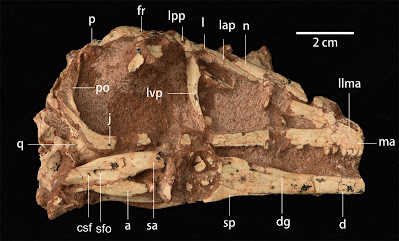
Skull of Papiliovenator, from Pei et al. (2022). (The paper was released as an advance online publication in 2021.)

Last year also saw the description of a new Jeholornis-like avialan, Neimengornis, from the Early Cretaceous Jiufotang Formation of China. It appears to be known from an essentially complete skeleton. However, there have already been suggestions that the type specimen is likely a chimera.

Enantiornitheans
As is often the case, the Jiufotang Formation also contributed some new enantiornitheans in 2021, two to be precise. One of these was Brevirostruavis, which is notable for preserving an elongated hyoid, suggesting that it may have used its tongue for handling food. Although the original description compares this condition to that seen in hummingbirds and woodpeckers, the hyoid elongation seen in Brevirostruavis does not look to my eye quite as extreme as that of those crown birds. My guess would be that Brevirostruavis might have used its tongue to help pick up food and manipulate it within its mouth, but did not use a feeding strategy that involved protruding the tongue very far beyond its snout.

The other new Jiufotang enantiornithean was Yuanchuavis, which preserves a set of eight tail feathers forming a fan-like array. This contrasts with the typical condition seen in most other enantiornitheans (which tended to either lack large tail feathers or have only a single pair of them), but resembles that of Chiappeavis. Unlike Chiappeavis, the central pair of tail feathers in Yuanchuavis was particularly elongate.

Personally, I think one of the most scientifically important new maniraptors to be named last year was Yuornis from the Late Cretaceous Qiupa Formation of China. It is based on a partial skeleton with an essentially complete skull preserved in three dimensions, a rarity for avialan fossils. It is also one of the few enantiornitheans known to have had entirely toothless jaws.

Holotype of Yuornis, from Xu et al. (2021).

A fourth enantiornithean to come out of 2021 was Fortipesavis, known from a foot preserved in Late Cretaceous Burmese amber that had been previously described in 2019.

Non-neornithean Euornitheans
Two non-neornithean euornitheans were named in 2021 based primarily on cranial material, these being Brevidentavis and Meemannavis from the Early Cretaceous Xiagou Formation of China. The type specimen of Brevidentavis was previously reported as the skull of Gansus, but a more likely candidate for an actual Gansus skull was described in the new paper. The lower jaw of Brevidentavis exhibits unusually short, blunt teeth set in a groove (instead of in sockets), whereas Meemannavis has a toothless lower jaw.

Holotype of Brevidentavis, from O'Connor et al. (in press).

One Mesozoic avialan named last year that was not discovered in Asia was Kaririavis from the Early Cretaceous Crato Formation of Brazil. Based on a partial foot, it was unusual for a Cretaceous euornithean in being particularly small (around the size of a sparrow) and in that its one preserved toe claw was large and strongly curved.

Paleognaths
Perhaps one of the biggest overhauls in dinosaur systematics in 2021 was the reinterpretation of geranoidids, eogruids, and ergilornithids as stem-ostriches instead of gruiforms. Although a close relationship between ergilornithids and ostriches had been suggested in the 1950s and contemplated more recently in light of further data on fossil paleognaths, anatomical information from newly described eogruid and ergilornithid specimens seems to strongly bolster this hypothesis. In their revision of these birds' affinities, the authors additionally resurrected the genus Proergilornis, which had been previously synonymized with Ergilornis, and suggested that it was less closely related to extant ostriches than ergilornithids proper.

A new fossil paleognath was also described last year, the kiwi Apteryx littoralis, based on a tarsometatarsus from the Pleistocene of New Zealand. Kiwi fossils are rarely found, and this species is the first one known from the early Pleistocene.

Galloanserans
A couple of extinct total-group anseriforms were named in 2021. One of these was the small presbyornithid Bumbalavis from the Eocene Naran-Bulak Formation of Mongolia. (Meanwhile, the type specimen of "Presbyornis" mongoliensis from the same locality was reinterpreted as a stem-mirandornithean similar to Juncitarsus.) The other was the stiff-tailed duck Manuherikia primadividua from the Miocene Bannockburn Formation of New Zealand, the fourth species to be named in the genus Manuherikia. It appears to be stratigraphically separated from the older M. lacustrina.

Two small, early total-group galliforms were described from the Naran-Bulak Formation last year as well, these being Bumbanipodius and Bumbanortyx.

Strisoreans
New fossil members of Strisores don't get described every day, or every year for that matter. (The last one I recall was Cypseloramphus from 2016.) That's why I was excited to see the publication of Archaeodromus from the Eocene London Clay Formation of the United Kingdom, known from a partial skeleton. This new taxon is a member of Archaeotrogonidae (formerly thought to be a group of stem-trogons, as their name suggests, later reevaluated as strisoreans), and not only provides new anatomical information on this group, but also suggests that they may be stem-nightjars. The absence of clear examples of Eocene stem-nightjars had been a conspicuous gap in the known fossil record of Strisores, so the common but enigmatic archaeotrogonids filling that space seems like a tantalizing possibility. It would also imply that my earlier hypothesis that the putative archaeotrogonid Hassiavis was a stem-owlet-nightjar is probably wrong, but that's the way science goes sometimes.
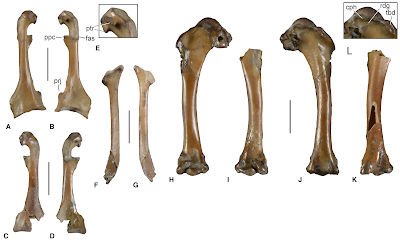
Shoulder and forelimb bones of Archaeodromus, from Mayr (2021).

Gruiforms
The Naran-Bulak Formation gave us two more new fossil birds in 2021, the possible gruiforms Bumbanipes and Bumbaniralla. Bumbanipes appears to have been a specialized swimming form with morphological similarities to the limpkin (Aramus guarauna) and finfoots, whereas Bumbaniralla resembles messelornithids. Additional new entrants in the extinct gruiform department were the crane-like Palaeogeranos, based on a coracoid from the Oligocene of France, and the recently extinct rail Gallirallus astolfoi, based on a tarsometatarsus from the island of Rapa Iti in French Polynesia. Recent revisions in the generic assignment of recent rails have restricted the genus Gallirallus to the weka (G. australis) and sometimes the New Caledonian rail (G. lafresnayanus), in which case it wouldn't surprise me if G. astolfoi was transferred to a different genus in the future, perhaps Hypotaenidia. In fact, reassignment to Hypotaenidia was proposed last year for another recently extinct rail, the Chatham rail ("Cabalus" modestus), in one study on rail phylogeny.

Charadriiforms
No new extinct charadriiforms were named in 2021, but a study on the original illustrations used to describe the Moorea sandpiper (Prosobonia ellisi) supported synonymizing it with the Tahiti sandpiper (P. leucoptera).

Natatoreans
There has still been no formal proposal to name the clade uniting Phaethontimorphae and Aequornithes, but last year the name Feraequornithes was coined for the group including most aequornitheans other than loons. As it happens, all of the extinct members of the "waterbird clade" that were named in 2021 belong to Feraequornithes.

The excellent fossil record of total-group penguins continued to provide, with new taxa in the form of the giant Kairuku waewaeroa, based on a partial skeleton from the Oligocene Glen Massey Formation of New Zealand, and the smaller Marambiornopsis, based on a tarsometatarsus from the Eocene Submeseta Formation of Antarctica. Perhaps more surprising was the description of a new fossil petrel based on a well-preserved skeleton, Procellaria altirostris from the Pliocene Tangahoe Formation of New Zealand.

Holotype of Procellaria altirostris, from Tennyson and Tomotani (2021).

Among pelecanimorphs, Eopelecanus was described as the oldest known stem-pelican based on a tibiotarsus from the Eocene Birket Qarun Formation of Egypt, whereas a revision of plotopterid specimens from the Paleogene of Washington State resulted in "Tonsala" buchanani being reassigned to Klallamornis.

Telluravians
Although not as many new raptors were named last year as there were in 2020, they were still pretty well represented. Arguably the most exciting was Archaehierax, known from a partial skeleton from the Oligocene Namba Formation of Australia. It was nearly as big as the wedge-tailed eagle (Aquila audax, the largest bird of prey in Australia today), and phylogenetic analyses (which have otherwise almost never been done on fossil accipitrimorphs!) suggest that it was a crown accipitrid, but not especially closely related to any living species.
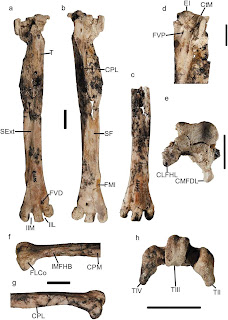
Tarsometatarsus of Archaehierax, from Mather et al. (in press).

The other new fossil accipitrids of 2021 were also quite large species, Buteo dondasi from the Pliocene Chapadmalal Formation of Argentina and Buteogallus irpus from the Pleistocene of the Dominican Republic and Cuba. B. irpus is notably based on specimens formerly assigned to Titanohierax (now restricted to fossils from the Bahamas) and "Amplibuteo" woodwardi (now restricted to fossils from the United States). Its description further suggested sinking members of the genus Amplibuteo into Buteogallus, which had been foreshadowed in previous papers. Another new raptor was the owl Margarobyas abronensis from the Pleistocene of Cuba, a close relative of the poorly-known bare-legged owl (M. lawrencii) that still lives in Cuba today.

Among coraciimorphs, there was Ueekenkcoracias from the Huitrera Formation of Argentina, based on a partial hindlimb. It was described as a stem-member of the group uniting ground rollers and rollers, in which case it would be the first representative of this clade known from South America. However, a later study argued that Ueekenkcoracias more closely resembles the enigmatic Eocene bird Palaeopsittacus, in which case it may not be a telluravian at all. Probably less controversial are the three Pleistocene woodpeckers described from the La Brea tar pits (listed in order of decreasing body size), Breacopus, Melanerpes shawi, and Bitumenpicus.

The London Clay Formation had a good year as far as new fossil birds were concerned, with Tynskya waltonensis revealing new details about messelasturid morphology, though the phylogenetic affinities of these parrot-like birds remain mysterious. Perhaps even more remarkable was the psittacopedid Parapsittacopes, known from a very well-preserved partial skeleton that sheds new light on the anatomy of these stem-passeriforms. It further adds to the already impressive ecological diversity of psittacopedids, exhibiting a slightly widened beak that may have allowed it to feed on fruits and flying insects.
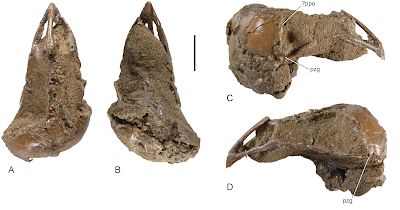
Skull of the holotype of Parapsittacopes, from Mayr (2020). (The print version of the journal retroactively dates the paper to 2020, but really, the paper was first released in 2021.)

Last but not least, a few fossil crown passeriforms were also described in 2021, the possible suboscine Crosnoornis, based on a nearly complete skeleton from the Oligocene of Poland, and the magpie Pica praepica from the Pleistocene of Bulgaria.

Type specimen of Crosnoornis, from Bochenski et al. (2021).

Tuesday, January 19, 2021

New (Extinct) Maniraptors of 2020

The "new year" is not so new anymore (three new maniraptors have been named in 2021 already), but this is a tradition and I'm sticking to it, for now. Having done a sweeping overview of the past year in maniraptoran discoveries, I will now take a more in-depth look at the new extinct taxa that were described last year. In addition to the new genera and species of 2020, this time around I will also make an effort to mention other relevant nomenclatural changes that were proposed.

Alvarezsaurs
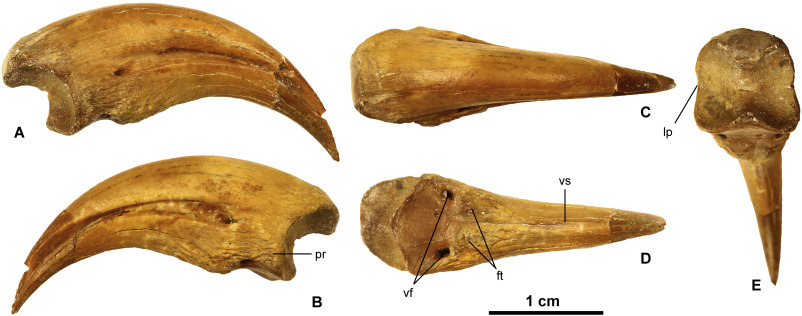
Last year saw the naming of Trierarchuncus, the youngest known alvarezsaur. Fragmentary alvarezsaur specimens had been previously reported from the latest Cretaceous Hell Creek and Lance Formations of the western United States, but these fossils had been left unnamed. Trierarchuncus itself is not known from a whole lot—it was described based on three thumb claws (belonging to three different individuals) from the Hell Creek Formation, and there are parts of an arm and a foot as well as a previously described partial hip that may also belong to it. Shortly after its initial description, a second paper assigned two more thumb claws to Trierarchuncus.

Even though the specimens don't represent much of the skeleton, Trierarchuncus is potentially quite informative about alvarezsaur biology. I noted last year in a post about alvarezsaurids that completely preserved alvarezsaurid thumb claws are rare. One of the claws assigned to Trierarchuncus, however, is very complete, showing a sharp tip and stronger curvature than is typically assumed for alvarezsaurid thumb claws. To my eye at least, this claw shape is in keeping with use of the claw in hook-and-pull digging, as I had contended in my blog post (and others had contended in scientific papers). Perhaps in reference to the strongly curved claw, the name Trierarchuncus can be translated as "Captain Hook".

The most completely preserved thumb claw referred to Trierarchuncus, from Fowler et al. (2020).

Seeing as the claws assigned to Trierarchuncus come from individuals of different sizes, they may also provide insight into how alvarezsaurid claws changed as they grew. The larger Trierarchuncus claws are widened at their base and the surface of the bone exhibits a roughened texture, which likely developed as a response to considerable stresses. The authors who made these observations noted that this is also consistent with the hypothesis that alvarezsaurids used their thumb claws for digging.

Oviraptorosaurs
One of the most spectacular new maniraptors from last year, in terms of the fossil material represented, may have been the oviraptorid Oksoko from the Late Cretaceous Nemegt Formation of Mongolia. It is known from the skeletons of several individuals, including nearly complete skeletons. Notably among these specimens is an assemblage of at least three (maybe four) juveniles preserved together, which had been confiscated from fossil poachers in 2006. Some of these juveniles are preserved in lifelike crouched postures, suggesting that they had been buried rapidly and simultaneously. They therefore provide strong evidence of gregarious behavior in oviraptorosaurs. Oksoko was unusual among oviraptorosaurs in that its third finger was highly reduced, giving it functionally two-fingered hands, and the describers note that similar hands may have been present in Heyuannia huangi.

Several juvenile specimens of Oksoko (including the holotype, marked in blue) preserved together, from Funston et al. (2020).

2020 also saw a much-needed taxonomic overhaul of the caenagnathid oviraptorosaurs from the Late Cretaceous Dinosaur Park Formation in Alberta. Many Dinosaur Park caenagnathids were named based on non-overlapping parts of the skeleton, which has naturally raised questions about whether they all really represent distinct species or not. Based on the examination of newly described, more complete specimens, as well as assessment of individual growth stage based on bone microstructure, this latest study concluded that there are probably three distinct caenagnathids known from the Dinosaur Park Formation: the large Caenagnathus, the medium-sized Chirostenotes, and the small, newly-named genus Citipes, which had formerly often been considered a species of either Chirostenotes or Leptorhynchos. Although not the main focus of the study, this paper additionally mentions that the Gobiraptor from the Nemegt Formation likely represents a juvenile of Conchoraptor, as had been hinted in the past.

Also in the world of oviraptorosaur taxonomy, the feather-preserving specimens of Similicaudipteryx were reassigned to Incisivosaurus (previously known only from a skull and partial neck vertebra).

Non-ornithothoracean Paravians
In contrast to 2019, which was conspicuously lacking in new dromaeosaurids, at least two new dromaeosaurids were described in 2020. One of these was the microraptorian Wulong from the Early Cretaceous Jiufotang Formation of China, known from the exquisitely-preserved complete skeleton of an immature individual. Like Microraptor, Wulong had large feathers on its hindlimbs, and the specimen also preserves a single pair of elongated tail feathers at the tip of its tail.

Holotype of Wulong, from Poust et al. (2020).

The other new dromaeosaurid was Dineobellator, a mid-sized (Velociraptor-sized) dromaeosaurid from the Late Cretaceous Ojo Alamo Formation of the United States. It is known from a partial skeleton, and as in Velociraptor and Dakotaraptor, its ulna exhibits a series of bumps for the attachment of wing feathers along the forearm.

One new paravian that might be a dromaeosaurid was Overoraptor, known from a couple of partial skeletons from the Late Cretaceous Huincul Formation of Argentina. The phylogenetic analysis in the description of Overoraptor recovered it as a close relative of Rahonavis, a smaller, likely flight-capable paravian from the Late Cretaceous of Madagascar. The phylogenetic position of Rahonavis is controversial; it has been found as either an unenlagiine dromaeosaurid or an avialan in recent studies. This particular study found Overoraptor and Rahonavis as avialans, though the phylogenetic dataset used tends to find paravian relationships that are not strongly supported by other analyses, with microraptorians and unenlagiines outside of dromaeosaurids and instead being more closely related to modern birds. It would be interesting to see where Overoraptor turns up when included in other phylogenetic datasets.

Rounding out the long-tailed paravians of 2020 is Kompsornis, a Jeholornis-like avialan from the Jiufotang Formation. The taxonomy of the various Jeholornis-like avialans is debated, but the describers of Kompsornis argue that Shenzhouraptor, Jixiangornis, Jeholornis prima, Jeholornis palmapenis, and Jeholornis curvipes all represent distinct, valid taxa. This paper is also notably one of the few to address "Dalianraptor", a supposedly short-armed, long-tailed avialan. The authors confirm that the original specimen of "Dalianraptor" is likely a composite, and find no definitive features that distinguish it from other Jeholornis-like avialans.

Enantiornitheans
Only one new enantiornithean was named last year, but it was a doozy. Falcatakely from the Late Cretaceous Maevarano Formation of Madagascar is known from a nearly complete skull, and it's a skull unlike that of any other known theropod. Its snout was long and tall, giving it a superficial resemblance to a toucan or a hornbill. However, most of the snout was composed of enlarged maxilla bones, contrasting with the condition in modern birds, in which the snout is primarily composed of the premaxillae. The maxillae of Falcatakely were toothless and probably covered in a keratinous sheath, but the specimen preserves at least one small premaxillary tooth.

Holotype of Falcatakely, from O'Connor et al. (2020).

The describers of Falcatakely ran several different phylogenetic analyses and consistently recovered it as an enantiornithean each time. Even so, it's probably fair to wonder whether this bizarre creature really was an enantiornithean, especially considering that very few other Late Cretaceous enantiornithean skulls are known for comparison. As Mickey Mortimer has pointed out, a highly modified Late Cretaceous theropod with no obvious close relatives and known from limited remains is likely going to be difficult to place no matter what. (It's perhaps worthy of note that little to no skull material has been found for the two other paravians that have been named from the Maevarano Formation, Rahonavis and Vorona.) Regardless of what it turns out to be, the unusual and unexpected morphology of Falcatakely easily qualifies it as one of the highlights among last year's new dinosaurs.

In other news, a review of the Mesozoic and Paleocene pennaraptoran fossil record considered the poorly-studied Jiufotang enantiornitheans Largirostrornis and Longchengornis to be synonyms of Cathayornis, though this was not elaborated upon.

Non-neornithean Euornitheans
The taxonomy of yanornithid euornitheans was revised in 2020, resulting in the recognition of two new genera, Abitusavis and Similiyanornis. Similiyanornis from the Jiufotang Formation had a distinctive tooth arrangement in which the frontmost tooth in its lower jaw was enlarged. Abitusavis was larger than Similiyanornis and was discovered in the older Yixian Formation. Of note is that the first yanornithid specimen reported with fish remains preserved in its digestive tract (originally assigned to Yanornis) is now considered a specimen of Abitusavis. Several other previously described specimens (including the poorly-studied "Aberratiodontus") were deemed indeterminate yanornithids in this study, whereas Yanornis guozhangi was sunk into the type species of Yanornis, Y. martini.

Holotype of Similiyanornis, from Wang et al. (2020).

Another new Early Cretaceous euornithean is Khinganornis from the Longjiang Formation of China. It is the first dinosaur to be described from this formation, and is known from a nearly complete skeleton, but its anatomical details are not well preserved. It appears to have been generally similar to the semi-aquatic euornitheans Gansus and Iteravis, and may have led a similar lifestyle.

Paleognaths
No new paleognaths were named last year (at least, none based on skeletal material), but the old genus Palaeostruthio was brought back and applied to "Struthio" karatheodoris, a large ostrich from the Miocene of Eurasia.

Galloanserans
Alright, let's do this one more time... Asteriornis from the Late Cretaceous Maastricht Formation of Western Europe is one of the few well-established examples of a Mesozoic crown bird. It is known from several bones, most notably a nearly complete skull. The skull exhibits features characteristic of both anseriforms and galliforms, and Asterornis may thus be a close approximation of what the ancestral galloanseran looked like. There's plenty more that could be said, but I already wrote about Asteriornis in more detail here.

Skull of Asteriornis, from Field et al. (2020).

The Cenozoic contributed its fair share of new galloanserans as well. From the Eocene of Kazakhstan came the anseriform Cousteauvia, known from a tarsometatarsus that displays features suggestive of diving behavior (hence the name honoring Jacques Cousteau). Its full binomial, Cousteauvia kustovia, is a bit of fun with homophones. There were also a couple of new pheasants from Bulgaria, the Miocene Phasianus bulgaricus and the Pleistocene Chauvireria bulgarica.

It's not often that we get a new gastornithid, but last year gave us Gastornis laurenti from the Eocene of France. It was named based on a distinctive lower jaw, but its describers mention that it is known from postcranial bones as well, which will be described in a later publication.

Columbimorphs
What's this? A fossil columbimorph older than the Pleistocene and represented by decently complete material?! Linxiavis was a sandgrouse from the Miocene Liushu Formation of China, and is known from a partial skeleton including most of the forelimbs. Sandgrouse today live in arid habitats (they famously use their belly feathers to transport water for their young), so the discovery of Linxiavis is consistent with other lines of evidence suggesting that the Liushu Formation was deposited in a relatively dry environment.

Holotype of Linxiavis, from Li et al. (2020).

A new columbimorph that lived in more recent times is the Pleistocene–Holocene pigeon Tongoenas, remains of which are known from several islands in the Kingdom of Tonga. Its hindlimb anatomy suggests that it was a primarily tree-dwelling form, similar to the fruit doves and imperial pigeons that are still extant today. Tongoenas was one of the largest known flying pigeons, surpassed in that department only by the crowned pigeons, which can reach the size of a small turkey.

Gruiforms
The one new gruiform named last year was the coot Fulica montanei, known from a few tarsometatarsi found in the Pleistocene–Holocene Laguna de Tagua Tagua Formation of Chile. It was large for a coot, comparable in size to the extant horned coot (F. cornuta), and potentially had limited flight capabilities due to its size.

Meanwhile, to maintain consistency with the current taxonomy of extant cranes, the Pleistocene Cuban flightless crane "Grus" cubensis was transferred to the genus Antigone, which includes its probable close relatives such as the sarus (A. antigone) and sandhill (A. canadensis) cranes.

Charadriiforms
The origins of charadriiforms are murky, but 2020 saw the publication of a new taxon that may bear on the subject. That new taxon was Nahmavis from the Eocene Green River Formation of the United States, and it is known from a partial skeleton (missing the forelimbs and shoulder girdle) with preserved feathers. This specimen had previously been reported in popular books and websites as a potential close relative of the seriema-like bird Salmila from the Eocene of Germany, but the describers of Nahmavis instead find it to be more similar to possible stem-charadriiform Scandiavis from the Eocene of Denmark.

In the new study, Nahmavis and Scandiavis were indeed sometimes found as stem-charadriiforms. However, other analyses in this paper placed them as gruiforms instead. It is unfortunate that forelimb material is unknown for both Nahmavis and Scandiavis, seeing as the forelimb bones of charadriiforms are often distinctive. For what it's worth, playing around with the phylogenetic dataset used in this study, I've found that Nahmavis and Scandiavis are consistently recovered as stem-charadriiforms when the internal topology of crown charadriiforms is constrained to the results of molecular studies. In any case, the holotype of Nahmavis is a lovely specimen, and it's good to see it described at last.

Holotype of Nahmavis, from Musser and Clarke (2020).

Among crown charadriiforms, a new species described last year was the recently extinct sandpiper Prosobonia sauli from Henderson Island in the Pitcairn Islands. The genus Prosobonia also includes at least three other extinct sandpiper species as well as the extant Tuamotu sandpiper (P. parvirostris). Unlike typical sandpipers, the members of this genus are not migratory, and are confined to various remote Polynesian islands. Compared to the Tuamotu sandpiper, P. sauli had a wider, straighter bill tip and longer hindlimbs.

Natatoreans
As yet, it appears that no one has formally suggested in technical literature what name should be used for the clade uniting phaethontimorphs (tropicbirds, sunbitterns, and kagus) and aequornitheans ("core waterbirds", such as penguins, petrels, pelicans, etc.). I have provisionally settled on resurrecting the old name Natatores for this group, as it has been used in relatively recent literature for a very similar assemblage of birds.

Fossil penguins have generally had a good showing in recent years, and 2020 added Eudyptes atatu from the Pliocene Tangahoe Formation of New Zealand to the lineup. It is known from several specimens, and the holotype is a partial skeleton that includes much of the skull and shoulder girdle. E. atatu was closely related to the extant crested penguins, but its beak was shallower in depth compared to the fairly tall beak seen in the living members of this genus.

Two other new natatoreans belonged to a different group of wing-propelled divers, the extinct plotopterids, which were probably close relatives of boobies and cormorants. The new plotopterids Empeirodytes and Stenornis both come from the Oligocene of Japan and are known from isolated coracoids, with Stenornis being the larger of the two.

Telluravians
Whereas no raptorial telluravians were named in 2019, 2020 turned out to be extremely productive in the realm of new raptors. Two New World vultures were named from the Quaternary of Cuba, Coragyps seductus (which was similar to the extant black vulture, Coragyps atratus) and Cathartes emsliei (the smallest member of the genus Cathartes, which also includes the turkey vulture, C. aura, among others).

The Quaternary of Cuba gave us three new hawk species as well, these being Gigantohierax itchei, Buteogallus royi, and Buteo sanfelipensis. G. itchei was the biggest of the three (though it wasn't as big as the type species of Gigantohierax, G. suarezi), whereas B. sanfelipensis was the smallest, being somewhat smaller than a red-tailed hawk (Buteo jamaicensis). From further back in geologic time, we got the large Vinchinavis from the Miocene Toro Negro Formation of Argentina, represented by partial forearm bones. Even older was ?Palaeoplancus dammanni from the Eocene of the United States, known from a tarsometatarsus.

Arguably the most spectacular new accipitrid, however, was Aviraptor from the Oligocene of Poland. It wasn't spectacular due to its size—it was the smallest of the new accipitrids, about the same size as the aptly-named tiny hawk (Accipiter superciliosus). However, it is known from a nearly complete skeleton, a rarity among fossil accipitrids. Its combination of small body size and relatively long hindlimbs is commonly seen in extant accipitrids that hunt other birds, suggesting that it may have had similar habits. It may not be a coincidence that early hummingbirds and passeriforms are known to have lived in Europe at around the same time as Aviraptor.

Holotype of Aviraptor, from Mayr and Hurum (2020).

The surge of new fossil raptors was not limited to vultures and hawks, as fossil owls had a very good year, too. There was the pygmy owl Glaucidium ireneae from the Pliocene–Pleistocene of South Africa, the oldest unambiguous member of its genus from Africa. The Quaternary of Cuba contributed the small barn owl Tyto maniola and the giant Ornimegalonyx ewingi, the latter based on specimens previously assigned to the horned owl Bubo osvaldoi. Although O. ewingi was much smaller than the type species of Ornimegalonyx, O. oteroi, it was still larger than any living owl species. The remaining species of Ornimegalonyx (O. acevedoi, O. gigas, and O. minor), however, have been sunk into O. oteroi.

Another large owl was Asio ecuadoriensis from the Pleistocene Cangagua Formation of Ecuador. Known from a couple of robust hindlimb bones, it was about the same size as a great horned owl (Bubo virginianus). Interestingly, its remains were found in association with the bones of smaller owls (and small mammals) that appear to have been etched by stomach acid, suggesting that it may have preyed on other owl species.

Numerous owls have been named from Paleogene fossil deposits, but most of these species are based on very limited material. Primoptynx from the Eocene Willwood Formation of the United States is known from a partial skeleton, making it one of the most completely known Paleogene owls. Like accipitrids, but unlike extant owls, Primoptynx had enlarged claws on its first and second toes, perhaps implying that it captured prey in a similar manner to accipitrids (maybe making use of the infamous "raptor prey restraint" method that may have also been employed by dromaeosaurids).

Toes of Primoptynx, from Mayr et al. (2020). The claws on the first and second toes are particularly large.

Moving away from raptors for a moment, Jacamatia from the Oligocene of France was a tiny piciform known from a partial wing skeleton. Its describers suggest that it was closely related to the jacamars and puffbirds, which are otherwise poorly represented in the fossil record. It may have belonged to the Sylphornithidae, a group of similarly tiny Paleogene piciforms, though very little overlapping material is available for comparison.

On the australavian side of Telluraves, we meet the small caracara Milvago diazfrancoi, yet another new raptor from the Quaternary of Cuba. The remaining new fossil australavians of 2020 were all songbirds: the corvid Corvus bragai from the Pliocene–Pleistocene of South Africa (the oldest known corvid from Africa) and the New World blackbirds Icterus turmalis and Molothrus resinosus from the Pleistocene Talara tar seeps of Peru.

Some additional revisions of note concerning fossil songbirds: the holotype of "Pliocalcarius" from the Pliocene of Central Asia, originally described as a longspur, was reinterpreted as a lark and transferred to the horned lark genus Eremophila, whereas "Eremophila" prealpestris from the Pleistocene of Bulgaria was argued to have been more similar to a different lark genus, Ammomanes, and removed from Eremophila.

Saturday, January 11, 2020

New (Extinct) Maniraptors of 2019

A longstanding tradition on this blog was to poll readers on their favorite newly-named maniraptors of the previous year. Following the removal of Blogger's poll widget, I was forced to discontinue this tradition. Last year, I tried out a different way of honoring new taxa by writing a paragraph about every extinct maniraptor named in 2018.

I received some positive feedback for this new format, but I'm thinking that I'll change it up again this year. Drafting a paragraph on every new species required me to spend roughly the same amount of time on species known from a single, fairly nondescript bone as those known from essentially complete or particularly bizarre specimens. Although nearly all fossil descriptions have some scientific value, I suspect that isolated coracoids are generally not of as much interest to most of my readers.

This year, I will instead divide this post up into several sections based (approximately) on phylogeny, and briefly discuss each new maniraptor of 2019 under the relevant section. Every new species of extinct maniraptor that was named last year will at least get a mention, but I won't make myself write a full paragraph on each one. This will probably also result in a shorter post that is presumably less daunting to read... though writing about more than forty species produces a sizable post no matter how it's sliced.

Alvarezsaurs
Two new theropods were described as alvarezsaurs last year, which is a decent number considering that 2013-2017 went without any new alvarezsaurs being named (with the possible exception of Aorun, which wasn't originally recognized as an alvarezsaur). One of the 2019 alvarezsaurs, Shishugounykus, hails from the Late Jurassic Shishugou Formation of China, making it one of the oldest known alvarezsaurs alongside Haplocheirus and potentially Aorun. Shishugounykus is known from a partial skeleton, including a nearly complete hand, and appears to have been more distantly related to the Late Cretaceous alvarezsaurids than Haplocheirus was. Given the famously bizarre anatomy of alvarezsaurids, any finding that sheds light on their origins is a welcome one.

That's assuming, of course, that Shishugounykus was indeed an alvarezsaur. The phylogenetic analysis in the description of the troodont Hesperornithoides (discussed later in this post) recovered Aorun and Haplocheirus as compsognathids instead of alvarezsaurs, and Shishugounykus reportedly comes out as a compsognathid in that dataset, too. In contrast, a recent unpublished iteration of Andrea Cau's dataset corroborates an alvarezsaur identity for both Haplocheirus and Shishugounykus.

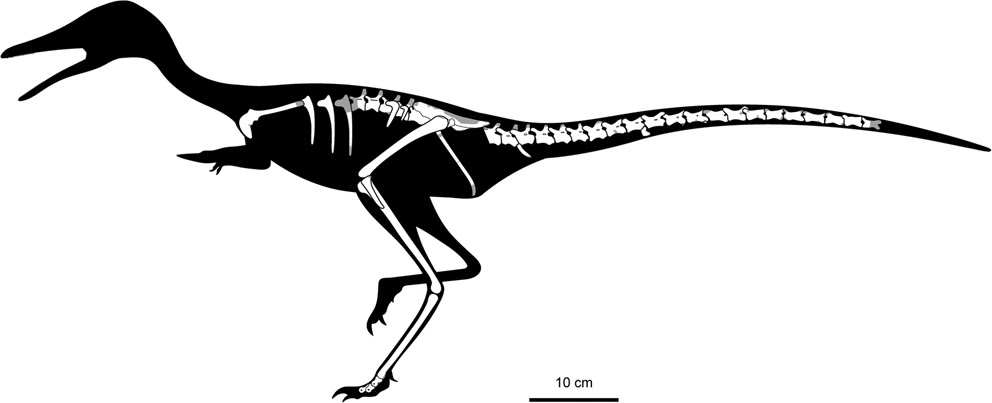
The other new alvarezsaur of 2019 was Nemegtonykus, which was also named after the geologic formation it was found in, the Late Cretaceous Nemegt Formation of Mongolia. Prior to the description of Nemegtonykus, the only alvarezsaur previously known from the Nemegt had been Mononykus. The holotype of Nemegtonykus is a partial skeleton including much of the tail, trunk, and left hindlimb. It exhibits patterns of bone fusion in the hip, shoulder girdle, and feet that are unique among alvarezsaurs.

Skeletal reconstruction of Nemegtonykus showing preserved elements, from Lee et al. (2019).

Therizinosaurs
Therizinosaurs are another group of maniraptors for which new species are described relatively infrequently. Last year gave us Lingyuanosaurus from the Early Cretaceous Jehol Biota of China, known from some vertebrae and partial limbs. The holotype is quite small (coyote-sized), though it probably represents a juvenile. The specimen is incomplete enough that it is unclear whether it really was a therizinosaur; Mickey Mortimer found it as an oviraptorosaur using the Hesperornithoides dataset, but also noted that a therizinosaurian identity was only slightly less parsimonious.

Oviraptorosaurs
In recent times oviraptorosaurs have usually gotten away with at least one or two new entries every year. Two were described in 2019. One was Xingtianosaurus from the Early Cretaceous Yixian Formation of China, a Caudipteryx-like form known from a partial skeleton with incompletely preserved wing feathers. The other was Gobiraptor from the Nemegt Formation, known from partial remains of the skull, hip, limbs, and tail. Bone histology suggests that the holotype of Gobiraptor was an immature individual, but, at over a meter in length, it was already larger than the adults of many other oviraptorosaurs. Oviraptorosaur researcher Greg Funston has mentioned on social media that unpublished evidence indicates that Gobiraptor is actually the same species as a previously-named oviraptorosaur.

Basal Paravians
2019 was a good year for what Justin Tweet calls "coming attractions" in dinosaur paleontology, which are essentially fossil dinosaurs known to the paleontological community through brief descriptions, conference presentations, and word of mouth, but have yet to receive a formal name. Although not all of them were included in Tweet's list (which was not meant to be exhaustive), I would consider the ornithopod Convolosaurus, the sauropod Wamweracaudia, the allosauroid Asfaltovenator, and the tyrannosauroid Suskityrannus to all qualify as long-standing "coming attractions" that were finally named last year.

Several maniraptoran "coming attractions" came to light in 2019 as well. One of these was the so-called "Naze dromaeosaurid", known from a foot from the Late Cretaceous Snow Hill Island Formation in Antarctica. First mentioned publicly in 2005 and then briefly described in 2007, this dinosaur was formally named Imperobator last year. Despite its original nickname, the describers of Imperobator found its precise phylogenetic position within Paraves difficult to place, and Andrea Cau has argued that it may not even be a maniraptor at all. The title of the paper that named Imperobator called it a "gigantic" paravian, yet its visible dimensions are comparable to those of Deinonychus. That's larger than average for a paravian, but "gigantic" may be overstating it.

One of the most highly anticipated "coming attractions" described last year was Hesperornithoides, a troodont from the Late Jurassic Morrison Formation of the United States. First announced in a conference abstract in 2004, Hesperornithoides (then nicknamed "Lori") was a big deal for several reasons, particularly the fact that Jurassic paravians other than Archaeopteryx were essentially unknown at the time. With the discovery of Anchiornis and its ilk since then, this is no longer the case, but Hesperornithoides remains notable for the three-dimensional preservation of its skeletal elements (as opposed to the flattened state anchiornithids tend to be preserved in) and for being the best-represented Jurassic paravian from North America.

Skeletal reconstruction of Hesperornithoides showing preserved elements, from Hartman et al. (2019).

Hesperornithoides also generated some buzz for the phylogenetic analysis that accompanied its description. The dataset used has greater taxon sampling than any other published analysis of Mesozoic theropods (it includes nearly all Mesozoic maniraptoromorphs known at the time of study and even a handful of Cenozoic birds), and originated from reevaluating the Theropod Working Group phylogenetic dataset, which has been the basis for the majority of Mesozoic theropod analyses. This resulted in several novel findings, such as Haplocheirus as a compsognathid (as mentioned previously) and Pelecanimimus as an alvarezsaur. Time will tell whether these results hold up, but this analysis highlights the importance of independently evaluating phylogenetic datasets, as repeatedly building directly on previous datasets can create an illusion of consensus.

Strangely enough, no new (definite) dromaeosaurids were named in 2019. Someone drew the short end of the stick.

Basal Avialans
In recent times, Archaeopteryx has generally been considered the only known paravian from the Late Jurassic of Germany, but this has started to change in the past few years. In 2017, one supposed Archaeopteryx specimen was reevaluated as an anchiornithid and given the new genus Ostromia. Last year added another new paravian to the lineup, Alcmonavis from the Mörnsheim Formation. Although it is known only from a forelimb, Alcmonavis appears to differ from Archaeopteryx in the robusticity of certain bones as well as the prominence of various muscle attachment sites.

Another exciting find in the Mesozoic avialan department was Fukuipteryx from the Early Cretaceous Kitadani Formation of Japan. Not only is it the first Early Cretaceous avialan to be found in Japan, Fukuipteryx is known from a partial, three-dimensionally preserved skeleton including much of the front and hind limbs. Despite having a short tail with a pygostyle, it was found to have been less closely related to modern birds than the long-tailed Jeholornis was, which may indicate that the pygostyle evolved more than once among avialans, as some other recent studies have suggested.

Skeletal reconstruction of Fukuipteryx showing preserved elements, from Imai et al. (2019).

Enantiornitheans
The "opposite birds" had a good showing last year, and probably the most intriguing new taxon was Elektorornis from the Late Cretaceous of Myanmar, known from hindlimbs and wing feathers preserved in amber. Burmese amber has produced some of the most spectacular fossils of Mesozoic dinosaurs in recent years, including partial specimens of juvenile enantiornitheans and the tail of a non-pygostylian theropod, but Elektorornis is the first of these fossils to be named. It had an unusually long third toe, which the authors suggest may have been used as a probing tool for foraging. It is likely also the smallest known mature Mesozoic dinosaur, the holotype being of comparable size to juvenile enantiornitheans from the same locality despite apparently being an adult or subadult.

Holotype of Elektorornis, from Xing et al. (2019).

Also particularly interesting was Avimaia from the Early Cretaceous Xiagou Formation of China. The holotype is a partial skeleton preserved with an unlaid egg, a first for Mesozoic avialans. Furthermore, histological examination of the egg revealed a double-layered eggshell, indicating that the unfortunate individual had likely died from egg binding (a usually fatal condition in which an unlaid egg is retained for an abnormally long time). A second specimen of Avimaia had been previously described in 2006, but had not been named.

Holotype of Avimaia, from Bailleul et al. (2019). Note the unlaid egg preserved in its body cavity.

As usual, the Jehol Biota did not skimp on enantiornitheans, giving us the relatively large (pigeon-sized) Gretcheniao and the smaller Mirusavis and Shangyang. Mirusavis is noteworthy for preserving medullary bone (produced by female birds before and during egg laying) throughout much of the skeleton, a more extensive distribution of this type of bone than seen in many modern birds.

Although not newly discovered, another Jehol enantiornithean that was given a new name in 2019 was Camptodontornis. It had been originally named "Camptodontus" in 2010, but this genus turned out to be preoccupied by a beetle. It is likely that Camptodontornis is the same as Longipteryx though, as had already been suggested by other studies.

Mesozoic Euornitheans
An unusual euornithean described last year was Mengciusornis from the Early Cretaceous Jiufotang Formation of China. Its teeth were large and curved, but restricted to the tip of the upper jaw. This deviates from the typical pattern in toothed euornitheans, in which the upper jaw tip was usually toothless.

Holotype of Mengciusornis, from Wang et al. (2019).

More closely related to modern birds were Antarcticavis from the Snow Hill Island Formation, known from a partial skeleton, and Kookne from the Late Cretaceous Chorrillo Formation of Argentina, known from a partial coracoid. The describers of Kookne suggest that it may even be a neognath, as it shares some similarities with waterfowl, but this is naturally difficult to verify with such a fragmentary specimen.

Paleognaths
One extinct paleognath was named last year, the emu Dromaius arleyekweke from the Miocene Waite Formation of Australia. Known mainly from hindlimb bones, D. arleyekweke was smaller than modern emus and cassowaries (even the dwarf cassowary). Its feet were proportionately very long, however, indicating that it was probably a fast runner.

Galloanserans
Among the galloanserans described last year was what I consider to be one of the most scientifically important new dinosaurs of 2019, the stem-waterfowl Conflicto from the Paleocene López de Bertodano Formation of Antarctica. It is the oldest unequivocal total-group anseriform known from well-represented remains, and may provide evidence that a long-legged, flat-billed body plan was ancestral to all modern waterfowl (including the unusual screamers). I wrote about Conflicto in more detail here. Another Paleocene waterfowl was described last year, the large (swan-sized) Naranbulagornis from Mongolia. It is far less completely known, represented only by a partial carpometacarpus and femur.

Skull of Conflicto, from Tambussi et al. (2019).

On the galliform side of things, 2019 gave us Xorazmortyx from the Eocene of Uzbekistan, which is only known from a partial coracoid. Its describers suggest that it belonged to a group of stem-galliforms called paraortygids, in which case it would be the first paraortygid known from Asia. Better remains are known for a trio of quail from the Macaronesian Islands, Coturnix alabrevis, C. centensis, and C. lignorum. These quail likely went extinct in historic times (within the last 1000 years) due to human activity. Their short wings suggest that they may have been flightless, which would have made them vulnerable to invasive predators.

Columbimorphs
The early fossil record of pigeons and their kin remains stubbornly sparse, but last year did welcome a new species of recently extinct pigeon, Ducula shutleri from Tonga. Known from sites dated to nearly 3000 years old, D. shutleri was the largest known member of the genus Ducula (the imperial pigeons), probably weighing over 1 kg. Despite its large size, there is no evidence that it had reduced flight capabilities.

Gruiforms
Last year we got a new member of the enigmatic Eogruidae, Sinoergilornis from the Miocene Liushu Formation of China. The life appearance of eogruids is mysterious, as they are known mostly from hindlimb bones, and unfortunately Sinoergilornis does not break that curse. Like some other eogruids, Sinoergilornis had only two toes per foot. Although I provisionally treat eogruids as gruiforms here, another study from last year noted that their assignment to Gruiformes is weakly based.

Two species of recently extinct, flightless rails were also described last year, Dryolimnas chekei from Mauritius and the large (chicken-sized) Hypotaenidia vavauensis from Tonga.

Charadriiforms
Surprisingly, given their diversity and frequent association with aquatic habitats, shorebirds have a relatively poor fossil record, but we did get a new fossil taxon in 2019, Cherevychnavis from the Miocene of Ukraine. Although it is very fragmentary (known only from a coracoid and partial humerus), it is notable for likely being a member of Charadrii (a group that also includes plovers, oystercatchers, etc.), which have a scant fossil record even by shorebird standards.

Ardeans
If any crown-bird group can claim to have a good fossil record, it's the penguins, and last year we gained three new species of extinct penguin, all from New Zealand. Two of these, the giant ?Crossvallia waiparensis from the Waipara Greensand and the smaller Kupoupou from the Takatika Grit, were from the Paleocene, making them some of the oldest known penguins. The third new penguin was Eudyptes warhami, a species of crested penguin that probably went extinct within the last 500 years.

The closest living relatives of penguins, the procellariiforms (petrels, albatrosses, etc.), have a decidedly worse fossil record. As such, the small albatross Aldiomedes from the Pliocene Tangahoe Formation of New Zealand was a pleasant surprise, especially seeing as it is known from a well-preserved skull. Its narrow beak suggests that it may have been more specialized for fish-eating than extant albatrosses (which feed more on squid).

Holotype of Aldiomedes, from Mayr and Tennyson (2019).

Two other waterbirds described last year were the ibis Geronticus thackerayi from the Pliocene-Pleistocene of South Africa, known from numerous (but often fragmentary) bones, and the heron Taphophoyx from the Miocene of the United States, only known from a coracoid and scapula.

Telluravians
The afroavian side of Telluraves only presented one new fossil species last year, but it was a good one: ?Laurillardia smoleni, a small stem-member of Upupides (hoopoes and woodhoopoes) from the Oligocene Tylawa Limestones of Poland. Not only is it known from a nearly complete specimen, the genus Laurillardia had been in severe need of a modern reevaluation.

Holotype of ?Laurillardia smoleni, from Mayr et al. (2019).

Things were more active on the australavian side, with the parrot Heracles from the Miocene Bannockburn Formation of New Zealand receiving substantial press attention. Heracles is known only from partial hindlimb bones, but these are enough to suggest a body mass of around 7 kg, making it the largest known parrot to have ever existed.

2019 was a good year for stem-passerines. The finch-like beaks of the Eocene Eofringillirostrum boudreauxi and E. parvulum showed that stem-passerines had evolved into seed-eating specialists long before true passerines did. E. boudreauxi was found in the Green River Formation of the United States, whereas E. parvulum was found in the Messel Formation of Germany. I wrote about these two species in more detail here. Another new stem-passerine was Zygodactylus ochlurus from the Oligocene Renova Formation of the United States, the youngest known stem-passerine from North America.

Holotype of Eofringillirostrum boudreauxi, from Ksepka et al. (2019).

Among crown-passerines, there was Dasyornis walterbolesi from the Miocene of Australia, the oldest known member of the bristlebirds, a poorly-studied group of Australian songbirds.

Miscellanea
The scansoriopterygids from the Late Jurassic of China continue to prove difficult to place phylogenetically. Already considered unusual since their discovery in 2002, scansoriopterygids rocked the paleontological world again in 2015 with the description of Yi, which appeared to preserve membranous wings partly supported by an elongated wrist bone (known as the styliform). Although this seemed to be the most plausible interpretation of the evidence, some researchers were naturally skeptical. 2019 gave us another new scansoriopterygid, Ambopteryx, which also preserves wing membranes and a styliform, providing support for the original interpretation of Yi.

Holotype of Ambopteryx, from Wang et al. (2019).

Another phylogenetically recalcitrant clade of maniraptors is the pelagornithids, a group of seagoing Cenozoic birds with tooth-like projections in their beaks. Protodontopteryx from the Waipara Greensand is the oldest known pelagornithid and is known from much of the skeleton, potentially making it very valuable for understanding the origins of these mystery birds. It would get my vote for the most scientifically important new dinosaur of 2019 (though Conflicto would be a close second). Protodontopteryx was much smaller than later pelagornithids (which include the largest known wingspans of any bird at up to 7 m wide), about the size of a typical gull.

Skull of Protodontopteryx, from Mayr et al. (2019).

Last but not least, Carpathiavis from the Oligocene of Poland is a small (sparrow-sized) bird of unclear affinities. It is known from a nearly complete (but poorly preserved) skeleton with some similarities to rail-like birds.