Tuesday, January 1, 2019

Review of 2018

I made fewer than 20 posts on this blog last year, a foreseeable consequence of continuing work on my PhD. However, I'd like to draw attention to the fact that I wrote at least one post for every month of the year, a first in the history of Raptormaniacs! These posts included summaries of recent scientific discoveries about maniraptors (some of which have ended up being among the most popular posts on this blog) as well as the usual conference and trip reports. Last year, I attended ProgPal, IPC, SVP, and PalAss, presenting my ongoing research at each one. A personal highlight of 2018 was the fact that I got to speak at TetZooCon. I also enjoyed visiting Dinosaurs in the Wild and the French National Museum of Natural History.

I said last year that I would at least try to update the Raptormaniacs askblog more often in 2018, which... uh, didn't happen. This was, in part, the fault of Tumblr for flagging the askblog as explicit without notifying me, but I didn't exactly follow through once the issue had been cleared up either. Mark my words though: as long as nothing happens to me, there will eventually be a proper conclusion to the Raptormaniacs comic. It might take months or (more realistically?) years before I get to work on it, but it will be done. I am all too familiar with the frustration of following an enjoyable web series that fades away without notice to let that be the eternal fate of one of my own major works.

Speaking of how web series end, last year my friend Joan Turmelle and I made the difficult decision to officially cancel one of our longstanding and very popular collaborations, the webcomic TetZoo Time. However, in its place we have started a new paleontology-themed comic, Chile & Yi, which can be followed on DeviantArt and Tumblr. I consider Chile & Yi in some ways to be a spiritual successor to both TetZoo Time and Raptormaniacs, so if anyone is somehow starved for the very niche genre of "paleontology webcomics I am involved with", I encourage them to check it out.

The first comic we made for Chile & Yi.

I made a few significant changes to this blog proper as well, namely retiring two of my few annual Raptormaniacs traditions: the April Fools' posts (by choice) and the favorite new maniraptor polls (by necessity). Dispensing with the April Fools' posts in particular was another tough choice to make and I share the disappointment that some of my friends and readers have expressed in response, but I do think it was the right decision in the end. I have been considering alternative ways of celebrating the occasion in coming years though, so stay tuned! On the whole, it can be said that 2018 was a time of change for Raptormaniacs, despite the reduced posting frequency.

National Geographic called 2018 the Year of the Bird, and as usual scientific advances in our understanding of maniraptors continued unabated. In January, the structure of super-black bird-of-paradise feathers was described. Emperor penguins were reported feeding at night during breeding period. Structures in the lower jaw of caenagnathids were interpreted as vestigial tooth sockets. Stress in female yellow-legged gulls was found to prime their young for quicker antipredator behavior. Alarm calls were shown to evoke a visual search image for predators in Japanese tits. A new specimen of Archaeopteryx and an amber-trapped juvenile enantiornithine were described. New studies came out on the morphometrics of hesperornithines in comparison to extant diving birds, the kinematics of avian take-off, variation in growth patterns of basal paravians, the evolution of song in ovenbirds, the development of flight feathers, the diversification of fluvicoline flycatchers, the benefits of tool use in New Caledonian crows, the anatomy of finger joints in ostriches, and the importance of spatial memory for long-billed hermits. Newly-named maniraptors included the anchiornithid Caihong juji, the Miocene passerine Kischinskinia scandens, and the Cretaceous euornithine Eogranivora edentulata.

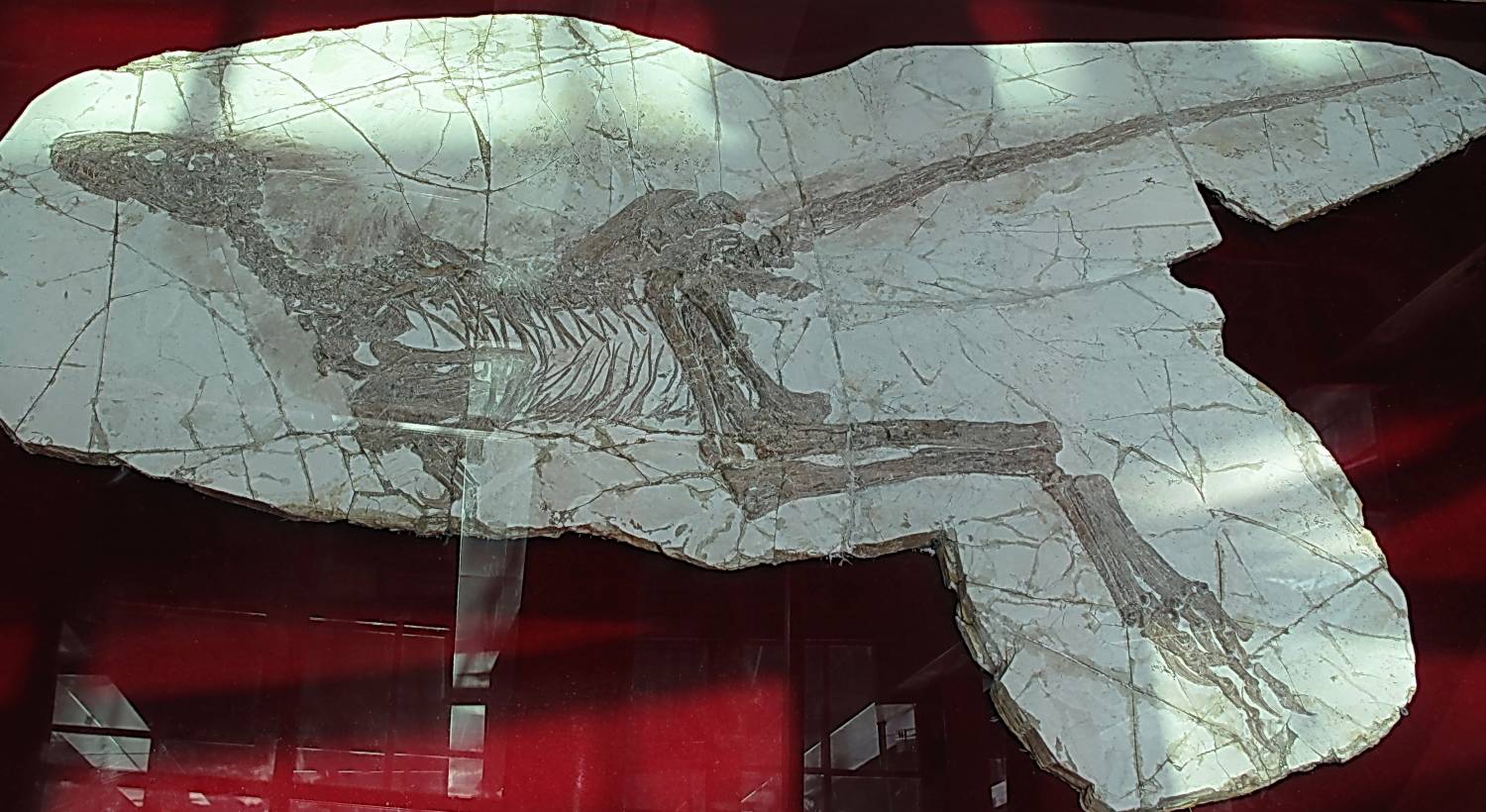
Holotype of Caihong juji, from Hu et al. (2018).

In February, a three-legged African penguin was reported. Tau accumulations (usually indicative of brain damage in humans) were documented in woodpeckers. New specimens of Anchiornis were described. Cognitive performance was shown to be linked to group size in Australian magpies. The ecology of New Zealand birds was inferred from coprolites. Yellow-billed oxpeckers were observed roosting on their mammalian hosts. It was argued that pelvic morphology prevented most Mesozoic avialans from sitting directly on their eggs. New studies came out on the adjustment of heart rate and body temperature in greylag geese, maneuverability in hummingbirds, thermoregulation in parrots, the distribution of medullary bone in birds, mimicry of hairy woodpeckers by downy woodpeckers, the evolution of drumming in woodpeckers, the biomechanics of terrestrial locomotion in birds, the taxonomic composition of vegaviids, the flight style of Concornis and Eoalulavis, the correlation between curvature and keratin sheath extent in beaks, the phylogenetic position of the Cuban macaw, and phalangeal joint kinematics of ostriches running on sand. Newly-named maniraptors included the Paleocene penguins Sequiwaimanu rosieae and Muriwaimanu tuatahi (formerly a species of Waimanu), the Miocene rails Litorallus livezeyi and Priscaweka parvales, the Miocene duck Chenoanas asiatica, and the southern dark newtonia (Newtonia lavarambo).

Downy woodpecker, photographed by Wolfgang Wander, under CC BY-SA 3.0.

In March, evidence of salt glands was reported in Iteravis. Black jacobins were found to vocalize above the known hearing range of birds. Genomic evidence of speciation reversal was documented in common ravens. A juvenile enantiornithine specimen was described. The diet of Mesozoic avialans was reviewed. Wing bone geometry in Archaeopteryx was put forth as evidence that it performed powered flight. The white-chested tinkerbird was shown to have been based on an individual of the yellow‐rumped tinkerbird. New studies came out on variation in avian egg shape and nest structure, the phylogeny of tytonid owls, call recognition in common cuckoos, the postcranial skeletal anatomy of Buitreraptor, cognitive deficiencies in hybrid chickadees, and the nanostructure of the avian eggshell. Newly-named maniraptors included the alvarezsaur Qiupanykus zhangi, the oviraptorosaur Anomalipes zhaoi, and the Oligocene heron Proardea deschutteri.

The skull of Iteravis, with a close-up highlighting the depressions that would have made space for salt glands, from Wang et al. (2018).

In April, the courtship display of the Vogelkop superb bird-of-paradise was released on film for the first time. The cranial anatomy of Confuciusornis was reevaluated. Teeth were found to represent a negligible proportion of body mass in avialans. Multiple parallel deinonychosaur trackways from the Tianjialou Formation and a new specimen of Citipati were described. Cowbird eggshells were shown to be more resistant to cracking than those of their hosts. Moa were discovered to not have dispersed large seeds. Madrynornis was redescribed. New studies came out on color polymorphism in owls, the phylogeny of neoavians, drivers of dwarfism in emus, the diversification of ovenbirds, the evolution of display complexity in birds-of-paradise, the benefits of high-speed stooping in peregrine falcons, the courtship display of Costa's hummingbirds, host suitability for common cuckoos, the morphometrics of accipitrid skull shape, the feeding mechanics of paravians (and other theropods), and the genome of the common loon. Newly-named maniraptors included the Pleistocene rail Rallus gracilipes.

The courtship display of the greater superb bird-of-paradise (A) compared to that of the Vogelkop superb bird-of-paradise (B), from Scholes and Laman (2018).

In May, deforestation was suggested to have contributed to differential survival in avialans during the K-Pg. A complete skull of Ichthyornis was described. Caller characteristics were found to influence recruitment to jackdaw mobs. Oviraptorosaurs were shown to have constructed their nests so that they could brood their eggs without crushing them. Incipient speciation and bony head protrusions in birds were reviewed. Hulsanpes was redescribed. The taxonomy of confuciusornithiforms was revised. New studies came out on migration to molting grounds in North American birds, the evolutionary assembly of the avian body plan, the biogeographic origins of Darwin's finches, the evolution of nesting characteristics in birds, visual fields in raptorial birds, the scaling of avian bipedal locomotion, feather development in ducks, skin ultrastructure of maniraptors, and the correlation between drumming behavior and genes that encode calcium-handling proteins in woodpeckers. Newly-named maniraptors included the Pliocene plover Vanellus liffyae and the Miocene galliform Panraogallus hezhengensis. The Ascent of Birds by John Reilly was published and my review of it can be found here.

Reconstructed skull of Ichthyornis, from Field et al. (2018).

In June, the evolution of tongue mobility in avialans (and other ornithodirans) was investigated. Cultural evolution in birds was reviewed. Age at fledging is found to be a cause and consequence of predation risk in passerines. Great tits were shown to have a high level of self control. New studies came out on high altitude colonization in ruddy ducks, nestling recognition in large-billed gerygones, genomic differentiation between northern flicker taxa, the taphonomy of submerged avian carcasses, the phylogeny of Antilophia and Chiroxiphia manakins, the ontogeny of the avian tail, the cranial morphology of Sinovenator, the evolution of vocal mimicry in songbirds, the phylogenetic position of Foro, and cultural transmission in New Caledonian crows. Newly-named maniraptors included the zygodactylid Zygodactylus grandei, the western square-tailed drongo (Dicrurus occidentalis), and the Whenua Hou diving petrel (Pelecanoides whenuahouensis).

Holotype of Zygodactylus grandei, from Smith et al. (2018).

In July, the spectacled cormorant was shown to have formerly lived in Japan. Coordinated misdirection was reported to be a widespread anti-predator behavior in Neotropical birds. Preserved eggshell cuticle in Cretaceous maniraptors was examined. Tactile interactions between American crows and dead conspecifics were documented. The development of avian digits was reviewed. New studies came out on the structure of parrot brains, egg size in Oriental cuckoos, aggressive interactions between crows and ravens, the phylogeny of Chaetura swifts, the agility of running birds, the visual displays of Costa's hummingbirds, the morphology of avian maxillae, the forelimb musculature of African gray parrots, the middle ear vasculature of passerines, the relationship between avian egg shape and rolling dynamics, the dynamics of take-off and landing in diamond doves, and the basicranial soft tissues of Nothronychus. Newly-named maniraptors included the Miocene passerine Cinclosoma elachum and the Oligocene osprey Pandion pannonicus.

Schematic of coordinated misdirection performed by a pair of yellow-throated euphonias, showing the female discreetly entering their nest as the male continues to fly onward, diverting the attention of observers away from the location of the nest, from Gulson-Castillo et al. (2018).

In August, the genome of the ʻalalā was assembled. Categorical perception of color was reported in zebra finches. Economic decision-making was found in parrots. New studies came out on heterospecific alarm call recognition in superb fairy-wrens, signatures of human commensalism in the house sparrow genome, the endocranial anatomy of oviraptorosaurs, the evolution of egg shape in birds, swimming kinematics in common loons, the incubation period of troodonts, facial display in blue-and-yellow macaws, the development of pelagornithid pseudoteeth, long-range dispersal in tawaki, color vision in Harris's hawks, and colonization of habitat patches by willow warblers. Newly-named maniraptors included the confuciusornithiform Yangavis confucii, the Oligocene passerine Winnicavis gorskii, and the alvarezsaurs Bannykus wulatensis and Xiyunykus pengi.

Select bones and reconstructed skeletal of Bannykus wulatensis, from Xu et al. (2018).

In September, preserved pellets were described in Anchiornis. Reflection of near-infrared light was found to be a thermoregulatory strategy used by birds. Ejecting parasitic cowbird eggs was shown to be costly for dickcissels. New studies came out on the killing kinematics of loggerhead shrikes, the visual attention of pigeons, genomic differentiation in recently-diverged avian species, molting patterns in gruiforms, the evolution of parental activity at the nest in birds, the preservation of Shuvuuia feathers, the abundance and survival of migratory birds in North America, the development of striped feathers in galliforms, and adaptations for having proportionately large brains in hummingbirds. Newly-named maniraptors included the basal pygostylian Jinguofortis perplexus, the elephant bird Vorombe titan, and the blue-throated hillstar (Oreotrochilus cyanolaemus).

Anchiornis specimen preserved with pellet, from Zheng et al. (2018).

In October, pigmented dinosaur eggshells were found to likely have originated among maniraptors. Patterns of diversification in the avian limb skeleton were shown to be correlated with clade-specific ontogenetic trajectories. A new specimen of Archaeorhynchus with preserved lungs was described. New Caledonian crows were reported to be capable of constructing compound tools. Rapid speciation in manakins was suggested to be linked to acrobatic courtship behavior. The sensory ecology of elephant birds was investigated based on endocranial anatomy, though inferences of nocturnality are likely premature. New studies came out on pair bonding in great tits, the courtship display of blue-capped cordon-bleus, the genetic basis for color polymorphism in Gouldian finches, song learning in savannah sparrows, the evolution of iris color in owls and signal modality in birds, the mitochondrial genomes of parrots, the phylogenetic position of Mascarene owls, the phylogeny of babblers, the origin of the Inaccessible Island rail, the diversification of Todiramphus kingfishers, near-ground soaring in Gyps vultures, heat-conservation behaviors in birds, the correlation between avian pelvis and egg size, the ontogeny of wing-assisted incline running, the senses used by scavenging birds, the taxonomy of the white-browed shortwing, and stability during avian take-off. Newly-named maniraptors included the basal avialan Archaeopteryx albersdoerferi, the enantiornithine Orienantius ritteri, and the Rote leaf warbler (Phylloscopus rotiensis).

The evolution of eggshell pigmentation mapped onto archosaur phylogeny, from Wiemann et al. (2018).

In November, the crest feathers of peafowl were shown to be attuned to frequencies generated by their courtship displays. A three-species hybrid wood-warbler was reported. The textbook wisdom that the black bib of house sparrows signals dominance was questioned. The molecular and cellular profiles of avian scales were shown to be distinct from those of crocodylian scales. The smallest known dromaeosaurid tracks were described. New studies came out on plumage patterns of Confuciusornis, tool making in Goffin's cockatoos, gliding strategies in Gyps vultures, the evolution of iridescent plumage, fuel load in birds, the biomechanics of foraging flight in common swifts, the genetic basis for bill size in black-bellied seedcrackers, correlated complexity in the displays of birds-of-paradise, and the phylogeny of Hylopezus and Myrmothera antpittas. Newly-named maniraptors included the enantiornithines Mirarce eatoni and Gettyia gloriae (formerly a species of Avisaurus).

The suggested formation of a three-species hybrid wood-warbler (pictured in C), from Toews et al. (2018).

In December, amber-trapped specimens of rachis-dominated feathers were described. Medullary bone was reported in an enantiornithine. Hybrid speciation in birds was reviewed. A nesting rufous-tailed hummingbird was documented mistakenly attacking a snake-mimicking caterpillar. Secondary flightlessness was shown not to correlate with brain morphology in neornithines. Aerodynamic forces produced by the wings of Caudipteryx were found to have been limited. New studies came out on different rates of ageing between different white-throated sparrow morphs, the genomic basis for increased cognition and longevity in parrots, the structure of primary feathers, the evolutionary links between different signaling traits in hummingbirds, the relationship between beak shape and feeding ecology in birds, population differentiation in northern cardinals, the development of avian forelimb position, the courtship display of broad-tailed hummingbirds, and the phylogenetic affinities of Calcardea. Newly-named maniraptors included the recently extinct pigeon Ducula tihonireasini.

Rachis-dominated feathers preserved in amber, from Xing et al. (2018).

Saturday, December 22, 2018

PalAss 2018

This year's PalAss was held in Bristol! The weather wasn't on our side; trekking back and forth between different buildings in the rain wasn't the most fun of experiences, and one of the buildings they decided to use felt cramped for the number of people present. (I hear that the weather did clear up just in time for the post-conference field trips, which I didn't attend.) Other than that, however, it was good to be back and to catch up with everyone there.

The conference dinner was quite atmospheric, taking place in the Bristol Museum and watched over by a Pliosaurus.

As usual, I will list off a few presentations that I found particularly memorable:
  • François Therrien's talk on the effects of long-term climate change on Late Cretaceous dinosaur diversity
  • Tom Stubbs's talk on avialan diversification
  • Luke Parry's talk on Cambrian stem-gastrotrichs
  • Thomas Clements's talk on taphonomy of the Mazon Creek
  • Guillermo Navalón's talk on cranial evolution of strisorians (relevant to my own research...)
  • Elsa Panciroli's talk on a new specimen of Borealestes (which went on to win the President's Prize)
  • Delphine Angst's talk on dodo ecology
  • Laura Cotton's talk on the evolution of large size in Nummulites (I would not have guessed that a talk on foraminiferans could be so entertaining, but it goes to show the value of a good presenter!)
Beyond that, I don't have much else to report. As with the other conferences I attended this year, I presented (as a poster in this case) my own ongoing research on strisorian phylogeny and evolution. I still don't have anything ready to publicly unveil on that front, but with luck I'll get to talk a bit more about it in the not-so-distant future.

Wednesday, December 12, 2018

The Ascent of Birds

In honor of the centennial of the Migratory Bird Treaty Act, National Geographic has deemed 2018 the Year of the Bird. It is therefore appropriate that this year saw the publication of a general audience book about the evolutionary history of birds, and that book is The Ascent of Birds by haematologist and birder John Reilly. This book is not focused on the origin of birds from non-avian dinosaurs, which has already been the subject of several existing titles. Instead, it covers recent advances in our understanding of evolution within neornithine (crown-group) birds, a topic that certainly receives less attention in popular writings.


When I first saw the table of contents for The Ascent of Birds, I was instantly reminded of one of my favorite books on evolutionary biology, Richard Dawkins's The Ancestor's Tale. (Yes, I'm aware that Dawkins is not exactly a popular figure these days, but his writings have had a major influence on the development of my own understanding of evolutionary biology, and I know I'm not the only one to make that claim.) The Ancestor's Tale traces the origin of humans (and eventually of all extant life) backwards through time, starting with the last common ancestor of all modern humans and ending with the last universal common ancestor (LUCA) of life on Earth, with some discussion of the origin of life itself. Along the way, other modern life forms are introduced in decreasing order of relatedness to us (i.e.: chimpanzees join first, bacteria last), and some of them are assigned "tales" that explain different aspects of biological evolution. For example, "The Howler Monkey's Tale" discusses the evolution of color vision in primates and "The Fruit Fly's Tale" talks about Hox genes.

Lo and behold, in the prologue to The Ascent of Birds, Reilly cites The Ancestor's Tale as the main inspiration for how his own book is formatted. In The Ascent of Birds, specific types of birds are similarly given "stories" about more generally applicable evolutionary concepts that the birds exemplify in some way. Unlike The Ancestor's Tale, this book starts out with the oldest divergence among crown-birds (i.e.: the split between paleognaths and neognaths) and then goes on to cover more recent evolutionary events, instead of being a journey backwards in time. Additionally, even though the chapters are arranged in a roughly phylogenetic order, they do not strictly adhere to a specific topology except in some cases where a general consensus has been established. I consider that a good decision, given that the phylogenetic relationships between major neornithine groups remain controversial. (Reilly does cite Jetz et al., 2012 as his main source for how his chapters are ordered, but some of the chapter arrangements nonetheless deviate from this study. It should be noted that the phylogeny presented by that paper has since been superseded by more recent studies such as Jarvis et al., 2014 and Prum et al., 2015.)

With this arrangement, the book starts out with "The Tinamou's Story", which discusses how the traditional thinking of paleognaths as textbook examples of remnants from Gondwanan breakup was dismantled by later scientific research (a story that, incidentally, is also covered in the second edition of The Ancestor's Tale). This is followed by "The Vegavis's Story", the only chapter headlined by a fossil bird, which tells of the Mesozoic origin of neornithines and their survival across the Cretaceous-Paleogene (K-Pg) mass extinction. "The Waterfowl's Story" covers several subjects, including the role of isolation in anatid evolution, adaptations to high altitude flight (as seen in bar-headed geese), and how the penis (which is infamously elaborate in many waterfowl) was lost in most other birds, the last of which provides a segue into neoavian birds.

Unlike other extant paleognaths, tinamous can fly. However, it is now known that they are more closely related to some flightless paleognaths than to others, suggesting that the different flightless paleognath groups lost flight independently. Photographed by "Stavenn", under CC BY-SA 3.0.

Neoavians start off with "The Hoatzin's Story", which talks about how fossil evidence suggests that the ancestors of the modern hoatzin underwent a trans-Atlantic dispersal from Africa to South America, likely involving "natural rafts" of vegetation. (This same journey has been inferred for some other South American groups like New World monkeys and caviomorph rodents.) "The Penguin's Story" talks of how penguins gained their many unusual characteristics that make them superbly adapted to cold marine environments. "The Storm Petrel's Story" explains allopatric and sympatric speciation, using the Monteiro's storm petrel as an example of how speciation can occur without geographic separation. "The Albatross's Story" covers the ever-contentious question of what constitutes a "species", and "The Godwit's Story" looks at the evolution of migration.

"The Buzzard's Story" discusses speciation as primarily a chance event, as suggested by recent studies. "The Owl's Story" looks at adaptations to nocturnal life, and is followed by a chapter on another nocturnal bird, "The Oilbird's Story", which talks about the concept of evolutionary distinctiveness (famously used by the EDGE of Existence program as a way of prioritizing species to focus on for targeted conservation efforts). "The Hummingbird's Story" deals with the origins of those miraculous dinosaurs trying to be butterflies, a topic closely related to my own research interests. "The Parrot's Story" covers vicariance and dispersal, and how both may have contributed to the present-day distribution of parrots.

Hummingbirds are remarkable in every way, from their lifestyle to their morphology to their evolution from swift-like ancestors. Photographed by "Nature's Pics Online", under CC BY-SA 3.0.

After that, Reilly turns to the passerines, which account for 60% of all living birds. Their origins are explained in "The New Zealand Wren's Story". Of all the chapters in this book, this one seems poised to be the first to become outdated by new scientific research. Although acknowledging that dissent exists, the chapter ultimately favors the idea that New Zealand wrens diverged from other passerines in the Cretaceous, with the separation of Zealandia from the rest of Gondwana. As Reilly notes in the prologue to the book, several recent papers have estimated much younger dates for the origin of passerines, casting further doubt on this concept. These papers include the aforementioned broad-scale studies by Jarvis et al. and Prum et al., as well as more focused research on passerines specifically.

Delving deeper into passerines, "The Manakin's Story" covers the diversification of suboscine passerines. "The Sapayoa's Story" looks at the enigmatic sapayoa, the lone New World suboscine that is more closely related to Old World suboscines. The oscine passerines, or songbirds, are introduced with "The Scrubbird's Story", which discusses their origins in Australia. "The Bowerbird's Story" is used to explain extended phenotypes, another Dawkins-inspired concept. "The Crow's Story" appropriately focuses on the evolution of cognitive skills, and "The Bird-of-Paradise's Story" is dedicated to (what else?) sexual selection.

"The Starling's Story" discusses the evolution of structural colors (which I coincidentally wrote about recently). "The Thrush's Story" goes over the concept of unlikely (sweepstakes) dispersals. Hybrid speciation is covered by "The Sparrow's Story" in describing the origins of the Italian sparrow. "The Zebra Finch's Story" looks at the evolution of birdsong. "The White-eye's Story" talks about characteristics that make a "great speciator". "The Crossbill's Story" is one of coevolution between the birds and the coniferous trees that produce the seeds they feed on. Finally, "The Tanager's Story" examines one of the most recent and diverse passerine radiations, one that gave rise to everything from seedeaters to flowerpiercers to Darwin's finches.

Darwin's finches are not true finches at all, but are tanagers that colonized the Galápagos Islands. Photographed by "putneymark", under CC BY-SA 2.0.

Those are a lot of complex concepts to explain to a general audience. Does The Ascent of Birds do so effectively? For most part, I would say yes. One of the greatest strengths of this book is that Reilly's writing is eminently readable and does an excellent job of clearly explaining otherwise daunting subjects. This does, however, make the (very few) lapses in this regard particularly jarring. At one point, for example, the word "teleost" is used with no further explanation, even though this is a term unlikely to be already present in the lexicon of many prospective readers.

Overall, when it comes to using bird evolution as a vehicle to explain broader evolutionary concepts, I think that this book is quite successful. But does it really tell the evolutionary story of all crown-birds? I do generally approve of Reilly's choices of specific birds as exemplars for the different stories, and those birds do collectively span the diversity of all living birds. However, I can't help but feel that the story could have been more inclusive still.

Naturally, an overview of the precise evolutionary history of every individual bird species would have been impractical for numerous reasons. Reilly understandably had to be selective in his choice of birds to focus on. However, many of the bird groups that aren't given stories are relegated to passing mentions at most. These "omitted" groups include diverse or distinctive clades such as flamingos, cuckoos, and herons. (Come to think of it, parasitic cuckoos could have been given a very interesting story about the evolution of brood parasitism and arms races between parasites and their hosts.) In contrast, The Ancestor's Tale gave a dedicated chapter to every lineage "encountered" during the journey to LUCA, even those that weren't assigned "tales". Those chapters provided interesting details about the biology of these organisms and helped drive home the central theme of common ancestry. It would have been nice to have seen similar treatment given to the non-"storytelling" birds in The Ascent of Birds.

That being said, I wouldn't hold such omissions against The Ascent of Birds too much. It's already an impressive book for what it is. I do, however, have a few nitpicks about the book as it stands. Squid are incorrectly referred to as copepods (presumably "cephalopods" was intended), and I suspect many paleontologists who work on the Hell Creek Formation would balk at the claim that Vega and James Ross Island provide the "best picture" of life immediately prior to the K-Pg boundary. The ability to nest entirely free of sediment is suggested as a possible factor that contributed to neornithine survival across the K-Pg, but the source cited for this statement appears to be a self-published article by a non-biologist, even though this proposal has been made in peer-reviewed literature. Lastly, I did find one unambiguous inaccuracy: the recently extinct piopio are said to be bowerbirds (which they resembled in their behavior), but molecular evidence has shown they were actually unusual orioles.

All of those are minor parts of the book that barely detract from the overall enjoyment of reading it. The evolutionary history of neornithines in deep time is an exciting field of active, interdisciplinary scientific research, and The Ascent of Birds puts up a strong showing in bringing that excitement to a broader audience. If one is looking for a popular overview of neornithine evolution, this title is not one to overlook.

Thursday, November 29, 2018

Dazzle Like a Diamond in the Rough: The Evolution of Iridescent Plumage

From peacocks to hummingbirds, some of the most brilliantly-colored birds get their spectacular hues from iridescence. In feathers, iridescence is produced through a combination of melanin pigments and the keratin that makes up the feathers themselves. Light is scattered when it hits an iridescent feather; part of it is directly reflected by the surface layer of keratin, but another part passes through to the underlying melanin. If the light is white light (which it typically is), the melanin will absorb part of the beam that passes through while reflecting another part back out through the keratin layer. The two reflected beams travel parallel to one another, and depending on the angle they are viewed at, they can either strengthen one another or partially cancel each other out. This is why the brightness of iridescent objects changes when they are viewed from different directions. The feathers of some iridescent birds have multiple keratin and melanin layers that enhance this effect.

On its own, melanin generally produces shades of gray, brown, or black, but iridescence has the potential to create just about any type of color. This is determined by the thickness of the keratin and melanin layers, which influences the specific wavelengths of light they reflect. Given this versatility and its inherent glimmering qualities, it's no surprise that iridescence has been adopted by so many birds (and other animals) for the purpose of visual display.

Male Anna's hummingbird showing off its brilliant iridescent plumage, photographed by "Norvig", under CC BY-SA 3.0.

The cell structures that contain melanin pigments in feathers are called melanosomes, and in recent years paleontologists have become increasingly interested in melanosome morphology. This is due to the discovery that melanosomes are often preserved in fossilized feathers and other soft tissues. Studying the correlations between melanosome shape and plumage coloration has allowed the original colors of various fossil species to be at least partly inferred.

As it turns out, melanosomes that contribute to iridescence come in several different forms. They can be solid and cylindrical, making them similar to typical melanosomes that produce blacks and grays. However, they are generally still recognizable by being relatively longer and thinner in shape compared to "standard" melanosomes. Iridescence-producing melanosomes can also be hollow and cylindrical, solid and flat, or hollow and flat. These specializations make sense for generating iridescence, as being hollow increases the number of surfaces scattering light and a flattened form allows many melanosome layers to be packed into a single feather.

Schematics showing different morphologies of iridescence-producing melanosomes with examples of bird groups that have each type, from Nordén et al. (in press). (A) shows solid, cylindrical melanosomes (found in galliforms), (B) shows hollow, cylindrical melanosomes (found in trogons), (C) shows solid, flat melanosomes (found in sunbirds), and (D) shows hollow, flat melanosomes (found in hummingbirds).

These distinctive morphologies have led to iridescent plumage being inferred for several extinct theropods, including the dromaeosaurid Microraptor, the anchiornithid Caihong, an unnamed enantiornithine, the Eocene apodiform Eocypselus, and the Eocene gruiform Messelornis. Most of these taxa had cylindrical melanosomes, but Caihong is known to have had flat ones. Unfortunately, it is currently impossible to assess the original thickness of the keratin layers in these fossil feathers, so the exact hue of iridescence in these taxa cannot be reconstructed.

However, even in living theropods, the diversity of iridescence-producing melanosomes is not fully understood. To investigate the variety and evolution of melanosomes that contribute to iridescence, a new study assembled the largest dataset of iridescent bird feathers to date and compared their melanosome forms to those of other feathers. The authors found that iridescence-producing melanosomes were far more morphologically diverse than melanosomes that generate other colors, taking on forms that have not been observed in any other kind of melanosome. This is perhaps not a surprise, given that iridescence-producing melanosomes are the only ones known to be hollow or flattened.

Morphospace graph showing the morphological diversity of melanosomes, from Nordén et al. (in press). Note that iridescence-producing melanosomes (in purple) cover a much larger area than any of the other types.

Despite this diversity, the iridescence-producing melanosomes of different birds tend to converge on each another in form. Iridescence has evolved many times in birds (more than three times in galliforms alone), and yet the melanosomes that produce it are typically similar in width, length, and aspect ratio. At least, that is the case when it comes to cylindrical melanosomes. Flat melanosomes (especially hollow ones) do not show such striking convergence between the bird groups that have them. This may be because their flattened shape allows for greater variation in general. For example, width and thickness are equivalent for cylindrical melanosomes but are independently variable parameters for flat ones.

As a matter of fact, it is not clear why cylindrical melanosomes show such a strong trend of convergence to begin with, given that not all variables governing melanosome form directly affect color production. The authors suggest the trend may relate to the optimal organization of the melanosomes within a feather, an interesting idea that awaits further testing.

Probably the most exciting aspect of the study (from a paleontologist's perspective) is that the authors were able to use their big dataset to test the accuracy of different models used to infer plumage coloration from melanosome morphology. They applied the most accurate model they found to two fossil birds with preserved feathers: the Eocene swift Scaniacypselus and the Oligocene trogon Primotrogon. Both of these birds have close modern relatives with iridescent plumage.

The model did predict one feather sample from Scaniacypselus as iridescent, but with low statistical confidence. Several other samples were inferred to be gray or brown, with greater statistical support. Thus, the authors concluded that the feathers they sampled from Scaniacypselus were probably not iridescent.

My amateur restoration of Scaniacypselus, which was inferred to have had non-iridescent, gray feathers across its body by Nordén et al. (in press). One feather sample from the leading edge of its wing was also inferred to have been brown, but that region probably wouldn't have been visible when the wings were folded. The authors do caution that the gray plumage they sampled might have represented down feathers (which are typically gray in most birds), in which case their results might not be so indicative of how Scanicacypselus would have looked in life.

Gray plumage was also inferred for most of the samples from Primotrogon. However, one Primotrogon sample was strongly suggested to be iridescent! Interestingly, the melanosomes responsible for this inferred iridescence were solid, not hollow as in modern trogons. This is consistent with previous studies on the evolution of iridescence in birds: iridescence-generating melanosomes that are flat, hollow, or both readily evolve from one another, but rarely (possibly never) revert back to the ancestral solid, cylindrical form.

My amateur restoration of Primotrogon, which was inferred to have had gray and iridescent wing feathers by Nordén et al. (in press). (Okay, actually a colored-in restoration of Masillatrogon, which was morphologically similar to Primotrogon.) The hue of iridescence is unknown; I depicted it as green based on modern trogons. As with Scaniacypselus, the authors caution that they couldn't reject the possibility that the gray feathers were down.

I look forward to seeing this new dataset used to study the origin of iridescence in other bird groups. Certainly there are quite a few bird specimens from Messel that would be interesting to look at!

Reference: Nordén, K.K., J. Faber, F. Babarović, T.L. Stubbs, T. Selly, J.D. Schiffbauer, P.P. Štefanić, G. Mayr, F.M. Smithwick, and J. Vinther. In press. Melanosome diversity and convergence in the evolution of iridescent avian feathers—implications for paleocolor reconstruction. Evolution in press. doi: 10.1111/evo.13641

Friday, October 26, 2018

SVP 2018

Another year, another SVP! This time, we convened in Albuquerque, New Mexico. Just like in 2016, I was on the authorship of two posters presented at SVP. As before, one of these posters was about scientific outreach using the internet. My co-authors (Meig Dickson, Austin Deans, Henry Thomas, Blaire Voss, and Maya Jade McCallum) and I described our experience in running an informal online course about dinosaur paleontology earlier this year, and evaluated whether our methods of teaching were effective (spoiler alert: for most part, they were!). Meig presented our poster on the first day of the conference and will probably write up her own report about it in due course.

One of the star attractions of this year's SVP was this model of Utahraptor made by TRX Dinosaurs.

The welcome reception this year was held at (where else?) the New Mexico Museum of Nature and Science. My one regret is that I apparently didn't get any photos of the temporary paleoart exhibit Picturing the Past. (Check out this Twitter thread by Brian Engh for a selection of the impressive works on display!)

In the main hall of the museum, conference attendees were welcomed by a cast of the Tyrannosaurus specimen "Stan".

The museum's Triassic gallery was particularly impressive, as might be expected. Here are some fossils (and a partial life restoration) of an erythrosuchid. It's quite a large animal!

A block of Coelophysis specimens!

A wall of phytosaurs.

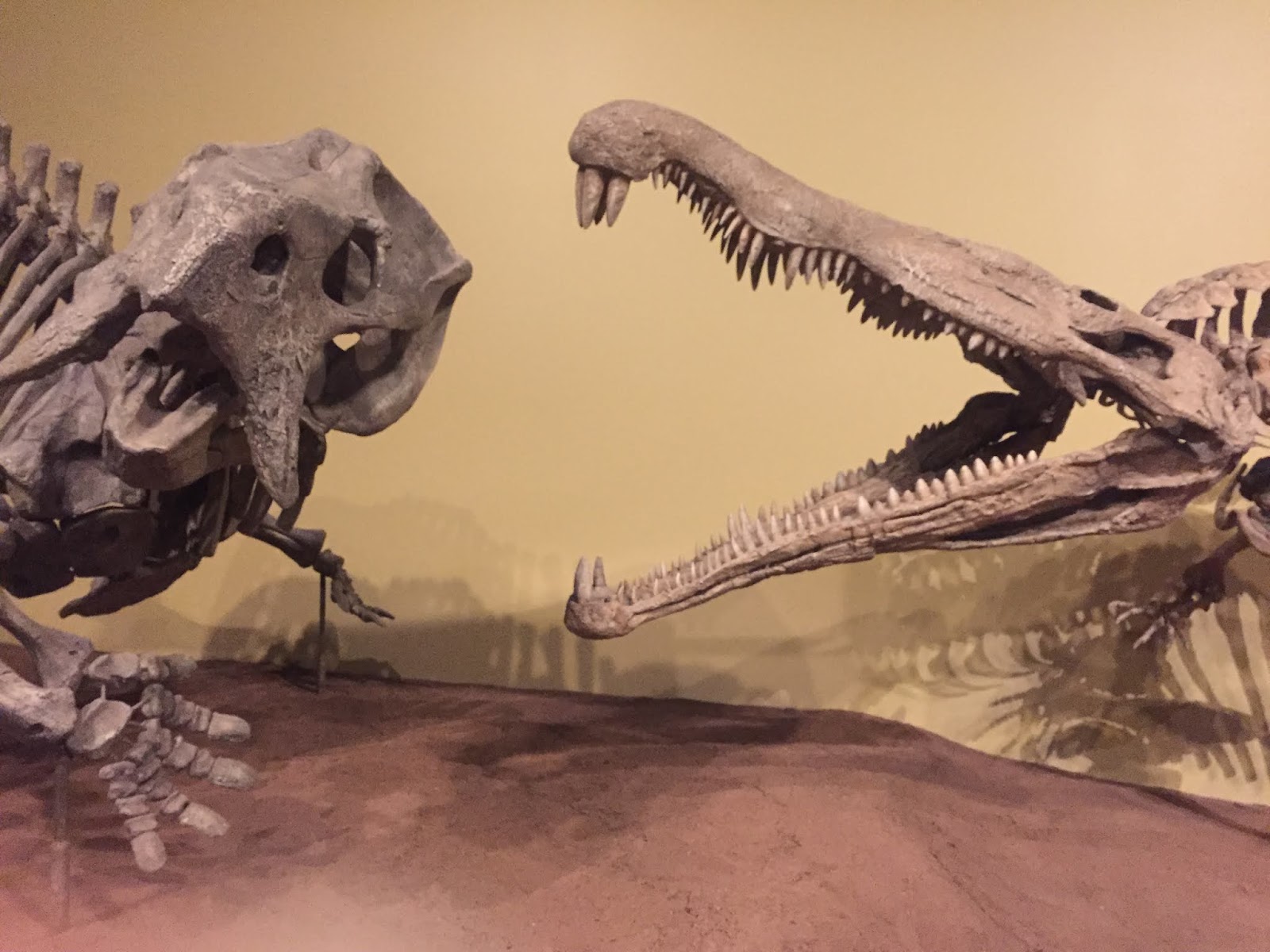
A Placerias realizes it has come within striking range of a Redondasaurus.

In the Jurassic hall, a Stegosaurus looks out on a confrontation between a Saurophaganax and a Diplodocus ("Seismosaurus").

Moving onward to the Cretaceous, here is a skull of Pentaceratops.

I was pleased to see that museum signage correctly marked dinosaurs as having survived the K-Pg extinction (so much so that I hadn't even noticed they were using the outdated term "Tertiary").

A few live gar were on display, presumably to represent a lineage of animals that supposedly hasn't changed much since the Cretaceous.

A highlight was the fact that the museum had concentrated their most impressive local fossil specimens in a temporary exhibition area. Here is a very complete specimen of the aetosaur Typothorax.

The tyrannosaurid Bistahieversor.

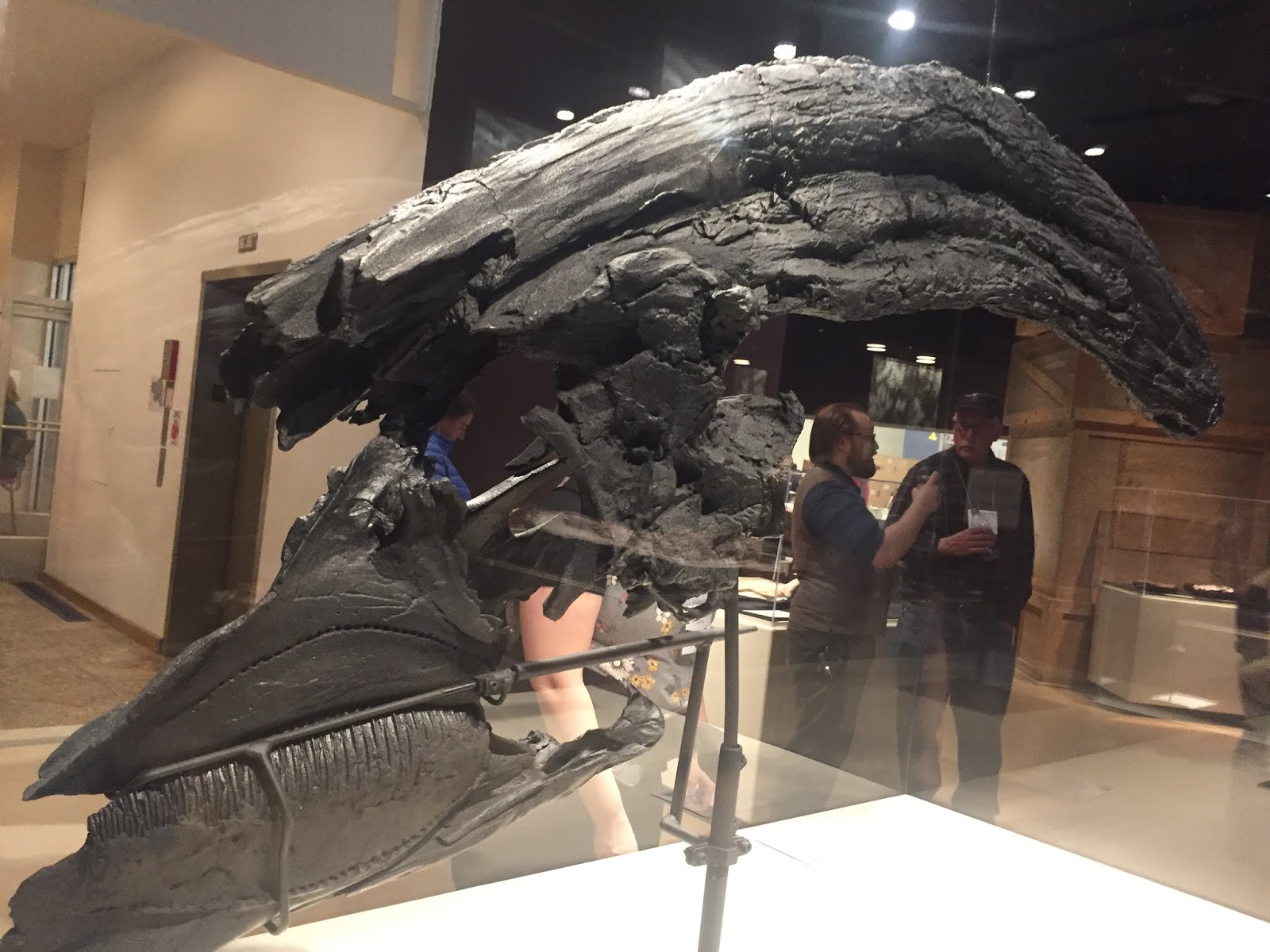
A partial skull of Parasaurolophus.

The early synapsid Sphenacodon.

On the second evening of SVP, many bird paleontologists gathered together for a "bird dinner", an event that had also occurred last year and seems poised to become a new SVP tradition. There were some snags with the logistics of getting everyone to the dining venue, but it appeared that much fun was had by all who attended. I ended up sitting next to Mike Habib, who regaled everyone at the table with facts about soaring animals and tales about his experiences testifying as an expert witness for crime trials.

It was also nice to have a University of Maryland reunion lunch on the third day (Friday) with my former instructors Thomas Holtz and John Merck and fellow alumni Benn Breeden, Susan Drymala, and Eugenia Gold, which hadn't been possible last year as several of us had not been in attendance.

Friday was also the day that I was scheduled to present my other poster, focusing on my own PhD research. I'd already presented this work earlier in the year during ProgPal and IPC, but (as expected) SVP provided me with the most substantial and diverse feedback on it. Thanks to Jordan Bestwick, Michael Hanson, Christian Kammerer, Mike Keesey, Dan Ksepka, David Marjanović, John Merck, Grace Musser, JP Nassif, James Proffitt, and many others for stopping by to chat. I got the impression that I left an overall positive impression, and I'm excited to wrap this project up and ready it for publication. As for those of you who haven't seen me present this research at ProgPal, IPC, or SVP, I'm afraid I'll have to make you wait just a little longer...

This is all I can show of my poster for now, sorry!

Meig had invited several friends (myself included) to her Shabbat dinner for Friday night. This, too, ran into some logistical issues (namely that the dinner was scheduled to start before the poster session ended...), but fortunately enough food was still left by the time I made my way there. Afterward, we were all also able to return to the conference in time for the auction, so it all worked out in the end.

This year's live auction theme was Doctor Who. The auction was entertaining as always, though I feel that I had a bit more fun at last year's auction by a small margin. This may have been partly because I was more familiar with last year's source material (the Guardians of the Galaxy films), but I suspect that the inclusion of a very inappropriate shirt in the preceding silent auction soured things for many attendees. Here's hoping that the discussion sparked by this kerfuffle leads to the implementation of more effective society policies moving forward.


I realize that those of you who have read this far are probably tired of hearing about who I had dinner with each night, and I still haven't listed my favorite talks of the conference yet, so I will do so now:
  • Mickey Mortimer's talk (presented by David Marjanović) on reevaluating Ornithoscelida
  • Viktor Radermacher's talk on the ornithischian respiratory apparatus
  • Emily Lessner's talk on identifying osteological correlates for crocodylian-style facial sensors
  • Tetsuto Miyashita's talk on the ontogeny of Paleozoic stem-lampreys (this year's Romer Prize winner)
  • David Grossnickle's talk on the adaptive radiation of therian mammals
  • Scott Hartman's talk on the origin of avian flight
  • Alida Bailleul's talk on a new enantiornithine preserved with unusual mineralized tissue
  • Greg Erickson's talk on the ontogeny of Ugrunaaluk
  • Eric Snively's talk on turning abilities in tyrannosaurids (which did a good job of keeping the audience attentive considering it was an 8:00 AM talk on the last day!)
  • Pete Makovicky's talk (presented by Eric Gorscak) on a new specimen of Tianyuraptor (yes, it's this specimen that's been circulating on the internet for some time)
  • Adam Pritchard's talk on forelimb function in Drepanosaurus
  • Savannah Olroyd's talk on chameleons as a possible analogue for hearing in non-mammalian therapsids
  • Roger Smith's talk on ecosystem collapse during the Permian mass extinction, which dropped the major bombshell that we now know of Lystrosaurus skin impressions!
Unfortunately, the one talk on alvarezsaurs (apparently reporting on a new species from the Hell Creek Formation) was cancelled, which I was quite disappointed by. However, Boban Filipović's model of a Hell Creek alvarezsaurid won the 3D art category for the Lanzendorf Paleoart Prize competition, so alvarezsaurs made at least one high-profile appearance at the conference.

On the whole, SVP was a rollercoaster ride of fun (for most part) from start to finish, as it typically is. This was the year that I was struck by just how many people in the community I know now, to the point where the entire conference went by without me having run into some of them! There was lamentably little chance to exchange more than a few words even with many of those who I did meet. Perhaps not coincidentally, this year's SVP was the biggest to date, numbering over 1300 attendees. (A bit of fun trivia: as far as I'm aware, Dougal Dixon and myself were the only individuals to have attended both TetZooCon and SVP this year.)

Not only was this the biggest SVP so far, it also hosted the largest gathering of members from my Palaeo-Tumblr friend group. Individuals represented are Tristan Stock (Leaellynasaura), myself (Albertonykus), Meig Dickson (Kulindadromeus), Tyler Young (Cryolophosaurus), Bobby Ebelhar (Triceratops), John D'Angelo (Ornithopsis), Sam Stanton (Deinonychus), Henry Thomas (Zhejiangopterus), Austin Deans (Machairasaurus), and Kevin Sievers ("Diplotomodon").

Several attendees have joked that next year's SVP (which will take place in Brisbane, Australia) is likely going to be the smallest SVP to date. I, for one, would certainly like to go, but I suppose we'll see.

Tuesday, October 9, 2018

TetZooCon 2018

This year's TetZooCon was the biggest so far, spanning two days instead of one. I suspect that many attendees would agree with me that it was also the best one so far. It was probably the most fun I've had a zoological gathering, and that's saying something!

Mark Witton was gracious enough to indulge my request for an alvarezsaur sketch when he signed my copy of The Palaeoartist's Handbook, despite admitting that it'd been a while since he'd drawn one. I ended up pulling up Scott Hartman's Mononykus skeletal for him to use as a reference, which felt like the least I could do.

For starters, there were some truly brilliant talks (though this is par for the course for TetZooCon). Some of my favorite presentations from the first day include Jennifer Jackson's talk on mysticete evolution, Lucy Cooke's talk on her book The Truth About Animals (so many laugh-out-loud moments!), and Katrina van Grouw's defense of domestic animals as scientifically important subjects of study. In addition, Fiona Taylor's talk on music in nature documentaries ranks among the most interesting talks I've ever heard at an event of this sort, shedding much insight on a subject that many (myself included) had been subconsciously aware of but rarely think about in detail. (Additional commentary on Taylor's talk, along with some music clips used in the presentation, can be found on SV-POW.)

This year's TetZooCon was the first to have a themed session of presentations. This was the bird session on the second day, including my talk. (Oh, right, I got to give a talk this year!) However, Darren Naish had also invited us bird speakers to partake in a panel discussion on the afternoon of the first day, and so it was such that I found myself answering questions about bird evolution onstage alongside Caitlin Kight, Hanneke Meijer, Robyn Womack, and Glyn Young. As a lowly second-year PhD student, being in such esteemed company made me feel woefully inadequate! I probably fidgeted and tripped over my words a lot, but my quip that hummingbirds are "dinosaurs trying to be butterflies" apparently struck a chord with many people, so everything seemed to work out in the end. It was also nice to see one of the points I tried to make during the panel later reaffirmed by herpetologist Mark O'Shea in his talk. (The point was that advances in molecular biology should not supplant a detailed understanding of morphology in extant taxa.)

Unfortunately, the bird panel coincided with the paleoart workshop (this was also the first TetZooCon with parallel sessions), so I was unable to experience the latter firsthand. From what I saw, the workshop was productive, with attendees being encouraged to create pieces using "unconventional" styles of paleoart (rather than standard photorealism).

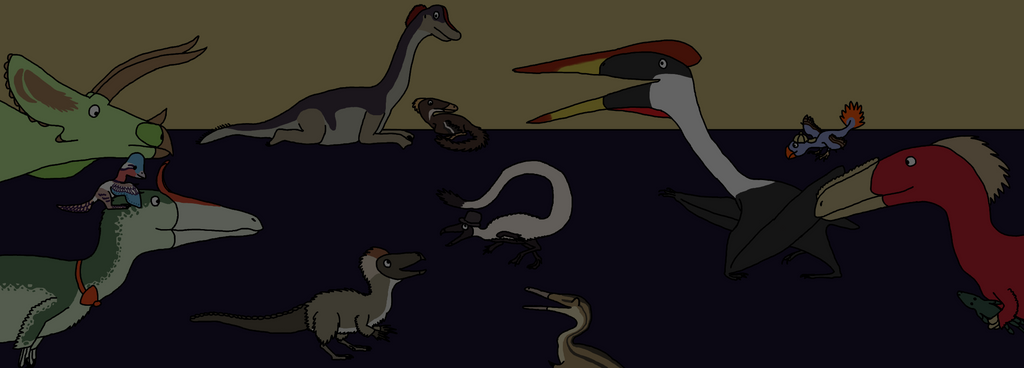
Speaking of the paleoart workshop, this year's TetZooCon banner was illustrated with drawings produced by last year's attendees. I drew the Sharovipteryx above "2018" and the small mammaliaform overlapping the bottom of the "C" (camouflaged among crocodyliform osteoderms).

With the morning of the second day, it came time for the bird talks themselves to be presented. My fellow speakers all did an excellent job, and between us we covered a diverse and fascinating array of subjects in ornithology. Robyn Womack started the session off by discussing the circadian rhythms of birds, Caitlin Kight talked about the effects of noise pollution on birds, Hanneke Meijer presented on fossil birds of Southeast Asia, and Glyn Young looked at Southern Hemisphere ducks and why they're commonly perceived to be boring. I went second (after Robyn—a tough act to follow!), talking about ongoing controversies surrounding the early evolution of crown-group birds (some of which my PhD research is meant to address). I've received some queries about how I was even able to get a talk slot at TetZooCon to begin with, and honestly all I did was ask Darren if I could.

I've always liked the custom avatars John Conway draws for TetZooCon speakers. I appear to be depicted as a paleognath, or maybe an alvarezsaur whose tail is hidden by perspective.

Luckily, it seems that I had not bitten off more than I could chew. Overall audience response to my talk was (as far as I know) very positive, a recurring compliment being the clarity with which I'd explained the contents of my presentation. Indeed, I got quite flustered at just how high some of the praise I received was. It was a pleasure to see the various sketches Sara Otterstätter had drawn based on my talk (as she had done for most of the presentations). My use of a "this is fine" meme gained some traction, and some also appreciated my Infinity War reference. Here's hoping that this year's talks will be put online so that everyone else can judge for themselves. Apparently, though, at least one attendee had come away with the mistaken impression that I was supportive of the idea that songbirds and parrots had originated in the Cretaceous (whereas I'd meant to imply that I thought such ancient dates resulted from analytical artifacts). I'll need to work on making that clearer next time I present on this subject.

Edit: A recording of my talk can now be viewed online.

People seemed to like this slide. Credit really goes to Luigi Gaskell for coming with the joke in the first place; I simply capitalized on its relevance to my talk.

Yet another one of many personal highlights was that I got to meet skeptic activist and science communicator Aron Ra. I found Aron's Foundational Falsehoods of Creationism and Falsifying Phylogeny video series very informative when I was younger, and I still enjoy his videos on a regular basis. (I particularly recommend his ongoing Systematic Classification of Life series.) What floored me the most, however, was that Aron had been looking forward to meeting me, too! This was because he'd known about me from the intermittent assistance I'd been lending to his Phylogeny Explorer Project (PEP), an ambitious attempt to present the complete tree of life in a digital format. (Truth be told, all I've really done is refine and flesh out the maniraptor parts of the PEP somewhat, but it's good to hear that my minor input is valued regardless.) Aron would later present on the PEP during the afternoon of the second day, concluding his talk by inviting all TetZooCon attendees to contribute to the project. Besides Aron, I also met PEP manager Steve Owen, consultant Renato Santos, and benefactor Charles Buchan. Meeting Renato was particularly memorable, as I've known him through the internet for many years. As Steve has written in his own report about the convention, this has been the greatest number of people involved in the PEP assembled in one room to date.

Aron's talk was followed by another panel discussion, this time with Gert van Dijk and Dougal Dixon talking about speculative biology. Many great quotes were spoken, my favorite being Dixon's proclamation that humanoid aliens are a "great example of evolution". One really got a sense of how much thought and creativity goes into their elaborate spec bio projects. The final talk of the convention was by Darren himself, talking about the making of Dinosaurs in the Wild. It was extremely impressive to hear about the numerous details incorporated into the experience, not all of which I'd noticed on my own visit. Unfortunately, the sound system at the venue broke down by this point for unknown reasons, preventing Darren from using video clips to full effect (though hearing him provide his own sound effects was quite entertaining). Nonetheless, the fact that that was the worst thing to go wrong at the convention (as far as I could tell) meant a job well done to all involved.

At the past two TetZooCons, I'd come in second place on the TetZooCon quiz. With the greater number of people in attendance this time around, I'd assumed that it would be statistically unlikely for me to perform as well again. However, contrary to my expectations, I came in first place! (It was also amusing to discover that listing the membership of a specific neoavian clade was one of the questions on the quiz, as I'd joked about that being the case during my talk.) I was permitted to pick two out of a selection of potential prizes, ultimately walking away with a Fauna Figures bichir figurine and a Dinosaurs in the Wild Dakotaraptor plush (which has inaccurate wings, but the "pick the maniraptor thing!" part of my brain was yelling).

Another of my slides, this time showing the major groups of neoavian birds. I'd joked that though I wouldn't be quizzing the audience on any of these after the talk, Darren might. As it turns out, he did. I'll leave it up to readers to guess which group was the subject of the quiz question (unless Darren or a fellow attendee sees fit to reveal the answer).

Although this was the longest TetZooCon yet, it still felt like it was over far too soon! I'd gained several new contacts and caught up with many old friends, but I can still think of individuals who I would've liked to talk to and didn't get the chance. Even so, from my perspective as an attendee and speaker, the first two-day TetZooCon was an evident success. Watching the Tet Zoo community blossom and grow over the years has been an exciting experience, and it's been a real pleasure and an honor to have been a small part of it all.

Sunday, September 30, 2018

Favorite Maniraptor of 2017 Results

Longtime readers will notice that this post comes at an unusual time of the year. I hadn't planned on retiring more than one of my few annual traditions on here, but thanks to external circumstances outside of my control, it looks like I might have to.

A few months ago, Blogger got rid of its poll widget, bringing my ongoing poll on newly-named maniraptors of 2017 to a premature close. Probably needless to say, this will also prevent me from hosting these polls in future years. There are plenty of other sites that allow for poll creation, but I suspect the voter base would greatly diminish if the polls weren't hosted on the blog itself. And though embedding a third-party poll on the blog by editing the HTML is a possibility, it sounds like too much work to spend on a bit of frivolity.

Without further ado, presenting the results of perhaps the last ever annual favorite maniraptor poll on Raptormaniacs...


Unsurprisingly, the unusual, possibly semi-aquatic dromaeosaurid Halszkaraptor took the lead by a long shot. Coming in second was the large troodont Latenivenatrix, and third place went to the well-preserved anchiornithid Serikornis. I was somewhat disappointed to see that no one picked Cruralispennia, despite it being the subject of one of my most popular blog posts. This was particularly jarring given that even Junornis (a bog-standard enantiornithine by comparison) got one vote, though I will admit that its holotype looks spectacular. More astounding was the fact that Corythoraptor, a tall-crested oviraptorid, also failed to gain any votes.

As it happens, 2017 also saw the publication of several new maniraptors that took some time to filter into the online paleontology community and thus did not make it into my poll. These new taxa include:
  • Awengkere: A large diving duck from the Miocene of Australia.
  • Deliaphaps: A pigeon from the Miocene of New Zealand, likely closely related to the Nicobar pigeon and the dodo.
  • Microenantiornis: A small enantiornithine (shocker!) from the Early Cretaceous of China.
  • Miocariama: A seriema from the Miocene of Argentina. The holotype was formerly referred to Noriegavis, which the describers reevaluate as a synonym of the falcon Thegornis.
  • Pampagyps: A condor from the Pleistocene-Holocene of Argentina.
Among these, Microenantiornis escaped notice by having been published in an obscure Chinese journal. The others were named in a printed volume, the conference proceedings of the 9th SAPE meeting (held in 2016). Even now, the description of Miocariama has to my knowledge yet to appear in digital format.