Showing posts with label Announcement. Show all posts

Friday, April 1, 2022

Delays and Updates

I should know by now that announcing one's plans almost guarantees that they won't happen, but here we are. I'd mentioned that I'd already decided on what to write for the annual April 1st post this year; however, the way things have transpired, other projects and events have demanded enough of my attention to prevent me from writing it. Maybe I'll write it up within the next month, or (arguably more likely) maybe I'll save it for next year... we'll see. In the meantime, perhaps you can consider the Story of Perrine review a retroactive make-up post for today.

Most of the projects that I've been working on instead are not at a stage where they can be discussed in detail. However, one major announcement I can make is that within the last two weeks, both my labmate Juan Benito Moreno and I passed our PhD vivas (with no corrections requested of either of us), making us the first PhDs to fledge from the Field Palaeobiology Research Group. I suppose I really am Dr. Claw now...

Tuesday, November 5, 2019

New "About" Page

Ever since the inception of this blog, the "About" page has largely remained unchanged. Seeing as it was written in an "answers to frequently asked questions that are not in fact frequently asked" format and much of the text pertained to my not-officially-cancelled-but-rarely-updated webcomic, I thought this would be a good time to overhaul into something that will potentially be more useful.

As a result, my "About" page now contains a very, very simplified overview of maniraptor diversity and evolution. In some ways, it can be considered a spiritual successor of my very old "What is a maniraptor?" post, which some readers have requested me to update in the past.

For the new "About" page, I had to cut out some of the material that I had planned (I would have liked to go into more detail regarding neoavian diversity), because it was already getting long for an introductory post. However, I hope that what I managed to fit in will be of some use in helping readers orient themselves regarding the groups and concepts that I regularly discuss on this blog.

Note for theropod taxonomy buffs: for the sake of simplicity and convention, I have not currently adopted the new definition for Dromaeosauridae proposed by Hartman et al. (2019). However, I would certainly be open to using it if it ends up in prevailing usage by theropod paleontologists.

As some "bonus material", here are three phylogenetic diagrams that didn't make it into the final write-up:

Monday, January 21, 2019

The Raptormaniacs List of Extinct Cenozoic Birds

For almost as long as there has been an online paleontology community, there have been online Lists of Dinosaurs. An entire article could probably be written on the "List of Dinosaurs" phenomenon. To be fair, one can find taxonomic lists of nearly any sufficiently charismatic group of organisms in existence, but the dinosaur enthusiast community appears to be exceptional for the number of times it has independently compiled the "List of Dinosaurs". Examples of some that are still around include George Olshevsky's Dinosaur Genera List, Thomas Holtz's supplement to his dinosaur encyclopedia (last updated in early 2012), and The Compact Thescelosaurus (successor to Thescelosaurus.com). Of course, these lists don't include every dinosaur. They generally only cover non-avialan dinosaurs or, at most, Mesozoic dinosaurs.

A few months after I started this blog in 2010, I wanted in on the fun. I wasn't quite as ambitious as try and make my own version of the List of Every Mesozoic Dinosaur, but I did want to make a list of Mesozoic maniraptors. With all the Lists of Dinosaurs that were already in existence for me to reference, it didn't take long for me to set one up. My list likely doesn't do anything that the other Lists of Dinosaurs don't. It's written for most part in very non-technical language and doesn't cite any technical sources. Its main function over the years has probably been to help myself keep track of Mesozoic maniraptors more than anything else.

However, I am not only interested in Mesozoic maniraptors. Ever since its inception, the heading to my list included the sentence: "I hope to include the Cenozoic taxa someday, but for now I'm focusing on the Mesozoic ones." A comprehensive, up to date list of extinct Cenozoic birds remained an empty niche, but that also made starting one up at all much more challenging. Even Wikipedia doesn't have articles on all Cenozoic extinct birds at the time of writing.

Well, I have now taken the plunge. I have started a separate page on the blog where I've compiled a list of Cenozoic birds.

Before anyone gets too excited, I'd like to make clear that my list does not completely fill the void that is there. At present, the list only includes entirely extinct bird genera, so it does not include extinct species that are classified in the same genera as still-living species. It is possible that I will change that one day. (Will it take another eight years? We'll find out.)

It is very unlikely though that I will ever compile my own list of bird genera known only from extant members. This is due to the immense amount of work that would be required, as well as the fact that several lists of extant birds already exist (a couple of my favorite examples being Taxonomy in Flux and the IOC World Bird List). I suppose if Mesozoic dinosaur fans and Cenozoic dinosaur fans have anything in common beyond liking dinosaurs, it's an inordinate fondness for lists!

My Cenozoic extinct bird list is written in the same non-technical style as my Mesozoic maniraptor list. However, I did have to consult numerous technical publications to compile it. I'd like to highlight in particular Gerald Mayr's Avian Evolution and Paleogene Fossil Birds, Jirí Mlíkovsky's Cenozoic Birds of the World (yes, I am aware of the caveats associated with this work), and Pierce Brodkorb's Catalogue of Fossil Birds. If it weren't for these books, my task would likely have been almost impossible to complete. Some other (less technical) sources of importance were Julian Hume's Extinct Birds and Meig Dickson's A Dinosaur A Day (which, given its coverage of extant birds, is almost certainly the most ambitious List of Dinosaurs of all!).

Given the state of affairs, I would be surprised if I really had managed to include every extinct Cenozoic bird taxon on my first try, so if you spot any errors or omissions, please leave a comment! Keep in mind though that I have excluded certain taxa if they are now considered congeneric with extant taxa or if their genus name is preoccupied and a replacement name has not yet been coined.

Sunday, September 30, 2018

Favorite Maniraptor of 2017 Results

Longtime readers will notice that this post comes at an unusual time of the year. I hadn't planned on retiring more than one of my few annual traditions on here, but thanks to external circumstances outside of my control, it looks like I might have to.

A few months ago, Blogger got rid of its poll widget, bringing my ongoing poll on newly-named maniraptors of 2017 to a premature close. Probably needless to say, this will also prevent me from hosting these polls in future years. There are plenty of other sites that allow for poll creation, but I suspect the voter base would greatly diminish if the polls weren't hosted on the blog itself. And though embedding a third-party poll on the blog by editing the HTML is a possibility, it sounds like too much work to spend on a bit of frivolity.

Without further ado, presenting the results of perhaps the last ever annual favorite maniraptor poll on Raptormaniacs...


Unsurprisingly, the unusual, possibly semi-aquatic dromaeosaurid Halszkaraptor took the lead by a long shot. Coming in second was the large troodont Latenivenatrix, and third place went to the well-preserved anchiornithid Serikornis. I was somewhat disappointed to see that no one picked Cruralispennia, despite it being the subject of one of my most popular blog posts. This was particularly jarring given that even Junornis (a bog-standard enantiornithine by comparison) got one vote, though I will admit that its holotype looks spectacular. More astounding was the fact that Corythoraptor, a tall-crested oviraptorid, also failed to gain any votes.

As it happens, 2017 also saw the publication of several new maniraptors that took some time to filter into the online paleontology community and thus did not make it into my poll. These new taxa include:
  • Awengkere: A large diving duck from the Miocene of Australia.
  • Deliaphaps: A pigeon from the Miocene of New Zealand, likely closely related to the Nicobar pigeon and the dodo.
  • Microenantiornis: A small enantiornithine (shocker!) from the Early Cretaceous of China.
  • Miocariama: A seriema from the Miocene of Argentina. The holotype was formerly referred to Noriegavis, which the describers reevaluate as a synonym of the falcon Thegornis.
  • Pampagyps: A condor from the Pleistocene-Holocene of Argentina.
Among these, Microenantiornis escaped notice by having been published in an obscure Chinese journal. The others were named in a printed volume, the conference proceedings of the 9th SAPE meeting (held in 2016). Even now, the description of Miocariama has to my knowledge yet to appear in digital format.

Sunday, April 1, 2018

The End of a Tradition

Given that this blog has always been a side project that I work on when I happen to have the drive and opportunity, I have not beholden myself to a regular posting schedule here. Nonetheless, a few annual traditions have arisen. At the beginning of the year, I always write up an overview of the past year's scientific discoveries on maniraptors, shortly followed by the results of my annual poll on my readership's favorite newly-named maniraptor genera. Then on April 1st, I always make an April Fools' post, usually on a blatantly fake scientific discovery, but sometimes on a dramatically different creative direction for the blog. Starting this year, however, I will be scrapping that last tradition.

Didn't see that coming, eh?

My decision was prompted by a Twitter thread by biologist David Steen, in which he argues against the use of "April Fools' articles" by scientists and science communicators. To summarize his points: first of all, misleading the audience when one has built themselves up as a credible source is counterproductive. Secondly, not everyone will get that such articles are jokes. Lastly, the articles will not be read only on April Fools', nor will everyone who did read them on April Fools' remember when they did so.

This is not by any means the first time I've encountered similar sentiments. They are legitimate concerns, I've thought to myself in self-consolation. But my April Fools' jokes have never been intended to "fool" anyone. If anything, I aim to get a laugh out of my audience rather than a laugh at their expense. My posts are slathered so thickly in absurdity and sarcasm that the jig is obvious. In fact, they could even be considered a creative brand of science communication, considering that I often use them as an opportunity to point out the flawed logic of real pseudoscience. No one would ever misinterpret my April Fools' posts as seriously championing the outlandish claims they contain.

Unfortunately, it has dawned on me that the last point up there isn't true. Regardless of my intent, it's likely that some readers will be (and probably have been) misled. Though I don't remember anyone ever claiming to have taken the April Fools' jokes on Raptormaniacs seriously, I should've known better from experience with my earlier attempts at satire, such as the time I pretended to justify depicting phorusrhacids without feathers using the same flawed arguments that I've seen applied to dromaeosaurids*. Even with excessive use of exclamation marks, even with blatant self-contradictions, even with my explicitly pointing out the fact that there were self-contradictions, more than a few commenters confessed that they'd thought (if only momentarily in some cases) that I'd been serious. Naturally, I'd feel a twinge of frustration whenever someone didn't get the joke, but ultimately I can't blame the audience. Some pseudoscience really is that outlandish, that illogical, and that poorly-presented.

*Such arguments don't appear to be nearly as common anymore. Things do change...

Aren't unfeathered terror birds ridiculous? No one will ever think that I think terror birds were unfeathered if I drew a satirical picture of one without feathers! Actually, some will.

I've had fun coming up with my April Fools' articles and (I think) some of my readers have had fun reading them as well. I myself have enjoyed reading the fake articles written by other science bloggers such as Darren Naish (who has also announced that he will be dropping the tradition this year). However, having fun is not worth adding to the mountains of misinformation that already exist.

I don't want to come across as anti-fun. I am a staunch supporter of using humor and levity in science communication. But humor can be employed in many ways that don't involve creating misinformation. By abandoning this yearly tradition, I hope to remind myself to apply my sense of humor in a more productive fashion.

Another old work of mine (and a Raptormaniacs comic to boot) that (I think) uses humor while communicating science more effectively than a fake scientific article.

(If anyone has read to the end expecting me to pull a double fake-out: no, this post is not a joke.)

Friday, January 5, 2018

Favorite Maniraptor of 2016 Results


Last year was a close race, but the unusual Fukuivenator narrowly won against Tongtianlong, an oviraptorosaur known from a nearly complete skeleton preserved in three dimensions. Coming in third place was Apatoraptor, one of the most completely known caenagnathid oviraptorosaurs.

These polls are inevitably biased in favor of taxa that receive more press. Though a truly level playing field is impossible to achieve, I will try something new this year by providing a concise blurb for each contestant and links to their original description papers. This way at least, none of the taxa will be complete unknowns. That being said, I suspect one particular genus already has this year in the bag...

  • Albertavenator: A troodont from the Late Cretaceous of Canada. Known from a single bone in the skull.
  • Almas: A small troodont from the Late Cretaceous of Mongolia. Known from a partial skeleton including a nearly complete skull. It has been included in several phylogenetic analyses in the past, but wasn't named until last year.
  • Aprosdokitos: A small penguin from the Eocene of Antarctica. Known from a single upper arm bone.
  • Beibeilong: An oviraptorosaur from the Late Cretaceous of China. Known from an embryo long nicknamed "Baby Louie" as well as several eggs. Its adult size would have been comparable to that of Gigantoraptor, the largest known oviraptorosaur.
  • Chupkaornis: A hesperornithine from the Late Cretaceous of Japan. Known from a partial skeleton including parts of the vertebral column and hind limbs. It is the most completely known Asian hesperornithine.
  • Corythoraptor: An oviraptorosaur from the Late Cretaceous of China, one of many recently named from the Nanxiong Formation. Known from a nearly complete skeleton. It had a particularly tall crest on its head.
  • Crexica: A rail from the Miocene of Russia. Known from partial limb bones.
  • Cruralispennia: An enantiornithine from the Early Cretaceous of China. Known from a mostly complete skeleton with preserved feathers. It had several features unusual for an enantiornithine, including strap-like feathers on its legs and wings as well as a rapid growth rate.
  • Daliansaurus: A troodont from the Early Cretaceous of China. Known from a nearly complete skeleton.
  • Diomedavus: A small albatross from the Oligocene of the USA. Known from parts of the limbs and hip as well as a single neck vertebra.
  • Garrdimalga: A large megapode from the Pleistocene of Australia. Known from parts of the limbs and skull.
  • Halszkaraptor: A small dromaeosaurid from the Late Cretaceous of Mongolia. Known from a nearly complete skeleton. It had some unusual anatomical features suggesting that it foraged in the water, including numerous teeth, a long neck, and paddle-like forelimbs.
  • Jianianhualong: A troodont from the Early Cretaceous of China. Known from a nearly complete skeleton with preserved feathers.
  • Junornis: An enantiornithine from the Early Cretaceous of China. Known from a mostly complete skeleton with preserved feathers. The size and shape of its wings suggest that it used bounding flight, similar to many small extant birds.
  • Kumimanu: A large penguin from the Paleocene of New Zealand. Known from a partial skeleton including parts of the limbs, hip, and vertebral column. Among the most completely known giant penguins.
  • Latagallina: A large megapode from the Pleistocene of Australia. Known from several specimens, including one that is nearly complete. The type species was formerly considered a species of Progura.
  • Latenivenatrix: A large troodont from the Late Cretaceous of Canada. Known from several specimens, including a partial skeleton. Many of these were formerly considered specimens of Troodon. The largest troodont known, estimated at over 3 m long.
  • Liaoningvenator: Yet another troodont from the Early Cretaceous of China. Known from a nearly complete skeleton.
  • Maaqwi: A euornithine from the Late Cretaceous of Canada. Known from parts of a forelimb. Its thickened bone walls suggest that it was a diving seabird.
  • Miohypotaenidia: A rail from the Miocene of Russia. Known from partial limb bones.
  • Ostromia: A basal paravian from the Late Jurassic of Germany. Known from a partial skeleton including parts of the limbs and faintly-preserved wing feathers. The holotype has had a convoluted taxonomic history, having been mistaken for a pterosaur and later considered a specimen of Archaeopteryx.
  • Piscivorenantiornis: An enantiornithine from the Early Cretaceous of China. Known from a partial skeleton along with a possible pellet containing fish bones.
  • Serikornis: A basal paravian from the Late Jurassic of China. Known from a complete skeleton with "silky" feathers preserved all over its body.
  • Tsidiiyazhi: A stem-mousebird from the Paleocene of the USA. Known from a partial skeleton. The oldest known member of the "core landbird" clade Telluraves.
  • Vanolimicola: A shorebird-like bird from the Eocene of Germany. Known from a partial skeleton.
  • Zhongjianosaurus: A small dromaeosaurid from the Early Cretaceous of China. Known from a partial skeleton. One of the smallest dromaeosaurids known.

Saturday, April 1, 2017

Reflecting on Raptormaniacs

It's been seven years(!) since I started this blog. Apropos of absolutely nothing, I think a retrospective is in order.

My original drawing of the Raptormaniacs cast. Compare to the (more) current image on the characters page.

Raptormaniacs was originally created as a place to host my comic series of the same name. It has since expanded in scope, also becoming an outlet for me to share photos of zoos and museums, review dinosaur-related works in the media, and report on dinosaur news. Through all this, I have continued to draw Raptormaniacs comics. This work has been done in fits and starts, but it has continued regardless. Though in concept the comic was largely inspired by the '90s animated show Animaniacs, it has certainly evolved and changed over the years, seeing a shift from traditional to digital art, gaining an interactive Tumblr companion blog, and taking on longer-form storylines, which have included original stories, whole-plot references, and strange crossovers. In all this time of working on-and-off on this project, I have come to a simple conclusion.

Maniraptors are really, really boring.

They all look the same. Check out this nonsense.

Least flycatcher, photographed by "Mdf", licensed.
Alder flycatcher, photographed by "Cephas", licensed.

Literally the only way to distinguish these species is that one is facing to the left, and the other to the right.

I have no doubt some upstart commenters will protest by providing examples of supposedly "morphologically distinctive" maniraptors, like therizinosaurs or something. Those commenters will be wasting their time. Therizinosaurs are no more than flightless turkeys with hypertrophied manual unguals, hardly distinctive in the grand scheme of things.

Effective immediately, I will no longer be producing any new comics for Raptormaniacs. I have already come up with character concepts for an entirely new comic. It will be completely different and far superior to my current drivel. Watch this space.

It's time for Arthromaniacs!

In fact, I should change my usual online handle to a more interesting animal as well. I'm liking the sound of Drosophila.

Tuesday, January 10, 2017

Favorite Maniraptor of 2015 Results


My predictions were on the money, as Yi (deservedly) took this one, followed by Dakotaraptor and then Zhenyuanlong. I liked that a Cenozoic maniraptor (Llallawavis) did fairly well for once. Meanwhile, Boreonykus shows that you can gain a decent number of votes as long as you are purportedly a dromaeosaurid, even if you are known from nothing but scrap.

This year's poll looks to be less predictable, as there was no outstanding new maniraptor superstar last year. My guess is that the crown will go to either the enigmatic Fukuivenator or one of the new oviraptorosaurs.

Friday, April 1, 2016

What Did Mesozoic Maniraptors Eat? Results from My Senior Thesis

I don't neglect this blog just because I can. At last, it is time to unveil what has been eating up most of my time: my senior thesis research. Contrary to some of my previously-expressed concerns, there is no risk in releasing my findings in this fashion because everyone knows that blogs are entirely worthless for any form of scientific discourse. When I get around to submitting my thesis as a manuscript, those journals will have no idea that I've already publicized this information, because what proper academic (including editors of scientific journals) ever reads or writes blogs?

There has been much debate and speculation on the diets of Mesozoic maniraptors, in part due to their diverse skull morphology that frequently deviates from what is expected of "typical" theropods. In recent years, it has been popular to argue on morphological and biomechanical grounds that herbivory and omnivory were widespread in Mesozoic maniraptors.

A digital reconstruction of the skull of the therizinosaur Erlikosaurus in multiple views, from Lautenschlager et al., 2014.
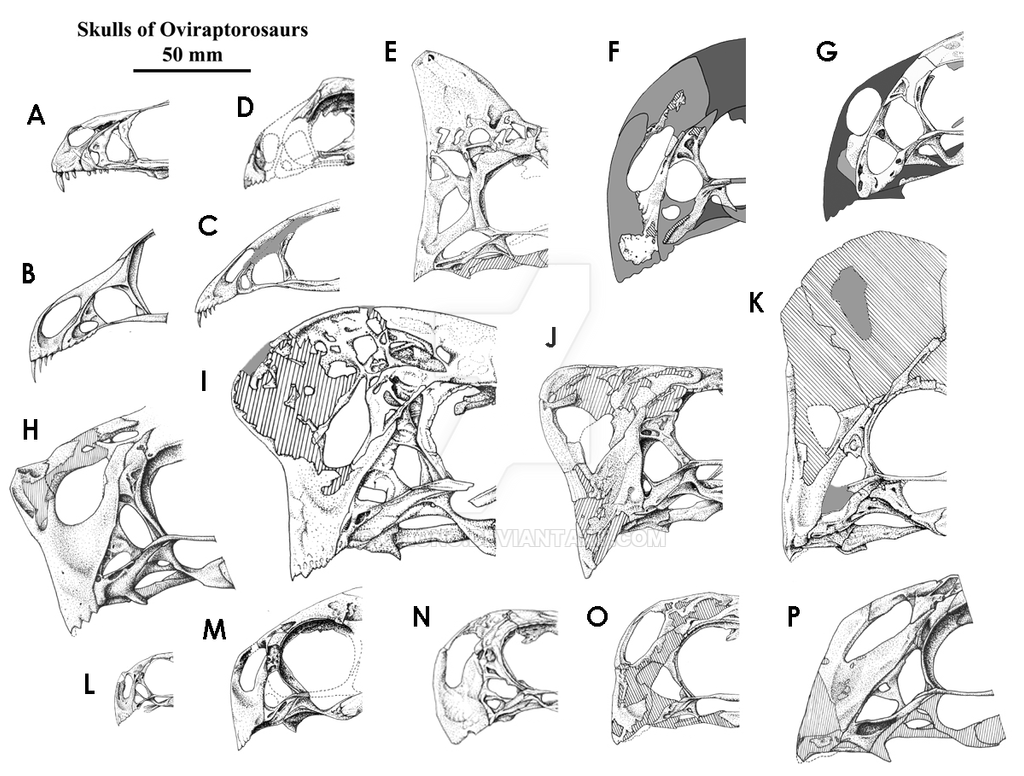
A selection of oviraptorosaur snouts, drawn by Jaime Headden, licensed.
A selection of enantiornithine skulls, from O'Connor and Chiappe, 2011.

However, the existence of fruit-eating alligators and meat-eating ruminants demonstrate that morphological inference of animal diets is unreliable at best. Direct observations are what count. For my senior thesis, I looked at direct evidence of maniraptor diets (gut contents and feeding traces) throughout the Mesozoic. The results can be seen in the graph below.


The trend is clear: for most of the Mesozoic, most maniraptors were eating absolutely nothing! This is at great odds to the popular interpretation of widespread herbivory in these dinosaurs, but it makes a good amount of sense. After all, if these animals were not eating anything, their skull morphology would not be at all constrained by diet and would be free to take on other functions such as sexual display and species recognition. This revelation brilliantly explains the diversity of skull shapes in maniraptors.

Another finding of interest is the spike in hypercarnivorous maniraptor species during the Campanian. The most parsimonious explanation for this observation is that, considering the evolution of all organisms is driven by the aesthetic preferences of a single Holocene primate species (66 million years away from the last non-neornithine maniraptors), this was an attempt by the maniraptors to become more awesome, because feeding on fish or plants is lame. (And fish is not meat, what are you talking about?) Unfortunately for maniraptors, all carnivorous species died out prior to the Maastrichtian, likely because that ecospace was already dominated by other types of theropods.

What of the increase in rock-eating species during the Aptian? The great abundance of fossil species and specimens found dating to the Aptian is reflective of an increase in the generation of sedimentary rock during this time period. Evidently, a number of maniraptor species became adapted to take advantage of this resource.

References
Awesomebro, I. 2013. Y animulz musth b kewl enuff 4 me. Annals of Awesomebro 95: 26-910. doi: x8615/asum.2399

Blank, D.A. 2003. On the carnivorism and feces eating of Gazella dorcas Linnaeus, 1758 and other ungulates. Mammalia 674: 579-585.

Lautenschlager, S. 2013. Cranial myology and bite force performance of Erlikosaurus andrewsi: a novel approach for digital muscle reconstructions. Journal of Anatomy 222: 260-272. doi: 10.1111/joa.12000

Lautenschlager, S., L.M. Witmer, A. Perle, L.E. Zanno, and E.J. Rayfield. 2014. Cranial anatomy of Erlikosaurus andrewsi (Dinosauria, Therizinosauria): new insights based on digital reconstruction. Journal of Vertebrate Paleontology 34: 1263-1291. doi: 10.1080/02724634.2014.874529

O'Connor, J.K. and L.M. Chiappe. 2011. A revision of enantiornithine (Aves: Ornithothoraces) skull morphology. Journal of Systematic Palaeontology 9: 135-157. doi: 10.1080/14772019.2010.526639

Platt, S.G., R.M. Elsey, H. Liu, T.R. Rainwater, J.C. Nifong, A.E. Rosenblatt, M.R. Heithaus, and F.J. Mazzotti. 2013. Frugivory and seed dispersal by crocodilians: an overlooked form of saurochory? Journal of Zoology 291: 87-99. doi: 10.1111/jzo.12052

Zanno, L.E. and P.J. Makovicky. 2011. Herbivorous ecomorphology and specialization patterns in theropod dinosaur evolution. Proceedings of the National Academy of Sciences, USA 108: 232-237. doi: 10.1073/pnas.1011924108

Tuesday, January 5, 2016

Favorite Maniraptor of 2014 Results


Much as I predicted, Anzu took this one by a landslide. Changyuraptor came in second, to be expected for a well-preserved dromaeosaurid. I appear to have been the only one who voted for Eopengornis, but come on, check out that fossil. Not to mention the interesting implications for rectricial evolution in avialans (possibly confirmed by the publication of Chiappeavis last year).

Holotype of Eopengornis, from Wang et al., 2014.

As for this year's poll? We have two dromaeosaurids as strong contenders, the giant Dakotaraptor and the excellently-preserved Zhenyuanlong (both of which, coincidentally, preserve evidence that wings were retained in flightless dromaeosaurids), but I imagine the unexpectedly bizarre Yi will be tough to beat.

Thursday, October 29, 2015

Redbubble shop!

After receiving some requests for merchandise of my Cartoon Guide to Vertebrate Evolution, I decided to open a Redbubble shop.

Suggestions for other designs to include are welcome. (However, I will not upload any of my fan art of copyrighted works as designs.)

Wednesday, April 1, 2015

A sneak peek at what I've been up to

In between writing scripts for TetZoo Time, grading weekly quizzes, and wondering why there aren't more phylogenetic analyses of xenarthrans with more than craniodental characters, I've been busy. Most importantly, I have been busy co-authoring a revolutionary new paper... or what would be a revolutionary new paper if, in acts of blatant scientific censorship, all the legitimate scientific journals we submitted to had not rejected the manuscript.

Thus, for the time being, I have chosen to reveal some of the most important results of our study on my blog. This is at the tremendous risk of having this information scooped by other researchers, but I believe it is more important to publicize it as soon as possible, in hopes of misleading illuminating passing readers.

Results of phylogenetic analysis of Volantia, with identified synapomorphies labeled.

It's another phylogenetic analysis of Volantia, but in addition to being the largest analysis of this group to date, we also used this opportunity to test dogmatically popular hypotheses such as the theropod origin of birds. We were able to falsify these hypotheses by a priori reasoning, a truly devastating blow to textbook wisdom. However, mainstream science is loath to update textbooks, a primarily motivator behind the organized movement to bar our study from publication. The joke's on you, ivory tower suckers! Ha ha!

We also discovered that it's easy to recover the clades you want if you count a single character as 23 out of a total of 131. Likely this has been the case for analyses purporting to support birds as theropods, but almost no one else has ever caught this because phylogenetic matrices are well designed to blur the vision of anyone trying to evaluate what data was input into them.

Emily, Scott Reid, and Adam Schmoetzer provided helpful discussion that greatly improved this manuscript, though evidently not enough to get it published in a high-profile journal.

Monday, February 2, 2015

New poll for last year's maniraptors up


From the limited number of votes, it would look like Skull is the current fan favorite! Was it because of the stunts he pulled in Turn to Stone? His quest for popularity may not be so hopeless after all.

At the other end of the scale, poor Savape, not that she would care. I recognize that she has probably some of the least character depth even by this comic's standards as of yet. An implicit goal of mine with the use of the Tumblr askblog and the longer form stories is to occasionally showcase other facets of the characters beyond their base concepts, which were frankly very one-note. We'll see what the future holds for Savape and the others.

For the rest of the year, it's back to our regularly scheduled "favorite newly-named maniraptor" poll. I suspect that first place will not be much of a contest considering the buildup and hype we had for Anzu, which, in addition to that, is a charismatically-sized animal. Second place, however, may be up for grabs.

Sunday, January 4, 2015

Favorite Maniraptor of 2013 Results


Acheroraptor took the lead and Aurornis was runner-up! Not terrifically unpredictable. My personal choice was Piscivoravis, which didn't do badly for a Mesozoic euornithine that didn't get much press.

I'll put up a new maniraptors of 2014 poll at some point, but I figure a month will not make a big difference for a survey that runs for nearly a year, so I'm going to poll a different subject this time for a short while. Several readers have told me their favorite Raptormaniacs characters lately and the results are quite varied across the board, making me curious about overall preferences. In addition, the Tumblr has been running for a fair amount of time now and with the completion of last year's storyline, I feel that I have provided enough incipient characterization introduced for decisions to be made. I look forward to seeing/reading your responses.

Tuesday, April 1, 2014

Skimming with Semirostra

It's been a year since the clade Volantia was established, uniting all flying organisms as a monophyletic group. Hot off the presses today, the next stage in advancing research of this newly recognized clade has been unveiled.

Traditionally, birds, bats, pterosaurs, insects, and planes have been considered the only groups capable of powered flight, and it was these groups that were analyzed in the original. However, it is being increasingly recognized that other groups, such as rockets, hot air balloons, and squid should all be considered part of this roster. The new study includes these taxa and more in the most comprehensive phylogenetic analysis of the clade yet. (Sample size of two? What does that mean?)

The results confirm that the jet/heat-propelled groups are highly specialized volantians and, in fact, are each others' closest relatives. In addition, taxa such as dragons, griffons, and pegasi, long thought to be entirely mythical, were also included on the basis of oft-maligned but truly overwhelming evidence such as anecdotal accounts on Ask.com.

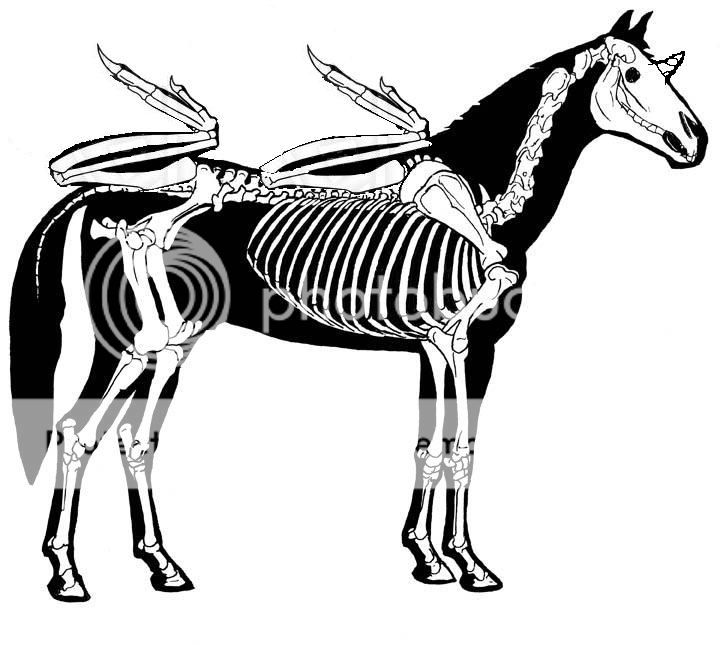
One of the most common criticisms leveled at the original paper coining Volantia was its choice of unicorns as the outgroup in its phylogenetic analysis, with good reason. There is a wealth of evidence supporting a flying ancestry for unicorns, including widely publicized developmental data showing that wing-making genes can be activated even in their postnatal development. What's more, fossil evidence now exists to further corroborate these conclusions, for last year also saw the announcement of the pegacorn (rumored name "Pegasoceras wimmeri"), known from a well-preserved fossil representing what appears to be a four-winged stem member of the clade including both unicorns and pegasi. It was widely dubbed in the press the Pony from Hell, because ponies don't receive enough attention and a four-winged pseudo-horse is not spectacular enough of a find to attract the media on its own merits. The new analysis takes the opportunity to amend the oversight of the original, deeming unicorns secondarily flightless volantians.

Most intriguing of all, however, may be the discovery of another clade of secondarily flightless volantians, hitherto unrecognized. Not only secondarily flightless, in fact, but also secondarily aquatic. This is the clade Halirostra, which includes Semirostrum ceruttii (initially thought to have been a porpoise) and the Hemiramphidae or halfbeaks (long thought to be actinopterygians). Some species of halfbeaks are still able to glide over the surface of the water, further testament to their flying ancestry.

Phylogeny of Volantia, from Troll, 2014. The blue dot marks the newly-coined clade Halirostra and the red marks Semirostra.

What were the flighted ancestors of halirostrans like? An extant taxon may provide some clues. The Rynchopidae or skimmers have long been thought to be birds, but the new analysis demonstrates conclusively that this is not the case. In reality, they share just one several important features with the halirostrans, such as a prognathous mandible. Besides, their slit pupils should have been a dead giveaway that skimmers are not really birds.

Together with pterosaurs, skimmers and halirostrans are found to form the clade Semirostra. This has interesting implications for the paleobiology of the extinct members of this group. Skimmers are famous for their distinctive skim-feeding method of foraging. As they are the only extant proxies of extinct semirostrans*, perhaps it's time to take another look at the all too hastily discredited notion that pterosaurs also skim fed. Using the method Use Photoshop and Look Really Hard (UPALRH), pioneered by Dave Preter, and a healthy dose of SRC, the researcher behind today's study was able to see previously unknown features in pterosaur fossils, including eyeballs, elongated mandibles, speech bubbles, and the original surface of the water in which the pterosaurs had been skimming in prior to their death, providing support for the much cooler idea that pterosaurs could skim feed, no matter what those dang clueless biomechanists say.

*Halfbeaks don't count, they are faaaaaaaar too different.

Reinterpretation of a specimen of the pterosaur Darwinopterus modularis after applying UPALRH and SRC, from Troll, 2014 and modified from a photograph by Didier Descouens, licensed.

And Semirostrum? Why not?

Restoration of Semirostrum ceruttii depicting it utilizing the foraging method suggested in Troll, 2014.

We may be momentarily astonished by these revelations, but in hindsight they are incredibly conspicuous. It is a wonder that professional scientists have not yet put together the true relationship between pterosaurs and skimmers when it could easily be proven by taking quotes from abstracts of scientific articles and Wikipedia out of context. Once again, this demonstrates that the scientific community are an incompetent lot who have to be given reality checks by untrained amateurs that hold the true keys to the ultimate truth, because of Galileo and some crap. (Who was Galileo anyway?)

Special thanks to Thomas Holtz and Logan Orlowski for assisting me in the coverage of this revolutionary new paper.

References
Claw, A. and I.M.A. Troll. 2011. A new and extremely inaccurate method for inferring the integument of extinct maniraptors. Journal That Sometimes Accepts Silly Things 1: 1-9. doi: WTF/???sdflkjsdf

Humphries, S., R.H.C. Bonser, M.P. Witton, and D.M. Martill. 2007. Did pterosaurs feed by skimming? Physical modelling and anatomical evaluation of an unusual feeding method. PLoS Biology 5(8): e204. doi: 10.1371/journal.pbio.0050204

Larson, M.A. 2013. Magical mystery cure. The Hub 4: 13. doi: 413/mlp.fim.90123

Muramatsu, K., J. Yamamoto, T. Abe, K. Sekiguchi, N. Hoshi, and Y. Sakurai. 2013. Oceanic squid do fly. Marine Biology 160: 1171-1175. doi: 10.1007/s00227-013-2169-9

Orlowski, L. 2013. Fossil evidence for a secondarily flightless ancestry in unicorns. The Proboscipoda Annual Conference Abstracts 1A: 7-12. doi: 42.1007/666.x4351

Preter, D. 2000. Look at all this kool stuff. Empire of King Preter 1: 1-9. doi: 9999.dsf91.999

Racicot, R., T. Deméré, B. Beatty, and R. Boessenecker. 2014. Unique feeding morphology in a new prognathus extinct porpoise from the Pliocene of California. Current Biology 24: 774–779. doi: 10.1016/j.cub.2014.02.031

Troll, I.M.A. 2013. A four-winged configuration for basal birds: implications for the Single Origin of Flight (SOF) Hypothesis. Journal of Random Crap 1: 1-5. doi: 42.1007/s42336.012.0910.7

Troll, I.M.A. 2014. Skimming, fire-breathing, and secondary flightlessness: a comprehensive phylogenetic analysis of the newly recognized clade Volantia shows hitherto unknown diversity. Journal of Random Crap 2: 1-5. doi: 42.1007/s42336.013.0910.7

Friday, January 3, 2014

Favorite Maniraptor of 2012 Results


I figured the poll last year would be unpredictable, and it was. For once, an alvarezsaur victory in Bonapartenykus! I'm even more surprised by Martharaptor coming in second place given its fragmentary nature, but maybe everyone was excited about the first new (potential) therizinosaur we'd gotten in a while. My other favorite, Schizooura, didn't do badly either.

New poll is up. You know the drill.

Thursday, July 25, 2013

The Raptormaniacs Tumblr

In an effort to make myself do more with my web comic thing, I present my new extension of it, the Raptormaniacs Tumblr askblog, where readers can send in questions for the comic characters. This format has several benefits over my previous convention, such as the fact that I probably won't have to use as many panels most of the time. I don't plan on crossposting every individual Tumblr post I make to this blog, but I will post "Tumblr roundups" here once a given number of posts has been put up or a given amount of time passed.

Monday, July 15, 2013

Raptormaniacs Revamp (For Real)


At long last I have come around to revisit the original reason I started this blog to begin with: the Raptormaniacs web comic. It's been more than a year since I last drew a real comic for the blog and much has changed since then. I started dabbling in digital art, for one thing. For another, there have been new scientific discoveries that have made my character designs outdated. All that called for something of a makeover.

For the sake of trivia, have a quick list of the major changes I made.

-I've had readers tell me that they've had trouble differentiating between Savape and Zahavi. In hindsight it was extremely foolish of me to have two "archaeopterygid"-type main characters in the comic and for a long time I'd wanted to either put up a guide to distinguishing the two or have Zahavi transform into a larger troodont in-universe to eliminate the problem. (He has unlimited cartoon powers; he can do that kind of thing.) In the meantime though, paleontology came to the rescue. New analysis of Archaeopteryx feathers show that they had black leading edges. Although an earlier study already demonstrated that the original Archaeopteryx specimen, an isolated covert feather, was dark colored, I had been reluctant to include this in the comic for fear that it would quickly wear down my pencils. Switching to digital art removes the dilemma. Savape's new color patterns are not easy to see at the resolution of the new dramatis personae above, but with luck she should be less mistakable when she shows up in future comics. While we're at it, I gave Remex his tail bands too.

-Feathers extend down to the foot in all the characters (besides Skull and Dinky for obvious reasons) now, based on new Mesozoic avialan specimens showing the ubiquity of foot feathers in Mesozoic theropods. (There's something I wasn't kidding about!)

-Ebeff now has pennibrachiae (wings), based on new evidence of them being present in (adult) ornithomimosaurs, suggesting a wider phylogenetic bracket for them.

-A number of aesthetic choices, such as smoothing the body contours of most of the characters (based on the concept that "primitive"-looking body feathers on fossil dinosaur specimens may be taphonomic illusions) and making their hands and upper legs more obscured by feathers (because there's no reason to think they didn't work like living birds in that respect).

Can I guarantee that I'll post comics more frequently now? Simply put, no. However, I might do an experiment that may help me in doing so, to be revealed shortly.

Monday, April 1, 2013

Hail Volantia

A lot has happened since I last posted any comics. (How long has it been? A bit more than a year?) In fact, plenty has happened since I last posted here at all. (What, I'm supposed to write more about Earthflight and zoo trips? When did I say that?)

For instance, a paper came out describing the prevalence of large leg feathers in Mesozoic avialans, finding evidence of pennaceous feathers on the tibiotarsi of several confuciusornithid and enantiornithine specimens as well as on the metatarsals of Sapeornis. In fact, almost all coelurosaurs that preserve integument on the lower legs and feet have feathers there, with plumulaceous leg feathers and extensive foot scales (as in most modern birds) known only in Yanornis and more derived taxa. It is perhaps no accident that this is also the point in avialan phylogeny that a tail fan homologous with those of modern birds is known to have been present. (On that subject, the new Sapeornis specimen also preserves tail feathers, previously unknown in this genus, but that's a story for a different time.)

New specimen of Sapeornis showing hind limb feathers, from Zheng et al, 2013.

The implications of this are quite clear. After all, what else has four wings?

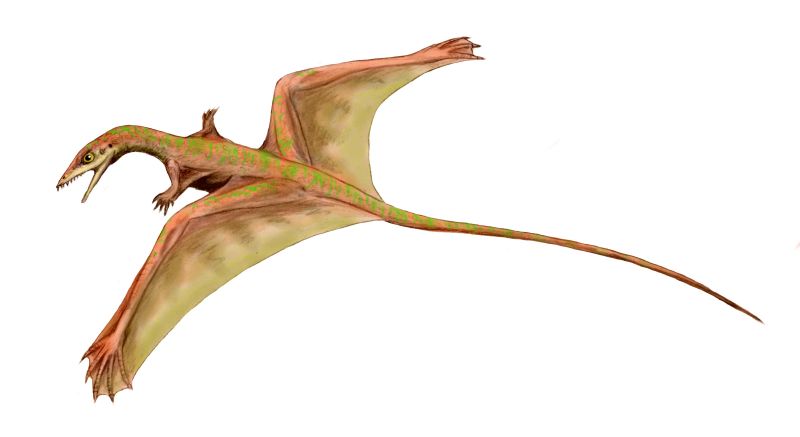
The pterosauromorph Sharovipteryx mirabilis, licensed.

The anisopteran insect Hemicordulia tau, photographed by Fir0002 and licensed.

The chiropteran Agilichiropteryx johtoensis.

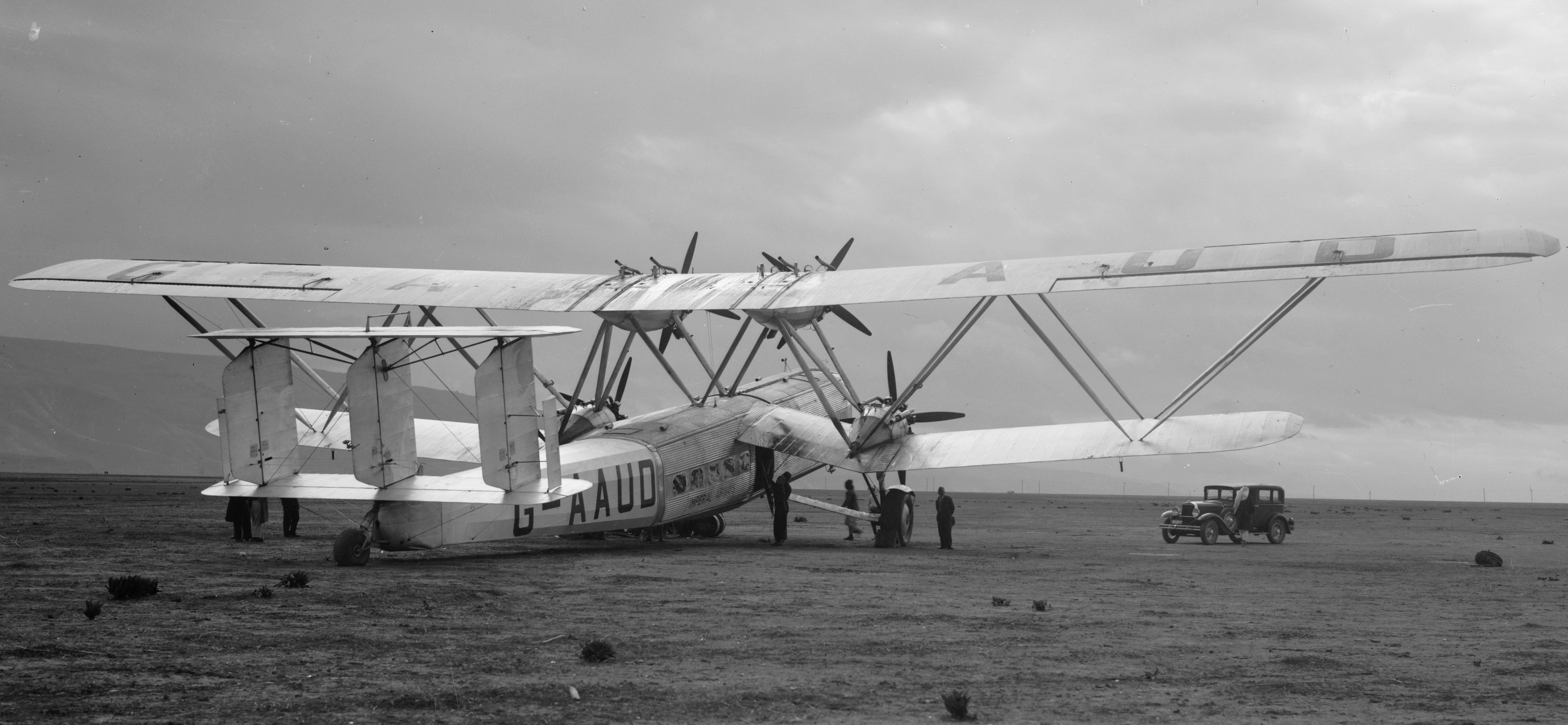
The biplane Handleyvolans hannoi.

That's right, a new analysis shows that it's looking likely that flight evolved only once in the entire history of life, all flying organisms being united in a clade now called Volantia. Aside from the common biplane design, the monophyly of this group is supported by many other previously overlooked features. (I didn't look at the data matrix, but the study listed so many synapomorphies I figured it simply must be correct.) For example, the clade is also united by the ancestral characteristics of echolocation (still retained in swifts, oilbirds, planes, and most bats), being capable of learning the move Wing Attack (secondarily lost in planes due to their stiff wing structure)*, and eating foods widely considered to be disgusting in Western society (such as insects, rotting carcasses, and aviation fuel). In an interesting example of convergence, all five major clades of Volantia are all known to have independently evolved two-winged forms later on. This discovery is also further refutation of several ideas so preposterous it's a wonder there still exist those who support them in the scientific community, such as the dinosaurian origin of birds, the ornithodiran origin of pterosaurs, the mammalian origin of bats, the arthropod origin of insects, and the human invention of planes. (Too bad about the squamate origin of pterosaurs and the pterosaurian origin of birds though, those actually had some good things going for it.) Biology textbooks will now have to look elsewhere for comparisons between analogous and homologous structures. In fact, this was such a badly-written significant paper that an entirely new journal was created just to publish it. Fortunately, it is open-access, although you actually have to pay about $200 so unfortunately it is not really open-access.

*Evidently the production team of Pokémon was on to something when they included a puff of feathers in the animation of Wing Attack (despite some featherless Pokémon knowing this move). Considering that there are many obscure biological references in Pokémon, it appears likely that this was included as a nod to the Volantia hypothesis (then called the Single Origin of Flight Hypothesis or SOF).

Results of the new phylogenetic analysis for Volantia, from Troll, 2013. (To avoid confusion, unicorns are the outgroup here, not part of Volantia proper.)

Naturally, this also has implications for my comic, because it indicates that the use of echolocation and a biplane configuration should be present in most of my characters. However, I don't think I will bother to incorporate this new info into future comic strips. It is just too much work and having to come up with reasons for changing the characters' attributes in-universe is way too difficult. Even though I tried to include scientific understanding and in-jokes when I began this comic, I now realize that accuracy is overrated and is entirely irrelevant in a universe with levitating troodonts, talking fossil casts, and turkey-sized dinosaurs that can jump three meters in the air to slash an Allosaurus fatally in the throat. It's not like anyone actually appreciates the sciency stuff I put in to begin with and the few that do are just whiny nerds who can always go start their own comic if they want silly things like accurate dinosaurs volantians.

References
Troll, I.M.A. 2013. A four-winged configuration for basal birds: implications for the Single Origin of Flight (SOF) Hypothesis. Journal of Random Crap 1: 1-5. doi: 42.1007/s42336.012.0910.7

Zheng, X., Z. Zhou, X. Wang, F. Zhang, X. Zhang, Y. Wang, G. Wei, S. Wang, and X. Xu. 2013. Hind wings in basal birds and the evolution of leg feathers. Science 399: 1309-1312. doi: 10.1126/science.1228753

Thursday, January 3, 2013

Favorite Maniraptor of 2011 Results


The results of last year's poll are in. While not as one-sided as the poll for 2010, we have a clear winner in the troodont Talos, followed by the basal paravian Xiaotingia. Not much of a surprise there!

A new poll for last year's newly-named maniraptor genera is now up as well, so go ahead and vote.