Saturday, April 1, 2017

Reflecting on Raptormaniacs

It's been seven years(!) since I started this blog. Apropos of absolutely nothing, I think a retrospective is in order.

My original drawing of the Raptormaniacs cast. Compare to the (more) current image on the characters page.

Raptormaniacs was originally created as a place to host my comic series of the same name. It has since expanded in scope, also becoming an outlet for me to share photos of zoos and museums, review dinosaur-related works in the media, and report on dinosaur news. Through all this, I have continued to draw Raptormaniacs comics. This work has been done in fits and starts, but it has continued regardless. Though in concept the comic was largely inspired by the '90s animated show Animaniacs, it has certainly evolved and changed over the years, seeing a shift from traditional to digital art, gaining an interactive Tumblr companion blog, and taking on longer-form storylines, which have included original stories, whole-plot references, and strange crossovers. In all this time of working on-and-off on this project, I have come to a simple conclusion.

Maniraptors are really, really boring.

They all look the same. Check out this nonsense.

Least flycatcher, photographed by "Mdf", licensed.
Alder flycatcher, photographed by "Cephas", licensed.

Literally the only way to distinguish these species is that one is facing to the left, and the other to the right.

I have no doubt some upstart commenters will protest by providing examples of supposedly "morphologically distinctive" maniraptors, like therizinosaurs or something. Those commenters will be wasting their time. Therizinosaurs are no more than flightless turkeys with hypertrophied manual unguals, hardly distinctive in the grand scheme of things.

Effective immediately, I will no longer be producing any new comics for Raptormaniacs. I have already come up with character concepts for an entirely new comic. It will be completely different and far superior to my current drivel. Watch this space.

It's time for Arthromaniacs!

In fact, I should change my usual online handle to a more interesting animal as well. I'm liking the sound of Drosophila.

Thursday, March 30, 2017

London Zoo Part II: Happy Families, Into Africa, and Birds

Near the Rainforest Life/Nightlife building at the London Zoo is a section known as "Happy Families", probably because the species that it exhibits are all gregarious.

This is an Alaotran bamboo lemur. Despite being a bamboo lemur, it feeds mainly on reeds rather than bamboo. In the wild it has an extremely restricted distribution even for a lemur, only found around parts of Lake Alaotra.

Some Asian small-clawed otters. Though this species is ubiquitous in zoos (to the fatigue of some regular zoogoers), they were so cooperative during my visit that I couldn't help but snap a few photos.

Their exhibit is quite well-decorated, too.

Also in the same general area of the zoo is Into Africa, essentially the obligatory spotlight on charismatic African megafauna. To its credit, there are a few relatively rarely-seen species on display, such as this okapi.

Additionally, spot the red forest duiker!

Naturally, however, I was most interested in seeing the zoo's bird collection, so I headed to the northern edge of the zoo where there several species are exhibited. Unfortunately, due to recent reports of avian influenza in Europe, the zoo's walkthrough aviaries (of which there are several) were closed during my visit. Regardless, I was able to photograph this green peafowl from outside one of the aviaries.

A tawny frogmouth, which resembles a broken tree branch when at rest and a Muppet when wide awake.

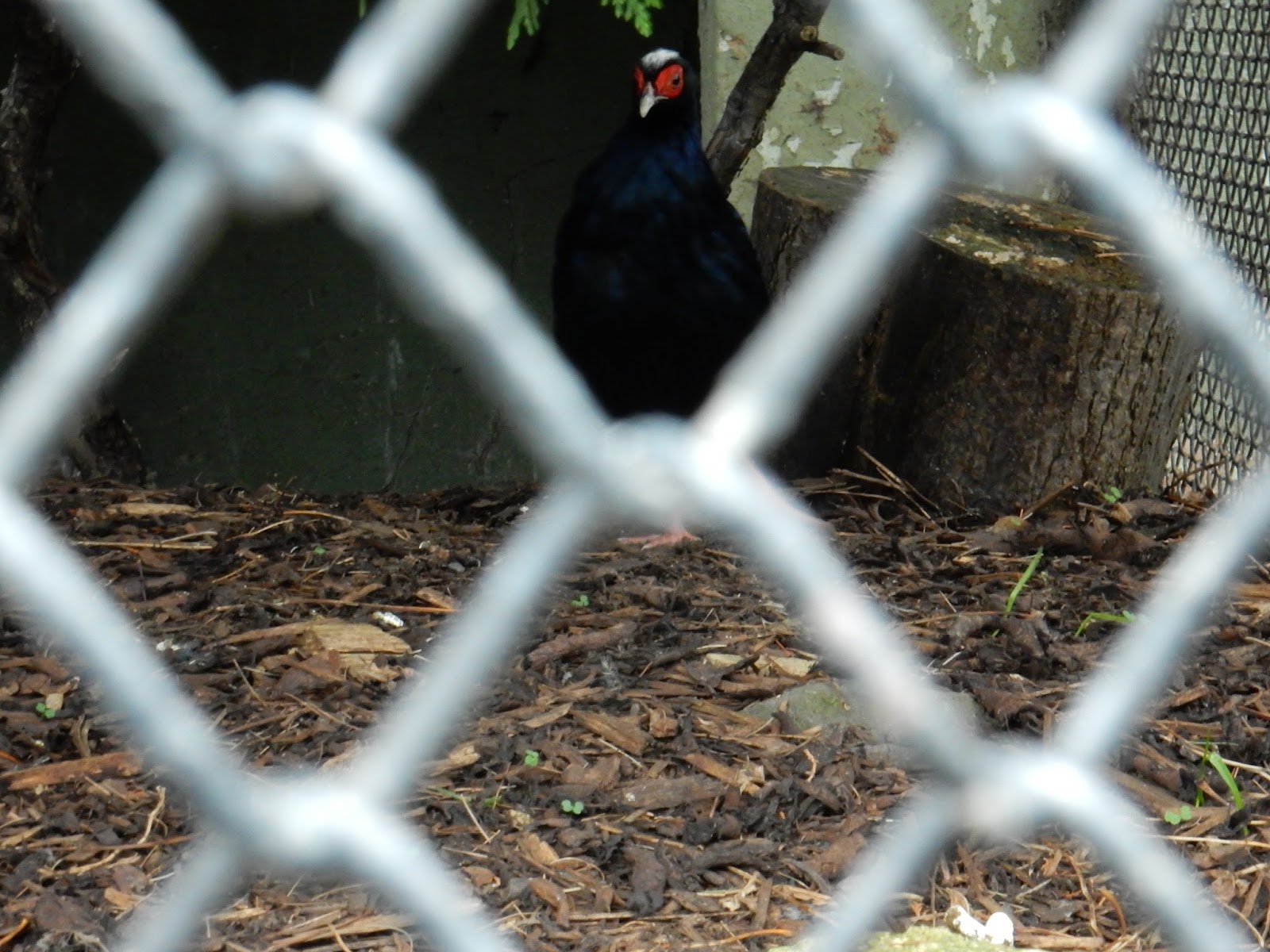
An Edwards's pheasant.

Some northern white-faced owls, which have gained some fame as the "transformer owl".

In fact, here is one in its "camouflage pose".

Some northern red bishops, a type of weaverbird.

Tuesday, March 21, 2017

London Zoo Part I: Rainforest Life and Nightlife

London Zoo is situated within a large park with abundant opportunities for birding. Here a mute swan browses from a waterside tree.

A European green woodpecker, a lifer for me. This species is ecologically similar to the North American northern flicker, which I'm more familiar with. Both woodpecker species forage mainly for ants on the ground.

I had to restrain myself from spending too much time on birdwatching in the park, but I eventually made it to the zoo.

My first stop was the exhibit closest to the zoo's main entrance, the aquarium. It has a nice collection with many rarely-seen fish species, but it is so dimly-lit that getting any decent photos was a real struggle. My only fish photo taken there that is remotely presentable was of this white-eyed moray.

There is also a poignant display on plastic pollution.

Next, I headed to the Rainforest Life/Nightlife building. Half of this building (the "Rainforest Life" half) is a walkthrough rainforest exhibit where monkeys, sloths, and tamanduas roam freely. Some of the branches in the exhibit are arranged so that the animals can (and do) venture close right overhead or next to the visitors. Here is an emperor tamarin keeping its distance for the time being.

Most surprising to me, however, were the narrow-striped bokies kept in a glass-fronted display on the side of the walkway. Though commonly called the narrow-striped mongoose (including by the exhibit signage), the narrow-striped boky is no longer considered a true mongoose, but a separate radiation of carnivorans endemic to Madagascar. I must have taken around thirty photos of them trying to get a good shot.

The other half of the building (the "Nightlife" half) is a nocturnal exhibit. I'd heard that Panay cloudrunners could be seen here, but, to some slight disappointment, they didn't appear to be on display when I visited.

I did, however, have a great time watching some other rodents present, namely the rakalis. Not only were they a first for me, they are an interesting species in themselves, being the largest Australian rodents. As placentals living in a land of marsupials, rakalis have taken on the role of semi-aquatic predators, a niche that hasn't been exploited by Australian marsupials. They have a decently-sized pool with underwater viewing at the London Zoo, though I didn't see them use it. Regardless, their terrestrial antics were plenty entertaining enough. As is typical of nocturnal houses, my attempted photos turned out less than stellar.

I also received another opportunity to get pictures of Malagasy giant jumping rats. Not there yet...

Say what? It is possible to get halfway decent pictures at nocturnal exhibits? It helps, naturally, when the subject of the photo is one that spends a significant amount of time not moving around much, such as this gray slender loris.

Saturday, March 18, 2017

How Therizinosaurs Nibbled and Munched

That new Anchiornis paper is quite something, isn't it? Everyone else is talking about it, so I don't have to, but check it out if you haven't already.

Instead, I will discuss another recent paper about a different group of maniraptors, the unusual therizinosaurs. Since 2012, a series of publications on the functional biology of therizinosaurs, primarily authored by Stephan Lautenschlager, have contributed greatly to demystifying these bizarre herbivorous theropods. (A selection of these papers is linked in the preceding sentence, but it is by no means an exhaustive list.)

These previous papers have largely focused on the therizinosaur Erlikosaurus from the Late Cretaceous Bayan Shireh Formation in Mongolia, a sensible choice given that this genus has the best-preserved skull material of all known therizinosaurs. The new study, also conducted by Lautenschlager, takes the logical next step by asking: how does Erlikosaurus compare to other therizinosaurs?

Phylogeny of therizinosaurs with digital models of the lower jaws of taxa used in the analysis, from Lautenschlager (in press).

To answer this question, Lautenschlager digitally modeled the lower jaws of other therizinosaur taxa, including Falcarius, Jianchangosaurus, Beipiaosaurus, Alxasaurus, and Segnosaurus, and subjected the models to finite element analysis (FEA). Under FEA, stress (force per unit area) experienced by the jaw under different simulated feeding conditions could be calculated, as could relative bite force. The different feeding scenarios tested were biting using one side of the jaw at different tooth positions, biting using both sides of the jaw at different tooth positions, clipping using the tip of the jaw, pulling an object upwards, pulling an object downwards, and pulling an object sideways.

The results of finite element analysis simulating potential feeding behaviors in different therizinosaur taxa, from Lautenschlager (in press).

It is worthy to note that this study did not calculate the absolute bite force of these therizinosaurs, only their relative bite forces. In other words, instead of estimating how strong a bite the therizinosaurs were actually capable of generating, the study estimated which therizinosaur could generate the highest bite force if all of them exerted the same amount of force with their jaw muscles.

With that in mind, what did the results say? It turns out of the taxa tested, Falcarius and Alxasaurus had, on average, the highest relative bite forces. This is consistent with the idea that Falcarius was more omnivorous than other therizinosaurs and may have still fed on some animal prey. Alxasaurus has also been interpreted as a more generalist forager than other therizinosaurs on the basis of its claw morphology, so having a relatively high bite force may have increased the variety of foodstuffs it could feed on.

On the other hand, the results indicated that Falcarius and Alxasaurus would have experienced greater amounts of stress during feeding than other therizinosaurs, whereas Erlikosaurus and Beipiaosaurus would have experienced the least. Additionally, all therizinosaurs would have experienced less stress while pulling items downwards compared to pulling upwards or sideways, suggesting that they habitually fed at or above head level. However, Erlikosaurus and Segnosaurus were more suited to pulling objects sideways than other therizinosaurs. What appears to have made the difference in this case is that Erlikosaurus and Segnosaurus both had a downturned lower jaw.

This is an interesting result considering that a downturned lower jaw has independently evolved in other herbivorous dinosaurs. The unusual ceratosaur Limusaurus even gained one during growth (in addition to losing its teeth)! This study confirms that such a jaw would have been advantageous for herbivores by helping to mitigate stress while feeding. A similar adaptive benefit has been attributed to the widespread presence of a beak in herbivorous dinosaurs (including therizinosaurids).

Among the taxa studied, Erlikosaurus and Segnosaurus were contemporaneous with one another, suggesting there may have been niche partitioning between them. This is supported by the study: Segnosaurus had relatively higher bite forces (as well as probably higher absolute bite forces, considering its larger size) and may have been able to feed on tougher plants, but Erlikosaurus experienced less stress during feeding and may have been able to use a greater variety of feeding methods. Though not discussed in the paper, one wonders whether the same was true of Jianchangosaurus and Beipiaosaurus, both found in the Yixian Formation. Here, however, the differences are less explicit: Beipiaosaurus experienced lower stresses while feeding, but both had similar relative bite forces.

Reference: Lautenschlager, S. In press. Functional niche partitioning in Therizinosauria provides new insights into the evolution of theropod herbivory. Palaeontology in press. doi: 10.1111/pala.12289

Tuesday, February 28, 2017

Vanolimicola, Rail or Jacana?

Animals that live in or near water usually have an edge when it comes to preserving as fossils. After all, the very habitats they live in are depositional environments. As a result, one might think that we would have an excellent fossil record of the charadriiforms. In addition to living in environments favorable to fossil preservation, charadriiforms are tremendously diverse. True to their common name of "shorebirds", many charadriiforms do forage by walking around on shores (e..g: most plovers), but there are also those that wade into the water (e.g.: avocets), swim on the water surface (e.g.: phalaropes), dive underwater (e.g.: auks), hunt from the air (e.g.: skuas), and even a few that feed on dry land, sometimes far from water (e.g.: buttonquails).

Yet, the early fossil record of charadriiforms is surprisingly sparse. Some bird fossils from near the end of the Cretaceous have been considered charadriiforms, but these specimens are so fragmentary that it is difficult to be certain of their classification. Even if they were charadriiforms, they would have little to tell us about the ancestral morphology of the group. One clade of charadriiforms that has a decent early record, however, are the jacanas.

Comb-crested jacana, photographed by "Djambalawa", licensed.

Extant jacanas live in freshwater lakes, where they use their astonishingly long toes to walk on floating vegetation. (For this reason, they are also known as lily trotters.) In most jacanas, the females are larger than the males, and the latter are in large part responsible for rearing their young. Unlike other living charadriiform groups, jacanas are known from identifiable fossils going back to the Eocene. A recently-described fossil appears to continue this trend... maybe.

The holotype of Vanolimicola, from Mayr (in press).

Vanolimicola longihallucis comes from Messel in Germany, known for being a treasure trove of well-preserved Eocene fossils. The holotype of Vanolimicola is far from the cream of the crop by Messel standards, but it's complete enough to show that it's a small, long-legged bird. (It's rather striking how frequently the description refers to it as being "fragmentary". Had it been discovered almost anywhere else, it likely would have been considered a decent find.) Its sandpiper-like beak and the proportions of its pedal phalanges suggest charadriiform affinities. However, it also has a very long hallux, which would be unusual for most charadriiforms... but is typical in jacanas! Though the feet of Vanolimicola aren't quite as disproportionately large as in modern jacanas, might it represent an early stem-jacana that lacked such specializations?

Perhaps, but the case is far from watertight. Rails are another group of birds that often live and feed on the margins of water bodies. As such, they are superficially similar to shorebirds in many ways, despite being more closely related to cranes. As is well known (at least among paleornithologists), a large diversity of rail-like birds was present in the Eocene, some (such as Songzia from China) being anatomically very similar to Vanolimicola. Proportions of the forelimb bones are a reliable way to distinguish between the skeletons of rails and shorebirds, but unfortunately, the wings of Vanolimicola are poorly-preserved.

Even given these ambiguities, it would have been nice had the description included a phylogenetic analysis to directly test these different possibilities. As of now, the affinities of Vanolimicola remain tantalizing but uncertain. Nonetheless, the fact that it is one of the few semi-aquatic birds known from the Messel makes it a somewhat notable find.

Reference: Mayr, G. In press. A small, "wader-like" bird from the Early Eocene of Messel (Germany). Annales de Paléontologie in press. doi: 10.1016/j.annpal.2017.01.001

Sunday, February 12, 2017

Cruralispennia, the Opposite Opposite Bird

Despite maintaining a continuous list of new maniraptor studies, I have not been very inclined to write entire articles about dinosaur news. After all, everyone else already blogs about them! However, I have come to the conclusion that this assumption is not completely correct. Some of the papers from last year that I found most interesting barely received any popular press. As a result, I have decided that I'm going to start blogging occasionally about maniraptor news, time permitting (but I'm in the middle of working on my Master's, so don't expect too much).

Fossil birds in particular get little attention in the blogosphere (or anywhere else) compared to other dinosaurs, except from Andrea Cau, Mickey Mortimer, and Matt Martyniuk, so it seems appropriate to start with one. I'll discuss one of the first new dinosaurs described this year, the enantiornithine Cruralispennia multidonta.

The name is somewhat clunky; the etymology section in the paper implies that "donta" is Latin for teeth... Even as someone who has never been educated in Latin, that gives me pause. I imagine they had the Latin "dens" or the Greek "odus" or "odon" in mind. Yet behind all that is quite an unusual and fascinating dinosaur.

The holotype of Cruralispennia, from Wang et al. (2017).

Cruralispennia hails from the Early Cretaceous Huajiying Formation in China, the oldest formation from which we have found pygostylian (short-tailed) avialans and home to other spectacularly-preserved early birds such as Eoconfuciusornis, Eopengornis, and Archaeornithura. As its species name suggests, Cruralispennia had a whole lot of teeth, specifically in its lower jaw. As preserved, the holotype preserves at least fourteen lower teeth. Even though most enantiornithines had teeth, this is more than almost all other known enantiornithines except maybe Eopengornis.

Enantiornithes translates to "opposite birds", so called because whereas modern birds have a socket in their coracoid bone where the scapula (shoulder blade) connects to it, most enantiornithines have a socket in their scapula that the coracoid fits into instead. As it happens, Cruralispennia doesn't have this feature, though other details of its anatomy suggest that it is an enantiornithine. However, it has some characteristics that are not only atypical of enantiornithines, but are in fact more similar to those of modern birds, hence the title of this post!

The pygostyle, a fusion of the tail vertebrae at the tip of the tail in short-tailed birds, is short and stubby in Cruralispennia. This is not at all normal for most groups of Mesozoic avialans, which generally have longer, rod-shaped pygostyles, but it is widely found in one specific clade: the euornithines (modern birds and anything more closely related to them than enantiornithines)! In euornithines, the pygostyle supports a mobile fan of tail feathers that functions in steering and braking during flight, and pygostyle shape has been correlated with tail feather structure in modern birds, so one might expect Cruralispennia to have had a (presumably convergent) tail fan as well.

It doesn't. Though the holotype preserves feathers on its tail, it doesn't have large rectrices at all, instead just having short fuzz much like the condition in Eoenantiornis or female(?) Confuciusornis. Perhaps it evolved a blunt pygostyle for a different, undetermined reason from euornithines. Or, speculatively, maybe only some individuals had rectrices? That is the case in Confuciusornis, after all. As is typical in paleontology, we need more specimens!

Photographs and schematics of fossil avialan pygostyles, from Wang et al. (2017). (A) is Cruralispennia, (B) and (C) are other enantiornithines, (D-F) are euornithines, and (G) is Confuciusornis.

Another way in which Cruralispennia is more similar to euornithines than to other enantiornithines is in its growth rate. Modern birds grow unbelievably fast, most reaching adult size in a matter of months or even weeks. This was also the case in some Mesozoic euornithines. Most enantiornithines, on the other hand, took several years. Lines of arrested growth (essentially annual growth rings) are visible when you cut into their limb bones. The describers of Cruralispennia looked at the bone histology of the holotype's humerus, and they found... no growth rings at all, despite the fact that it appeared to have stopped growing. Like most euornithines, Cruralispennia was essentially an adult by the time it celebrated its first birthday.

One last oddity of Cruralispennia that I would like to highlight is its feathers. It is these that its genus name (which translates to "shin feather") refers to. The feathers on its legs and the leading edges of its wings are quite unusual in their structure. Each feather appears to be a narrow, solid sheet for most of its length, but there are short individual filaments that stick out at the tip. The describers gave them another somewhat clunky-sounding name: Proximally Wire-like [feathers] with a Filamentous Distal Tip (PWFDTs). This exact type of feather has not been found in any other kind of dinosaur (living or extinct), though they remind me of the "paintbrush-like" feathers in scansoriopterygids. It's difficult to say what these feathers were used for, but the describers point out that narrow feathers are useful for display without impeding flight too much.

Photographs and schematic of PWFDTs in Cruralispennia, from Wang et al. (2017).

That took longer than I expected. However, Cruralispennia deserved the attention, as I'm certain everyone now agrees.

Reference: Wang, M., J.K. O'Connor, Y. Pan, and Z. Zhou. 2017. A bizarre Early Cretaceous enantiornithine bird with unique crural feathers and an ornithuromorph plough-shaped pygostyle. Nature Communications 8: 14141. doi: 10.1038/ncomms14141

Tuesday, January 10, 2017

Favorite Maniraptor of 2015 Results


My predictions were on the money, as Yi (deservedly) took this one, followed by Dakotaraptor and then Zhenyuanlong. I liked that a Cenozoic maniraptor (Llallawavis) did fairly well for once. Meanwhile, Boreonykus shows that you can gain a decent number of votes as long as you are purportedly a dromaeosaurid, even if you are known from nothing but scrap.

This year's poll looks to be less predictable, as there was no outstanding new maniraptor superstar last year. My guess is that the crown will go to either the enigmatic Fukuivenator or one of the new oviraptorosaurs.