Wednesday, September 13, 2017

Royal Tyrrell Museum

The Royal Tyrrell Museum has been on my bucket list for a long time, not only for its world-renowned paleontological collections but also for its role in the plot of the now-defunct Tyrannosaur Chronicles. Needless to say, I jumped at the chance to visit when I learned that it was one of the field trip destinations during SVP 2017.

Among the natural history museums I've been to, the Tyrrell is unusual in how it has a single main pathway that forces visitors to pass through most of the exhibits in a specific order, instead of having many disparate galleries spread apart that visitors can selectively visit as they wish. Upon first entering the exhibition halls, visitors are immersed in a depiction of life in the early Maastrichtian of Alberta. The main stars here are a group of Albertosaurus models representing different life stages, inspired by the Dry Island bonebed.

There are also some models of smaller animals for patient visitors to find, such as this Aspideretoides, a soft-shelled turtle. A Didelphodon (which I don't have pictures of) is depicted as an arboreal, opossum-like animal, a portrayal that has likely been outdated by findings of more complete specimens. Who should I talk to in order to get a model of Albertonykus added to the exhibit? :)

Following the diorama, the fossil displays proper begin. The first part of the exhibitions provides an introduction to the basic concepts and methods used in paleontology. It's also an excuse to give visitors a small taste of some of the museum's most impressive specimens in its collections. Here are 25 specimens of the gar Atractosteus preserved together.

A small wing off to the side (one of the few displays at the Tyrrell that it's possible to skip past, not that a first-time visitor should or would skip anything) showcases notable specimens that have recently been scientifically examined. Here is the skull of Regaliceratops.

A lovely specimen of Rhamphorhynchus with preserved wing membranes.

A Struthiomimus skull.

The skull of Latoplatecarpus in palatal view.

Back out along the main visitor pathway, an excellent specimen of Gorgosaurus. As part of the field trip, we were given behind-the-scenes tours of the museum collections, and I can say there's far more where this came from!

A cast of the Tyrannosaurus specimen nicknamed "Black Beauty".

The original skull of "Black Beauty".

A mounted skeleton of Dromaeosaurus.

After the introductory exhibits is "Grounds for Discovery", a newly-opened display featuring some of the museum's most exceptional specimens. This being the Royal Tyrrell, selecting the "most exceptional" specimens must have been an incredibly tough choice. However, I'll wager most everyone would agree that the holotype of the recently-named Borealopelta had this in the bag.

The skull and forelimb material of an unnamed pantodont mounted in life position.

Here is the lower jaw of Leptacodon, a lipotyphlan. I found this to be a creative way of exhibiting small mammal specimens.

This is Promioclaenus, a hyopsodontid.

The head and neck of Nichollssaura, an Early Cretaceous leptocleidid plesiosaur.

The rest of the museum is framed as a journey through time, with exhibits arranged in chronological order. Before visitors enter the "time tunnel", they can get a view from an elevated walkway of a mammoth being menaced by saber-toothed cats, giving them a glimpse of where they will end up.

I would be remiss if I didn't mention the Cambrian material on display, along with a diorama of Cambrian fauna at over ten times their actual size. However, neither the lighting nor the size of the specimens are conducive to obtaining good photographs.

Looking down to the floor below reveals the dinosaur hall, a tantalizing peek at what's to come. Here is a Camarasaurus, the sole sauropod at the museum.

The backside of Triceratops.

The obligatory Tyrannosaurus. Fans of the Tyrannosaur Chronicles blog (so... only me then?) will remember this as Traumador's mother.

However, there is much to go through first before one reaches the Mesozoic. Here is a depiction of a Devonian reef, which reminds me of the marine dioramas that used to be at the Smithsonian. A shame that they are not planned to return following the ongoing renovations of the paleontological displays there.

I thought the globes that accompanied each exhibit were a nice touch, showing how the Earth's landmasses have changed over time.

Easily missed next to the much larger Dimetrodon (not pictured here) is Mesenosaurus, a small varanopid synapsid.

Off to the side is the Cretaceous garden, mainly home to plants similar to those that were alive during the Cretaceous. If you're lucky, you may also spot some animals that inhabit the garden, such as this fire-bellied toad.

The animal residents are there to keep insect pests in check, but some of the plants themselves contribute to the effort as well. Here are some carnivorous pitcher plants.

A very large specimen of Shonisaurus gets an entire exhibition area to itself.

Then the main dinosaur hall comes into view. Here, visitors are no longer funneled along a single path and have more freedom to wander around the hall, and there is much to see. Starting out in the Jurassic, an Allosaurus is mounted finishing off a Camptosaurus.

Ornitholestes. Note the retractable second toes and lack of a nasal crest.

Stegosaurus needs no introduction.

Moving onward into the Cretaceous, one of the few specimens of Confuciusornis that can be seen outside of China.

To paraphrase one of my undergraduate instructors, Thomas Holtz, "one does not visit the Tyrrell to look at casts of Morrison dinosaurs" (or, for that matter, at that single Confuciusornis, as nice as it is). The stars of the show are the locals. Here, a Euoplocephalus defends itself from an Albertosaurus.

The skull of Edmontonia.

One corner of the dinosaur hall is devoted entirely to ceratopsians, which is unsurprising considering how many have been found in Alberta. Here is Chasmosaurus.

The horn-less, frill-less ceratopsian Psittacosaurus, another rare exception to the otherwise Canadian lineup.

The skull of Leptoceratops.

Pachyrhinosaurus.

Styracosaurus.

Centrosaurus.

Anchiceratops.

Albertaceratops.

Moving away (but not too far away) from the ceratopsians, a pair of Stegoceras.

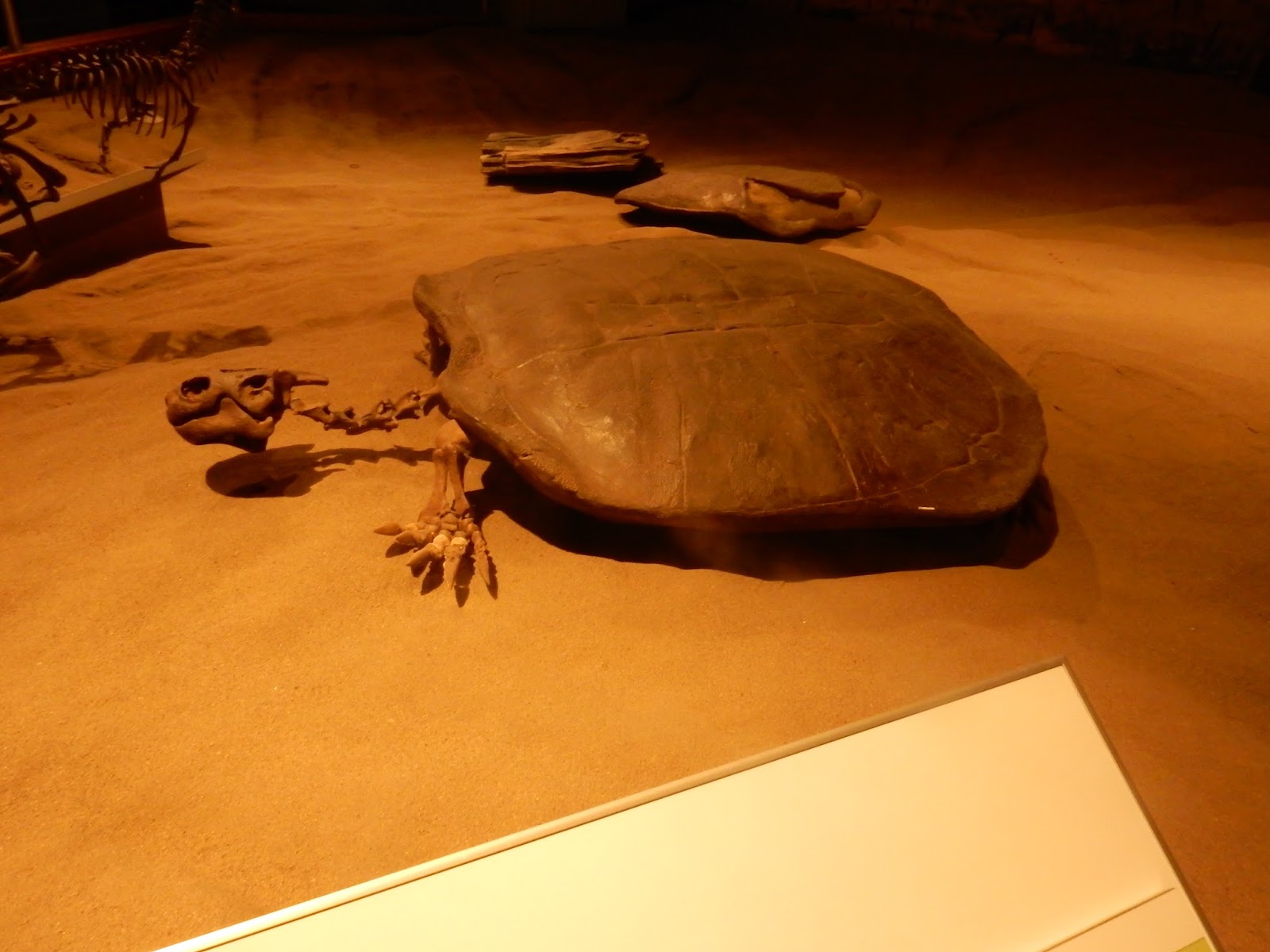
Basilemys, a large turtle.
Gorgosaurus looms over a Centrosaurus carcass.

Prosaurolophus hugs a tree.

Myledaphus, a Cretaceous freshwater guitarfish. Myledaphus teeth are commonly found, but fossils that preserve the rest of their bodies (such as this one) are far less so (which is unsurprising, given that they are cartilaginous fish).

The skull of the crocodylian Leidyosuchus.

The tibia of an azhdarchid pterosaur. The arrow is pointing to an embedded Saurornitholestes tooth.

The skull of Ankylosaurus.

The Cenozoic section of the museum returns to funneling guests down one path, but, after being mentally blown away by the dinosaur hall, most visitors are probably grateful for some order. Here is Simoedosaurus, a choristodere. At around this point in the gallery, there are also some live animals to look at (including a Florida soft-shelled turtle and some gar), though I was unable to get good photographs of them.

Even here, you haven't seen the last of the dinosaurs! This is an Eocene coraciiform.

A Gomphotherium.

As visitors near the exit, Glossotherium says, "Bye." Ground sloths really like waving. (I regret not taking a picture of the sign on this one, because it was almost impossible to find out which genus it was! Almost no one else on the internet had identified it as anything more specific than "ground sloth".)

I didn't take as many decent photos during the aforementioned tour of the collections as I'd have liked, but I at least got one of this iconic Dromiceiomimus/Ornithomimus specimen, currently not on display.
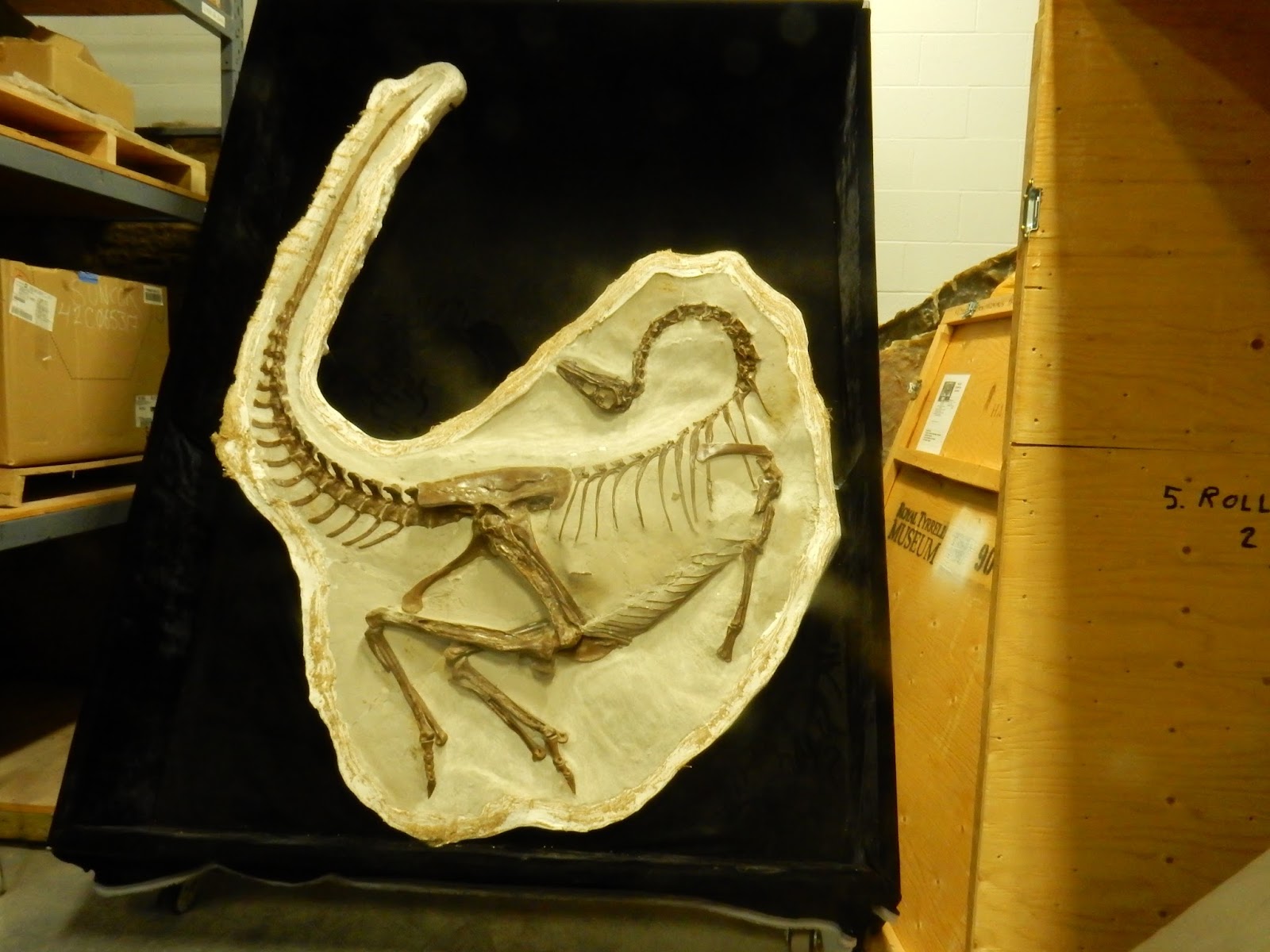
This specimen is notable not only for its well-preserved, articulated skeleton, but also for the fact that it preserves carbonized traces of forelimb feathers on the bones of its forearm where they once attached. See if you can spot them!

A specimen of Prosaurolophus with a patch of scales preserved.

A pond just outside the museum entrance, complete with a fountain and a leaping ichthyosaur.

I wouldn't be surprised if this pond was the most lushly-planted area here for miles around. Unsurprisingly, local wildlife, such as this cedar waxwing, was taking advantage.

Scenery more typical of the Albertan badlands.

Some marked trails near the museum provide the opportunity to experience the badlands more directly if one wishes. Trekking on one such trail, I spotted this vesper sparrow.

Ground squirrels were a common sight. This appears to be a Richardson's ground squirrel, though I may be wrong.

One of many Pachyrhinosaurus models surrounding the museum.

All in all, my first visit to the Royal Tyrrell did not disappoint. I hope that it is not my last. After all, there is still one thing that I haven't managed to accomplish on this trip, and that is seeing the original specimens of Albertonykus! I suppose that's going on the bucket list as a revised entry...

Saturday, September 9, 2017

SVP 2017

Another SVP has come and gone, this time slightly earlier in the year than we're accustomed to. This year's meeting took place in Calgary and, as one might expect, its location provided many exciting field trip opportunities. Exciting enough, in fact, to entice me into joining an SVP field trip for the first time. I chose the trip going to the Royal Tyrrell Museum, which deserves a post all on its own. Having been on my bucket list for a long while, the Tyrrell proved more than worth the visit, though it was at the cost of missing out on an alternate field trip that included a visit to the type locality of Albertonykus (as more than one participant on that other trip was eager to inform me afterward).

The day after the Tyrrell field trip, the conference proper began in earnest. The welcome reception that evening took place at the Telus Spark science museum. Many of the conference-goers (including some of my associates) were particularly taken by the museum's playground.

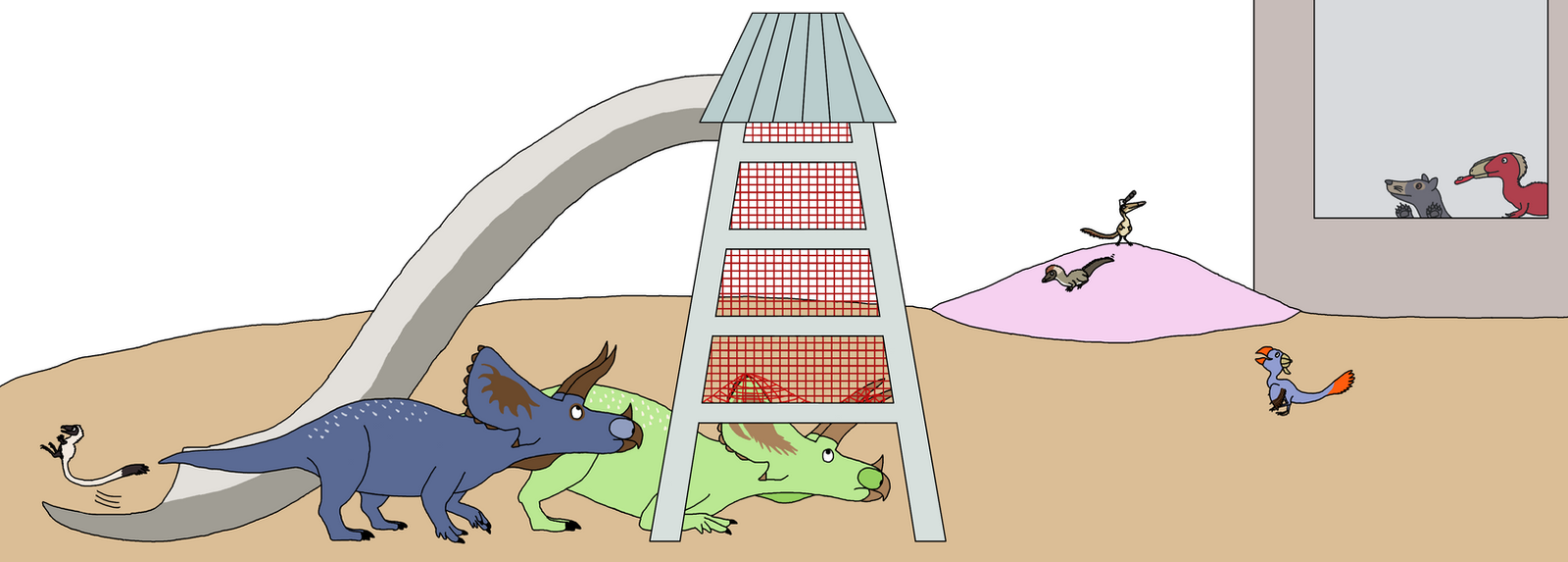
Fun on the playground at the SVP welcome reception. Individuals represented are Tristan Stock (Leaellynasaura), Arthur Jarrett Brown (blue Triceratops), Bobby Ebelhar (green Triceratops), Meig Dickson (Kulindadromeus), myself (Albertonykus), Austin Deans (Machairasaurus), Tut Tran (Amphicyon), and Kevin Sievers ("Diplotomodon").

The playground was a nice diversion, but the meat of the conference was of course the presentations. I didn't have anything to present this year, given that my recent research has been focused on invertebrates, so I was free to focus on what everyone else was saying. Some of my favorite presentations included (in order of delivery):
  • Igor Schneider's talk on limb regeneration as an ancestral trait of osteichthyans
  • Ashley Heers's talk on the wing stroke of Archaeopteryx
  • Yara Haridy's talk on ontogenetic tooth migration and tooth loss in Opisthodontosaurus
  • Shuo Wang's talk on ontogenetic tooth loss in theropods (it's not just Limusaurus)
  • Bhart-Anjan Bhullar's talk on evolution and development of the avian beak
  • Grace Musser's talk on the phylogenetic position of Aptornis
  • Alexis Mychajliw's talk on Caribbean Holocene extinctions and solenodon conservation
  • Derek Larson's talk on reconstructing diet in Mesozoic coelurosaurs
  • Aaron LeBlanc's talk on the evolution of mammalian tooth attachment (which deservedly went on to win the Romer Prize)
  • Daniel Field's talk on the selective extinction of arboreal birds during the K-Pg
  • Mike Habib's talk on the aerodynamic function of azhdarchid heads
  • Pete Makovicky's talk on a new specimen of Alnashetri
  • Scott Hartman's talk on "Lori" the Morrison troodont
  • Angelica Torices's talk on inferring theropod feeding strategies through their tooth denticles
  • Ali Nabavizadeh's talk on ornithischian jaw musculature
  • Ross MacPhee's talk on inferring sloth phylogeny through proteomics
  • Alex Hastings's poster on paleontological accuracy in comic books
With honorable mentions to Evan Saitta's talk on recreating Jehol-style preservation in the lab and Fiann Smithwick's talk on evidence of countershading in Sinosauropteryx. (As a student at Bristol, I'd already seen earlier versions of these talks and thus was not as surprised by them as I otherwise might have been.)

In addition to disseminating cutting-edge science, perhaps the most important role of academic conferences is providing the opportunity to socialize and network. Some memorable moments:
  • I must give special thanks to my future PhD supervisor, Daniel Field, for actively going around and introducing me to many of the researchers working in paleornithology, as well as inviting me to their "paleornithology dinner". Never in my wildest dreams did I expect to be sitting at the same dinner table as Jacques Gauthier and Xu Xing at this conference.
  • Among the individuals Field introduced me to was Nick Longrich. Having met Phil Currie at my first SVP, I have now met both describers of Albertonykus! I didn't get to talk to Longrich for long, but, considering where I'm going for my PhD, I have a feeling I'll be seeing him often enough in the future...
  • Brian Choo lived up to his old nickname of Ozgod (from the days of the Speculative Dinosaur Project) by using his divine powers to show up out of nowhere right when I was trying to remember whether current consensus favored the "inside-out" or "outside-in" model for tooth origins. (Apparently, outside-in.)
  • On the last day of the conference, I got to meet Scott Potter, known in the online paleontology community as the creator of the Thagomizers YouTube channel. Longtime readers of this blog may remember that he was responsible for the first ever Raptormaniacs fan art!
  • Though it didn't directly involve me, seeing Pascal Godefroit meet Meig Dickson's plush Kulindadromeus (custom-made by Sam Stanton) was a fantastic moment.

Also worthy of mention was the annual SVP auction. I did attend the auction last year, but had been unable to get a good seat and ended up leaving partway through. This time, I managed to secure much better seating. I avoided bidding on anything myself (as a grad student, I don't exactly have much in the way of disposable income), but the proceedings were plenty entertaining in and of themselves, one notable example (among many) being the bidding for an Anomalocaris plush.

As usual, the auction had a theme: this year, the hosts dressed up as the Guardians of the Galaxy. Special props to the person who played Yondu, who did an incredible job. He made good use of the character's most memorable quotes and quirks, and remained in-character throughout. (A small snippet of his performance, his self introduction, can be seen here.) Unfortunately, I didn't know/recognize who he was. Someone who does, please leave a comment!


If there was one downside to the meeting, it was that that many people I know had to miss out or leave early, mainly due to the unusual timing of this year's conference. (I luckily seem to have dodged what apparently was the other major downside, the post-conference flu.) Even so, I certainly had lots of fun, established several new contacts, and listened to some excellent presentations, so I can't complain.

Next up: my photos from the Royal Tyrrell field trip.

Friday, July 21, 2017

Soaring with Sapeornis

Among the diverse avifauna of the Cretaceous, there were none (that we know of) quite like Sapeornis from the Early Cretaceous of China. Though a few other avialans have been described as its close relatives, including "Omnivoropteryx", "Didactylornis", and "Shenshiornis", all of them almost certainly represent additional specimens of Sapeornis itself. Most phylogenetic analyses recover Sapeornis as having been more distantly related to modern birds than Confuciusornis (which is known from the same geologic formations) was, but Sapeornis possessed a strange mosaic of features, some of which were convergently similar to those of modern birds.

Like modern birds, Sapeornis had a reduced third finger that lacked a claw, unlike Confuciusornis, which retained claws on all three of its fingers. Sapeornis was also similar to modern birds in having a backwards-facing first toe that would have allowed it to easily grip a perch, whereas Confuciusornis and other avialans more distantly related to modern birds had a first toe that pointed inward at most. However, unlike Confuciusornis and modern birds, but similar to earlier paravians such as Anchiornis and Archaeopteryx, Sapeornis lacked a bony sternum (breastbone), and may not even have had a cartilaginous one. The sternum anchors many of the chest muscles used for flapping in modern birds, so this suggests that Sapeornis was not a very strong flapper.

A well-preserved specimen of Sapeornis showing the long wing feathers, from Serrano and Chiappe (2017).

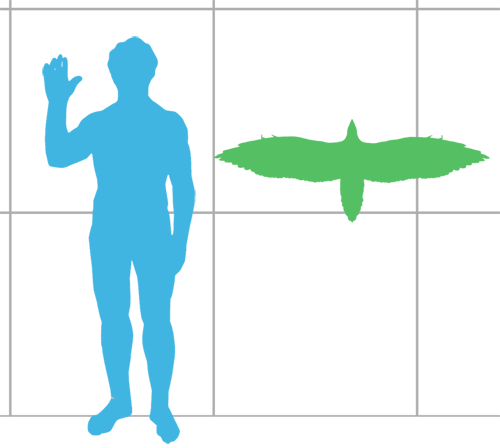
Sapeornis was very large for a Mesozoic avialan, likely weighing around 1 kg, comparable in size to a common raven or a red-tailed hawk. Its forelimbs were very long and had long wing feathers attached to them, giving it an estimated wingspan of more than a meter wide, as well as a wing planform very unlike the relatively short, broad wings of most other Mesozoic avialans. So Sapeornis could likely perch skillfully with its reversed first toe, and it likely flew from perch to perch, as indicated by the reduced grasping ability in its hands and its extremely long wings. Yet its anatomy also suggests that couldn't flap its wings very well.

The size of Sapeornis compared to a human, by Matt Martyniuk, licensed.

Perhaps this apparent paradox could be explained if Sapeornis only did quick bursts of flapping flight to get from tree to tree, but such a lifestyle is more common among birds with short, broad wings, more similar to those of other Mesozoic avialans. Another possibility is that Sapeornis was specialized for soaring, given that soaring flight doesn't require a whole lot of flapping. Extant soaring birds tend to have very long wings, similar to Sapeornis, and some previous studies have certainly concluded on anatomical grounds that Sapeornis could likely soar. Until recently, however, detailed investigation into the aerodynamics of Sapeornis had not been carried out to further test these conclusions.

In a newly-published study, Francisco J. Serrano and Luis M. Chiappe used multiple lines of evidence to infer and model the flight style of Sapeornis. First, they found that the size of the deltopectoral crest (a ridge on the humerus, or upper arm bone, that helps anchor the chest muscles) is negatively correlated with flapping frequency in modern birds. In other words, birds that flap less frequently (such as soaring birds) have a larger deltopectoral crest. Sapeornis had a sizeable deltopectoral crest relative to its body size. Score one for soaring.

The forelimb of Sapeornis showing its large deltopectoral crest (DPC), from Serrano and Chiappe (2017).

Next, they used computational modeling to calculate the amount of power necessary for Sapeornis to support itself using sustained flapping as well as the amount of power it could actually generate. These results showed that it would be extremely inefficient for Sapeornis to use sustained flapping flight. This is again similar to extant soaring birds such as hawks and ravens. These birds are capable of sustained flapping, but it is energetically costly for them to do so, and as such they prefer to soar when they can. Score another for soaring.

In addition, Serrano and Chiappe estimated the wing aspect ratio (the length of the wing relative to the width of its chord) of Sapeornis using both multivariate equations as well as direct measurements of reconstructed wing area. In both cases, the wing aspect ratio of Sapeornis plotted among soaring birds, and specifically among thermal soarers such as vultures that primarily soar on columns of warm air rising off the land. This makes sense. There are other soaring birds that are dynamic soarers, specialized for soaring at high speeds over the ocean by exploiting differences in wind velocity at different altitudes. Most of these species are seabirds with narrow, pointed wings. Given that fossils of Sapeornis were preserved in inland lakes near forested environment, it would have been a big surprise if it was found to have been a dynamic soarer!

The reconstructed wing planform of Sapeornis, from Serrano and Chiappe (2017).

All of these features are consistent with Sapeornis having been a thermal soarer, but could it, in fact, soar? Thermal soarers need to be able to make tight turns so that they remain near the center of a thermal where lift is the strongest. Using their computational models, Serrano and Chiappe were also able to calculate the turning radius and minimum sinking speed of Sapeornis. They found that the smaller specimens of Sapeornis could have had turning radii comparable to those of turkey vultures, some of the most masterful extant thermal soarers. Larger specimens had turning radii closer to those of white storks, which are also capable soarers.

Meanwhile, the large wings of Sapeornis would have been more than enough to slow its sinking speed so that it could be offset by the typical speed of rising air generated by thermals, and Sapeornis is also known to have had several large feathers on its tail, which would have given it even more lift. (In contrast, Confuciusornis had a single pair of long tail feathers at most.) Some specimens of Sapeornis preserve large feathers on the feet, which weren't incorporated into this analysis. I wonder what aerodynamic function, if any, they might have had.

Diagrams showing how Sapeornis likely soared and a graph comparing its estimated turning radii and sinking speeds to those of extant soaring birds, from Serrano and Chiappe (2017).

Thermal soaring also meshes well with the likely ecology of Sapeornis. The shape of its teeth indicate that it was most likely primarily herbivorous, and seeds have been found as its gut contents, suggesting perhaps that it ate fruit. Herbivory being a relatively low-energy diet, Sapeornis would benefited from the low-energy flight style of thermal soaring. Serrano and Chiappe suggest that good ecological analogues for Sapeornis are the screamers, a group of bizarre South American waterfowl that grow daggers on their wings, given that screamers are among the few herbivorous extant birds that both soar and perch in trees. (Though I personally suspect that Sapeornis was less terrestrial than screamers, considering the relative lengths of its forelimbs and hindlimbs as well as its large, curved foot claws.)

On the whole, this study does a convincing job of showing that both the anatomy and biomechanics of Sapeornis support thermal soaring as its main flight style, providing a plausible explanation for its unusual combination of aerially-adapted characteristics with the lack of flapping adaptations. It's easy to envision Mesozoic avialans as mere intermediates, gaining progressively more impressive flying abilities as they approached modern birds. However, the specialized soaring adaptations of Sapeornis, so far unique among Early Cretaceous avialans, set a good example in showing that many of them forged their own innovations that were not directly inherited by the line ancestral to extant birds.

I look forward to seeing this kind of multi-pronged approach applied to studying the locomotion of other extinct flying dinosaurs. Perhaps we can get an enantiornithine next...? ;)

Reference: Serrano, F.J. and L.M. Chiappe. 2017. Aerodynamic modelling of a Cretaceous bird reveals thermal soaring capabilities during early avian evolution. Journal of the Royal Society Interface 14: 20170182. doi: 10.1098/rsif.2017.0182