Tuesday, July 17, 2018

French National Museum of Natural History

The location of IPC 2018 was well chosen, taking place essentially next door to the botanical garden Jardin des plantes. It is here that the main galleries of the French National Museum of Natural History (Muséum national d'Histoire naturelle) are found. (The museum is divided into several sites scattered throughout France, but most of the publicly accessible galleries are at Jardin des plantes, which is also considered to be the museum's original location.)

Our first taste of the museum was at the conference's cocktail dinatoire, hosted at the museum's Gallery of Evolution. This gallery is probably most famous for its parade of African animals. Here I decided to take a shot focusing on the pangolin (with bonus marabou stork).

Though there was a lot to see in the Gallery of Evolution, the halls were dimly lit for most part, making photography difficult. Hidden away in a corner was an exhibit dedicated to recently extinct animals, featuring this skeletal mount of a dodo.

Some frolicking platypuses. I've rarely seen taxidermied monotremes put in such dynamic poses.

One section of the marine-themed exhibits in the gallery was focused on narwhals.

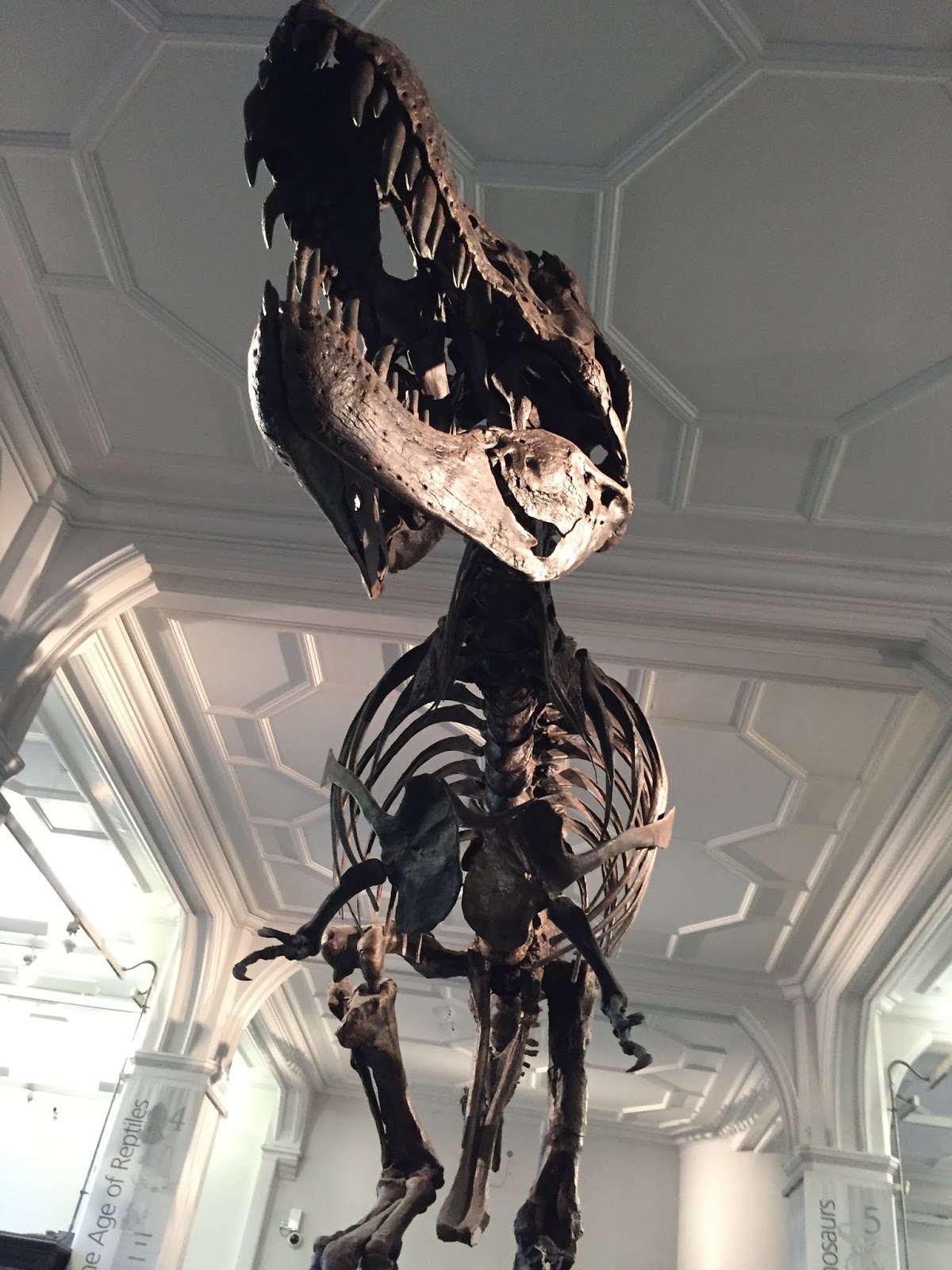
In a separate gallery was a temporary exhibit showcasing the Tyrannosaurus specimen "Trix", the first original Tyrannosaurus specimen to be on display in France.

In the same hall as "Trix" was a statue of the father of vertebrate paleontology himself, Georges Cuvier. For some reason he is depicted using his index finger to carve a rift through Africa on a globe.

The dinatoire had given us a good taster of the museum, but it hadn't yet given us a chance to visit the legendary Gallery of Paleontology and Comparative Anatomy. So (as I mentioned previously) on the third day of the conference some of us went to check that out. Along the way we passed by this carousel of extinct and endangered animals, featuring an elephant bird, a glyptodont, a Meiolania, and Sivatherium among others.

This was the sight that greeted us when we entered the Gallery of Paleontology and Comparative Anatomy. I guarantee that it is ten thousand times more impressive in person than what this photo suggests. Calling it a literally mind-blowing experience would barely be an exaggeration. I feel like everyone in my party was struck speechless for a few moments.

There was a lot to take in. It would have been impossible to properly examine everything even if we had spent an entire day there (partly due to the quantity of specimens and partly because some of the specimens weren't situated in places conducive to viewing), but we gave it a good shot. Here is a skeleton of a juvenile gorilla.

The marsupial case featured a thylacine skeleton as its centerpiece.

A long-beaked echidna.

The mustelid case, featuring a juvenile ratel.

A giraffe mounted with its nuchal ligament.

Naturally, Daniel and I spent a long time staring at the bird skeletons. Here is a case full of sunbirds.

A pair of kagu.

A screamer. It took us a few moments to figure out what it was (the scientific name on the label was outdated), but the carpometacarpal spurs probably should have clued us in.

Spoonbills.

A pelican mounted with its throat pouch.

A manatee skull.

An ocean sunfish.

A two-toed sloth turning its head around.

A bowhead whale mounted with baleen.

A balcony halfway up the stairs gave us the chance to look at the comparative anatomy exhibits from above.

The next floor up were the vertebrate paleontology displays. Here are some limb bones of Cetiosaurus.

A Sarcosuchus.

An Arctocyon, one of many Paleocene mammals of uncertain affinities.

I was surprised to see a restoration of a fully feathered dromaeosaurid included on one of the exhibit signs.

The French specimen of Compsognathus. Though Compsognathus was formerly considered the smallest non-avian dinosaur, I can confirm that it's not that small. At about the size of a turkey, it's certainly larger than the likes of Mei and Parvicursor.

A cast of the smaller holotype of Compsognathus.

The type specimen of Mosasaurus!

Another floor up hosted the museum's invertebrate paleontology displays. It was cool to see the holotype of Meganeura, though my photos of it turned out subpar.

After the museum, Daniel and I were interested in going to the small zoo (Ménagerie du Jardin des plantes) nearby, but Antoine (being a palynologist) decided to give us a tour of the botanical attractions in the garden first. Of course, I couldn't resist being distracted by the first sign of animal activity.

A Metasequoia, well known to paleobotanists who work on the Late Cretaceous (and onward).

The greenhouses were impressive. One simulated a tropical forest environment and included a staircase the allowed visitors to experience the "forest canopy". Though it must be said that being in a "tropical forest" without hearing any animal calls whatsoever was mildly eerie.

Another greenhouse arranged its exhibits in a more phylogenetically-based sequence, starting out with mosses and lycopods.

Platycerium, an unusual fern.

Some fossils of bennettitaleans.

By the time we stopped looking at plants, the Ménagerie was on the verge of closing. I did, however, take some time away from the conference to visit it on the following day, and will be covering it in the next post.

Monday, July 16, 2018

IPC 2018

Last week I was away at the 5th International Palaeontological Congress (IPC) in Paris. IPC, which is held only once every four years, is the largest conference I've ever been to, attended by paleontologists of all subdisciplines. (In contrast, SVP, my second largest conference so far, is largely attended by vertebrate paleontologists.)

I suspect that if this had been my first paleontology conference, I would have been completely overwhelmed. Fortunately, I was somewhat surprised to find that I already knew a fair number of other attendees and I had a good time catching up with those who I hadn't seen in a while (more than a year in some cases).

I presented a poster on my ongoing research, similar in content to the talk I gave at ProgPal. If there was one downside of the conference, it's that there was no dedicated poster session. Instead, posters were set up at the beginning of the conference and left there for its duration. Though this provided ample time for attendees to check out the posters they were interested in, there were fewer chances for presenters to receive direct discussion and feedback.

Don't worry, I'm the author and am allowed to disrespect my own no-photography icon.

With up to eleven parallel talk sessions at any given time slot, trying to see all the talks one is interested in was next to impossible. Regardless, I was satisfied with the talks I ended up attending and managed to catch all my top-priority sessions (the bird session on the first day and the phylogenetics sessions on the second and fourth days).

A small selection of personal talk highlights:
  • Diego Pol's plenary lecture on sauropodomorph evolution
  • Luis Chiappe's talk on a new enantiornithine bonebed
  • Ross MacPhee's talk on the role of proteomics in paleontology
  • Isaac Casanovas-Vilar's talk on a new Miocene flying squirrel
  • Martin Sander's talk on the evolution of endothermy in plesiosaurs
  • Catherine Musinsky's talk on the origin of the mammalian fauces
  • Allison Hsiang's talk on developing models for morphological evolution in MrBayes
  • Matt Phillips's talk on tip-dating mammalian evolution
  • Dominic Evangelista's talk on cockroach evolution
  • Alessio Capobianco's talk on the phylogenetic affinities of marine osteoglossomorphs
  • Matt Friedman's talk on the internal cranial anatomy of Carboniferous-Permian actinopterygians
  • Leif Tapanila's talk on edestoid dentition
(As you might infer from the diversity of topics, there was a relatively small number of dinosaur talks! Birds were the only dinosaurs to get their own dedicated session.)

As it happens, this trip was also my first time in Paris (as well as in continental Europe, for that matter), and one couldn't very well visit Paris for the first time without doing some sightseeing. Typically, conference events are so packed that there is little opportunity to see much of the city they take place in, but IPC gave attendees a free third day of the conference to satisfy their travel cravings.

In my case, I started my morning by taking the Metro to the Louvre. After snapping a photograph of the iconic pyramid just so I could claim I've seen it, I departed.

The Seine River (well, a small stretch of it).

The Notre-Dame Cathedral.

For lunch I stopped by the café of Shakespeare and Company, an independent English-language bookstore. The bookstore itself is pictured below. Within it I found copies of several popular paleontology books including Tony Martin's The Evolution Underground and Steve Brusatte's The Rise and Fall of the Dinosaurs. (No pictures of them to show though; photography was not permitted inside the store.)

After lunch, I returned to the vicinity of the conference venue to meet up with my supervisor, Daniel Field, who was also accompanied by palynologist Antoine Bercovici, computational evolutionary paleobiologist Allison Hsiang, and paleohistologist Holly Woodward. Our main objective was to visit the galleries of the French National Museum of Natural History (Muséum national d'Histoire naturelle), which will require a separate blog post dedicated to it.

Following that, Antoine (as a local Parisian) generously guided us to some of the more underappreciated highlights of the city. One stop he took us to was an overlook at the National Museum of Modern Art (Musée National d'Art Moderne) that gave us excellent views of the rest of Paris.

For dinner I had this duck confit (recommended by Antoine). I can confirm that it was both filling and absolutely delicious. If I ever return to Paris, it will be for this. This, and ice cream.

The evening of the fourth day played host to our conference dinner, which took place on a cruise along the Seine. While lining up to get on the boat, some of us saw this mother mallard guide her ducklings to a patch of floating vegetation where they could feed.

The cruise was a good way to see many of the major landmarks in Paris, with the Eiffel Tower being our final destination.

By the time the boat dropped us off, the skies were dark, just the right moment to appreciate the tower's lights. From there attendees had to stumble (in some cases likely drunkenly) and navigate by public transport back to where they were staying.

Monday, June 11, 2018

ProgPal 2018

I said last year that I intended to attend ProgPal again, and I did. This year the conference was held in Manchester and the icebreaker took place at the Manchester Museum. Here is their cast of the Tyrannosaurus specimen "Stan".


Though I would have liked to explore the museum more than I did, the fact that my digital camera happened to be under repair made me less inclined to take photos than usual. In addition, I ended up being too caught up in conversation to check out most of the exhibits. Thanks to Callum McLean for ensuring that I didn't miss the museum's maniraptor specimens such as this Confuciusornis!


There were also casts of several bones from Hesperornis.


Being more familiar with the conference logistics and knowing more people this time around, the whole conference honestly feels like a blur. (Given that ProgPal lasts for only three days with the main bulk of events packed into a single day, this may well be the way it's supposed to feel!) I still had lots of fun and got to meet many new faces.

The newly expanded University of Bath paleo-contingent was well represented, with nearly all other paleontology grad students in my year not only attending the conference but also presenting their research. Unlike last year, I gave a talk of my own about my ongoing work. I won't say much about it here until it's published, but responses were, dare I say, overwhelmingly positive.

My title slide.

Institutional loyalties aside, a selection of presentations that I thought were highlights include:
  • Orla Bath Enright's talk on Burgess Shale taphonomy
  • Robert Brocklehurst's talk on convergence between afrosoricidans and lipotyphlans
  • Alessandro Chiarenza's talk on dinosaur diversity prior to the K-Pg
  • Christopher Stockey's talk on an assemblage-level reconstruction of color patterns in fish from the Bolca Lagerstätte
  • Nuria Melisa Morales Garcia's poster on a new approach to studying Triassic mammaliaform jaw biomechanics

ProgPal remains a fantastic opportunity for paleontology students to hone their skills and network with future colleagues.

Wednesday, May 9, 2018

Did Confuciusornis Really Eat Fish? The Mysteries of Mesozoic Bird Diets

Without a doubt, the Jehol Biota dating to the Early Cretaceous of northeastern China has been one of the greatest contributors to the exponential increase in our understanding of Mesozoic bird biology and evolution in recent years. Hundreds of complete dinosaur skeletons have been recovered from the Jehol, often preserved with soft tissue structures such as feathers and scales. These fossils have shed much light on the anatomy and life appearance of Mesozoic birds and other feathered dinosaurs. Naturally, such complete specimens sometimes also preserve gut contents, providing us with information about the feeding habits of these dinosaurs.

A recent paper by Jingmai O'Connor, a leading expert on Jehol fossil birds, reviews our current knowledge of Mesozoic bird diets. I was reminded of Darren Naish's 2014 review paper on evidence of avian behavior (including feeding) preserved in the fossil record... which isn't cited by this new paper. Hmm.

Nonetheless, the detailed overview and evaluation of previous claims makes O'Connor's paper an important publication on the topic of Mesozoic bird biology. As expected, Jehol specimens have contributed the most direct evidence on this subject: fish have been preserved as gut contents or pellets in the euornithines Piscivoravis and Yanornis, whereas seeds have been preserved as gut contents in the long-tailed avialan Jeholornis, the basal short-tailed avialan Sapeornis, and the euornithine Eogranivora. A few Mesozoic birds outside of the Jehol have also been reported with gut contents: the enantiornithine Eoalulavis from Spain was preserved with crustacean exoskeletons and the hesperornithine Fumicollis (not mentioned in O'Connor's paper) from the United States was preserved with fish remains.

Seeds preserved in the gut of Jeholornis, from O'Connor (in press). Insets show the skull and teeth of Jeholornis.

In addition, a large number of Jehol birds have been preserved with gastroliths (gizzard stones). These include specimens of Jeholornis, Sapeornis, Archaeorhynchus, Bellulornis, Changzuiornis, Dingavis, Eogranivora, Gansus, Iteravis*, and Hongshanornis. Gastroliths are also known in some non-avian theropods (such as Caudipteryx), but it appears that not all Mesozoic theropods used gastroliths given that some have never been preserved with them despite being known from numerous specimens. It's likely that a muscular gizzard was widespread in theropods, yet only some lineages independently evolved the habit of swallowing stones as digestive aids.

*This paper is yet another recent publication that accepts the synonymy of Iteravis and "Gansus" zheni (even though they're still listed separately in the table listing preserved gut contents in Mesozoic birds). Looks like this taxonomic revision can now be comfortably considered the general consensus.

Cretaceous euornithines that preserve gastroliths, from O'Connor (in press). (A) is Dingavis, (B) is Archaeorhynchus, (C) is Eogranivora, (D) is Hongshanornis, and (E) is Gansus.

The positioning of gut contents preserved in the specimens can sometimes provide evidence for the anatomy of their digestive system. Ingested food in both Sapeornis and Yanornis have been found clustered near the base of the neck, suggesting that these birds had a crop, an expansion at the base of the esophagus that is used to temporarily store food.

Despite the wealth of information they contain, however, interpreting Jehol fossils is not always straightforward. They are generally preserved as crushed slabs, which can distort anatomical information in spite of the completeness of the specimens. When it comes to inferring diet of fossil taxa, chance associations between the specimens and external objects can also mislead. O'Connor identifies several instances of purported gut contents in Jehol birds that are not as convincing as the previous examples.

Fish remains associated with the euornithine Jianchangornis** and the enantiornithine Piscivorenantiornis, for example, are not located directly within their body cavity and cannot be definitively considered evidence for diet, contrary to previous interpretations. In fact, the mass of fish bones preserved near Piscivorenantiornis (originally interpreted as a pellet) more strongly resembles the fossilized droppings of carnivorous fish or aquatic reptiles that have previously been found in the Jehol. This renders the name of this bird (meaning "fish-eating opposite bird") particularly awkward.

**An additional tidbit provided in the paper is that the skull of the only known specimen of Jianchangornis is a composite constructed from several different animals, not all of which may even be birds! Given that features of its teeth were claimed to be one of its distinguishing features in its original description, a restudy of the specimen may be in order.

Another enantiornithine, Bohaiornis, has been suggested to have been a carnivorous, raptorial bird, based primarily on the fact that one specimen was preserved with a few small gastroliths. Raptorial birds today are known to consume small numbers of stones to aid in cleansing their digestive system, and it was thought that this represented evidence of Bohaiornis having done the same. (In contrast, the gastroliths of herbivorous birds tend to be more numerous and are used to help grind up food.) However, based on personal examination of the specimen, O'Connor concludes that the supposed gastroliths are more likely to be precipitated minerals.

Enantiornithines purportedly preserved with gut contents, from O'Connor (in press). (A) is Bohaiornis, (B) shows its supposed gastroliths, and (C) is Piscivorenantiornis.

Outside of China, the enantiornithine Enantiophoenix from Lebanon has been interpreted as a sap eater based on globs of amber associated with the holotype, but the specimen is highly disarticulated and as such the amber cannot be confirmed as gut contents. With these reevaluations, the only direct evidence of diet in enantiornithines is found in the aforementioned Eoalulavis. Enantiornithines likely exhibited a variety of specialized feeding strategies given the diversity of their tooth and skull shapes, but it appears that they mainly fed on foods that would not preserve easily as fossils.

One Jehol bird in which the absence of preserved gut contents has been especially perplexing is Confuciusornis. Known from hundreds of specimens, more specimens of Confuciusornis have been collected than likely any other Mesozoic dinosaur. Despite this, no specimens that preserve definite gut contents have been identified. One individual was thought to preserve fish remains in a crop. However, this association is by no means unequivocal, especially given that it has only been reported in one out of hundreds of Confuciusornis specimens. O'Connor points out that, in contrast, about half of all known Yanornis specimens preserve fish in their gut. Regardless of whether the fish associated with that one specimen represents ingested material, evidence for fish being the main diet of Confuciusornis is lacking.

One of the many, many, many known specimens of Confuciusornis, photographed by Tommy from Arad, under CC BY 2.0.

Even without direct evidence from gut contents, one might think it wouldn't be so hard to get at least a general idea of what Confuciusornis ate. Inferring diet in many Mesozoic birds can be tricky because they had teeth, which makes it difficult to compare them to modern birds (all of which are toothless). Confuciusornis, however, had a beak instead of teeth, convergent with modern birds. Despite this, no living bird has a beak that closely resembles that of Confuciusornis, setting us back to square one.

Not that paleontologists haven't tried drawing conclusions from the beak morphology of Confuciusornis. A common interpretation is that Confuciusornis ate seeds, which on the surface seems reasonable. Its beak was quite robust and tooth loss is commonly associated with herbivory in other theropods. However, this runs into the same problem as the suggestion that it fed mainly on fish: definite seed-eating birds found in the Jehol regularly preserve gut contents, yet the same cannot be said of Confuciusornis.

Another recent study may shed light on this problem. Andrzej Elżanowski and colleagues have redescribed the skull anatomy of Confuciusornis based on detailed examination of multiple specimens and comparison with modern birds. As mentioned previously, the anatomical features of Jehol fossils aren't always easy to interpret, and the reconstruction presented in this new paper differs from those of previous authors in some notable ways. It's probably no coincidence that one of the authors on the paper is Gerald Mayr, known for his research on similarly crushed bird fossils of the Eocene Messel Shale.

Reconstructed skull of Confuciusornis, from Elżanowski et al. (2018).

One of the most surprising discoveries made by the researchers was that, despite not being particularly closely related to modern birds among Mesozoic avialans, Confuciusornis resembled certain living birds in more than just its lack of teeth. In their new interpretation, Confuciusornis had a bony rim behind its eye socket, and this rim was connected to the back of the skull by a bony bridge. Among modern birds, the prominent rim behind the eye is also found in the tawny frogmouth, the courol, puffbirds, some rollers, and some kingfishers. In addition, the tawny frogmouth also has a bony connection between the rim and the back of the skull.

All of these modern birds feed in a similar manner: watching from a perch before flying forth to grab their prey (often insects) in their jaws. This method of hunting is called sally-striking. The bony expansions of the skull behind their eyes likely provide room to attach larger jaw-closing muscles, increasing the grip strength of their beak.

Some modern sally-striking birds, including a tawny frogmouth (top left), white-whiskered puffbird (top right), Indian roller (lower left), and brown-headed paradise kingfisher (lower right), composited from photographs by JJ Harrison, Len Blumin, Shantanu Kuveskar, and "markaharper1", under CC BY-SA 3.0.

Is a sally-striking lifestyle consistent with the rest of Confuciusornis anatomy? Probably! Like modern sally-strikers, its beak was relatively large and deep. A close relative of Confuciusornis, Changchengornis, even had a slightly hooked bill like many modern sally-strikers do. The foot anatomy of Confuciusornis suggests that it was capable of perching, and its wing shape would have allowed it to maneuver well in its forest environment while making its prey-catching flights. Confuciusornis was also about the same size as some of the larger sally-striking birds today (such as the tawny frogmouth). And if Confuciusornis mainly fed on invertebrates whose remains might not have survived for long in the digestive system, that would explain why its gut contents are so rarely preserved.

Sally-strikers may snatch their quarry from the ground, from vegetation, or in mid-air. Though Confuciusornis could probably perch, some of its limb proportions have been likened to birds that spend part of their time on the ground. And while it may have had relatively maneuverable flight, it still lacked many of the flying specializations that modern birds possess, so it may not have been quite as acrobatic as some living sally-strikers. Perhaps it primarily apprehended prey on the ground, which might also explain how two individuals ended up as gut contents of the terrestrial theropod Sinocalliopteryx!

On the whole, the suggestion that Confuciusornis was a sally-striker appears plausible in light of what was previously inferred about its biology. Given this model, I do wonder if we'll ever find direct evidence of Confuciusornis feeding on vertebrates. Many modern sally-strikers also readily prey on smaller vertebrates in addition to insects, and Confuciusornis certainly was large enough to have done so. Even if vertebrates did not account for a large proportion of its diet, it is perhaps not a huge stretch to predict that such a discovery will one day be found.

References