Monday, April 20, 2020

The Lost Mousebird Dynasty

In sub-Saharan Africa there live six species of small, sociable birds called the mousebirds or colies. Classified into two genera (Colius and Urocolius), they are found in semi-open habitats such as savannah and woodlands, where they flit from tree to tree and feed on fruits, leaves, and flowers. Mousebirds climb with great agility, scurrying along tree branches in almost mouse-like fashion (hence "mousebirds").

Facilitating the arboreal activities of mousebirds are their unusual feet. Both the outermost and innermost toe on each foot can swivel to direct either forward or backward. As a result, mousebirds can adopt not only the anisodactyl toe arrangement of most modern birds, in which each foot has three toes pointing forward and one pointing back, but also zygodactyl (two toes forward, two toes back) and pamprodactyl (all four toes facing foward) configurations as well. Given this versatility, mousebirds can grasp and cling to surfaces in a variety of ways, as well as use their feet to handle food items. They often dangle from perches in a distinctive posture, with their feet held up at chest level and their very long, stiff tail feathers propped against a nearby surface.

A speckled mousebird in the characteristic dangling pose frequently adopted by mousebirds, photographed by Bob McDougall, under CC BY-NC 4.0.

Despite their specializations for climbing, mousebirds seem to have no trouble walking and running on the ground. They rarely drink water, but when they do, they are among the few birds that can drink by suction, and thus don't need to tip their head back to swallow each mouthful. (Among birds, similar abilities are also found in pigeons and some estrildid songbirds.) When food is scarce, mousebirds may enter torpor at night, dramatically lowering their metabolism to conserve energy.

Genetic studies have consistently placed mousebirds within Telluraves, a very diverse clade of mainly arboreal birds that also includes songbirds, parrots, woodpeckers, the various groups of birds of prey, and many, many more. Although some researchers have noted anatomical similarities between mousebirds and parrots, genetic studies generally don't favor a close relationship between these two groups within Telluraves. Instead, the most comprehensive recent analyses recover mousebirds as the closest living relatives of Cavitaves, a clade that unites woodpeckers, kingfishers, hornbills, trogons, and the Malagasy courol. Even so, uncertainty remains, as some types of genetic material strongly favor placing mousebirds as more distant relatives of cavitavians than are hawks and owls.

Phylogeny showing the phylogenetic position of mousebirds (Coliiformes) recovered by the most recent large-scale genetic studies (though see main text).

Mousebirds are generally unfamiliar to people outside of Africa today. However, during the Eocene Epoch (56-33.9 million years ago), the close extinct relatives of mousebirds were likely some of the most common birds in the forests of Europe and North America, as evidenced by the discovery of numerous fossil specimens. (Eocolius from the Eocene London Clay Formation in England probably wasn't one of them though. Known from a partial skeleton, it was originally described as a mousebird, but subsequent studies have found that it exhibits no convincing mousebird traits.)

A number of early mousebirds belonged to the extinct group Sandcoleidae, named by Peter Houde and Storrs Olson in 1992. Some sandcoleids, such as Botauroides, Eobucco, and the two species of Uintornis from the Bridger Formation of North America, are only known from feet. In contrast, Sandcoleus from the Willwood Formation and Anneavis from the Green River Formation of North America are known from nearly complete skeletons, as is Eoglaucidium from Geisel Valley and the Messel Formation in Germany.

In addition to Eocene fossil deposits, sandcoleids are also known from rocks dating to the preceding epoch, the Paleocene. In fact, ~62.5-million-year-old Tsidiiyazhi, known from a partial skeleton discovered in the Nacimiento Formation of New Mexico, represents the oldest well-corroborated fossil of any kind of neoavian bird, indicating that modern-type birds had already diversified greatly by the early Paleocene.

A specimen of Eoglaucidium preserved with feathers, from Mayr (2018).

Sandcoleids had "generalist", thrush-like beaks, suggesting that they weren't particularly specialized for feeding on any specific type of food. However, seeds have been found as gut contents in some specimens. These seeds had been swallowed intact rather than crushed, perhaps implying that sandcoleids swallowed fruits whole at least on occasion, similar to modern mousebirds.

Some specimens of Anneavis and Eoglaucidium have been found with preserved feathers. Like extant mousebirds, they had short, rounded wings, but at least Eoglaucidium differed from them in lacking a head crest. The tail feathers of sandcoleids were fairly long, but not elongated to the extent seen in modern mousebirds. This, along with a pygostyle (fused vertebrae at the end of the tail) that was not as broad as it is in living mousebirds, indicate that sandcoleids did not habitually prop their tail against surfaces.

The feet of sandcoleids were more robust than those of extant mousebirds, further implying that they did not typically use a dangling perching posture. They were probably still skilled climbers and clingers, as was proposed by Houde and Olson, and later supported in a functional study by Nikita Zelenkov and Gareth Dyke in 2008. Sandcoleid feet bore curved claws, which have been likened to those of raptors. Although sandcoleids seem to otherwise lack raptorial adaptations, perhaps this indicates that they used their feet for manipulating food items. Like modern mousebirds, sandcoleids appear to have had flexible toes that could alternate between several different toe configurations.

Intriguingly, the raptor-like claws of sandcoleids may be consistent with the hypothesis that the last common ancestor of all telluravians was a raptorial bird. Might this also explain the apparently convergent similarities between mousebirds and parrots, in that their shared features could have both resulted from the adoption of a fruit-eating ecology by a raptorial ancestor? Food for thought. (Maybe someone should keep an eye on the palm-nut vulture...)

The feet of Eoglaucidium showing large, curved claws, from Mayr (2018).

Formerly thought to be a sandcoleid was Selmes from the Messel Formation. (Its genus name is an anagram of "Messel".) Originally named in 1999, a better-preserved specimen described by Gerald Mayr in 2001 exhibited several features, including slender feet and a broad pygostyle, that suggested it was more closely related to modern mousebirds than sandcoleids were. In addition, these characteristics suggest that it often perched in the dangling pose of modern mousebirds. Selmes was also initially interpreted as having toes that were permanently fixed in a pamprodactyl arrangement, but Mayr argued that its feet more likely functioned similarly to those of sandcoleids and living mousebirds. Like sandcoleids, Selmes has been found with seeds preserved as gut contents. A mousebird foot from the Eocene Quercy Phosphorites may represent a French record of Selmes.

A specimen of Selmes, from Mayr (2001). The black arrow points to the broad pygostyle.

There is, however, another Messel mousebird that might have actually had permanently pamprodactyl feet. That mousebird is Masillacolius, known from three specimens that all have the toes preserved in a pamprodactyl posture. Other than mousebirds, the only extant birds that adopt a pamprodactyl foot configuration with any regularity are some types of swifts (though they don't do so as frequently as sometimes implied by popular texts), which use this ability to cling to vertical surfaces. Perhaps Masillacolius did the same.

A seed is associated with one specimen of Masillacolius; this may represent yet another example of ingested material preserved in an extinct mousebird, though in this case the seed is not directly preserved in the body cavity. Masillacolius is also one of several fossil mousebirds (as we shall see) known to have had long bony projections on the back of its lower jaw. These projections are relatively reduced in living mousebirds, but are often well developed in birds that need to open their jaws widely and forcefully.

A specimen of Masillacolius, from Mayr (2015). An associated seed is marked as "sd".

Among fossil mousebirds, such well-developed projections were first noted in Chascacocolius. The first species of Chascacocolius to be named was C. oscitans from the Willwood Formation. It was described as a sandcoleid by Houde and Olson (1992), but more recent studies suggest that it was more closely related to extant mousebirds. Although a lower jaw is known for C. oscitans, the rest of its skull has not been found.

However, a second species from the Messel Formation, C. cacicirostris, was named by Mayr in 2005, and it is known from a complete skull as well as some neck vertebrae. And what an unexpected skull it had! Its long, pointed beak more closely resembles those of New World blackbirds than that of any other kind of mousebird, living or extinct. In fact, Mayr noted that if it weren't for his knowledge of a privately-owned specimen that preserves a complete skeleton (figured in his paper), it would have been difficult to identify C. cacicirostris as a mousebird at all! (Unfortunately, the current location of the complete skeleton is unknown.) New World blackbirds use their enhanced gaping abilities and pointed bills to pry open crevices in search of prey and to open up large fruits so they can lap up the juices inside. Chascacocolius may have done so as well. Zelenkov and Dyke (2008) proposed that Chascacocolius had a woodpecker-like, trunk climbing ecology, though a later study by Dan Ksepka and Julia Clarke in 2010 was unable to verify the presence of features that purportedly supported this hypothesis.

The skull of Chascacocolius cacicirostris, from Mayr (2005).

Ksepka and Clarke (2010) also named one of the most unusual fossil mousebirds that have been described so far, Celericolius from the Green River Formation. Celericolius is known from a complete skeleton preserved with traces of the wing and tail feathers. These feather remains indicate that it had very long, pointed wings, quite unlike the short, rounded wings of modern mousebirds and sandcoleids. Such wings are commonly found in birds that specialize in catching insects in flight, such as swallows and swifts. Was Celericolius a mousebird version of a swallow? The only known specimen has a poorly-preserved skull and no associated gut contents, so it's hard to say.

Holotype of Celericolius, from Ksepka and Clarke (2010). The arrows indicate preserved wing and tail feathers.

The youngest known mousebird from North America was Palaeospiza from the late Eocene Florissant Formation. It is known from a partial skeleton preserved with feathers, and appears to have been closely related to modern mousebirds. However, it still differed from living mousebirds in details of the feet and forelimb bones. Possibly similar to Palaeospiza were the two species of Primocolius that lived at around the same time in what would become France, but a detailed comparison is difficult because Primocolius is only known only from isolated bones.

In Europe, mousebirds continued to persist beyond the Eocene. Two species of the appropriately named Oligocolius have been identified, both of which lived during the Oligocene in what would become Germany. The slightly older O. brevitarsus is known from a partial skeleton, whereas the younger O. psittacocephalon is known from a nearly complete skeleton, including a skull.

O. psittacocephalon is yet another extinct mousebird known to have had elongated projections behind the lower jaw. However, its beak was short and stout, more similar to those of extant mousebirds than that of Chascacocolius. It also had a marked hinge between its upper jaw and the rest of its skull, which likely allowed the upper jaw more freedom to flex up and down. As it happens, O. psittacocephalon was found with several large seeds preserved in its throat region. Its well-developed lower jaw projections and hinge at the base of the upper jaw may have both allowed it to swallow large fruits.
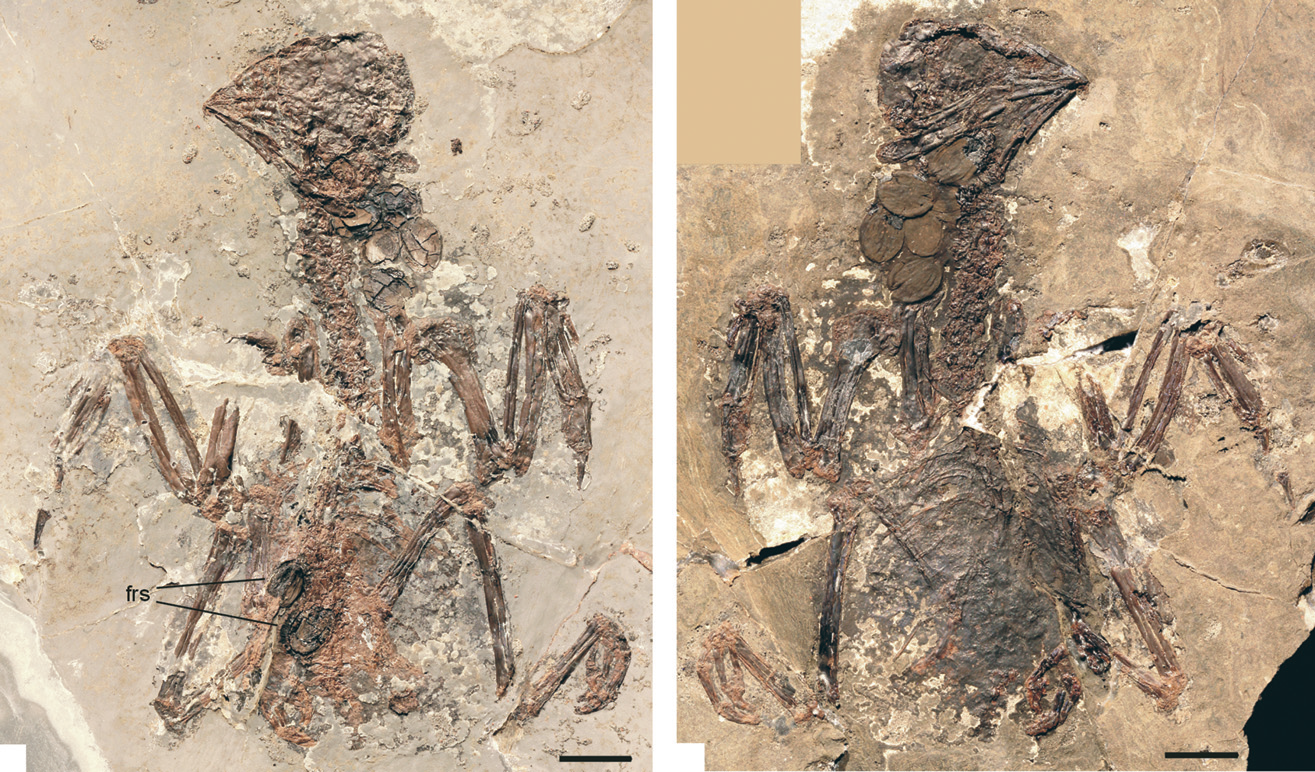
Holotype of Oligocolius psittacocephalon, from Mayr (2013). Note the large seeds preserved in the throat region.

Mousebirds remained part of the European avifauna during the first half of the Miocene, and two genera, Limnatornis and Necrornis, have been named for European mousebird fossils from this time. Yet no mousebird fossils younger than the mid-Miocene have been discovered in Europe, nor anywhere else in the Northern Hemisphere.

What happened to the northern mousebird dynasty? In 2019, Erin Saupe and colleagues showed that climatic conditions in North America and Europe during the early Eocene were similar to those favored by living mousebirds, matching the known occurrences of mousebird fossils. However, the cooling and drying of global climate throughout the Cenozoic gradually restricted such favorable conditions to regions near the equator. Saupe et al. also found similar patterns for several other bird groups that have geographically restricted distributions in modern times.

It is not clear whether mousebirds already lived in Africa before climate change limited them to that continent. However, the oldest known African mousebird is Colius hendeyi from the Pliocene of South Africa, postdating mousebird fossils from North America and Europe. Although assigned to the extant mousebird genus Colius, it is uncertain whether C. hendeyi really belonged to the modern radiation of mousebirds.

Mousebirds today are greatly diminished not only in geographic range but also in ecological diversity. The six living species only differ from one another in relatively minor details. Yet despite occasionally falling victim to persecution (due to their feeding on fruiting trees), pesticides, and collisions with vehicles, none of them are under immediate threat of extinction. In fact, mousebirds have benefited from some human activity, as gardens, orchards, and fruit plantations provide suitable habitat for them. As long as such conditions are maintained, it is likely that these curious little birds will continue the legacy of their incredible former diversity.

My amateur restorations of some fossil mousebirds.

References

Wednesday, April 1, 2020

Why I Like My Little Pony: Friendship is Magic

My new April 1st tradition is to write about topics that would normally be off-topic for this blog. This year, let's talk about... this.

Fan art does not comprise the bulk of my artistic output, but I've drawn a fair amount for My Little Pony: Friendship is Magic (henceforth "MLP" for brevity, though I realize that that also refers to the entire franchise instead of just this particular iteration of it). It's even been the primary basis for one of the major storylines in the Raptormaniacs comic. Why do I keep drawing fan art of MLP?

This isn't a post that anyone asked me to write. Some might even think it's inane that I've spent time writing it. I suspect that most of my friends and followers would be satisfied if I answered that question with "because I like the show".

At the same time, I also suspect that few if any people who follow me did so for the fan art. It wouldn't surprise me if I have followers who are curious, perplexed, or even frustrated every time I drop a new piece of MLP fan art in their social media feeds. So I'm going to talk a little bit about what this show means to me.


Is the show really that great? I certainly think that it's good overall, and much better than a glorified toy commercial needs to be. However, it is not my favorite show, and though I would consider it a standout animated series for when it premiered in 2010, I feel that both the absence of a coherent vision in series direction (due to it changing hands between several different showrunners) and the surge of other high-quality cartoons in recent years has rendered it in some ways unexceptional.

Even so, there's a lot I like about MLP. The fact that the protagonists are six female characters with contrasting personalities and career choices who are all multifaceted beyond what first impressions might suggest is a big plus. The concept that there are many ways of being a girl is a great message for the target audience, and it also means that almost anyone watching the show can likely identify with one (or more) of the main characters. (I relate most to Twilight and Fluttershy, for the record.)

I suppose I should have at least one image here showing what the main characters actually look like in the cartoon.

I would be lying if I claimed that MLP hasn't made me more aware of common pitfalls in the portrayal and representation of female characters in popular media, including my own rare forays into fiction writing. It's had a real influence on my work for TetZoo Time (which, uh, probably won't ever be released) and Chile & Yi. And, boy, do I regret having only one female character on the main cast of Raptormaniacs.

Beyond the characters themselves, I find it refreshing to watch a show that revolves around adults making and maintaining friendships, instead of constantly putting each other down. Sure, a world in which "friendship conquers all" may come across as sickeningly sweet to jaded adult audiences, but the show doesn't shy away from the notion that one may need to fight (figuratively or literally) to maintain such a world. Friendship is powerful, but it's not always easy, and that is a lesson that can be just as applicable to adult lives as to those of children.

And frankly? Friendship may not manifest as villain-vanquishing lasers in real life, but a society built upon collaboration, acceptance, and compassion is one that I would like to live in, and it's one that we have the power to create. Especially in times like the ones we're living in right now, that seems like a worthy goal to strive for.

Sometimes friendship is zapping insectoid shapeshifters in the face.

Uh, right, I got sidetracked there for a bit. What else do I like about MLP? Well, the music is pretty great. I think just about anyone who has worked on a creative project can relate at least a little to "Art of the Dress", "Winter Wrap Up" is a nice piece of worldbuilding packaged into a catchy tune, and I find "A Kirin Tale" to be quite uplifting, just to name a few of my favorites.

That much explains the main reasons why I like the show. But why do I draw so much fan art of it? Partly it's because fan art adds a layer of novelty to otherwise unremarkable concepts. I could draw a Microraptor flying or an oviraptorosaur kicking a predator, but there's not much I could bring to those subjects that a better artist couldn't conceive of and execute. However, if I drew Rainbow Dash as a microraptorian in flight and Rarity as an oviraptorosaur kicking a changeling? That's much less likely to have already been done by someone else.

Yet there remains the question of why it's MLP that features so frequently in my fan art, as opposed to the handful of other fictional works I follow. I have tried my hand at "dinosaurifying" some other cartoons I enjoy, but so far they haven't inspired as many creative works from me as MLP has.

One reason is practical: MLP's art style is fairly easy to emulate. It's probably testament to the design and characterization in the series that it's relatively straightforward to adapt the characters into alternate forms. It's even been done in canon more than once (albeit to... varying results).

Another important factor is that the series setting presents a mixture of familiar and fantastical elements that readily provides a springboard for creativity. It may be simple enough to come up with alternate forms for the characters, but what might this change about how they interact with their world? How would a sapient paravian use a teacup? Would an event analogous to the Chicxulub impact be a major concern when your ruler can move the sun? In some ways, it's not dissimilar to a speculative biology project about dinosaurs that have evolved human-like intelligence (and magic, apparently).

Besides, how often does one get to draw a dinosaur having tea with a chaos spirit?

That about covers everything I wanted to say. I'll leave you with a record of my artistic evolution as documented by My Little Maniraptor. This was the first MLP fan art I ever drew, and I've redrawn it twice since then. Time will tell if I revisit it again.

Wednesday, March 18, 2020

Catch a Falling Star: Meet Asteriornis!

Today marks the publication of a very exciting study that I have been waiting to talk about for a long time. Led by my supervisor Daniel Field, we describe a new species of fossil bird from the Late Cretaceous of Europe, and it's a doozy.

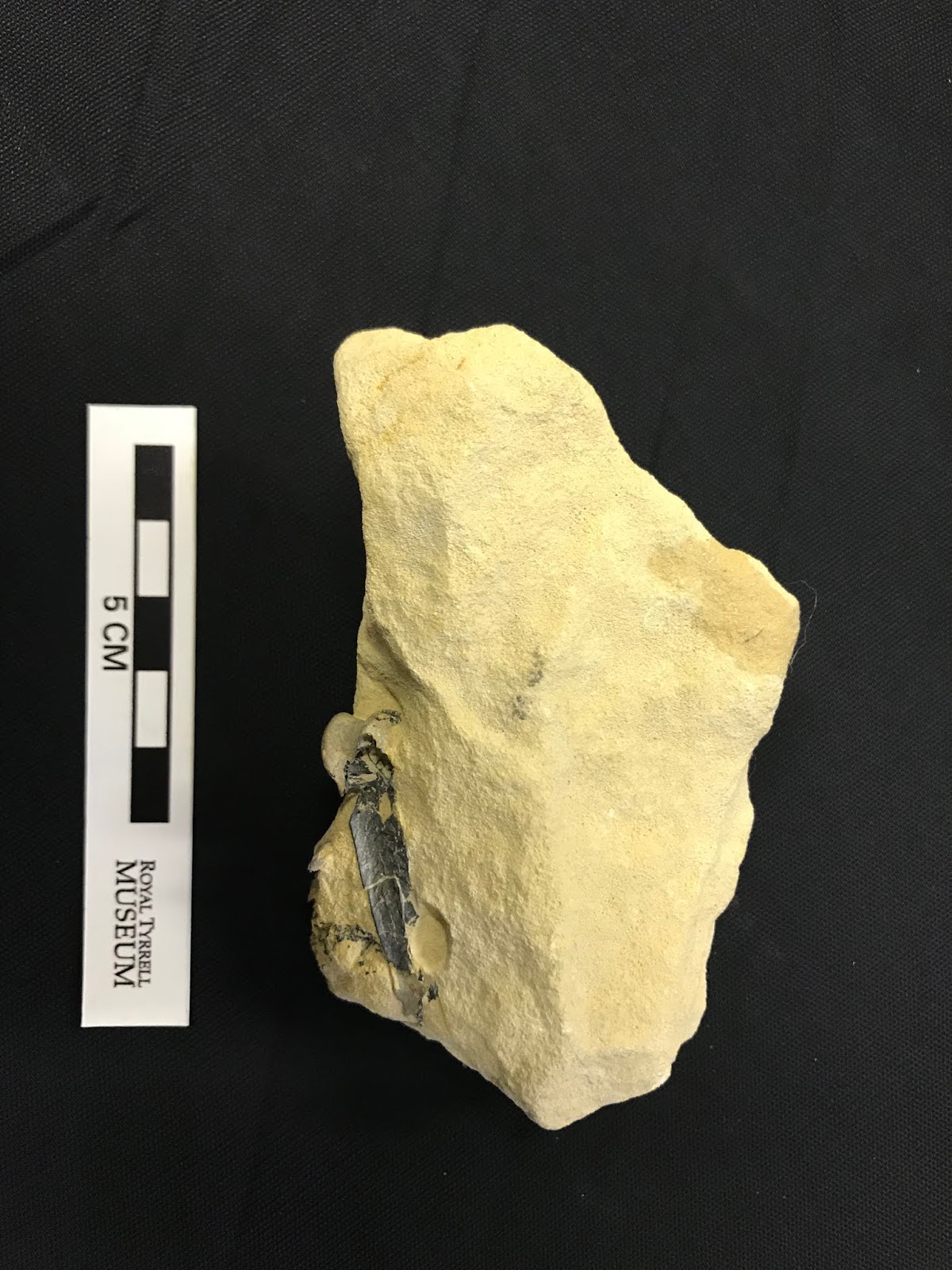
Doesn't look like much, does it? But read on... (Photo by Daniel Field.)

Among the most highly sought-after discoveries in the avian fossil record are specimens of the oldest modern-type birds. Although we now know of numerous bird-like dinosaur fossils that document the evolutionary acquisition of many notable avian features, the origin of the modern bird group (Neornithes) itself remains cryptic.

Molecular clock analyses, which use molecular sequences from different organisms and estimated mutation rates to infer the age of divergence between different lineages, place the origin of modern-type birds in the Cretaceous. For reasons that I won't go into here (lest I wander too far off topic), timing the origin of modern birds is a subject fraught with controversy. However, all recent molecular clock analyses of modern-type birds agree in placing the divergences between the three main extant avian lineages—paleognaths (ostriches, emus, and their kin), galloanserans (chickens, ducks, and their kin), and neoavians (all other living birds)—by the end of the Cretaceous. Despite this, fossil evidence for these hypothetical modern-type birds in the Cretaceous has been limited.

There have been a number of specimens purported to represent Cretaceous modern-type birds, but most of them are so fragmentary that their supposed affinities are best taken with an unhealthy serving of salt. By far the best represented (and probably the most convincing) example of a Mesozoic modern-type bird is Vegavis iaai, known from two partial skeletons from the Late Cretaceous of Antarctica. However, the skull of Vegavis is largely unknown. Furthermore, how Vegavis relates to living birds is not well understood. Although it was originally described as a close relative of modern ducks and geese, this has been questioned by some recent studies.

By the end of the Cretaceous (66 million years ago), modern-type birds had likely diverged into at least three major lineages.

In 2018, Daniel arranged a loan of a fossil bird specimen with the Maastricht Natural History Museum (Natuurhistorisch Museum Maastricht or NHMM) in the Netherlands. My labmate Juan Benito Moreno traveled to Maastricht to borrow the specimen from curator and coauthor John Jagt, who also provided us with information about the geologic setting in which the fossil had been discovered.

The specimen had been recovered from a quarry in Belgium, hailing from the Valkenburg Member of the Maastricht Formation. This site dates to 66.8-66.7 million years old, very close to the end of the Late Cretaceous (66 million years ago). Another fossil from this site had been previously described briefly as an Ichthyornis-like bird. Seeing as it preserves at least one tooth, this previously-studied specimen was certainly not a modern-type bird.

The new specimen is a very unassuming fossil, composed of four blocks of rock matrix that together take up about as much space as a deck of playing cards. In fact, the only reason we paid any attention to it was because one of the blocks (pictured at the beginning of this post) had an avian leg bone exposed on its surface. Bits and pieces of other bones were visible as well, but nothing that looked particularly exciting at a glance. Little did we know what we would find when we took a look inside.

To visualize the fossil material still hidden inside the rock, Daniel and Juan CT-scanned the specimen at the Cambridge Biotomography Centre. Shortly after they'd done so, Juan sent me a photo of what they saw inside the aforementioned block.

Holy fucking shit.

It was the nearly complete skull of a modern-type bird! Although it was distinct from any other bird skull known, we immediately noticed similarities with those of extant galloanserans. For reasons that I will explain near the end of this post, we eventually decided to give this bird the scientific name Asteriornis maastrichtensis. However, while we were in the process of studying the specimen, we called it by the nickname "Wonderchicken", for its suspected galloanseran affinities.

Due to the delicate nature of the fossil, we chose not to physically separate the bones from the surrounding rock. (For some perspective, the preserved length of that skull is less than 5 cm long, shorter than my thumb.) Instead, we spent much of 2019 digitally isolating each of the bones in the CT scans. In addition to the amazing skull, we were able to identify several wing and leg bones contained within the blocks, even though these bones were broken or incomplete.

Once we had digitally extracted the bones, we could look at them more thoroughly and make detailed comparisons with the anatomy of other birds. Here our coauthor Dan Ksepka brought his extensive experience in studying bird skeletons to bear, and we were able to confirm the presence of several features in Asteriornis that are also seen in most galloanserans. These include long, curved retroarticular processes (projections at the back of the lower jaws), narrow, upward-pointing medial processes (projections on the inside of the lower jaws), and a shallow groove along the top of the skull. In addition, the quadrate (a bone at the back of the upper jaw) of Asteriornis closely resembles that of the Paleogene waterfowl Presbyornis.

The skull of Asteriornis in multiple views. Juan spent a copious amount of time preparing the anatomical figures in our paper. This image is Extended Data Fig. 2 from Field et al. (2020).

To test our phylogenetic hypothesis and to give us a better handle on exactly what type of galloanseran Asteriornis might have been, we added Asteriornis to a modified version of the phylogenetic dataset used by Tambussi et al. (2019) in their description of the Paleocene waterfowl Conflicto. (As an aside, the last sentence in my blog post about Conflicto was intended to be an oblique reference to Asteriornis.) This dataset includes a range of extant and extinct galloanserans, and originated from Worthy et al. (2016).

The phylogenetics section of our study was my primary contribution to the description of Asteriornis. I implemented many of the changes to the dataset that we'd agreed to make, set up the phylogenetic analyses, and wrote up our phylogenetic methods and results. (Readers interested in those details are encouraged to check out our 136-page supplementary material. It contains more than just phylogenetics, but my input does take up a pretty big chunk!)

Ultimately, one of our analyses found Asteriornis to have most likely been a stem-galloanseran (more closely related to galloanserans than to any other living group, but not a member of either the landfowl or the waterfowl lineages). However, some of our other analyses found it best supported as an early stem-landfowl (more closely related to chickens than to ducks, but outside of the group uniting all modern landfowl), and we found that an early stem-waterfowl position was potentially plausible as well. This is not terribly surprising; species that retain many ancestral traits of a given group are often very difficult to confidently place on one specific branch or another. Yet regardless of exactly where Asteriornis goes in galloanseran phylogeny, no other fossil has been identified as a better representative for what the ancestral galloanseran probably looked like.

Landfowl and waterfowl have not always been widely accepted to be close relatives. Some previous authors have even provided long lists of anatomical differences between these two groups while expressing skepticism of such a relationship. Although the close ties between landfowl and waterfowl are now strongly supported by more recent studies, the distinct anatomy between the two groups has made it difficult to infer what their ancestral form was like. Asteriornis exhibits a mixture of traits from both lineages. Like landfowl, the bones in its snout are only weakly joined to each other and there is no obvious hinge at the base of its upper beak. On the other hand, its rounded, unhooked bill tip is more commonly found in waterfowl, as are the forward-pointing bony projection behind each eye socket and the hourglass-shaped depression on the top of its skull.

The skull of Asteriornis (with particular focus on the quadrate bone) compared to those of other galloanserans, including an Australian brushturkey (Alectura lathami), an... actual turkey (Meleagris gallopavo), the Eocene waterfowl Presbyornis, the Paleocene waterfowl Conflicto, a southern screamer (Chauna torquata), and a mallard (Anas platyrhynchos). This image is Extended Data Fig. 4 from Field et al. (2020).

We recovered a few additional phylogenetic results that I found especially interesting. First of all, none of our analyses found a particularly close relationship between Vegavis and waterfowl, supporting recent studies that have raised questions about its affinities. In fact, one of our analyses even found it outside of modern-type birds, though support for this result was very weak (and we are pretty skeptical of it). Secondly, in some (but not all) of our analyses, we recovered the extinct, long-legged presbyornithids as stem-waterfowl instead of their more traditional position as extinct members of the modern waterfowl group, similar to the findings of Tambussi et al. (2019). Having seen the similarities between Asteriornis and Presbyornis, I personally feel quite amenable towards the possibility that presbyornithids were stem-waterfowl.

We were also interested in adding two species of pelagornithids to our phylogenetic analyses. These large, extinct seabirds with tooth-like projections in their beaks have been suggested to have been aberrant galloanserans or close relatives thereof, but had not been included in previous versions of the dataset we used. However, our analyses did not find any consistent position for them. Resolving their evolutionary relationships will probably require a detailed study for another time.

The results of one of our phylogenetic analyses. This one recovered Asteriornis as a stem-galloanseran. This image is modified from Extended Data Fig. 9 from Field et al. (2020), and the restorations of Asteriornis were painted by Phillip Krzeminski.

Given that Asteriornis lived near the end of the Cretaceous, it provides us with a potential test of previous ideas about Cretaceous modern-type birds. Recent studies have predicted that the modern-type birds at the end of the Cretaceous were likely small-bodied, ground-dwelling animals, and that these factors may have been critical to their survival across the Cretaceous-Paleogene (K-Pg) mass extinction. To determine the body size of Asteriornis, Daniel used equations for estimating avian body mass from the width of their limb bones, and calculated its body mass at less than 400 g. That's much smaller than the average domestic duck or chicken, falling within the size range of a teal or partridge: relatively small by galloanseran standards.

As for the preferred habitat of Asteriornis, the preserved limb bones in our specimen are mostly incomplete, but enough is present to show that the hindlimbs of Asteriornis were relatively long and slender, well within the expected proportions for a ground-dwelling bird. This, along with the nearshore marine rocks that the specimen was preserved in, may even suggest that it mainly lived and foraged on the beach. Interestingly, the idea that all modern birds evolved from shore-dwelling ancestors has been put forth by other paleontologists in the past. Our current understanding of avian evolution does not support the notion that the group of living birds popularly known as "shorebirds" (Charadriiformes) gave rise to other modern birds, but Asteriornis suggests that a shorebird-like ancestral ecology may well be plausible for at least some modern bird groups.

Finding a single species of modern-type bird from near the end of the Cretaceous that fits these predictions certainly does not demonstrate that these features were widespread in end-Cretaceous modern-type birds, nor that they contributed to avian survival across the K-Pg. However, it is at least consistent with these hypotheses. Here's hoping more well-preserved modern-type bird specimens from Late Cretaceous rocks will be found that can further inform us about this subject!

Wonderful restoration of Asteriornis in what was likely its natural habitat, by Phillip Krzeminski. Two Ichthyornis-like birds squabble over a mosasaur carcass in the background.

One final takeaway from our study that I would like to highlight pertains to where Asteriornis was discovered. Some researchers have proposed that modern-type birds most likely originated in the Southern Hemisphere, largely based on the distribution of bird groups today and seemingly corroborated by the discovery of Vegavis and similar birds from the Cretaceous of Antarctica. Being from Europe, however, Asteriornis shows that modern-type birds were present in the Northern Hemisphere during the Late Cretaceous as well. This does not necessarily indicate that modern-type birds instead arose in the north, but it does warn us that the available data does not unambiguously point to a southern origin.

I promised that I would explain why we named Asteriornis the way we did. The species name, maastrichtensis, naturally reflects the Maastricht Formation in which the fossil had been found. Selecting a genus name, however, was a source of internal debate within our team for some time, until Dan Ksepka, in a stroke of genius, came up with "Asteriornis". This name translates to "Asteria's bird", after the Titaness Asteria from Greek mythology. Asteria relates to our fossil bird in three different ways: she was the goddess of falling stars (referencing the K-Pg asteroid impact that would occur shortly after the time that Asteriornis was alive), in mythology she transformed into a quail (referencing the galloanseran affinities of Asteriornis), and she threw herself into the sea to escape an amorous Zeus (referencing the preservation of Asteriornis in marine rocks).

Fossils from the Maastricht Formation have been collected and studied for over 200 years. That a remarkable find like Asteriornis had gone undiscovered for so long is testament to the fact that even well-excavated fossil sites can continue to surprise us. As for Asteriornis itself, there is still much left to learn about our Wonderchicken and we are excited to continue studying it.

Also... yeah, I suppose I've helped describe a new Mesozoic dinosaur in Nature now.

Reference: Field, D.J., J. Benito, A. Chen, J.W.M. Jagt, and D.T. Ksepka. 2020. Late Cretaceous neornithine from Europe illuminates the origins of crown birds. Nature 579: 397-401. doi: 10.1038/s41586-020-2096-0

Saturday, January 11, 2020

New (Extinct) Maniraptors of 2019

A longstanding tradition on this blog was to poll readers on their favorite newly-named maniraptors of the previous year. Following the removal of Blogger's poll widget, I was forced to discontinue this tradition. Last year, I tried out a different way of honoring new taxa by writing a paragraph about every extinct maniraptor named in 2018.

I received some positive feedback for this new format, but I'm thinking that I'll change it up again this year. Drafting a paragraph on every new species required me to spend roughly the same amount of time on species known from a single, fairly nondescript bone as those known from essentially complete or particularly bizarre specimens. Although nearly all fossil descriptions have some scientific value, I suspect that isolated coracoids are generally not of as much interest to most of my readers.

This year, I will instead divide this post up into several sections based (approximately) on phylogeny, and briefly discuss each new maniraptor of 2019 under the relevant section. Every new species of extinct maniraptor that was named last year will at least get a mention, but I won't make myself write a full paragraph on each one. This will probably also result in a shorter post that is presumably less daunting to read... though writing about more than forty species produces a sizable post no matter how it's sliced.

Alvarezsaurs
Two new theropods were described as alvarezsaurs last year, which is a decent number considering that 2013-2017 went without any new alvarezsaurs being named (with the possible exception of Aorun, which wasn't originally recognized as an alvarezsaur). One of the 2019 alvarezsaurs, Shishugounykus, hails from the Late Jurassic Shishugou Formation of China, making it one of the oldest known alvarezsaurs alongside Haplocheirus and potentially Aorun. Shishugounykus is known from a partial skeleton, including a nearly complete hand, and appears to have been more distantly related to the Late Cretaceous alvarezsaurids than Haplocheirus was. Given the famously bizarre anatomy of alvarezsaurids, any finding that sheds light on their origins is a welcome one.

That's assuming, of course, that Shishugounykus was indeed an alvarezsaur. The phylogenetic analysis in the description of the troodont Hesperornithoides (discussed later in this post) recovered Aorun and Haplocheirus as compsognathids instead of alvarezsaurs, and Shishugounykus reportedly comes out as a compsognathid in that dataset, too. In contrast, a recent unpublished iteration of Andrea Cau's dataset corroborates an alvarezsaur identity for both Haplocheirus and Shishugounykus.

The other new alvarezsaur of 2019 was Nemegtonykus, which was also named after the geologic formation it was found in, the Late Cretaceous Nemegt Formation of Mongolia. Prior to the description of Nemegtonykus, the only alvarezsaur previously known from the Nemegt had been Mononykus. The holotype of Nemegtonykus is a partial skeleton including much of the tail, trunk, and left hindlimb. It exhibits patterns of bone fusion in the hip, shoulder girdle, and feet that are unique among alvarezsaurs.

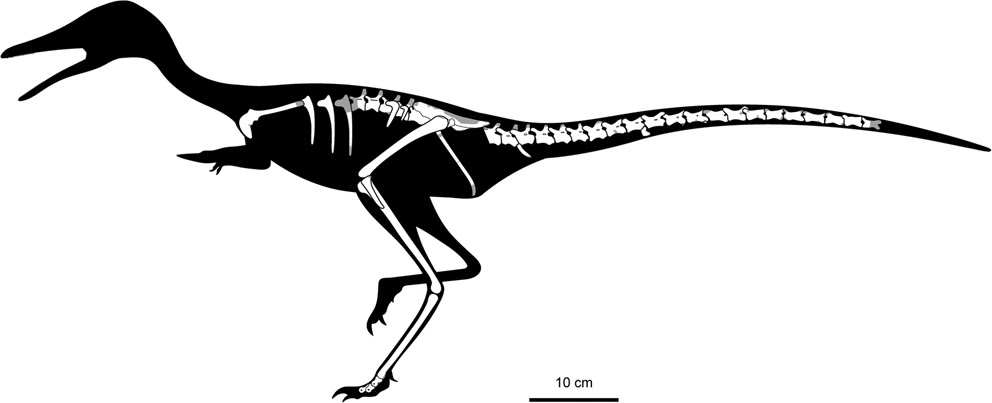
Skeletal reconstruction of Nemegtonykus showing preserved elements, from Lee et al. (2019).

Therizinosaurs
Therizinosaurs are another group of maniraptors for which new species are described relatively infrequently. Last year gave us Lingyuanosaurus from the Early Cretaceous Jehol Biota of China, known from some vertebrae and partial limbs. The holotype is quite small (coyote-sized), though it probably represents a juvenile. The specimen is incomplete enough that it is unclear whether it really was a therizinosaur; Mickey Mortimer found it as an oviraptorosaur using the Hesperornithoides dataset, but also noted that a therizinosaurian identity was only slightly less parsimonious.

Oviraptorosaurs
In recent times oviraptorosaurs have usually gotten away with at least one or two new entries every year. Two were described in 2019. One was Xingtianosaurus from the Early Cretaceous Yixian Formation of China, a Caudipteryx-like form known from a partial skeleton with incompletely preserved wing feathers. The other was Gobiraptor from the Nemegt Formation, known from partial remains of the skull, hip, limbs, and tail. Bone histology suggests that the holotype of Gobiraptor was an immature individual, but, at over a meter in length, it was already larger than the adults of many other oviraptorosaurs. Oviraptorosaur researcher Greg Funston has mentioned on social media that unpublished evidence indicates that Gobiraptor is actually the same species as a previously-named oviraptorosaur.

Basal Paravians
2019 was a good year for what Justin Tweet calls "coming attractions" in dinosaur paleontology, which are essentially fossil dinosaurs known to the paleontological community through brief descriptions, conference presentations, and word of mouth, but have yet to receive a formal name. Although not all of them were included in Tweet's list (which was not meant to be exhaustive), I would consider the ornithopod Convolosaurus, the sauropod Wamweracaudia, the allosauroid Asfaltovenator, and the tyrannosauroid Suskityrannus to all qualify as long-standing "coming attractions" that were finally named last year.

Several maniraptoran "coming attractions" came to light in 2019 as well. One of these was the so-called "Naze dromaeosaurid", known from a foot from the Late Cretaceous Snow Hill Island Formation in Antarctica. First mentioned publicly in 2005 and then briefly described in 2007, this dinosaur was formally named Imperobator last year. Despite its original nickname, the describers of Imperobator found its precise phylogenetic position within Paraves difficult to place, and Andrea Cau has argued that it may not even be a maniraptor at all. The title of the paper that named Imperobator called it a "gigantic" paravian, yet its visible dimensions are comparable to those of Deinonychus. That's larger than average for a paravian, but "gigantic" may be overstating it.

One of the most highly anticipated "coming attractions" described last year was Hesperornithoides, a troodont from the Late Jurassic Morrison Formation of the United States. First announced in a conference abstract in 2004, Hesperornithoides (then nicknamed "Lori") was a big deal for several reasons, particularly the fact that Jurassic paravians other than Archaeopteryx were essentially unknown at the time. With the discovery of Anchiornis and its ilk since then, this is no longer the case, but Hesperornithoides remains notable for the three-dimensional preservation of its skeletal elements (as opposed to the flattened state anchiornithids tend to be preserved in) and for being the best-represented Jurassic paravian from North America.

Skeletal reconstruction of Hesperornithoides showing preserved elements, from Hartman et al. (2019).

Hesperornithoides also generated some buzz for the phylogenetic analysis that accompanied its description. The dataset used has greater taxon sampling than any other published analysis of Mesozoic theropods (it includes nearly all Mesozoic maniraptoromorphs known at the time of study and even a handful of Cenozoic birds), and originated from reevaluating the Theropod Working Group phylogenetic dataset, which has been the basis for the majority of Mesozoic theropod analyses. This resulted in several novel findings, such as Haplocheirus as a compsognathid (as mentioned previously) and Pelecanimimus as an alvarezsaur. Time will tell whether these results hold up, but this analysis highlights the importance of independently evaluating phylogenetic datasets, as repeatedly building directly on previous datasets can create an illusion of consensus.

Strangely enough, no new (definite) dromaeosaurids were named in 2019. Someone drew the short end of the stick.

Basal Avialans
In recent times, Archaeopteryx has generally been considered the only known paravian from the Late Jurassic of Germany, but this has started to change in the past few years. In 2017, one supposed Archaeopteryx specimen was reevaluated as an anchiornithid and given the new genus Ostromia. Last year added another new paravian to the lineup, Alcmonavis from the Mörnsheim Formation. Although it is known only from a forelimb, Alcmonavis appears to differ from Archaeopteryx in the robusticity of certain bones as well as the prominence of various muscle attachment sites.

Another exciting find in the Mesozoic avialan department was Fukuipteryx from the Early Cretaceous Kitadani Formation of Japan. Not only is it the first Early Cretaceous avialan to be found in Japan, Fukuipteryx is known from a partial, three-dimensionally preserved skeleton including much of the front and hind limbs. Despite having a short tail with a pygostyle, it was found to have been less closely related to modern birds than the long-tailed Jeholornis was, which may indicate that the pygostyle evolved more than once among avialans, as some other recent studies have suggested.

Skeletal reconstruction of Fukuipteryx showing preserved elements, from Imai et al. (2019).

Enantiornitheans
The "opposite birds" had a good showing last year, and probably the most intriguing new taxon was Elektorornis from the Late Cretaceous of Myanmar, known from hindlimbs and wing feathers preserved in amber. Burmese amber has produced some of the most spectacular fossils of Mesozoic dinosaurs in recent years, including partial specimens of juvenile enantiornitheans and the tail of a non-pygostylian theropod, but Elektorornis is the first of these fossils to be named. It had an unusually long third toe, which the authors suggest may have been used as a probing tool for foraging. It is likely also the smallest known mature Mesozoic dinosaur, the holotype being of comparable size to juvenile enantiornitheans from the same locality despite apparently being an adult or subadult.

Holotype of Elektorornis, from Xing et al. (2019).

Also particularly interesting was Avimaia from the Early Cretaceous Xiagou Formation of China. The holotype is a partial skeleton preserved with an unlaid egg, a first for Mesozoic avialans. Furthermore, histological examination of the egg revealed a double-layered eggshell, indicating that the unfortunate individual had likely died from egg binding (a usually fatal condition in which an unlaid egg is retained for an abnormally long time). A second specimen of Avimaia had been previously described in 2006, but had not been named.

Holotype of Avimaia, from Bailleul et al. (2019). Note the unlaid egg preserved in its body cavity.

As usual, the Jehol Biota did not skimp on enantiornitheans, giving us the relatively large (pigeon-sized) Gretcheniao and the smaller Mirusavis and Shangyang. Mirusavis is noteworthy for preserving medullary bone (produced by female birds before and during egg laying) throughout much of the skeleton, a more extensive distribution of this type of bone than seen in many modern birds.

Although not newly discovered, another Jehol enantiornithean that was given a new name in 2019 was Camptodontornis. It had been originally named "Camptodontus" in 2010, but this genus turned out to be preoccupied by a beetle. It is likely that Camptodontornis is the same as Longipteryx though, as had already been suggested by other studies.

Mesozoic Euornitheans
An unusual euornithean described last year was Mengciusornis from the Early Cretaceous Jiufotang Formation of China. Its teeth were large and curved, but restricted to the tip of the upper jaw. This deviates from the typical pattern in toothed euornitheans, in which the upper jaw tip was usually toothless.

Holotype of Mengciusornis, from Wang et al. (2019).

More closely related to modern birds were Antarcticavis from the Snow Hill Island Formation, known from a partial skeleton, and Kookne from the Late Cretaceous Chorrillo Formation of Argentina, known from a partial coracoid. The describers of Kookne suggest that it may even be a neognath, as it shares some similarities with waterfowl, but this is naturally difficult to verify with such a fragmentary specimen.

Paleognaths
One extinct paleognath was named last year, the emu Dromaius arleyekweke from the Miocene Waite Formation of Australia. Known mainly from hindlimb bones, D. arleyekweke was smaller than modern emus and cassowaries (even the dwarf cassowary). Its feet were proportionately very long, however, indicating that it was probably a fast runner.

Galloanserans
Among the galloanserans described last year was what I consider to be one of the most scientifically important new dinosaurs of 2019, the stem-waterfowl Conflicto from the Paleocene López de Bertodano Formation of Antarctica. It is the oldest unequivocal total-group anseriform known from well-represented remains, and may provide evidence that a long-legged, flat-billed body plan was ancestral to all modern waterfowl (including the unusual screamers). I wrote about Conflicto in more detail here. Another Paleocene waterfowl was described last year, the large (swan-sized) Naranbulagornis from Mongolia. It is far less completely known, represented only by a partial carpometacarpus and femur.

Skull of Conflicto, from Tambussi et al. (2019).

On the galliform side of things, 2019 gave us Xorazmortyx from the Eocene of Uzbekistan, which is only known from a partial coracoid. Its describers suggest that it belonged to a group of stem-galliforms called paraortygids, in which case it would be the first paraortygid known from Asia. Better remains are known for a trio of quail from the Macaronesian Islands, Coturnix alabrevis, C. centensis, and C. lignorum. These quail likely went extinct in historic times (within the last 1000 years) due to human activity. Their short wings suggest that they may have been flightless, which would have made them vulnerable to invasive predators.

Columbimorphs
The early fossil record of pigeons and their kin remains stubbornly sparse, but last year did welcome a new species of recently extinct pigeon, Ducula shutleri from Tonga. Known from sites dated to nearly 3000 years old, D. shutleri was the largest known member of the genus Ducula (the imperial pigeons), probably weighing over 1 kg. Despite its large size, there is no evidence that it had reduced flight capabilities.

Gruiforms
Last year we got a new member of the enigmatic Eogruidae, Sinoergilornis from the Miocene Liushu Formation of China. The life appearance of eogruids is mysterious, as they are known mostly from hindlimb bones, and unfortunately Sinoergilornis does not break that curse. Like some other eogruids, Sinoergilornis had only two toes per foot. Although I provisionally treat eogruids as gruiforms here, another study from last year noted that their assignment to Gruiformes is weakly based.

Two species of recently extinct, flightless rails were also described last year, Dryolimnas chekei from Mauritius and the large (chicken-sized) Hypotaenidia vavauensis from Tonga.

Charadriiforms
Surprisingly, given their diversity and frequent association with aquatic habitats, shorebirds have a relatively poor fossil record, but we did get a new fossil taxon in 2019, Cherevychnavis from the Miocene of Ukraine. Although it is very fragmentary (known only from a coracoid and partial humerus), it is notable for likely being a member of Charadrii (a group that also includes plovers, oystercatchers, etc.), which have a scant fossil record even by shorebird standards.

Ardeans
If any crown-bird group can claim to have a good fossil record, it's the penguins, and last year we gained three new species of extinct penguin, all from New Zealand. Two of these, the giant ?Crossvallia waiparensis from the Waipara Greensand and the smaller Kupoupou from the Takatika Grit, were from the Paleocene, making them some of the oldest known penguins. The third new penguin was Eudyptes warhami, a species of crested penguin that probably went extinct within the last 500 years.

The closest living relatives of penguins, the procellariiforms (petrels, albatrosses, etc.), have a decidedly worse fossil record. As such, the small albatross Aldiomedes from the Pliocene Tangahoe Formation of New Zealand was a pleasant surprise, especially seeing as it is known from a well-preserved skull. Its narrow beak suggests that it may have been more specialized for fish-eating than extant albatrosses (which feed more on squid).

Holotype of Aldiomedes, from Mayr and Tennyson (2019).

Two other waterbirds described last year were the ibis Geronticus thackerayi from the Pliocene-Pleistocene of South Africa, known from numerous (but often fragmentary) bones, and the heron Taphophoyx from the Miocene of the United States, only known from a coracoid and scapula.

Telluravians
The afroavian side of Telluraves only presented one new fossil species last year, but it was a good one: ?Laurillardia smoleni, a small stem-member of Upupides (hoopoes and woodhoopoes) from the Oligocene Tylawa Limestones of Poland. Not only is it known from a nearly complete specimen, the genus Laurillardia had been in severe need of a modern reevaluation.

Holotype of ?Laurillardia smoleni, from Mayr et al. (2019).

Things were more active on the australavian side, with the parrot Heracles from the Miocene Bannockburn Formation of New Zealand receiving substantial press attention. Heracles is known only from partial hindlimb bones, but these are enough to suggest a body mass of around 7 kg, making it the largest known parrot to have ever existed.

2019 was a good year for stem-passerines. The finch-like beaks of the Eocene Eofringillirostrum boudreauxi and E. parvulum showed that stem-passerines had evolved into seed-eating specialists long before true passerines did. E. boudreauxi was found in the Green River Formation of the United States, whereas E. parvulum was found in the Messel Formation of Germany. I wrote about these two species in more detail here. Another new stem-passerine was Zygodactylus ochlurus from the Oligocene Renova Formation of the United States, the youngest known stem-passerine from North America.

Holotype of Eofringillirostrum boudreauxi, from Ksepka et al. (2019).

Among crown-passerines, there was Dasyornis walterbolesi from the Miocene of Australia, the oldest known member of the bristlebirds, a poorly-studied group of Australian songbirds.

Miscellanea
The scansoriopterygids from the Late Jurassic of China continue to prove difficult to place phylogenetically. Already considered unusual since their discovery in 2002, scansoriopterygids rocked the paleontological world again in 2015 with the description of Yi, which appeared to preserve membranous wings partly supported by an elongated wrist bone (known as the styliform). Although this seemed to be the most plausible interpretation of the evidence, some researchers were naturally skeptical. 2019 gave us another new scansoriopterygid, Ambopteryx, which also preserves wing membranes and a styliform, providing support for the original interpretation of Yi.

Holotype of Ambopteryx, from Wang et al. (2019).

Another phylogenetically recalcitrant clade of maniraptors is the pelagornithids, a group of seagoing Cenozoic birds with tooth-like projections in their beaks. Protodontopteryx from the Waipara Greensand is the oldest known pelagornithid and is known from much of the skeleton, potentially making it very valuable for understanding the origins of these mystery birds. It would get my vote for the most scientifically important new dinosaur of 2019 (though Conflicto would be a close second). Protodontopteryx was much smaller than later pelagornithids (which include the largest known wingspans of any bird at up to 7 m wide), about the size of a typical gull.

Skull of Protodontopteryx, from Mayr et al. (2019).

Last but not least, Carpathiavis from the Oligocene of Poland is a small (sparrow-sized) bird of unclear affinities. It is known from a nearly complete (but poorly preserved) skeleton with some similarities to rail-like birds.