Saturday, January 1, 2022

Review of 2021

It appears that I've set a new record for an all-time low in annual post count on this blog (beating out last year). The main reason for this is pretty clear: 2021 was the year that I was supposed to turn in my PhD thesis. As of the time of writing, the deed has been done, so the main task left before I can earn my degree is to pass my viva (which will presumably be held within the next few months). I still need to do a fair amount of work to prepare my final thesis chapter for publication, not to mention think about what I'll do after I graduate, but the most grueling part of the PhD might just be behind me. Does that mean I'll resume a (more) regular posting schedule here? Well, I'd like to, but I'm making no promises...

However, writing up my thesis did not completely halt my other activities (which was a good thing... I think). On the academic side of things, I attended and presented at a few (virtual) conferences and co-authored a paper on online science outreach. I also received the immense honor of consulting for the educational studio Kurzgesagt on several of their projects, including a poster depicting the tree of life, a poster about the last non-avialan dinosaurs, a video on paleoartistic depictions of extinct animals, and their calendar for 2022 (which features prehistoric life). The research team at Kurzgesagt was an absolute pleasure to work with, and I came away from each project feeling like they made a very dedicated and honest effort to consider all of my feedback.

Kurzgesagt's "Map of Evolution" poster depicting the tree of life. This was the first project that I worked with them on and I'm very pleased with the final result.

My friend Joan Turmelle and I have continued to run our YouTube channel Through Time and Clades. Our biggest accomplishment so far, I think, is that we have completed both of the long-form lecture series that we set out to make: Joan's "Humanity, a Prologue" (covering human origins) and my "Dinosaurs, the Second Chapter" (covering crown bird evolution), with plans to release annual updates incorporating new research from our respective fields. Although I'd be the first to say that my videos are far from ideal in some ways (for example, I know that the multi-hour length of some episodes can be a real deterrent), don't let it be said that I haven't tried to make information on the evolutionary history of Cenozoic birds available in a reasonably accessible and comprehensive manner. We are also working on a companion website that will present the material from our lecture series in what we hope will be a more approachable format for some, though that is in early stages still. Another pleasant surprise for our channel last year was that we received an invitation to participate in Paleo Rewind, an annual collaboration among paleontology-focused YouTube creators to recap the year in paleontological discoveries.

A collage of title slides from my YouTube series "Dinosaurs, the Second Chapter", in which Joan and I discussed the origins, evolution, and diversity of crown-group birds.

Astonishingly, I was even able to start a new personal project last year! That was the blog New Dinosaur Alert, on which I write a brief post for each new genus or species of dinosaur described (including extant birds). Despite everything else going on, I've managed to stay on top of that blog for the most part, so I intend to continue it in the foreseeable future.

When I picked Velociraptor as the primary basis of the logo for New Dinosaur Alert, I did not know that the first Mesozoic dinosaur to be described in 2021 would be the velociraptorine dromaeosaurid Shri devi. That was a happy coincidence!

Lastly, I didn't expect to enjoy rewatching a show from my childhood as much as I did, but I'm glad that I was inspired to do so.

... And that's more than enough about me. Let's take a look at what 2021 had to offer in the world of maniraptoran research. As always, my coverage of papers about modern birds is necessarily going to be incomplete, so I put more focus on those that have more direct connections to paleontology, such as studies on anatomy, ontogeny, and higher-order phylogeny.

In January, oilbirds were found to disperse seeds across longer average distances than megafauna. A specimen of Pachystruthio from the Nihewan Formation was described. The skull morphology of phorusrhacids and the language-like capabilities of Japanese tits were reviewed. New studies came out on the hindlimb musculature of Nothronychus, the evolution of tooth shape in avialans and coloration and song in American warblers, and the phylogeny of neoavians and shearwaters. Newly-named maniraptors included the dromaeosaurid Shri devi, the Pliocene petrel Procellaria altirostris, the Eocene possible stem-coracioid Ueekenkcoracias tambussiae, the Pleistocene woodpeckers Bitumenpicus minimus, Breacopus garretti, and Melanerpes shawi, and the psittacopedid Parapsittacopes bergdahli.

Skull of the holotype of Parapsittacopes bergdahli, from Mayr (2020). (The print version of the journal retroactively dates the paper to 2020, but really, the paper was first released in 2021.)

In February, southern giant petrels were reported preying on Atlantic yellow-nosed albatrosses. Purported gastroliths in Bohaiornis were reinterpreted as mineral precipitate (as had been previously suggested). The mineralization of avian eggshells was reviewed. A tinamou egg from the Dolores Formation was described. Macrornis was redescribed as a possible phorusrhacid (though a dubious taxon). Male superb lyrebirds were found to mimic the sounds of mobbing flocks during courtship. New studies came out on the evolution of disparity in Mesozoic avialans, the diversification of avialans, atavisms in the avian hindlimb, the structure of kiwi eggshells, the phylogenetic position of Brontornis (favoring galloanseran affinities), recent extinctions of eastern North American birds, the phylogeny of galliforms and potoos, the ontogeny of locomotion in chukars and hindlimb muscle mass in Cabot's tragopans, skeletal pneumaticity in cuckoos, the biogeography of rails, the cranial anatomy of Spheniscus urbinai, the offshore behavior of Whenua Hou diving petrels, the relationship between male-biased sexual selection and speciation in passeriforms, and the use of alarm calls in yellow warblers. Newly-named maniraptors included the Oligocene passeriform Crosnoornis nargizia.

Displaying male superb lyrebird and spectrograms comparing the sounds of a mobbing flock to a lyrebird's mimicry thereof, from Dalziell et al. (2021).

In March, the phylogenetic position of Nesotrochis was evaluated based on ancient DNA, recovering it as a stem-flufftail. The regionalization of avian integument was reviewed. Soft tissues were reported from an ostrich from the Liushu Formation. Vegavis and Columba congi were redescribed. The name Feraequornithes was coined for the clade uniting most aequornitheans other than loons. A raven skull from the Pleistocene of China was described. New studies came out on the pelvic musculature of maniraptors, the tail anatomy of alvarezsaurs, the forelimb musculature of Nothronychus and aquatic birds, the evolution of dentition in avialans, the bone histology of Mirarce, the evolutionary versatility of the avian neck, the factors influencing the ease of puncturing avian eggshells, the endocranial anatomy of dromornithids and piciforms, the phylogeny of sea ducks and leaf warblers, the skeletal elements of penguin eyes, and the correlation between cooperative breeding and longevity in birds. Newly-named maniraptors included the troodontid Tamarro insperatus, the Alagoas screech-owl (Megascops alagoensis), the Xingu screech-owl (Megascops stangiae), the Alagoas black-throated trogon (Trogon muriciensis), and the messelasturid Tynskya waltonensis.

Phylogenetic tree showing the position of Nesotrochis, from Oswald et al. (2021).

In April, a juvenile specimen of Archaeorhynchus was reported. A large caenagnathid from the Hell Creek Formation, a giant euornithean from the Tremp Formation, birds from the Nanjemoy Formation, a pheasant from the Chi-Ting Formation, and a petrel from the Gaiman Formation were described. The evolution of the avian chondrocranium and species limits in birds were reviewed. Red blood cell mitochondria in birds were shown to produce more heat in winter than in fall. The ecological consequences of the extinction of Chendytes were investigated. The feather microstructure of male Ramphocelus tanagers was found to amplify their plumage signals. New studies came out on the evolution of eggshell thickness in birds (and other dinosaurs), the osteology of Unenlagia and Dryornis, the scapulocoracoid bone histology of Confuciusornis, the hindlimb muscle function and jumping performance of elegant crested tinamous, the craniofacial development of strisoreans, cultural evolution in great tits, the cranial musculature of the black-throated finch, and the diversification of tanagers. Newly-named maniraptors included the Pleistocene kiwi Apteryx littoralis.

Juvenile specimen of Archaeorhynchus, from Foth et al. (2021).

In May, research on the evolution of hearing and vision in theropods suggested that alvarezsaurs were likely to have been nocturnal. Larger neuron numbers were found to correlate with longer yawn duration in birds (and mammals). The global abundance of birds was estimated. The genetics of avian coloration were reviewed. Eggs of extinct emus and coprolites of little bush moa were described. Supposed tooth sockets in a juvenile gastornithid were reevaluated. Ant-following birds were found to have a higher probability of being infested by ticks. The genome of the California condor was published. Siberian jays were shown to use social knowledge to avoid being deceived. Great reed warblers were reported flying at extreme altitudes during migration. Great-tailed grackles were documented to be able to direct their eyes independently towards different targets. New studies came out on the evolution of the inner ear in maniraptors (and other reptiles), pectoral girdle morphology in paravians, competition as a driver of trait divergence in birds, convergent evolution in avian mitochondria, the effects of environmental lighting on avian eye evolution, the coracoscapular joint of birds, hybridization in kiwi, the morphometrics of wing shape in aquatic birds, the macroevolutionary stability of fruit-eating birds, the bone histology of Genyornis, migration speeds in common swifts, the correlation between speciation and plumage color evolution in hummingbirds, variation in echo parakeets, the phylogeny of fieldwrens and Afro-Eurasian sparrows, the persistence of song culture in zebra finches, the diversification of Afro-Eurasian buntings, and feather coloration in swallow tanagers. Newly-named maniraptors included the presbyornithid Bumbalavis anatoides, the Oligocene gruiform Palaeogeranos tourmenti, the Pleistocene magpie Pica praepica, the white-tailed cisticola (Cisticola anderseni), and the Kilombero cisticola (Cisticola bakerorum). The new genus Radinopsyche was coined for the caatinga antwren ("Herpsilochmus" sellowi).

Comparison of maniraptoran skulls with sclerotic rings highlighted, including the nocturnal Australian owlet-nightjar (B), the potentially nocturnal Haplocheirus (C), the diurnal Finsch's pygmy parrot (D), and the potentially diurnal Erlikosaurus (E), from Choiniere et al. (2021).

In June, isotope analysis was used to infer that the Chatham Island duck primarily ate marine invertebrates. An alvarezsaurid from the Qiupa Formation and a juvenile enantiornithean from the Jiufotang Formation were described. The life history of troodontids and divergent foraging strategies in hummingbirds were reviewed. Flocks of rock pigeons were found not to exhibit "selfish herd" behavior when under threat. Great snipes were reported to make extreme changes in flight altitude during migration. Malar stripe prominence in peregrine falcons was found to correlate with solar radiation. New studies came out on vertebral pneumaticity in Unenlagia, the quadrate of Longipteryx, the diversity of avian olfactory receptor genes, the development of avian wing digits, the effects of flight efficiency on dispersal distances in birds, the phylogenetic positions of the bee hummingbird and the Whenua Hou diving petrel, the diet of the tiny hawk, the systematics of sharp-shinned hawks, diversity patterns in tyrant flycatchers, perceptual inabilities in Eurasian jays, avian defenses against brood parasites, magnetic sensitivity in European robins, and the innervation of vocal muscles in zebra finches. Newly-named maniraptors included the enantiornithean Fortipesavis prehendens (based on a Burmese amber specimen, albeit one already previously described), the Eocene pelican Eopelecanus aegyptiacus, and the satin berrypecker (Melanocharis citreola).
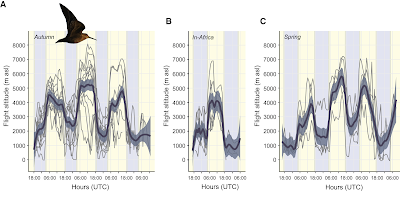
Changes in flight altitude of great snipes, from Lindström et al. (2021).

In July, possible troodontid pellets were reported. A new specimen of Elmisaurus (suggesting that "Nomingia" is a junior synonym), the wishbone of Halszkaraptor, a troodontid from the Wulansuhai Formation, a new skull of Ichthyornis, and teratornithids from the Pleistocene of Argentina were described. The diet and bone growth variability in Mesozoic avialans and the theft of mammal hair by birds were reviewed. Potential evidence of molting in Archaeopteryx was disputed. The innovation and spread of bin-opening behavior in sulfur-crested cockatoos were documented. The origin of sweet taste perception in songbirds was investigated. New studies came out on the evolution of body size in alvarezsaurs, brain shape in birds, and sex chromosomes in paleognaths, the morphometrics of avialan limbs, patterns of skeletal integration in birds, factors correlating with extinction in Quaternary birds, the bone histology of North Island brown kiwi, phylogenetic conflict in galliforms, the effects of dark wings on flight efficiency in seabirds, the taxonomic status of the Canary Islands oystercatcher, wing morphing in raptors, the phylogeny of white-eyes and Campylorhynchus wrens, the origin of the Sulawesi babbler, and morphological signatures of introgression in Darwin's finches. Newly-named maniraptors included the dromaeosaurid Kansaignathus sogdianus, the Eocene galliforms Bumbanortyx transitoria and Bumbanipodius magnus, the Eocene gruiforms Bumbanipes aramoides and Bumbaniralla walbeckornithoides, the archaeotrogonid Archaeodromus anglicus (suggesting that archaeotrogonids are stem-nightjars), and the Eocene stem-penguin Marambiornopsis sobrali. The new genus Aptenorallus was coined for the Calayan rail ("Gallirallus" calayanensis).

Charts showing that the taste receptors of many songbirds respond to sugars, whereas those of suboscines (the two leftmost species) only respond to amino acids, from Toda et al. (2021).

In August, eogruids and ergilornithids were reinterpreted as stem-ostriches instead of gruiforms. The preservation of cartilage in Confuciusornis and Yanornis was examined. Male-like ornamentation in female white-necked jacobins was shown to function in reducing social harassment. Tool manufacture was documented in wild Tanimbar corellas. Passeriforms from the Miocene of Austria were described. An evolutionary trade-off between song and plumage complexity was found in antwrens. New studies came out on the role of locomotor modularity in avian origins, the bone histology of Yanornis and Gansus, the (limited) correlation between latitude and evolutionary dynamics in birds, lateral openings and depressions in avian back vertebrae, the cerebellar anatomy of birds, the relationship between avian sternal variation and locomotion, the challenges of flying through gaps for birds, variation in the postcranial skeleton of ostriches, the morphology of the femoral nutrient foramen and nutrient artery in chickens, the migratory routes of Arctic terns, the genomic bases of telluravian diversification, the mitochondrial genomes of condors, the reproductive benefits of cooperative polygamy to acorn woodpeckers, the sensitivity of Eurasian jays to cognitive illusions, the diversification of the common chaffinch species complex, and the evolution of the skull of the giant cowbird. Newly-named maniraptors included the unenlagiine Ypupiara lopai. The new genus Microspizias was coined for the semicollared hawk ("Accipiter" collaris) and the tiny hawk ("Accipiter" superciliosus).

Partial eogruid or ergilornithid skull (A) compared to those of a common ostrich (C) and a limpkin (a gruiform, D), from Mayr and Zelenkov (2021).

In September, a special issue on vocal learning in birds (and other animals) was published, including a report of vocal learning in musk ducks. Nuclear preservation in the cartilage of Caudipteryx was examined. An enantiornithean from the Jiufotang Formation, plotopterids from the Paleogene of the United States, and a specimen of Septencoracias from the London Clay Formation were described. Recent advances in avian genomics were reviewed. Evidence of humans harvesting and rearing cassowaries in the Pleistocene and early Holocene was presented. Island colonization was found to facilitate diversification in pigeons. Tool innovation by a disabled kea was documented. Cockatiels were shown to be able to sing in synchrony with human music. New studies came out on the postcranial osteology of Beipiaosaurus, the body mass of Anzu, dental replacement in enantiornitheans, the effects of topographic uplift on avian (and mammalian) speciation, the role of brain size and allometry in avian craniofacial evolution, the relationship between avian forelimb proportions and flight capability, phylogenetic patterns of ultraviolet vision in birds, the diversity of eggshell thicknesses in moa, signatures of coevolution between hosts and brood parasites in the avian visual system, the use of olfactory cues by hummingbirds, species delimitation in rockhopper penguins, the population genomics of kākāpō, the perception of virtual stimuli by kea, constraints on skull shape in passeriforms, introgression in suboscines, and the diversification of bulbuls in South Asia. Newly-named maniraptors included the non-pygostylian avialan Neimengornis rectusmim, the enantiornitheans Yuanchuavis kompsosoura and Yuornis junchangi, the Oligocene stem-penguin Kairuku waewaeroa, the Oligocene hawk Archaehierax sylvestris, and the Pleistocene hawk Buteogallus irpus (with "Amplibuteo" considered a junior synonym of Buteogallus).
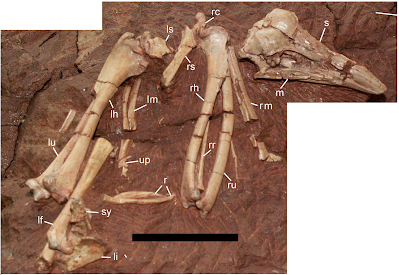
Holotype of Yuornis junchangi, from Xu et al. (2021).

In October, parthenogenesis was reported in California condors. The avian altricial–precocial spectrum was quantified. Birds from the Miocene of Spain were revised. Birds from the Pleistocene–Holocene of Tajikistan and a galliform skull from the Makah Formation were described. Frugivory in raptors was reviewed. A new westward migration route was documented in Richard's pipits. New studies came out on the distribution of carotenoid pigments in birds (and other reptiles), the bone histology of birds, ecological drivers of avian eggshell wettability, the evolution of sex chromosomes in paleognaths and egg coloration in Australian songbirds, sensory adaptations in flightless birds, the phylogeny of tinamous and the spectacled thrush species complex, the histology of sutures in chicken skulls, embryo movement in avian brood parasites, the phylogeography of Chalcophaps doves, rates of hybridization in hummingbirds, the relationship between plumage coloration and colonization history in barn owls of the British Isles, correlations between morphology and migratory behavior in kingbirds, dispersal of fungal spores by tapaculos, the maintenance of evolutionary diversity in pale martins, and beak color polymorphism in Darwin's finches. Newly-named maniraptors included the troodontid Papiliovenator neimengguensis and the inti tanager (Heliothraupis oneilli).

Inti tanager, from Lane et al. (2021).

In November, adaptations for wing-propelled diving in dippers were documented. Aposematism in birds was reviewed. A South Island giant moa from Rakiura was described. Ecological shifts were found not to be strongly linked to morphological evolution in Australasian parrots. New Caledonian crows were reported investigating heated objects. Cavity-nesting birds were found to use feathers to dissuade nest usurpers. New studies came out on wing kinematics in Caudipteryx, the loss of functional diversity due to recent island bird extinctions, the evolution of wing feather molt in birds, phylogenetic analyses of avian mitochondrial data, phylogenetic conflict in paleognaths, divergence times of galliforms, the annual cycle of pallid swifts, factors influencing plumage ornamentation in male red-backed fairywrens, the phylogenetic position of the Sulawesi thrush, and the genetic basis of variation in redpolls. Newly-named maniraptors included the alvarezsaur Khulsanurus magnificus, the dromaeosaurid Kuru kulla, the Cretaceous euornithean Kaririavis mater, the Pliocene hawk Buteo dondasi, and the cryptic flatbill (Rhynchocyclus cryptus).

Brown dipper, photographed by Alpsdake, under CC BY-SA 3.0.

In December, evidence of iridescent plumage in Eoconfuciusornis was reported. Putative red blood cells preserved in Beipiaosaurus were reevaluated. An oviraptorid embryo preserved in a bird-like prehatching posture and a new specimen of Scandiavis were described. The fossil record of avian tracks and the morphology of the avian notarium were reviewed. Migratory birds were shown to be generally lighter colored. Ring-billed gulls were documented solving the string-pull test. Zebra finches were shown to use calls to influence mitochondrial function in their developing young. New studies came out on the evolution of feeding mechanics in maniraptors (and other coelurosaurs), iridescent feather nanostructures, and avian beak shape, the morphology of Borogovia, divergence times of Mesozoic avialans, the metabolism of Concornis and Iberomesornis, the ossification of avian respiratory turbinates, pathologies in Genyornis, the diversification of shearwaters, the feeding behavior of the Haast's eagle, the population history of barn owls in the Western Palearctic, the development of parrot pseudoteeth, the correlation between sex roles and sexual dimorphism in fairywrens, the phylogeny of whistlers, the safekeeping of tools by New Caledonian crows, the carpometacarpus morphology of mimids, and the migratory routes of citrine wagtails. Newly-named maniraptors included the dromaeosaurid Vectiraptor greeni, the enantiornithean Brevirostruavis macrohyoideus, the Cretaceous euornitheans Brevidentavis zhangi and Meemannavis ductrix, the Miocene duck Manuherikia primadividua, and the Pleistocene owl Margarobyas abronensis. The new genus Leucoptilon was coined for the white-tailed flycatcher ("Cyornis" concretus).

Skull and foot of Haast's eagle, from Te Papa, under CC BY 4.0.

Tuesday, December 21, 2021

A Long Road to Happiness: The Story of Perrine

This post was co-written by Joan Turmelle. The use of "I" in this post refers to myself (Albertonykus), whereas "we" refers to both co-authors. A version of this post has been cross-posted to my Tumblr blog.

What's this? More than seven months without a new post, and I come back with one that's not about dinosaurs? And it's not even April 1st?! Well, I already had a different subject in mind for April 1st of next year, and I think that this post could be of potential interest to some people who might be looking for TV series to binge over the holidays, especially in these pandemic times. I also just completed a draft of an entire PhD thesis on dinosaur evolution, so I hope that even I can be forgiven for spending a little time not thinking about dinosaurs (and, believe me, it's not often that I do so). Besides, I'll be back soon enough in January with the usual reviews of the past year in maniraptoran discoveries; you won't have to wait long for more dinosaur content on this blog.

Over the last few months, I have not had much time to devote to anything other than my thesis, but taking breaks is supposed to be healthy, even for—uh, especially for final-year PhD students. And so it happened that on some of these breaks I was inspired to revisit a series I hadn't watched since my childhood, The Story of Perrine. I remember enjoying it as a child (which in hindsight is surprising in some ways), but having rewatched it recently, I'd go as far as to say that it may now be one of my favorite shows of all time.

The Story of Perrine originally aired in 1978 and was based on the 1893 French novel En Famille by Hector Malot (which has been translated into English as Nobody's Girl or The Story of Perrine). It is one of the entries in World Masterpiece Theater, a series of animated Japanese adaptations of classic children's literature. The story follows a 13-year-old girl, Perrine, as she travels across Europe with her mother Marie (who for some reason is almost always left out of promotional posters for the show), their dog Baron, and their donkey Palikare to see Perrine's paternal grandfather in France, who none of them have met before.

This anime was never dubbed into English and accordingly appears to be pretty obscure in the English-speaking world. The version that I knew as a child was the DVD release of the Mandarin dub that had aired in Taiwan (where my parents grew up). Fortunately, as of the time of writing, the original Japanese dub is available on YouTube with fan-made English subtitles, and it was through this version that I revisited the show earlier in the year.

One of the reasons I'm surprised that I sat through this series when I was little is that it's slow paced and has a very tranquil atmosphere. It's certainly not a show with constant action or epic magical quests. At the same time, it's telling a continuous narrative with strong continuity and consistent character development. The stakes in the show are rooted in the magic of reality: the way one can find joy or laughter or sorrow or great lessons even in everyday life, and how that appreciation for the mundane can be its own magic. It's a type of storytelling that I haven't seen in many other fiction shows. 

Cover art for the series soundtrack. As you can see, Marie has been left out of this one as well.

The closest comparison that comes to mind may be the Netflix animated series Hilda, which we also adore. Both shows are wholesome, down-to-earth, and sometimes very emotional series that feature precocious young girl protagonists being raised by single mothers. Other good comparisons might be the Studio Ghibli films Kiki's Delivery Service and My Neighbor Totoro. Unlike Hilda and the aforementioned Ghibli films, however, The Story of Perrine has essentially no fantasy elements at all. It really is more or less realistic fiction, such that one could probably re-enact almost everything that occurs in the series if circumstances were right. It also arguably gets a bit darker than Hilda, with permanent character deaths that are taken dead seriously. There are parts of the series that get pretty sad and bleak, though the story does ultimately have a happy ending.

The Story of Perrine was produced not long after the characteristic anime art style was popularized in the 1960s, and in some ways its character design actually deviates a bit from the "standard" anime style that is familiar nowadays. Its age shows from a technical perspective; though it evidently had the appropriate budget to portray the story as intended, there are definitely noticeable inconsistencies in the animation here and there. Even so, they are more fun things to point out instead of strong criticisms, and most certainly do not make the show any less compelling. Also amusing from a modern standpoint are the previews that play at the end of each episode, which tend to give away most of the plot of the subsequent episode—presumably symptomatic of a time without on-demand streaming services, meaning that missing entire episodes was a real possibility for viewers.

What follows are some of our thoughts on specific storylines and themes from the show. If you are at all interested in seeing The Story of Perrine for yourself, we strongly recommend that you stop reading at this point and just start watching. We would even advise against looking up anything else about the show, because nearly all the English summaries we've seen give away major events in the series. Additionally, if you'd prefer to get our thoughts in podcast form instead (along with a more detailed plot recap of the series), you can check out the review we did for our YouTube channel Through Time and Clades (embedded below).

SPOILERS AFTER THIS POINT

Monday, May 10, 2021

Angels of the High Seas: The Mystifying Affinities and Origins of Tropicbirds

I have never had the good fortune of seeing living tropicbirds in person, so I can only imagine that they must look ethereal. These seabirds range from pigeon- to chicken-sized, but their long, pointed wings give them wingspans of a meter or more. Both male and female tropicbirds are clad mostly in white plumage and possess a central pair of extremely long, narrow tail feathers (as long as or longer than the rest of their body), which they flaunt to each other during aerial courtship displays.

Red-billed tropicbird in its natural state, photographed by Dominic Sherony, under CC BY-SA 2.0.

True to their name, tropicbirds spend most of their lives flying over the tropical oceans of the world, far from land. Although there are other seabirds (like albatrosses and frigatebirds) that frequent the skies above the open ocean, many of these groups undertake their long pelagic journeys by soaring effortlessly on air currents. Tropicbirds, on the other hand, travel primarily by sustained flapping flight, punctuated by only brief periods of gliding and soaring. From the air, they spot their prey (mostly small fishes and squids), and capture them by plunging from the sky with a splash before taking off again.

When these elegant aeronauts need to rest, they alight on the surface of the ocean. However, despite having totipalmate feet (webbing between all the toes on each foot), their hindlimbs are so small that they are not particularly good at active swimming. Their feeble hindlimbs also render them awkward when they return to land to breed, requiring them to shuffle along the ground on their belly, sometimes with the aid of their beak and wings.

Red-billed tropicbird resting on the ocean's surface, photographed by Steven Mlodinow, under CC BY-NC 4.0.

Fortunately, tropicbirds nest on remote islands that are typically safe from land predators. They often adopt crevices in rocky ledges as nest sites, though flat ground or forks and hollows in trees may also be used. Tropicbirds are probably at their least angelic on their breeding grounds, as competition over suitable nest sites can be extremely fierce, and many adult tropicbirds bear scars on their head as a result of such disputes.

Three species of extant tropicbird are currently recognized. In order of increasing size, they are the white-tailed tropicbird (Phaethon lepturus), the red-billed tropicbird (Phaethon aethereus), and the red-tailed tropicbird (Phaethon rubricauda). Although they are low in diversity and restricted to equatorial regions today, the fossil record reveals an ancient history and more widespread distribution for total-group tropicbirds in the past.

What may be the oldest known stem-tropicbird fossils were described by Mayr and Scofield (2016), these being a partial humerus (upper arm bone) and carpometacarpus (fused wrist and palm bones) from the Paleocene Waipara Greensand of New Zealand (about 60.5–61.6 million years old), similar in age to some of the oldest known stem-penguins. A potentially even older fossil bird that has been likened to stem-tropicbirds is Novacaesareala, known from fragmentary forelimb bones found in the Hornerstown Formation of the eastern United States (Mayr and Scofield, 2016). The age of this formation is disputed (it may date to either the Late Cretaceous or early Paleocene), but in any case the available specimens of Novacaesareala are probably too limited for a well-founded identification (Mayr, 2017).

Partial humerus of a possible stem-tropicbird from the Waipara Greensand (A–D) compared to the humerus of a white-tailed tropicbird (H–K), from Mayr and Scofield (2016).

There are, however, much better-represented stem-tropicbird taxa that are only slightly younger (by geologic standards) than these records, namely Lithoptila from the late Paleocene–early Eocene of Morocco and Prophaethon from the early Eocene of England. (In fact, Lithoptila is the oldest crown bird known from Africa.) The placement of both these genera as stem-tropicbirds has been supported by phylogenetic analyses, though results differ on whether they form a clade with one another that excludes crown tropicbirds (Bourdon et al., 2005; Smith, 2010).

Lithoptila and Prophaethon were around the same size as extant tropicbirds, but had a longer pelvis and longer feet, suggesting that they were more capable swimmers. Although they were probably strong fliers, details of their wing skeleton indicate that they may not have been aerial specialists the way modern tropicbirds are. It has been proposed that Prophaethon lacked the elongate tail feathers of its closest living relatives, based on the shorter transverse processes (sideways projections) on its tail vertebrae (Mayr, 2015). The abundance of remains known from Lithoptila and Prophaethon suggest that they approached continental shorelines more frequently than extant tropicbirds do, maybe even forming large breeding colonies in these habitats (Bourdon et al., 2008a; Mayr, 2015). Taken together, these lines of evidence paint these stem-tropicbirds as having been less pelagic than modern tropicbirds, but potentially having spent more of their time in the water. Mayr (2015) speculated that they caught prey while swimming on the water's surface, similar to albatrosses. The aquatic inclinations of stem-tropicbirds may provide a plausible explanation for why extant tropicbirds retain totipalmate feet.

The foot of Prophaethon (a) compared to that of a white-tailed tropicbird (b), from Mayr (2015). The scale bars = 5 mm; as can be seen, Prophaethon had a much longer foot than modern tropicbirds, despite being similar in body size.

Another early stem-tropicbird was Zhylgaia, known from partial humeri dating to the late Paleocene of Kazakhstan that were originally mistaken for those of a shorebird (Bourdon et al., 2008a). Mayr and Scofield (2016) further noted that a tarsometatarsus (fused ankle and foot bones) described as "Tshulia" from the same time and place probably belongs to Zhylgaia. Other possible stem-tropicbird specimens similar to Lithoptila and Prophaethon have been reported from the late Paleocene of the eastern United States (Olson, 1994) and the middle Eocene of Belgium (Mayr and Smith, 2002). Additionally, the supposed ibis "Proplegadis", known from a fragmentary humerus from the Eocene of England, is likely a specimen of Prophaethon (Mayr, 2015).

Possibly more closely related to extant tropicbirds was Phaethusavis from the early Eocene of Morocco, based on a partial humerus (Bourdon et al., 2008b). After the Eocene, the completeness of the tropicbird fossil record appears to drop off sharply, perhaps corresponding to the onset of more pelagic tendencies. Nonetheless, there are a few younger fossil tropicbirds that have been described from regions where tropicbirds no longer occur, such as Heliadornis ashbyi from the middle Miocene of Belgium and the eastern United States (Olson, 1985; Olson and Walker, 1997), as well as possibly Heliadornis paratethydicus from the late Miocene of Austria (Mlíkovský, 1997) and Heliadornis minor from the late Pliocene of Slovakia (Kessler, 2009).

Why tropicbirds vanished from higher latitudes is unknown. Mayr (2015) suggested that competition and predation from other organisms may have driven them to specialize in living off nutrient-poor tropical waters, where food sources are relatively patchy and scarce. The Neogene disappearance of tropicbirds from high latitudes and their current restriction to the tropics bring to mind similar biogeographic histories in some terrestrial bird groups (such as mousebirds), which have been attributed to global climate change. It makes me wonder whether tropicbirds represent a marine example of this recurrent pattern.

One of the most longstanding mysteries surrounding the evolutionary history of tropicbirds concerns their phylogenetic position. Traditionally, tropicbirds were grouped together as "pelecaniforms" alongside pelicans, frigatebirds, boobies, cormorants, and anhingas, with which they share totipalmate feet. Tropicbirds have long been recognized as the "odd ones out" in this collective, however. For example, they lack a bare throat pouch, a long hallux (innermost toe), or reduced external nostrils, and have a covering of downy feathers upon hatching (as opposed to being naked). Some researchers instead argued for a closer relationship between tropicbirds and procellariiform birds (albatrosses, petrels, and kin), which was supported by several phylogenetic analyses based on morphological characteristics (Mayr, 2003; Bourdon et al., 2005; Smith, 2010).

Red-tailed tropicbird chick, covered in fluffy down, photographed by Forest & Kim Starr, under CC BY 3.0.

The rise of large-scale molecular phylogenetic analyses has greatly clarified the relationships among modern bird groups, and one of their major findings has led to the breakup of the traditional "pelecaniforms". It turns out that though frigatebirds, boobies, cormorants, and anhingas do form a clade (now known as Suliformes), pelicans are more closely related to herons, ibises, shoebills, and hamerkops, with the name Pelecaniformes now applied to this latter assemblage. Both suliforms and pelecaniforms, however, belong to a large group of mostly aquatic birds called Aequornithes, which also contains storks, procellariiforms, penguins, and loons.

A surprising commonality among the results of these analyses was that tropicbirds were not found as members of Aequornithes, meaning that they are not especially closely related to pelecaniforms, suliforms, or procellariiforms. However, early molecular phylogenetic analyses found little consistent support for what tropicbirds actually are closely related to. It was only more recently with the advent of increasingly large datasets that a more widely corroborated answer to that question has emerged, and it is an unexpected one: the closest living relatives of tropicbirds are likely the eurypygiforms.

... Well, it might be hard to find that shocking if one is not familiar with eurypygiforms. They are a group of birds that includes just two living species: the heron-like sunbittern (Eurypyga helias) from the Neotropics and the nearly flightless kagu (Rhynochetos jubatus) from New Caledonia, both of which exhibit little if any obvious anatomical similarity with tropicbirds. Furthermore, though the sunbittern regularly forages for prey in freshwater environments, neither species shows any inclination towards a marine lifestyle.

A sunbittern, which does not look or behave a whole lot like a tropicbird, photographed by Brent Moore, under CC BY 2.0.

Yet time and time again, a close relationship between tropicbirds and eurypygiforms (first recovered by McCormack et al., 2013) has been supported by recent large-scale analyses of genetic data (Jarvis et al., 2014; Prum et al., 2015; Reddy et al., 2017; Kuhl et al., 2021). Most (though not all) of these studies also place the eurypygiform–tropicbird clade (which has been called Phaethontimorphae) as most closely related to Aequornithes, forming an expanded "waterbird clade". (At present, no formal name has been assigned to the group uniting phaethontimorphs and aequornitheans in technical literature, though John Boyd has adopted the old name Ardeae for this clade on his Taxonomy in Flux website. Personally, I think another old name, Natatores, would also be a reasonable option, as it has been applied to a very similar assemblage of birds in at least one 21st Century paper.)

The current consensus of phylogenetic relationships in the expanded "waterbird clade", plotted against geologic time.

The eurypygiform–tropicbird relationship has not gone ignored in paleontological studies. Despite this, essentially no anatomical features that clearly characterize this clade have been identified, and even the existence of well-represented stem-tropicbird fossils has so far been of limited help in this regard (Mayr, 2014; Mayr, 2019). If anything, the aquatic adaptations of stem-tropicbirds seem to render the the close relationship with the terrestrial eurypygiforms even more baffling. Prophaethon does share with eurypygiforms long, slit-like nostril openings in the skull (which are retained in extant tropicbirds only as juveniles), but this feature is also found in most aequornitheans (Mayr, 2014). 

Skulls of Prophaethon (A), a red-tailed tropicbird (B), a juvenile brown pelican (C,  Pelecanus occidentalis), and a sunbittern (D), from Mayr (2014). Arrows indicate the extent of bony nostril openings.

Perhaps the biggest missing piece of the puzzle though is the virtual absence of known fossil eurypygiform specimens. There is a fossil from the Eocene Green River Formation of the western United States that has been proposed to be a stem-sunbittern; however, it has not yet been formally described. A group of Paleogene birds called the messelornithids were originally suggested to have been eurypygiforms, but all recent studies on their phylogenetic affinities instead find that they were probably gruiform birds, more closely related to cranes and rails.

So maybe the discovery of unambiguous stem-eurypygiforms will further clarify the evolutionary connection between eurypygiforms and tropicbirds. Such fossils may also have the potential to shed light on other aspects of tropicbird evolution, like whether their marine ecology was inherited from the last common ancestor of the expanded "waterbird clade" or arose independently in total-group tropicbirds and aequornitheans.

For now, there is clearly much we have yet to learn about tropicbirds. None of the three extant species are considered to be under immediate threat of extinction, though many of their breeding grounds are at risk from introduced predators, and their pelagic habits make their population trends difficult to monitor. However, if effective conservation measures are established and maintained, it is likely that we will have the opportunity to marvel at these angels of the high seas long into the foreseeable future.

White-tailed tropicbird in flight, photographed by hokoonwong, under CC BY-NC 4.0. Fly on, mysterious angel.

References

Thursday, April 1, 2021

Songs About the Fossil Record

It's annual off-topic day on this blog! What should I talk about? How about... music?

My taste in music is, shall we say... idiosyncratic. I don't tend to consciously gravitate towards specific genres in terms of musical styles, and I can't tell you anything about what songs are popular right now—chances are that I probably haven't even heard of those songs before, unless they've somehow become universal internet memes. However, I do have an affinity for songs about specific subjects, namely songs about science, and especially songs about the branches of science that I'm most interested in, like zoology and paleontology.

If that isn't a niche preference in music, I don't know what is. What's the appeal, anyway? In part, it might be that I often find music to be a very effective tool for learning. Many concepts become more memorable once you can associate them with a catchy tune. More than that, however, I think it's wonderful to see (or, perhaps more accurately in this context, hear) someone take seemingly arcane topics and turn them into an art form that can potentially connect with people who might otherwise have never heard of those subjects.

Well, I suppose the key word there is "potentially", because most people will probably be surprised to hear that songs about paleontology exist at all. Yet exist they do, and there are even some written by bands that would probably be considered mainstream. "History of Everything" (better known as the theme song to The Big Bang Theory*) by the Barenaked Ladies and "Endless Forms Most Beautiful" by Nightwish both take clear inspiration from paleontological concepts.

*I'm not a fan of the show. I still think it's a great song though.

Probably the song that is most famously associated with the field of paleontology, however, is "I am a Paleontologist" by They Might Be Giants (TMBG), which is embedded below. It is a longstanding tradition for attendees of the annual Society of Vertebrate Paleontology (SVP) conference to dance along to this song multiple times during the conference afterparty.

Yet even within the paleontology community, it sometimes appears that "I am a Paleontologist" is one of the few songs about paleontology that most people are familiar with, which I'm ever so slightly vexed by. Don't get me wrong, I love TMBG. (They even wrote my favorite song of all time, which ironically isn't a song about science, though I've unabashedly reinterpreted it as one.) However, there are more than enough songs about paleontology out there to make entire SVP afterparty playlists out of, so I find it somewhat disappointing that this is not capitalized on more often during what are some of the most appropriate possible events for these songs to be played at. And that is, in part, the impetus for this post.

This will not be a complete list of paleontology-related songs by any means. Believe it or not, there are too many for me to easily cover in a single post, and I regularly discover examples that I had been previously unaware of. Consider this a selected highlights reel, if you will.

I can start off with the fact that TMBG actually has at least a couple of lesser-known paleontology-adjacent songs, most notably "Mammal", which has a verse describing the phylogenetic relationships among major mammal lineages, and even mentions allotherians! A funny aside that is worth bringing up here is that TMBG's bassist Danny Weinkauf (who was also the lead singer on "I am a Paleontologist") wrote the song "Archaeology" apparently because audiences kept mistaking "I am a Paleontologist" for an "archaeology song".

Paleontology-inspired songs have a surprisingly long history. A song or poem about extinct dinosaurs was written by Edward Forbes for the famous 1853 New Year's Eve banquet that was held inside the clay mold of one of the Crystal Palace Iguanodon models. The original tune of the ditty (if it had one) is unknown, but Barney Brown, head of digital communications at the University of Cambridge, has set the words to music.

I don't know what the oldest paleontology-inspired song with a surviving tune is, but "It's a Long Way From Amphioxus" (sung to the tune of "It's a Long Way to Tipperary") is probably the oldest that I'm personally aware of. According to Joe Felsenstein's extremely informative website about this song, it had its chorus written by an unknown author sometime between 1912 and 1921, with additional verses penned by Philip H. Pope in 1921. Embedded below is a particularly well-known rendition of it performed by Sam Hinton. Although the science is outdated and the final verse is perhaps too blatantly obvious about written by a vertebrate, it's not hard to see why this song is such a classic.

In the late 1980s and through the 1990s, several paleontology-themed albums were released by James Robinson. Though he is no longer active in academia, Robinson was a working paleontologist for some time, notably authoring a key 1975 paper on whether plesiosaurs moved by drag-based swimming (rowing) or lift-based swimming (underwater flight). This subject naturally became the basis for one of his tunes, "Plesiosaurnithology". Listening to Robinson's songs, it is evident that they were written by someone with an insider's perspective on paleontology. "Ambition" is about the dinosaurian origin of birds (this in the 80s!) and "Systematic Classification" has a verse about how paleobotanists often coin different names for each part of the same plant. Although it's not specific to paleontology, I'd also like to mention "Anthem to Bureaucracy", which is still very salient in current times.

Most of Robinson's songs have been uploaded to YouTube as entire albums, so embedding them here probably would not be the most effective way to showcase individual tracks. Have a picture of "flying" plesiosaur instead, photographed by Kim Alaniz, under CC BY 2.0.

Paleontology-inspired music remains alive and well today, and there are even artists who specialize in producing it. Ray Troll is well known in the paleontology community for his surreal paleoart, but he is also a musician who performs as part of the band The Ratfish Wranglers, and many of their songs are appropriately paleontology-based. If I had to pick a favorite, it would probably be "Cruisin' the Fossil Freeway" (embedded below), which I think nicely encapsulates the spirit of paleontological discovery. (The song is named after the book of the same name authored by Kirk Johnson and illustrated by Troll.) I also greatly enjoy "Whorl Tooth Sharks of Idaho", about the recent reinterpretation of the bizarre stem-ratfish Helicoprion, and "Snowmastodon", about the Snowmastodon fossil site. An amusing anecdote I have is that "Snowmastodon" was where I first heard the name of paleobotanist Ian Miller, who had a good laugh when I told him this at SVP 2019.

Another paleontology-focused musician is Professor Flint, whose work has at least received some recognition from SVP, as he put on a live performance at SVP 2019. Professor Flint specializes in songs about Australian fossils in particular, and has produced tunes about taxa as obscure as the giant Pleistocene cuckoo Centropus maximus and the Pleistocene stem-koala Invictokoala (the latter co-written by Gilbert Price, one of the describers of Invictokoala). My personal favorite though is probably "Gigantic, Enormous, Ginormous, Genyornis" (embedded below). His tribute to Mary Anning is also quite delightful.

Then there are the The Amoeba People, whose songs celebrate a wide range of geosciences. In fact, my favorite song of theirs is "Girl Talk", which is not about paleontology, but the scientific contributions of oceanographic cartographer Marie Tharp and the struggles she faced as a woman in science. The Amoeba People haven't neglected paleontology in their output, however, with entries like "The Ballad of Barnum Brown" (embedded below) and "The Terrible Lizards". (And yes, every genus mentioned in the latter song, with the possible exception of Saltopus, is actually a dinosaur.)

Some music artists cover a remarkable diversity of scientific topics in their work. John Hinton has written songs about just about every major field of science there is for his Ensonglopedia series of shows. Although he hasn't yet produced an Ensonglopedia of Palaeontology (or Geoscience), he has touched on paleontology more than once with "The Jurassic Jive" from Ensonglopedia of Science, as well as "D is for Dunkleosteus" (embedded below), "I is for Ice Age", and "J is for Jehol Biota" from his ongoing online song challenge series. (Full disclosure: I was a scientific consultant on those last three songs.)

My own favorite of Hinton's works though is Ensonglopedia of Animals, and there's a lot there for paleontologists to appreciate. Although all the songs are about extant animal species (except maybe the Togo red jewel damselfly, which hasn't been recorded since its original description in 1898), phylogeny and evolutionary history are given a lot of focus. For example, "Aye-Aye" starts out with an overview of primate evolution, "Narwhal" highlights the fact that whales are ungulates, and "Verreaux's Eagle" mentions that birds are dinosaurs. In fact, the very structure of the show is based on phylogenetic relationships, starting with a song about humans and ending with one about sponges, our most distant relatives among animals. I was so impressed by Ensonglopedia of Animals that I was inspired to draw fan art of it.

This post is getting long, so I'm going to end this with a lightning round of select songs from various artists. "Dinosaurs" by Biscuithead and the Biscuit Badgers (embedded below) is a perfect summation of why people love dinosaurs. "Tiktaalik (Your Inner Fish)" by The Indoorfins is a great celebration of that stem-tetrapod and, in my experience, is actually fairly well-known in the paleontology community. (The Indoorfins also did "Amphibian Ark", a nice tune about amphibian conservation.) "Cambrian Explosion" and "Silurian" by Brighter Lights, Thicker Glasses are lovely tributes to those early periods in Phanerozoic history. "Quetzalcoatlus" by David Cagle really gets across how spectacular that giant pterosaur must have been. "How We Met, The Long Version" by Jens Lekman cleverly turns the origin of the universe (and eventually humankind) into a love song.

As eccentric as my musical tastes may be, I am not the first in the paleoblogosphere to write at length about paleontology songs. Andrew Stück of Dino Dad Reviews has covered the subject several times, with posts dedicated to The Ratfish Wranglers, Professor Flint, The Amoeba People, and more. Maybe when in-person gatherings are a thing again, some of the songs mentioned in these posts will finally get the attention they deserve at conference afterparties.