Thursday, July 25, 2013
The Raptormaniacs Tumblr
In an effort to make myself do more with my web comic thing, I present my new extension of it, the Raptormaniacs Tumblr askblog, where readers can send in questions for the comic characters. This format has several benefits over my previous convention, such as the fact that I probably won't have to use as many panels most of the time. I don't plan on crossposting every individual Tumblr post I make to this blog, but I will post "Tumblr roundups" here once a given number of posts has been put up or a given amount of time passed.


Thursday, July 18, 2013
I get fanart again!
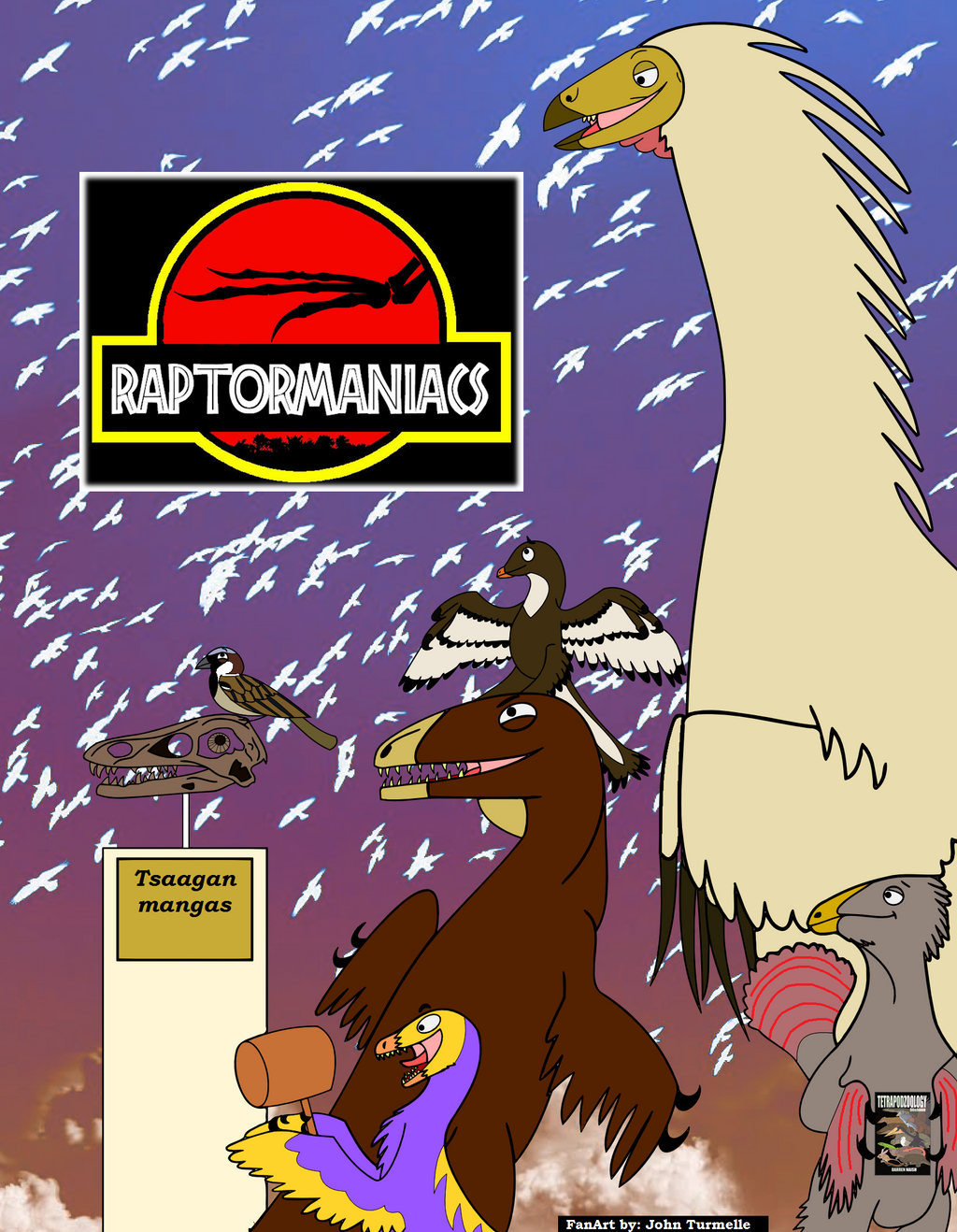
The above is courtesy of John Turmelle, also known as classicalguy on DeviantArt, who, in addition to producing this artwork, said a lot of kind words about my comic/blog/thingamabob in his artist's comments. I love it. I love that Remex is holding Tet Zoo the book, I love Zahavi maniacally holding a mallet, I love Skull being Skull. Words cannot express how happy and astounded I am that there are people who like Raptormaniacs this much, so I'll just provide a .gif instead. (I'd link to a clip of that scene but I can't find one on YouTube.)
Oh yes, I hinted earlier that I'd be making another announcement about the comics soon. Fear not; it really is coming. I just need to get something else that I've been working on out of the way first.
Monday, July 15, 2013
Raptormaniacs Revamp (For Real)
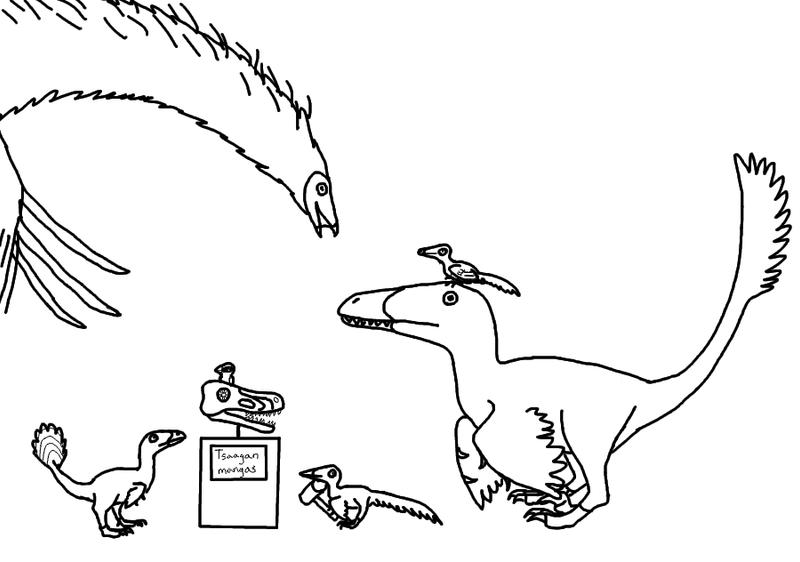
At long last I have come around to revisit the original reason I started this blog to begin with: the Raptormaniacs web comic. It's been more than a year since I last drew a real comic for the blog and much has changed since then. I started dabbling in digital art, for one thing. For another, there have been new scientific discoveries that have made my character designs outdated. All that called for something of a makeover.
For the sake of trivia, have a quick list of the major changes I made.
-I've had readers tell me that they've had trouble differentiating between Savape and Zahavi. In hindsight it was extremely foolish of me to have two "archaeopterygid"-type main characters in the comic and for a long time I'd wanted to either put up a guide to distinguishing the two or have Zahavi transform into a larger troodont in-universe to eliminate the problem. (He has unlimited cartoon powers; he can do that kind of thing.) In the meantime though, paleontology came to the rescue. New analysis of Archaeopteryx feathers show that they had black leading edges. Although an earlier study already demonstrated that the original Archaeopteryx specimen, an isolated covert feather, was dark colored, I had been reluctant to include this in the comic for fear that it would quickly wear down my pencils. Switching to digital art removes the dilemma. Savape's new color patterns are not easy to see at the resolution of the new dramatis personae above, but with luck she should be less mistakable when she shows up in future comics. While we're at it, I gave Remex his tail bands too.
-Feathers extend down to the foot in all the characters (besides Skull and Dinky for obvious reasons) now, based on new Mesozoic avialan specimens showing the ubiquity of foot feathers in Mesozoic theropods. (There's something I wasn't kidding about!)
-Ebeff now has pennibrachiae (wings), based on new evidence of them being present in (adult) ornithomimosaurs, suggesting a wider phylogenetic bracket for them.
-A number of aesthetic choices, such as smoothing the body contours of most of the characters (based on the concept that "primitive"-looking body feathers on fossil dinosaur specimens may be taphonomic illusions) and making their hands and upper legs more obscured by feathers (because there's no reason to think they didn't work like living birds in that respect).
Can I guarantee that I'll post comics more frequently now? Simply put, no. However, I might do an experiment that may help me in doing so, to be revealed shortly.
Thursday, June 27, 2013
Asahiyama Zoo
I really need to be better about keeping promises regarding posts I'm going to write... or stop making promises altogether. Have a bit of fresh material for now and maybe one day I'll get around to one of those reviews or months-ago trips I keep talking about.
Earlier this month I got to visit the Asahiyama Zoo, one of the most popular zoos in Japan. It is also the country's northernmost zoo, being situated in Hokkaido. While many of the exhibits were smaller than I'm used to seeing*, its animals looked healthy and were often provided with many sources of enrichment. In fact, the zoo is well known (at least within the country) for its exhibit designs that stimulate natural behaviors in its animals.
*As I once read someone joke, you could fit the entire Asahiyama Zoo into one exhibit at the San Diego Zoo.
Not all of the exhibit signs had English translations, but based on my limited knowledge of Japanese I think this is a black kite. (Thank goodness for my field guide to Japanese birds, which contained the Japanese names of the species it covered.) Black kites are common in Japan and I saw many wild individuals over the course of my vacation (including at the zoo), often mobbed by the even more ubiquitous jungle crows. While we're on the subject, jungle crows are the size of small common ravens and have even thicker bills; imagine those foraging in your neighborhood.

Capybaras lounging around. Capybaras always appear rather chill to me, but it was a hot day when I visited so they were probably trying to be especially so by cooling off in the water. It appears that these rodents are quite popular in Japan, for I saw plushie capybaras at many of the shops I visited.


Up above, spider monkeys clambered about on one of those enrichment structures I hinted at earlier.

Nearby were a series of enclosures for other monkeys (and ring-tailed lemurs). Note the presence of the primate keeper on this dramatis personae.

A eastern black-and-white colobus or mantled guereza.

A pair of De Brazza's monkeys.

A muntjac deer. Though among the smallest deer, the males have formidable-looking canines.

Some gibbons. They were sheltering in the shade when I initially arrived, but I did see them brachiating later on. I regret not taking more pictures of the enrichment structures, because some of them were rather elaborate. The nearby orangutans even had a veritable jungle gym that spanned a large wall as well as a suspended walkway that allowed them to venture beyond their main enclosures (similar to, though much smaller than, the O-Line at the National Zoo).

A wapiti.

A Japanese crane. It's hard to see here, but it'd just pulled a dead fish out of the pond in its exhibit and was adjusting it for ease of swallowing. I would see wild Japanese cranes (though protected by caging) later on during my vacation.

A local Japanese toad species in the reptile and amphibian house.

I don't know why these mice were being exhibited in the reptile house, though my personal suspicions are that they are fed to snakes. Speaking of the snakes, there was a sign at the building entrance warning visitors about snake droppings. Turns out they had a mesh tunnel overhead that allowed snakes to cross from one enclosure to another across the hallway.

An American alligator.

The next part of the zoo I went to exhibited local animals of Hokkaido. I often enjoy this sort of exhibition, for although they may contain species that locals find mundane, said species are often rare in foreign institutions. In this case, there were many owls on display, though the mesh cages made them hard to photograph. Here's an eagle owl.

This is some species of scops owl if I remember right.

A magnificent Steller's sea eagle. Though I said earlier that most of the enclosures at the Asahiyama Zoo were comparatively small, those of the large raptors were larger than what I've seen at many other zoos, which was nice. It's hard not to marvel at wild raptors and remember that captive individuals often have little room to fly even though flight is such a big part of their lifestyles in the wild. (Granted, in some instances the individuals have been rendered permanently flightless by injuries.)

A great spotted woodpecker. One of those species that's probably not too eyecatching to locals, but certainly new for a North American like me.

A Siberian chipmunk, the only chipmunk found outside of North America.

Raccoon dogs, unusual canids strongly featured in Japanese culture. (Yes, I did see statues of well-endowed raccoon dogs in front of Japanese shops on my trip.) How unusual are they? They hibernate and climb trees!

A red fox. Another species I would later see wild individuals of.

Elsewhere in the zoo, the polar bear enclosure, which surrounded a building with multiple viewing windows, including one designed so you can pretend to be a seal popping up from a breathing hole in what is presumably your final moments.

Unexpectedly, there were some fish exhibited in the polar bear building. They didn't come with English signs and my knowledge of fish is sketchy at best, but I think this is a clingfish.

Some lumpsuckers.

Uh... maybe a wolffish?

Some African crested porcupines.

A Blakiston's fish owl, one of Tet Zoo's ten most beautifully interesting birds. Like the sea eagles, it had a generously large exhibit with a small pond presumably for it to fish from.

Earlier this month I got to visit the Asahiyama Zoo, one of the most popular zoos in Japan. It is also the country's northernmost zoo, being situated in Hokkaido. While many of the exhibits were smaller than I'm used to seeing*, its animals looked healthy and were often provided with many sources of enrichment. In fact, the zoo is well known (at least within the country) for its exhibit designs that stimulate natural behaviors in its animals.
*As I once read someone joke, you could fit the entire Asahiyama Zoo into one exhibit at the San Diego Zoo.
Not all of the exhibit signs had English translations, but based on my limited knowledge of Japanese I think this is a black kite. (Thank goodness for my field guide to Japanese birds, which contained the Japanese names of the species it covered.) Black kites are common in Japan and I saw many wild individuals over the course of my vacation (including at the zoo), often mobbed by the even more ubiquitous jungle crows. While we're on the subject, jungle crows are the size of small common ravens and have even thicker bills; imagine those foraging in your neighborhood.

Capybaras lounging around. Capybaras always appear rather chill to me, but it was a hot day when I visited so they were probably trying to be especially so by cooling off in the water. It appears that these rodents are quite popular in Japan, for I saw plushie capybaras at many of the shops I visited.


Up above, spider monkeys clambered about on one of those enrichment structures I hinted at earlier.

Nearby were a series of enclosures for other monkeys (and ring-tailed lemurs). Note the presence of the primate keeper on this dramatis personae.

A eastern black-and-white colobus or mantled guereza.

A pair of De Brazza's monkeys.

A muntjac deer. Though among the smallest deer, the males have formidable-looking canines.

Some gibbons. They were sheltering in the shade when I initially arrived, but I did see them brachiating later on. I regret not taking more pictures of the enrichment structures, because some of them were rather elaborate. The nearby orangutans even had a veritable jungle gym that spanned a large wall as well as a suspended walkway that allowed them to venture beyond their main enclosures (similar to, though much smaller than, the O-Line at the National Zoo).

A wapiti.

A Japanese crane. It's hard to see here, but it'd just pulled a dead fish out of the pond in its exhibit and was adjusting it for ease of swallowing. I would see wild Japanese cranes (though protected by caging) later on during my vacation.

A local Japanese toad species in the reptile and amphibian house.

I don't know why these mice were being exhibited in the reptile house, though my personal suspicions are that they are fed to snakes. Speaking of the snakes, there was a sign at the building entrance warning visitors about snake droppings. Turns out they had a mesh tunnel overhead that allowed snakes to cross from one enclosure to another across the hallway.

An American alligator.

The next part of the zoo I went to exhibited local animals of Hokkaido. I often enjoy this sort of exhibition, for although they may contain species that locals find mundane, said species are often rare in foreign institutions. In this case, there were many owls on display, though the mesh cages made them hard to photograph. Here's an eagle owl.

This is some species of scops owl if I remember right.

A magnificent Steller's sea eagle. Though I said earlier that most of the enclosures at the Asahiyama Zoo were comparatively small, those of the large raptors were larger than what I've seen at many other zoos, which was nice. It's hard not to marvel at wild raptors and remember that captive individuals often have little room to fly even though flight is such a big part of their lifestyles in the wild. (Granted, in some instances the individuals have been rendered permanently flightless by injuries.)

A great spotted woodpecker. One of those species that's probably not too eyecatching to locals, but certainly new for a North American like me.

A Siberian chipmunk, the only chipmunk found outside of North America.

Raccoon dogs, unusual canids strongly featured in Japanese culture. (Yes, I did see statues of well-endowed raccoon dogs in front of Japanese shops on my trip.) How unusual are they? They hibernate and climb trees!

A red fox. Another species I would later see wild individuals of.

Elsewhere in the zoo, the polar bear enclosure, which surrounded a building with multiple viewing windows, including one designed so you can pretend to be a seal popping up from a breathing hole in what is presumably your final moments.

Unexpectedly, there were some fish exhibited in the polar bear building. They didn't come with English signs and my knowledge of fish is sketchy at best, but I think this is a clingfish.

Some lumpsuckers.

Uh... maybe a wolffish?

Some African crested porcupines.

A Blakiston's fish owl, one of Tet Zoo's ten most beautifully interesting birds. Like the sea eagles, it had a generously large exhibit with a small pond presumably for it to fish from.

Monday, April 1, 2013
Hail Volantia
A lot has happened since I last posted any comics. (How long has it been? A bit more than a year?) In fact, plenty has happened since I last posted here at all. (What, I'm supposed to write more about Earthflight and zoo trips? When did I say that?)
For instance, a paper came out describing the prevalence of large leg feathers in Mesozoic avialans, finding evidence of pennaceous feathers on the tibiotarsi of several confuciusornithid and enantiornithine specimens as well as on the metatarsals of Sapeornis. In fact, almost all coelurosaurs that preserve integument on the lower legs and feet have feathers there, with plumulaceous leg feathers and extensive foot scales (as in most modern birds) known only in Yanornis and more derived taxa. It is perhaps no accident that this is also the point in avialan phylogeny that a tail fan homologous with those of modern birds is known to have been present. (On that subject, the new Sapeornis specimen also preserves tail feathers, previously unknown in this genus, but that's a story for a different time.)
The implications of this are quite clear. After all, what else has four wings?
That's right, a new analysis shows that it's looking likely that flight evolved only once in the entire history of life, all flying organisms being united in a clade now called Volantia. Aside from the common biplane design, the monophyly of this group is supported by many other previously overlooked features. (I didn't look at the data matrix, but the study listed so many synapomorphies I figured it simply must be correct.) For example, the clade is also united by the ancestral characteristics of echolocation (still retained in swifts, oilbirds, planes, and most bats), being capable of learning the move Wing Attack (secondarily lost in planes due to their stiff wing structure)*, and eating foods widely considered to be disgusting in Western society (such as insects, rotting carcasses, and aviation fuel). In an interesting example of convergence, all five major clades of Volantia are all known to have independently evolved two-winged forms later on. This discovery is also further refutation of several ideas so preposterous it's a wonder there still exist those who support them in the scientific community, such as the dinosaurian origin of birds, the ornithodiran origin of pterosaurs, the mammalian origin of bats, the arthropod origin of insects, and the human invention of planes. (Too bad about the squamate origin of pterosaurs and the pterosaurian origin of birds though, those actually had some good things going for it.) Biology textbooks will now have to look elsewhere for comparisons between analogous and homologous structures. In fact, this was such abadly-written significant paper that an entirely new journal was created just to publish it. Fortunately, it is open-access, although you actually have to pay about $200 so unfortunately it is not really open-access.
*Evidently the production team of Pokémon was on to something when they included a puff of feathers in the animation of Wing Attack (despite some featherless Pokémon knowing this move). Considering that there are many obscure biological references in Pokémon, it appears likely that this was included as a nod to the Volantia hypothesis (then called the Single Origin of Flight Hypothesis or SOF).
Naturally, this also has implications for my comic, because it indicates that the use of echolocation and a biplane configuration should be present in most of my characters. However, I don't think I will bother to incorporate this new info into future comic strips. It is just too much work and having to come up with reasons for changing the characters' attributes in-universe is way too difficult. Even though I tried to include scientific understanding and in-jokes when I began this comic, I now realize that accuracy is overrated and is entirely irrelevant in a universe with levitating troodonts, talking fossil casts, and turkey-sized dinosaurs that can jump three meters in the air to slash an Allosaurus fatally in the throat. It's not like anyone actually appreciates the sciency stuff I put in to begin with and the few that do are just whiny nerds who can always go start their own comic if they want silly things like accuratedinosaurs volantians.
References
Troll, I.M.A. 2013. A four-winged configuration for basal birds: implications for the Single Origin of Flight (SOF) Hypothesis. Journal of Random Crap 1: 1-5. doi: 42.1007/s42336.012.0910.7
Zheng, X., Z. Zhou, X. Wang, F. Zhang, X. Zhang, Y. Wang, G. Wei, S. Wang, and X. Xu. 2013. Hind wings in basal birds and the evolution of leg feathers. Science 399: 1309-1312. doi: 10.1126/science.1228753
For instance, a paper came out describing the prevalence of large leg feathers in Mesozoic avialans, finding evidence of pennaceous feathers on the tibiotarsi of several confuciusornithid and enantiornithine specimens as well as on the metatarsals of Sapeornis. In fact, almost all coelurosaurs that preserve integument on the lower legs and feet have feathers there, with plumulaceous leg feathers and extensive foot scales (as in most modern birds) known only in Yanornis and more derived taxa. It is perhaps no accident that this is also the point in avialan phylogeny that a tail fan homologous with those of modern birds is known to have been present. (On that subject, the new Sapeornis specimen also preserves tail feathers, previously unknown in this genus, but that's a story for a different time.)
 |
| New specimen of Sapeornis showing hind limb feathers, from Zheng et al, 2013. |
The implications of this are quite clear. After all, what else has four wings?
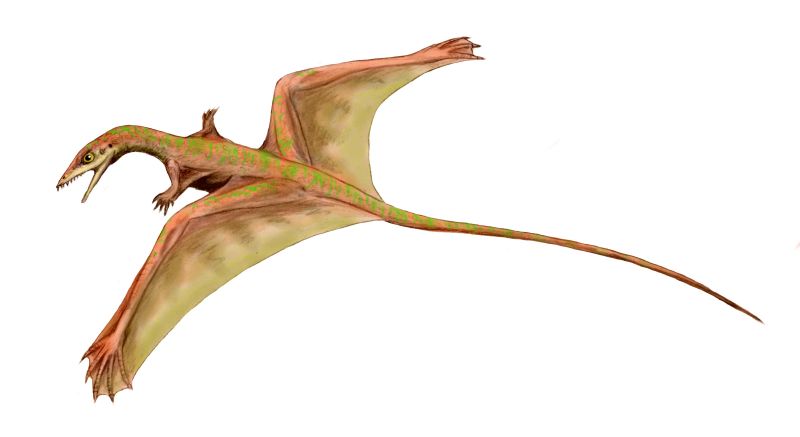 |
| The pterosauromorph Sharovipteryx mirabilis, licensed. |
 |
| The anisopteran insect Hemicordulia tau, photographed by Fir0002 and licensed. |
 |
| The chiropteran Agilichiropteryx johtoensis. |
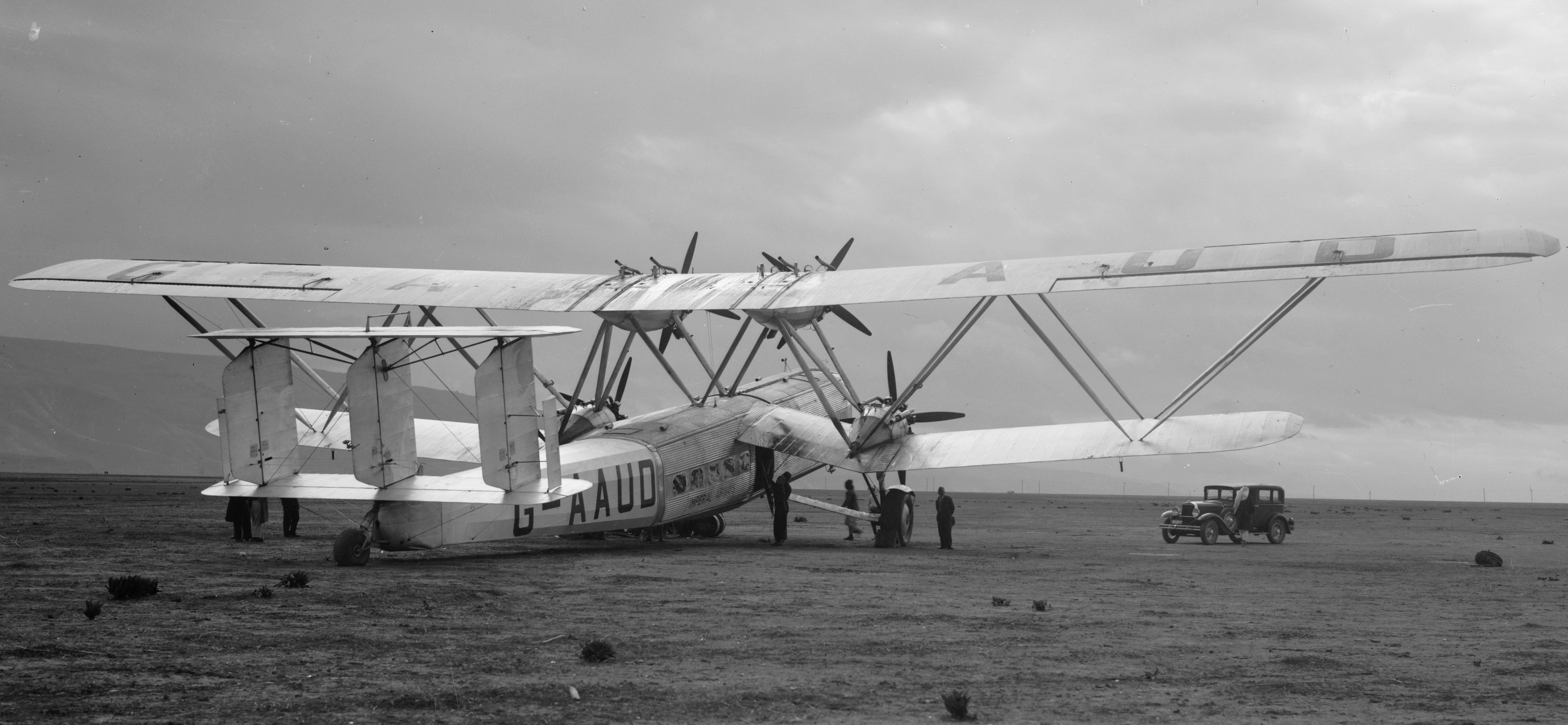 |
| The biplane Handleyvolans hannoi. |
That's right, a new analysis shows that it's looking likely that flight evolved only once in the entire history of life, all flying organisms being united in a clade now called Volantia. Aside from the common biplane design, the monophyly of this group is supported by many other previously overlooked features. (I didn't look at the data matrix, but the study listed so many synapomorphies I figured it simply must be correct.) For example, the clade is also united by the ancestral characteristics of echolocation (still retained in swifts, oilbirds, planes, and most bats), being capable of learning the move Wing Attack (secondarily lost in planes due to their stiff wing structure)*, and eating foods widely considered to be disgusting in Western society (such as insects, rotting carcasses, and aviation fuel). In an interesting example of convergence, all five major clades of Volantia are all known to have independently evolved two-winged forms later on. This discovery is also further refutation of several ideas so preposterous it's a wonder there still exist those who support them in the scientific community, such as the dinosaurian origin of birds, the ornithodiran origin of pterosaurs, the mammalian origin of bats, the arthropod origin of insects, and the human invention of planes. (Too bad about the squamate origin of pterosaurs and the pterosaurian origin of birds though, those actually had some good things going for it.) Biology textbooks will now have to look elsewhere for comparisons between analogous and homologous structures. In fact, this was such a
*Evidently the production team of Pokémon was on to something when they included a puff of feathers in the animation of Wing Attack (despite some featherless Pokémon knowing this move). Considering that there are many obscure biological references in Pokémon, it appears likely that this was included as a nod to the Volantia hypothesis (then called the Single Origin of Flight Hypothesis or SOF).
 |
| Results of the new phylogenetic analysis for Volantia, from Troll, 2013. (To avoid confusion, unicorns are the outgroup here, not part of Volantia proper.) |
Naturally, this also has implications for my comic, because it indicates that the use of echolocation and a biplane configuration should be present in most of my characters. However, I don't think I will bother to incorporate this new info into future comic strips. It is just too much work and having to come up with reasons for changing the characters' attributes in-universe is way too difficult. Even though I tried to include scientific understanding and in-jokes when I began this comic, I now realize that accuracy is overrated and is entirely irrelevant in a universe with levitating troodonts, talking fossil casts, and turkey-sized dinosaurs that can jump three meters in the air to slash an Allosaurus fatally in the throat. It's not like anyone actually appreciates the sciency stuff I put in to begin with and the few that do are just whiny nerds who can always go start their own comic if they want silly things like accurate
References
Troll, I.M.A. 2013. A four-winged configuration for basal birds: implications for the Single Origin of Flight (SOF) Hypothesis. Journal of Random Crap 1: 1-5. doi: 42.1007/s42336.012.0910.7
Zheng, X., Z. Zhou, X. Wang, F. Zhang, X. Zhang, Y. Wang, G. Wei, S. Wang, and X. Xu. 2013. Hind wings in basal birds and the evolution of leg feathers. Science 399: 1309-1312. doi: 10.1126/science.1228753
Wednesday, February 27, 2013
American Museum of Natural History
Sad to say, this will be a bit of a disappointing post, because I wasn't able to take enough photos on this trip. (However, as it turns out that's a minor good thing, because both the new image upload system of Blogger and the new design of Photobucket are stupid.) In all likelihood it's no great loss; the AMNH exhibitions have all been photographed so many times by so many people that I'm unlikely to add anything new. Besides that though, I'm not complaining about the trip at all, far from it. In fact, it was easily one of the best trips I've made anywhere in a while.
Believe it or not, I'd never been to the AMNH prior to this, so the fact that I got to visit alone would have been exciting enough, and, as one might expect, not much else could have made it any more exciting. What did manage that feat though was that I was on a field trip led by paleontologists Drs. Thomas Holtz and John Merck. In fact, it appears that this was an exceptional trip even for them, as Dr. Holtz tells me that in all the years they've been taking field trips there he can't think of another that went as smoothly as this one. Looks like I got lucky in that respect!
Upon our arrival, Drs. Holtz and Merck each gave us tours of the fossil halls. Unlike most other museums, at the AMNH these are arranged phylogenetically (for most part), with dinosaurs and synapsids getting their own dedicated halls. Here are some paintings of Pleistocene mammals by Charles Knight.


Needless to say, we were only passing through the synapsid halls to get to the good stuff. By chance I started out with Dr. Holtz's party, and he gave us an overview of (what else?) the dinosaurs. Here's "Big Mama" the nesting Citipati! (Though there's a chance it may really be "Big Papa".)

The hand of Plateosaurus. Non-pronated too! (Unfortunately the same can't be said for all the theropod mounts.)

The skull of Plateosaurus.

The head and neck of Apatosaurus. An elevated walkway allows us puny ones to get closer to its level.

Ah, Deinocheirus. More is coming. More is coming soon.

The genotype of Struthiomimus.

Little Archaeopteryx skeleton!

Just above it, its buddy Deinonychus. Here's a blurry picture of its foot, bearing the talon that gave it its name. Check out those short metatarsals!

Hey, it's Mononykus (still in the same case as avialans, naturally)! I tried to make conversation, but it didn't appear too inclined to talk.

It's worth mentioning that although the AMNH bungled with the tyrannosaurids (placing them among the carnosaurs)*, it places birds firmly in the saurischian dinosaur hall. Score!
*They do have a (later-installed) sign that has a more up-to-date phylogeny.
Incidentally, I swear that I didn't intend to take pictures only of saurischian dinosaurs and essentially nothing else.Saurischians are just better. It was entirely an unfortunate coincidence. Perhaps some other time...
After we finished with the dinosaurs, I joined Dr. Merck's tour, which took place in what is officially called the Hall of Vertebrate Origins, but was instead variously called the "Hall of Everything Else" and the "Hall of Paraphyly" by Dr. Holtz. In other words, it exhibits all the other fossil vertebrates that aren't either dinosaurs or synapsids. "Dinosaurs are overrated," Dr. Merck told us as he began his exposition, also known as "Vertebrate Evolution in 45 Minutes".
Interestingly, we even had a museum volunteer drop in to listen to Dr. Merck's talk, asking him about the origin of turtles. This was something that Dr. Merck had understandably not planned on talking about in detail - though it must be said that if the volunteer hadn't asked, I would have done so myself afterward. Either way, to paraphrase Dr. Merck, whatever you think about turtles, there will be someone else who thinks you're an idiot.
As it happens, said museum volunteer had been in contact with Dr. Holtz by email and using his website as a resource for a while now, and was delighted to finally meet him in person. As someone who has had a similar experience, I know firsthand what an awesome moment that must have been.
I also got to meet one of Drs. Holtz and Merck's former students, Eugenia Gold, who now does CT scanning on archosaurs at the museum (if I'm not mistaken). She very graciously took me on a tour behind the scenes, which was truly the icing on the cake. I got to look at specimens of Minotaurasaurus, Alioramus altai, and Khaan, what appeared to be a temnospondyl skull in the midst of being prepared, and the museum's CT scanning apparatus (along with an exquisite 3D print of a lizard skull). Apparently there was even more I could have been shown, but, alas, I had an assignment I needed to finish before we left the museum. Perhaps that was for the best, because I suspect that by then if I had gone through any more unspeakably awesome experiences I would have fallen over from excessive giddiness.
The end result was that during my last minutes at the museum, I went madly dashing about snapping arbitrary photos, but most of my efforts were thwarted either by crowds or my own poor photography skills. Ultimately, the only marginally useable photo that came out of that was, perhaps appropriately, one of the famous rearing Barosaurus mount.

Believe it or not, I'd never been to the AMNH prior to this, so the fact that I got to visit alone would have been exciting enough, and, as one might expect, not much else could have made it any more exciting. What did manage that feat though was that I was on a field trip led by paleontologists Drs. Thomas Holtz and John Merck. In fact, it appears that this was an exceptional trip even for them, as Dr. Holtz tells me that in all the years they've been taking field trips there he can't think of another that went as smoothly as this one. Looks like I got lucky in that respect!
Upon our arrival, Drs. Holtz and Merck each gave us tours of the fossil halls. Unlike most other museums, at the AMNH these are arranged phylogenetically (for most part), with dinosaurs and synapsids getting their own dedicated halls. Here are some paintings of Pleistocene mammals by Charles Knight.


Needless to say, we were only passing through the synapsid halls to get to the good stuff. By chance I started out with Dr. Holtz's party, and he gave us an overview of (what else?) the dinosaurs. Here's "Big Mama" the nesting Citipati! (Though there's a chance it may really be "Big Papa".)

The hand of Plateosaurus. Non-pronated too! (Unfortunately the same can't be said for all the theropod mounts.)

The skull of Plateosaurus.

The head and neck of Apatosaurus. An elevated walkway allows us puny ones to get closer to its level.

Ah, Deinocheirus. More is coming. More is coming soon.

The genotype of Struthiomimus.

Little Archaeopteryx skeleton!

Just above it, its buddy Deinonychus. Here's a blurry picture of its foot, bearing the talon that gave it its name. Check out those short metatarsals!

Hey, it's Mononykus (still in the same case as avialans, naturally)! I tried to make conversation, but it didn't appear too inclined to talk.

It's worth mentioning that although the AMNH bungled with the tyrannosaurids (placing them among the carnosaurs)*, it places birds firmly in the saurischian dinosaur hall. Score!
*They do have a (later-installed) sign that has a more up-to-date phylogeny.
Incidentally, I swear that I didn't intend to take pictures only of saurischian dinosaurs and essentially nothing else.
After we finished with the dinosaurs, I joined Dr. Merck's tour, which took place in what is officially called the Hall of Vertebrate Origins, but was instead variously called the "Hall of Everything Else" and the "Hall of Paraphyly" by Dr. Holtz. In other words, it exhibits all the other fossil vertebrates that aren't either dinosaurs or synapsids. "Dinosaurs are overrated," Dr. Merck told us as he began his exposition, also known as "Vertebrate Evolution in 45 Minutes".
Interestingly, we even had a museum volunteer drop in to listen to Dr. Merck's talk, asking him about the origin of turtles. This was something that Dr. Merck had understandably not planned on talking about in detail - though it must be said that if the volunteer hadn't asked, I would have done so myself afterward. Either way, to paraphrase Dr. Merck, whatever you think about turtles, there will be someone else who thinks you're an idiot.
As it happens, said museum volunteer had been in contact with Dr. Holtz by email and using his website as a resource for a while now, and was delighted to finally meet him in person. As someone who has had a similar experience, I know firsthand what an awesome moment that must have been.
I also got to meet one of Drs. Holtz and Merck's former students, Eugenia Gold, who now does CT scanning on archosaurs at the museum (if I'm not mistaken). She very graciously took me on a tour behind the scenes, which was truly the icing on the cake. I got to look at specimens of Minotaurasaurus, Alioramus altai, and Khaan, what appeared to be a temnospondyl skull in the midst of being prepared, and the museum's CT scanning apparatus (along with an exquisite 3D print of a lizard skull). Apparently there was even more I could have been shown, but, alas, I had an assignment I needed to finish before we left the museum. Perhaps that was for the best, because I suspect that by then if I had gone through any more unspeakably awesome experiences I would have fallen over from excessive giddiness.
The end result was that during my last minutes at the museum, I went madly dashing about snapping arbitrary photos, but most of my efforts were thwarted either by crowds or my own poor photography skills. Ultimately, the only marginally useable photo that came out of that was, perhaps appropriately, one of the famous rearing Barosaurus mount.

Thursday, January 3, 2013
Favorite Maniraptor of 2011 Results

The results of last year's poll are in. While not as one-sided as the poll for 2010, we have a clear winner in the troodont Talos, followed by the basal paravian Xiaotingia. Not much of a surprise there!
A new poll for last year's newly-named maniraptor genera is now up as well, so go ahead and vote.
Subscribe to:
Posts (Atom)