Showing posts with label Dromaeosaurids. Show all posts

Saturday, January 22, 2022

New (Extinct) Maniraptors of 2021

By my count, 42 new species of extinct maniraptors were named in 2021, which is about par for the course these days. Let's take a quick look at these new taxa and other nomenclatural proposals.

Alvarezsaurs
New alvarezsaurs have been described at a fairly steady trickle in recent years, and 2021 gave us Khulsanurus, known from a partial skeleton from the Late Cretaceous Barun Goyot Formation of Mongolia. It was discovered at the same locality as Parvicursor, but can be distinguished based on vertebral anatomy.

Oviraptorosaurs
No new oviraptorosaur species were described last year; in fact, they may have lost a member. A new specimen of Elmisaurus preserves overlapping material nearly identical to Nomingia, lending credence to the hypothesis that the two are synonymous (in which case the name Elmisaurus would take priority).

Non-ornithothoracean Paravians
2021 was a good year for dromaeosaurids, with the velociraptorines Shri (formerly known by the nickname "Ichabodcraniosaurus") and Kuru (formerly known by the nickname "Airakoraptor") both described based on partial skeletons from the Barun Goyot Formation. Less completely known are Kansaignathus (based on a partial jaw and possibly teeth from the Late Cretaceous Yalovach Formation of Tajikistan), Vectiraptor (based on partial vertebrae from the Early Cretaceous Wessex Formation of the United Kingdom), and Ypupiara (an unenlagiine based on jaw fragments from the Late Cretaceous Serra da Galga Formation* of Brazil). Tragically, the type specimen of Ypupiara was among the fossils lost in the 2018 fire that destroyed the main building of the National Museum of Brazil.

*Ypupiara was described as being from the Marília Formation. However, it was recently proposed that the classic Marília Formation should be split into the separate Marília and Serra da Galga Formations.

Holotype of Shri, from Turner et al. (2021).

Troodontids, on the other hand, got Papiliovenator from the Late Cretaceous Wulansuhai Formation of China, known from a partial skeleton including a nearly complete skull. Its name translates (I think quite adorably) into "butterfly hunter", not based on any inference about its ecology, but on the "butterfly-like" shape of its dorsal vertebrae. There was also Tamarro from the Late Cretaceous Talarn Formation of Spain, known from a partial metatarsal. Meanwhile, a detailed reassessment of small theropods from the Dinosaur Park Formation concluded that Latenivenatrix cannot be reliably distinguished from Stenonychosaurus, and that the two should be (re-)synonymized.
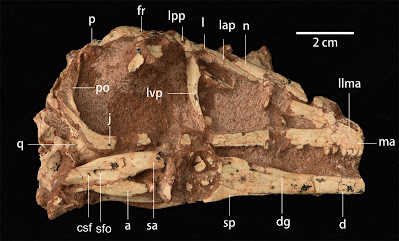
Skull of Papiliovenator, from Pei et al. (2022). (The paper was released as an advance online publication in 2021.)

Last year also saw the description of a new Jeholornis-like avialan, Neimengornis, from the Early Cretaceous Jiufotang Formation of China. It appears to be known from an essentially complete skeleton. However, there have already been suggestions that the type specimen is likely a chimera.

Enantiornitheans
As is often the case, the Jiufotang Formation also contributed some new enantiornitheans in 2021, two to be precise. One of these was Brevirostruavis, which is notable for preserving an elongated hyoid, suggesting that it may have used its tongue for handling food. Although the original description compares this condition to that seen in hummingbirds and woodpeckers, the hyoid elongation seen in Brevirostruavis does not look to my eye quite as extreme as that of those crown birds. My guess would be that Brevirostruavis might have used its tongue to help pick up food and manipulate it within its mouth, but did not use a feeding strategy that involved protruding the tongue very far beyond its snout.

The other new Jiufotang enantiornithean was Yuanchuavis, which preserves a set of eight tail feathers forming a fan-like array. This contrasts with the typical condition seen in most other enantiornitheans (which tended to either lack large tail feathers or have only a single pair of them), but resembles that of Chiappeavis. Unlike Chiappeavis, the central pair of tail feathers in Yuanchuavis was particularly elongate.

Personally, I think one of the most scientifically important new maniraptors to be named last year was Yuornis from the Late Cretaceous Qiupa Formation of China. It is based on a partial skeleton with an essentially complete skull preserved in three dimensions, a rarity for avialan fossils. It is also one of the few enantiornitheans known to have had entirely toothless jaws.

Holotype of Yuornis, from Xu et al. (2021).

A fourth enantiornithean to come out of 2021 was Fortipesavis, known from a foot preserved in Late Cretaceous Burmese amber that had been previously described in 2019.

Non-neornithean Euornitheans
Two non-neornithean euornitheans were named in 2021 based primarily on cranial material, these being Brevidentavis and Meemannavis from the Early Cretaceous Xiagou Formation of China. The type specimen of Brevidentavis was previously reported as the skull of Gansus, but a more likely candidate for an actual Gansus skull was described in the new paper. The lower jaw of Brevidentavis exhibits unusually short, blunt teeth set in a groove (instead of in sockets), whereas Meemannavis has a toothless lower jaw.

Holotype of Brevidentavis, from O'Connor et al. (in press).

One Mesozoic avialan named last year that was not discovered in Asia was Kaririavis from the Early Cretaceous Crato Formation of Brazil. Based on a partial foot, it was unusual for a Cretaceous euornithean in being particularly small (around the size of a sparrow) and in that its one preserved toe claw was large and strongly curved.

Paleognaths
Perhaps one of the biggest overhauls in dinosaur systematics in 2021 was the reinterpretation of geranoidids, eogruids, and ergilornithids as stem-ostriches instead of gruiforms. Although a close relationship between ergilornithids and ostriches had been suggested in the 1950s and contemplated more recently in light of further data on fossil paleognaths, anatomical information from newly described eogruid and ergilornithid specimens seems to strongly bolster this hypothesis. In their revision of these birds' affinities, the authors additionally resurrected the genus Proergilornis, which had been previously synonymized with Ergilornis, and suggested that it was less closely related to extant ostriches than ergilornithids proper.

A new fossil paleognath was also described last year, the kiwi Apteryx littoralis, based on a tarsometatarsus from the Pleistocene of New Zealand. Kiwi fossils are rarely found, and this species is the first one known from the early Pleistocene.

Galloanserans
A couple of extinct total-group anseriforms were named in 2021. One of these was the small presbyornithid Bumbalavis from the Eocene Naran-Bulak Formation of Mongolia. (Meanwhile, the type specimen of "Presbyornis" mongoliensis from the same locality was reinterpreted as a stem-mirandornithean similar to Juncitarsus.) The other was the stiff-tailed duck Manuherikia primadividua from the Miocene Bannockburn Formation of New Zealand, the fourth species to be named in the genus Manuherikia. It appears to be stratigraphically separated from the older M. lacustrina.

Two small, early total-group galliforms were described from the Naran-Bulak Formation last year as well, these being Bumbanipodius and Bumbanortyx.

Strisoreans
New fossil members of Strisores don't get described every day, or every year for that matter. (The last one I recall was Cypseloramphus from 2016.) That's why I was excited to see the publication of Archaeodromus from the Eocene London Clay Formation of the United Kingdom, known from a partial skeleton. This new taxon is a member of Archaeotrogonidae (formerly thought to be a group of stem-trogons, as their name suggests, later reevaluated as strisoreans), and not only provides new anatomical information on this group, but also suggests that they may be stem-nightjars. The absence of clear examples of Eocene stem-nightjars had been a conspicuous gap in the known fossil record of Strisores, so the common but enigmatic archaeotrogonids filling that space seems like a tantalizing possibility. It would also imply that my earlier hypothesis that the putative archaeotrogonid Hassiavis was a stem-owlet-nightjar is probably wrong, but that's the way science goes sometimes.
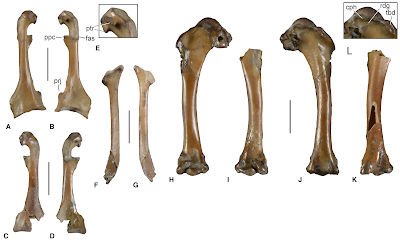
Shoulder and forelimb bones of Archaeodromus, from Mayr (2021).

Gruiforms
The Naran-Bulak Formation gave us two more new fossil birds in 2021, the possible gruiforms Bumbanipes and Bumbaniralla. Bumbanipes appears to have been a specialized swimming form with morphological similarities to the limpkin (Aramus guarauna) and finfoots, whereas Bumbaniralla resembles messelornithids. Additional new entrants in the extinct gruiform department were the crane-like Palaeogeranos, based on a coracoid from the Oligocene of France, and the recently extinct rail Gallirallus astolfoi, based on a tarsometatarsus from the island of Rapa Iti in French Polynesia. Recent revisions in the generic assignment of recent rails have restricted the genus Gallirallus to the weka (G. australis) and sometimes the New Caledonian rail (G. lafresnayanus), in which case it wouldn't surprise me if G. astolfoi was transferred to a different genus in the future, perhaps Hypotaenidia. In fact, reassignment to Hypotaenidia was proposed last year for another recently extinct rail, the Chatham rail ("Cabalus" modestus), in one study on rail phylogeny.

Charadriiforms
No new extinct charadriiforms were named in 2021, but a study on the original illustrations used to describe the Moorea sandpiper (Prosobonia ellisi) supported synonymizing it with the Tahiti sandpiper (P. leucoptera).

Natatoreans
There has still been no formal proposal to name the clade uniting Phaethontimorphae and Aequornithes, but last year the name Feraequornithes was coined for the group including most aequornitheans other than loons. As it happens, all of the extinct members of the "waterbird clade" that were named in 2021 belong to Feraequornithes.

The excellent fossil record of total-group penguins continued to provide, with new taxa in the form of the giant Kairuku waewaeroa, based on a partial skeleton from the Oligocene Glen Massey Formation of New Zealand, and the smaller Marambiornopsis, based on a tarsometatarsus from the Eocene Submeseta Formation of Antarctica. Perhaps more surprising was the description of a new fossil petrel based on a well-preserved skeleton, Procellaria altirostris from the Pliocene Tangahoe Formation of New Zealand.

Holotype of Procellaria altirostris, from Tennyson and Tomotani (2021).

Among pelecanimorphs, Eopelecanus was described as the oldest known stem-pelican based on a tibiotarsus from the Eocene Birket Qarun Formation of Egypt, whereas a revision of plotopterid specimens from the Paleogene of Washington State resulted in "Tonsala" buchanani being reassigned to Klallamornis.

Telluravians
Although not as many new raptors were named last year as there were in 2020, they were still pretty well represented. Arguably the most exciting was Archaehierax, known from a partial skeleton from the Oligocene Namba Formation of Australia. It was nearly as big as the wedge-tailed eagle (Aquila audax, the largest bird of prey in Australia today), and phylogenetic analyses (which have otherwise almost never been done on fossil accipitrimorphs!) suggest that it was a crown accipitrid, but not especially closely related to any living species.
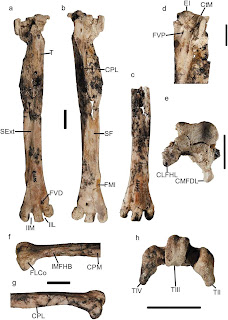
Tarsometatarsus of Archaehierax, from Mather et al. (in press).

The other new fossil accipitrids of 2021 were also quite large species, Buteo dondasi from the Pliocene Chapadmalal Formation of Argentina and Buteogallus irpus from the Pleistocene of the Dominican Republic and Cuba. B. irpus is notably based on specimens formerly assigned to Titanohierax (now restricted to fossils from the Bahamas) and "Amplibuteo" woodwardi (now restricted to fossils from the United States). Its description further suggested sinking members of the genus Amplibuteo into Buteogallus, which had been foreshadowed in previous papers. Another new raptor was the owl Margarobyas abronensis from the Pleistocene of Cuba, a close relative of the poorly-known bare-legged owl (M. lawrencii) that still lives in Cuba today.

Among coraciimorphs, there was Ueekenkcoracias from the Huitrera Formation of Argentina, based on a partial hindlimb. It was described as a stem-member of the group uniting ground rollers and rollers, in which case it would be the first representative of this clade known from South America. However, a later study argued that Ueekenkcoracias more closely resembles the enigmatic Eocene bird Palaeopsittacus, in which case it may not be a telluravian at all. Probably less controversial are the three Pleistocene woodpeckers described from the La Brea tar pits (listed in order of decreasing body size), Breacopus, Melanerpes shawi, and Bitumenpicus.

The London Clay Formation had a good year as far as new fossil birds were concerned, with Tynskya waltonensis revealing new details about messelasturid morphology, though the phylogenetic affinities of these parrot-like birds remain mysterious. Perhaps even more remarkable was the psittacopedid Parapsittacopes, known from a very well-preserved partial skeleton that sheds new light on the anatomy of these stem-passeriforms. It further adds to the already impressive ecological diversity of psittacopedids, exhibiting a slightly widened beak that may have allowed it to feed on fruits and flying insects.
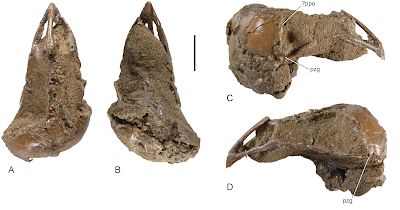
Skull of the holotype of Parapsittacopes, from Mayr (2020). (The print version of the journal retroactively dates the paper to 2020, but really, the paper was first released in 2021.)

Last but not least, a few fossil crown passeriforms were also described in 2021, the possible suboscine Crosnoornis, based on a nearly complete skeleton from the Oligocene of Poland, and the magpie Pica praepica from the Pleistocene of Bulgaria.

Type specimen of Crosnoornis, from Bochenski et al. (2021).

Tuesday, January 19, 2021

New (Extinct) Maniraptors of 2020

The "new year" is not so new anymore (three new maniraptors have been named in 2021 already), but this is a tradition and I'm sticking to it, for now. Having done a sweeping overview of the past year in maniraptoran discoveries, I will now take a more in-depth look at the new extinct taxa that were described last year. In addition to the new genera and species of 2020, this time around I will also make an effort to mention other relevant nomenclatural changes that were proposed.

Alvarezsaurs
Last year saw the naming of Trierarchuncus, the youngest known alvarezsaur. Fragmentary alvarezsaur specimens had been previously reported from the latest Cretaceous Hell Creek and Lance Formations of the western United States, but these fossils had been left unnamed. Trierarchuncus itself is not known from a whole lot—it was described based on three thumb claws (belonging to three different individuals) from the Hell Creek Formation, and there are parts of an arm and a foot as well as a previously described partial hip that may also belong to it. Shortly after its initial description, a second paper assigned two more thumb claws to Trierarchuncus.

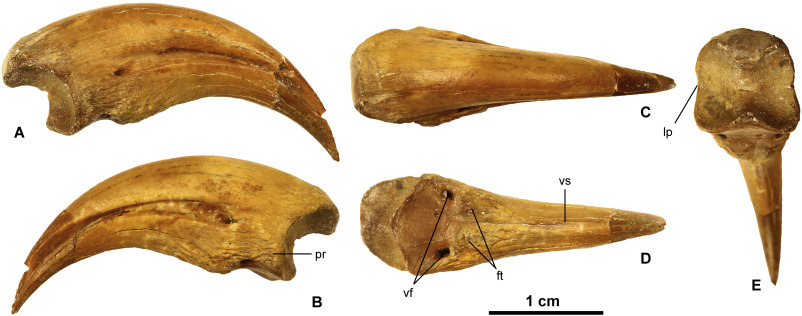
Even though the specimens don't represent much of the skeleton, Trierarchuncus is potentially quite informative about alvarezsaur biology. I noted last year in a post about alvarezsaurids that completely preserved alvarezsaurid thumb claws are rare. One of the claws assigned to Trierarchuncus, however, is very complete, showing a sharp tip and stronger curvature than is typically assumed for alvarezsaurid thumb claws. To my eye at least, this claw shape is in keeping with use of the claw in hook-and-pull digging, as I had contended in my blog post (and others had contended in scientific papers). Perhaps in reference to the strongly curved claw, the name Trierarchuncus can be translated as "Captain Hook".

The most completely preserved thumb claw referred to Trierarchuncus, from Fowler et al. (2020).

Seeing as the claws assigned to Trierarchuncus come from individuals of different sizes, they may also provide insight into how alvarezsaurid claws changed as they grew. The larger Trierarchuncus claws are widened at their base and the surface of the bone exhibits a roughened texture, which likely developed as a response to considerable stresses. The authors who made these observations noted that this is also consistent with the hypothesis that alvarezsaurids used their thumb claws for digging.

Oviraptorosaurs
One of the most spectacular new maniraptors from last year, in terms of the fossil material represented, may have been the oviraptorid Oksoko from the Late Cretaceous Nemegt Formation of Mongolia. It is known from the skeletons of several individuals, including nearly complete skeletons. Notably among these specimens is an assemblage of at least three (maybe four) juveniles preserved together, which had been confiscated from fossil poachers in 2006. Some of these juveniles are preserved in lifelike crouched postures, suggesting that they had been buried rapidly and simultaneously. They therefore provide strong evidence of gregarious behavior in oviraptorosaurs. Oksoko was unusual among oviraptorosaurs in that its third finger was highly reduced, giving it functionally two-fingered hands, and the describers note that similar hands may have been present in Heyuannia huangi.

Several juvenile specimens of Oksoko (including the holotype, marked in blue) preserved together, from Funston et al. (2020).

2020 also saw a much-needed taxonomic overhaul of the caenagnathid oviraptorosaurs from the Late Cretaceous Dinosaur Park Formation in Alberta. Many Dinosaur Park caenagnathids were named based on non-overlapping parts of the skeleton, which has naturally raised questions about whether they all really represent distinct species or not. Based on the examination of newly described, more complete specimens, as well as assessment of individual growth stage based on bone microstructure, this latest study concluded that there are probably three distinct caenagnathids known from the Dinosaur Park Formation: the large Caenagnathus, the medium-sized Chirostenotes, and the small, newly-named genus Citipes, which had formerly often been considered a species of either Chirostenotes or Leptorhynchos. Although not the main focus of the study, this paper additionally mentions that the Gobiraptor from the Nemegt Formation likely represents a juvenile of Conchoraptor, as had been hinted in the past.

Also in the world of oviraptorosaur taxonomy, the feather-preserving specimens of Similicaudipteryx were reassigned to Incisivosaurus (previously known only from a skull and partial neck vertebra).

Non-ornithothoracean Paravians
In contrast to 2019, which was conspicuously lacking in new dromaeosaurids, at least two new dromaeosaurids were described in 2020. One of these was the microraptorian Wulong from the Early Cretaceous Jiufotang Formation of China, known from the exquisitely-preserved complete skeleton of an immature individual. Like Microraptor, Wulong had large feathers on its hindlimbs, and the specimen also preserves a single pair of elongated tail feathers at the tip of its tail.

Holotype of Wulong, from Poust et al. (2020).

The other new dromaeosaurid was Dineobellator, a mid-sized (Velociraptor-sized) dromaeosaurid from the Late Cretaceous Ojo Alamo Formation of the United States. It is known from a partial skeleton, and as in Velociraptor and Dakotaraptor, its ulna exhibits a series of bumps for the attachment of wing feathers along the forearm.

One new paravian that might be a dromaeosaurid was Overoraptor, known from a couple of partial skeletons from the Late Cretaceous Huincul Formation of Argentina. The phylogenetic analysis in the description of Overoraptor recovered it as a close relative of Rahonavis, a smaller, likely flight-capable paravian from the Late Cretaceous of Madagascar. The phylogenetic position of Rahonavis is controversial; it has been found as either an unenlagiine dromaeosaurid or an avialan in recent studies. This particular study found Overoraptor and Rahonavis as avialans, though the phylogenetic dataset used tends to find paravian relationships that are not strongly supported by other analyses, with microraptorians and unenlagiines outside of dromaeosaurids and instead being more closely related to modern birds. It would be interesting to see where Overoraptor turns up when included in other phylogenetic datasets.

Rounding out the long-tailed paravians of 2020 is Kompsornis, a Jeholornis-like avialan from the Jiufotang Formation. The taxonomy of the various Jeholornis-like avialans is debated, but the describers of Kompsornis argue that Shenzhouraptor, Jixiangornis, Jeholornis prima, Jeholornis palmapenis, and Jeholornis curvipes all represent distinct, valid taxa. This paper is also notably one of the few to address "Dalianraptor", a supposedly short-armed, long-tailed avialan. The authors confirm that the original specimen of "Dalianraptor" is likely a composite, and find no definitive features that distinguish it from other Jeholornis-like avialans.

Enantiornitheans
Only one new enantiornithean was named last year, but it was a doozy. Falcatakely from the Late Cretaceous Maevarano Formation of Madagascar is known from a nearly complete skull, and it's a skull unlike that of any other known theropod. Its snout was long and tall, giving it a superficial resemblance to a toucan or a hornbill. However, most of the snout was composed of enlarged maxilla bones, contrasting with the condition in modern birds, in which the snout is primarily composed of the premaxillae. The maxillae of Falcatakely were toothless and probably covered in a keratinous sheath, but the specimen preserves at least one small premaxillary tooth.

Holotype of Falcatakely, from O'Connor et al. (2020).

The describers of Falcatakely ran several different phylogenetic analyses and consistently recovered it as an enantiornithean each time. Even so, it's probably fair to wonder whether this bizarre creature really was an enantiornithean, especially considering that very few other Late Cretaceous enantiornithean skulls are known for comparison. As Mickey Mortimer has pointed out, a highly modified Late Cretaceous theropod with no obvious close relatives and known from limited remains is likely going to be difficult to place no matter what. (It's perhaps worthy of note that little to no skull material has been found for the two other paravians that have been named from the Maevarano Formation, Rahonavis and Vorona.) Regardless of what it turns out to be, the unusual and unexpected morphology of Falcatakely easily qualifies it as one of the highlights among last year's new dinosaurs.

In other news, a review of the Mesozoic and Paleocene pennaraptoran fossil record considered the poorly-studied Jiufotang enantiornitheans Largirostrornis and Longchengornis to be synonyms of Cathayornis, though this was not elaborated upon.

Non-neornithean Euornitheans
The taxonomy of yanornithid euornitheans was revised in 2020, resulting in the recognition of two new genera, Abitusavis and Similiyanornis. Similiyanornis from the Jiufotang Formation had a distinctive tooth arrangement in which the frontmost tooth in its lower jaw was enlarged. Abitusavis was larger than Similiyanornis and was discovered in the older Yixian Formation. Of note is that the first yanornithid specimen reported with fish remains preserved in its digestive tract (originally assigned to Yanornis) is now considered a specimen of Abitusavis. Several other previously described specimens (including the poorly-studied "Aberratiodontus") were deemed indeterminate yanornithids in this study, whereas Yanornis guozhangi was sunk into the type species of Yanornis, Y. martini.

Holotype of Similiyanornis, from Wang et al. (2020).

Another new Early Cretaceous euornithean is Khinganornis from the Longjiang Formation of China. It is the first dinosaur to be described from this formation, and is known from a nearly complete skeleton, but its anatomical details are not well preserved. It appears to have been generally similar to the semi-aquatic euornitheans Gansus and Iteravis, and may have led a similar lifestyle.

Paleognaths
No new paleognaths were named last year (at least, none based on skeletal material), but the old genus Palaeostruthio was brought back and applied to "Struthio" karatheodoris, a large ostrich from the Miocene of Eurasia.

Galloanserans
Alright, let's do this one more time... Asteriornis from the Late Cretaceous Maastricht Formation of Western Europe is one of the few well-established examples of a Mesozoic crown bird. It is known from several bones, most notably a nearly complete skull. The skull exhibits features characteristic of both anseriforms and galliforms, and Asterornis may thus be a close approximation of what the ancestral galloanseran looked like. There's plenty more that could be said, but I already wrote about Asteriornis in more detail here.

Skull of Asteriornis, from Field et al. (2020).

The Cenozoic contributed its fair share of new galloanserans as well. From the Eocene of Kazakhstan came the anseriform Cousteauvia, known from a tarsometatarsus that displays features suggestive of diving behavior (hence the name honoring Jacques Cousteau). Its full binomial, Cousteauvia kustovia, is a bit of fun with homophones. There were also a couple of new pheasants from Bulgaria, the Miocene Phasianus bulgaricus and the Pleistocene Chauvireria bulgarica.

It's not often that we get a new gastornithid, but last year gave us Gastornis laurenti from the Eocene of France. It was named based on a distinctive lower jaw, but its describers mention that it is known from postcranial bones as well, which will be described in a later publication.

Columbimorphs
What's this? A fossil columbimorph older than the Pleistocene and represented by decently complete material?! Linxiavis was a sandgrouse from the Miocene Liushu Formation of China, and is known from a partial skeleton including most of the forelimbs. Sandgrouse today live in arid habitats (they famously use their belly feathers to transport water for their young), so the discovery of Linxiavis is consistent with other lines of evidence suggesting that the Liushu Formation was deposited in a relatively dry environment.

Holotype of Linxiavis, from Li et al. (2020).

A new columbimorph that lived in more recent times is the Pleistocene–Holocene pigeon Tongoenas, remains of which are known from several islands in the Kingdom of Tonga. Its hindlimb anatomy suggests that it was a primarily tree-dwelling form, similar to the fruit doves and imperial pigeons that are still extant today. Tongoenas was one of the largest known flying pigeons, surpassed in that department only by the crowned pigeons, which can reach the size of a small turkey.

Gruiforms
The one new gruiform named last year was the coot Fulica montanei, known from a few tarsometatarsi found in the Pleistocene–Holocene Laguna de Tagua Tagua Formation of Chile. It was large for a coot, comparable in size to the extant horned coot (F. cornuta), and potentially had limited flight capabilities due to its size.

Meanwhile, to maintain consistency with the current taxonomy of extant cranes, the Pleistocene Cuban flightless crane "Grus" cubensis was transferred to the genus Antigone, which includes its probable close relatives such as the sarus (A. antigone) and sandhill (A. canadensis) cranes.

Charadriiforms
The origins of charadriiforms are murky, but 2020 saw the publication of a new taxon that may bear on the subject. That new taxon was Nahmavis from the Eocene Green River Formation of the United States, and it is known from a partial skeleton (missing the forelimbs and shoulder girdle) with preserved feathers. This specimen had previously been reported in popular books and websites as a potential close relative of the seriema-like bird Salmila from the Eocene of Germany, but the describers of Nahmavis instead find it to be more similar to possible stem-charadriiform Scandiavis from the Eocene of Denmark.

In the new study, Nahmavis and Scandiavis were indeed sometimes found as stem-charadriiforms. However, other analyses in this paper placed them as gruiforms instead. It is unfortunate that forelimb material is unknown for both Nahmavis and Scandiavis, seeing as the forelimb bones of charadriiforms are often distinctive. For what it's worth, playing around with the phylogenetic dataset used in this study, I've found that Nahmavis and Scandiavis are consistently recovered as stem-charadriiforms when the internal topology of crown charadriiforms is constrained to the results of molecular studies. In any case, the holotype of Nahmavis is a lovely specimen, and it's good to see it described at last.

Holotype of Nahmavis, from Musser and Clarke (2020).

Among crown charadriiforms, a new species described last year was the recently extinct sandpiper Prosobonia sauli from Henderson Island in the Pitcairn Islands. The genus Prosobonia also includes at least three other extinct sandpiper species as well as the extant Tuamotu sandpiper (P. parvirostris). Unlike typical sandpipers, the members of this genus are not migratory, and are confined to various remote Polynesian islands. Compared to the Tuamotu sandpiper, P. sauli had a wider, straighter bill tip and longer hindlimbs.

Natatoreans
As yet, it appears that no one has formally suggested in technical literature what name should be used for the clade uniting phaethontimorphs (tropicbirds, sunbitterns, and kagus) and aequornitheans ("core waterbirds", such as penguins, petrels, pelicans, etc.). I have provisionally settled on resurrecting the old name Natatores for this group, as it has been used in relatively recent literature for a very similar assemblage of birds.

Fossil penguins have generally had a good showing in recent years, and 2020 added Eudyptes atatu from the Pliocene Tangahoe Formation of New Zealand to the lineup. It is known from several specimens, and the holotype is a partial skeleton that includes much of the skull and shoulder girdle. E. atatu was closely related to the extant crested penguins, but its beak was shallower in depth compared to the fairly tall beak seen in the living members of this genus.

Two other new natatoreans belonged to a different group of wing-propelled divers, the extinct plotopterids, which were probably close relatives of boobies and cormorants. The new plotopterids Empeirodytes and Stenornis both come from the Oligocene of Japan and are known from isolated coracoids, with Stenornis being the larger of the two.

Telluravians
Whereas no raptorial telluravians were named in 2019, 2020 turned out to be extremely productive in the realm of new raptors. Two New World vultures were named from the Quaternary of Cuba, Coragyps seductus (which was similar to the extant black vulture, Coragyps atratus) and Cathartes emsliei (the smallest member of the genus Cathartes, which also includes the turkey vulture, C. aura, among others).

The Quaternary of Cuba gave us three new hawk species as well, these being Gigantohierax itchei, Buteogallus royi, and Buteo sanfelipensis. G. itchei was the biggest of the three (though it wasn't as big as the type species of Gigantohierax, G. suarezi), whereas B. sanfelipensis was the smallest, being somewhat smaller than a red-tailed hawk (Buteo jamaicensis). From further back in geologic time, we got the large Vinchinavis from the Miocene Toro Negro Formation of Argentina, represented by partial forearm bones. Even older was ?Palaeoplancus dammanni from the Eocene of the United States, known from a tarsometatarsus.

Arguably the most spectacular new accipitrid, however, was Aviraptor from the Oligocene of Poland. It wasn't spectacular due to its size—it was the smallest of the new accipitrids, about the same size as the aptly-named tiny hawk (Accipiter superciliosus). However, it is known from a nearly complete skeleton, a rarity among fossil accipitrids. Its combination of small body size and relatively long hindlimbs is commonly seen in extant accipitrids that hunt other birds, suggesting that it may have had similar habits. It may not be a coincidence that early hummingbirds and passeriforms are known to have lived in Europe at around the same time as Aviraptor.

Holotype of Aviraptor, from Mayr and Hurum (2020).

The surge of new fossil raptors was not limited to vultures and hawks, as fossil owls had a very good year, too. There was the pygmy owl Glaucidium ireneae from the Pliocene–Pleistocene of South Africa, the oldest unambiguous member of its genus from Africa. The Quaternary of Cuba contributed the small barn owl Tyto maniola and the giant Ornimegalonyx ewingi, the latter based on specimens previously assigned to the horned owl Bubo osvaldoi. Although O. ewingi was much smaller than the type species of Ornimegalonyx, O. oteroi, it was still larger than any living owl species. The remaining species of Ornimegalonyx (O. acevedoi, O. gigas, and O. minor), however, have been sunk into O. oteroi.

Another large owl was Asio ecuadoriensis from the Pleistocene Cangagua Formation of Ecuador. Known from a couple of robust hindlimb bones, it was about the same size as a great horned owl (Bubo virginianus). Interestingly, its remains were found in association with the bones of smaller owls (and small mammals) that appear to have been etched by stomach acid, suggesting that it may have preyed on other owl species.

Numerous owls have been named from Paleogene fossil deposits, but most of these species are based on very limited material. Primoptynx from the Eocene Willwood Formation of the United States is known from a partial skeleton, making it one of the most completely known Paleogene owls. Like accipitrids, but unlike extant owls, Primoptynx had enlarged claws on its first and second toes, perhaps implying that it captured prey in a similar manner to accipitrids (maybe making use of the infamous "raptor prey restraint" method that may have also been employed by dromaeosaurids).

Toes of Primoptynx, from Mayr et al. (2020). The claws on the first and second toes are particularly large.

Moving away from raptors for a moment, Jacamatia from the Oligocene of France was a tiny piciform known from a partial wing skeleton. Its describers suggest that it was closely related to the jacamars and puffbirds, which are otherwise poorly represented in the fossil record. It may have belonged to the Sylphornithidae, a group of similarly tiny Paleogene piciforms, though very little overlapping material is available for comparison.

On the australavian side of Telluraves, we meet the small caracara Milvago diazfrancoi, yet another new raptor from the Quaternary of Cuba. The remaining new fossil australavians of 2020 were all songbirds: the corvid Corvus bragai from the Pliocene–Pleistocene of South Africa (the oldest known corvid from Africa) and the New World blackbirds Icterus turmalis and Molothrus resinosus from the Pleistocene Talara tar seeps of Peru.

Some additional revisions of note concerning fossil songbirds: the holotype of "Pliocalcarius" from the Pliocene of Central Asia, originally described as a longspur, was reinterpreted as a lark and transferred to the horned lark genus Eremophila, whereas "Eremophila" prealpestris from the Pleistocene of Bulgaria was argued to have been more similar to a different lark genus, Ammomanes, and removed from Eremophila.

Thursday, August 23, 2018

Dinosaurs in the Wild

Having heard many good things about the "immersive experience" Dinosaurs in the Wild, I figured that I should pay it a visit before it closes in London on September 2. I had largely neglected photography during the trip (and the few pictures I took didn't turn out great), so this post will be illustrated with images borrowed from the Dinosaurs in the Wild website.


For those who are unfamiliar with the experience, the conceit of Dinosaurs in the Wild is that time travel has been developed by the fictional company Chronotex, who have set up a research station in the Maastrichtian of western North America that is now open to visitors. Upon arrival, visitors are "transported" into the past and then "driven" to the research station. Along the way, they get their first look at the fauna of the Late Cretaceous (portrayed by photorealistic animation on 3D screens). As has been discussed at length by scientific consultant Darren Naish, the depictions of the animals are heavily informed by science, incorporating elements of both recent research and plausible All-Yesterdays-style speculation.


At the research station itself, visitors are first given a tour of the labs. Others have rightly praised the attention to detail presented by Dinosaurs in the Wild, and it is particularly prominent during this segment of the experience. The tables and cabinets are filled with "biological samples" taken from the "field", far too many for a visitor to completely take in on a single trip, but all inspired by real-world scientific research. Highlights include an Alamosaurus heart (which can be stimulated to beat), dinosaur fecal matter, and a preserved specimen of a stem-primate in a jar. I paid particular attention to the tray of feathers on one of the tables, which included not only "standard" pennaceous feathers but also speculative monofilaments from Pachycephalosaurus, as well as samples for which the source species had not been confidently identified (adding to the authenticity of the laboratory setting).

Continuing on, we were treated to an autopsy of a recently deceased Pachycephalosaurus (again, incorporating many recent findings about dinosaur anatomy) and then to a dinosaur hatchery. The eggs of different dinosaur species are shown to require different incubation strategies (also based on fossil evidence), and we were given the opportunity to meet a newly-hatched Dakotaraptor (portrayed by an animatronic).

Among the maniraptors depicted at Dinosaurs in the Wild, the recently-described large dromaeosaurid Dakotaraptor was the most prominently featured.

The next couple of rooms showcased "captive specimens" of Cretaceous animals (portrayed by more animatronics) being kept in the research station. I especially liked the "night room" dedicated to (speculatively) nocturnal species such as Didelphodon, Acheroraptor, and Leptoceratops. A nice touch was the "revelation" that the Leptoceratops had color patterns only visible under ultraviolet light.

But the best was naturally saved for last: having seen the inner workings of the research station, visitors are taken to an observation deck where four giant "windows" allow them to observe what's going on in the ecosystem "outside". It is impossible to keep track of all four windows at once, so one will inevitably miss some sequences, but any amount of attention given is sure to be rewarded by the sight of interesting (and believable) behaviors exhibited by the animals. A Prognathodon launches an attack on an unsuspecting dinosaur on a riverbank. A breeding colony of Dakotaraptor doesn't take kindly to an Alamosaurus wandering through their nesting ground. A group of Thescelosaurus repels a marauding Dakotaraptor by pelting it with sand, but lose one of their young to some Quetzalcoatlus. (Keen-eyed visitors will likely notice that some of these events are foreshadowed early in the tour: for example, one report shown at the beginning of the experience mentions that the Thescelosaurus appear to be unaccustomed to dealing with attacks from the Quetzalcoatlus.)


Despite Chronotex's apparent success, one gets the increasing impression during the tour that they still face some challenges that need to be ironed out, from contagious diseases that they're unprepared for to implied dinosaur escapes. When the tour eventually comes to an end, it is because the visitors are forced to evacuate. This is a good time for me to give props to the on-site staff I encountered, all of whom did an excellent job at staying in-character throughout. All of their words and actions, down to their conversations among themselves, were presented as organic reactions to the simulated events around them, even when they weren't the centerpiece of a given segment.

Notice the attendant enantiornithines perched on this Triceratops (also present on the Tyrannosaurus in the first image of this post). Unfortunately, I didn't notice any enantiornithines rendered in animated form at the actual experience (though it's possible they were simply overshadowed by larger animals), but their existence was certainly alluded to: they are included on observatory signage and samples of their feathers are on display at the lab.

Having already read glowing reviews of Dinosaurs in the Wild by Mark Witton and Marc Vincent (not to mention the positive insider's perspective of Darren Naish), I didn't exactly need any convincing of its overall merit. Indeed, my review offers little beyond adding to the chorus of positive reactions to it. However, being able to confirm its quality for myself was certainly a worthwhile experience.

What's more, the attraction seems to have been well received by the general public as well. At a time when many paleontologists frequently lament how mainstream media rarely reflects their latest research, Dinosaurs in the Wild appears to be an effective and successful means of exhibiting our current paleontological understanding to a broader audience.


Is there anything about Dinosaurs in the Wild that I would modify if I had the power to do so? It's easy to desire even bigger and better things. (More paleoenvironments! More dinosaurs!) However, in its current iteration, there's probably not much I'd change, to be honest. Okay... I suppose it needed more references to alvarezsaurids. (I didn't see any.)

Dinosaurs in the Wild is open in London until September 2, with future locations yet to be announced at the time of writing. If you are a paleontology enthusiast who is in reach of southern England during the next week or so, I would recommend a visit!

Wednesday, November 1, 2017

Dinosaurs of China at Wollaton Hall

Unfortunately for anyone who hasn't visited this exhibit at the time of this posting, it is now closed. As one might expect, I've wanted to visit the Dinosaurs of China ever since I first heard of its existence, but I put my trip off until the very last minute because I'd learned from Google Maps that it would take a grueling series of transfers between different train lines for me to reach the exhibition by public transport. As such, I'd been banking on the possibility of someone driving me there instead. Though some options were discussed, none ultimately panned out, so during the last week that the exhibit was open, I decided to bite the bullet and book the train to Nottingham. It was a fairly exhausting journey, but it hadn't been nearly as convoluted as Google Maps had led me to believe. Lesson learned about being overly trusting of Google, I suppose.

The long trip was more than worth it though. Visitors were first greeted by this giant Mamenchisaurus.

Nearby was a smaller and slightly older sauropodomorph, Lufengosaurus. The pronated hands on the bipedal dinosaur mounts were a recurring problem at this exhibit and just a little cringe-inducing, but hardly enough to tarnish all the greatness on display.

Greatness such as this juvenile Pinacosaurus specimen!

Though there was no sign of the famed feathered dinosaur specimens just yet, a Guanlong was mounted next to an ostrich here for comparison.

This Sinraptor mount was quite impressive, mounted as though it were prowling around.

Perhaps just as notable as the displays themselves was how well the temporary exhibition was integrated into the Wollaton Hall's existing galleries. Visitors were directed through a hall filled with the museum's taxidermied birds, which were magnificent displays in their own right. Given that my research focuses on strisorian birds at the moment, I was particularly drawn to this Eurasian nightjar.

Slotted in between the birds was this mount that's apparently supposed to be Oviraptor (but I wonder whether it was based on any other oviraptorids), posed over a model of its nest.

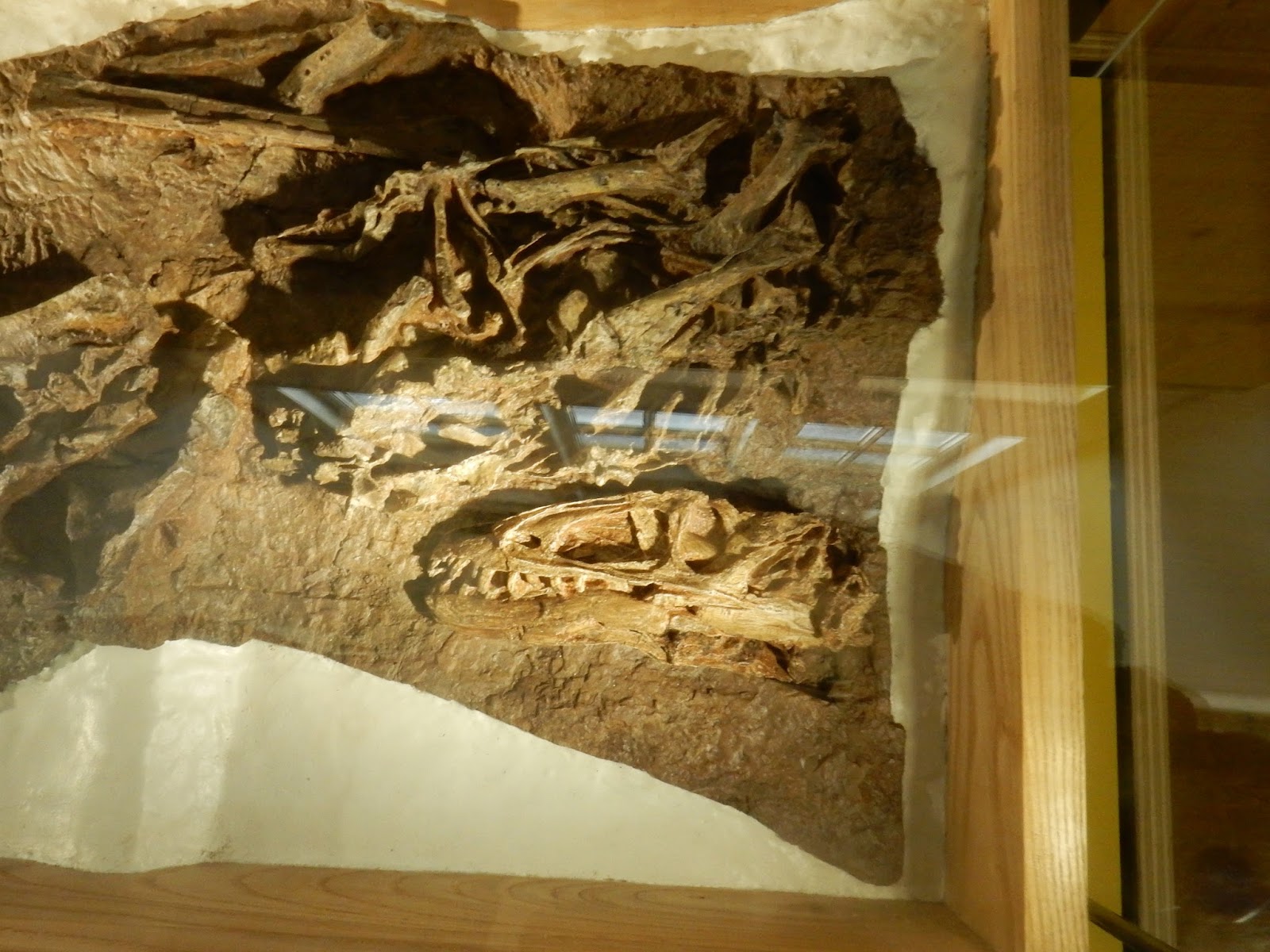
There was also a very faithful-looking 3D print of the Mei holotype!

The real stars of the show feature in the final hall, starting with this original specimen of Sinosauropteryx!

Sinosauropteryx was both the first non-avian dinosaur found with preserved feathers as well as the first Mesozoic dinosaur to have had its plumage color deciphered. Can you spot the tail stripes?

A mount of the giant oviraptorosaur Gigantoraptor formed the centerpiece of the hall, though the space and lighting made it difficult to capture good photos of it.

Another display that proved challenging to photograph was this cast of Linheraptor, due to barriers that kept visitors a good distance away.

A nice cast of the scansoriopterygid Epidexipteryx, known for its four very elongate tail feathers.

The original holotype of Caudipteryx dongi! Note the wing feathers and gastroliths.

What might this be? This is the infamous "Archaeoraptor" hoax, a chimera created by combining specimens of several different feathered dinosaurs into one.

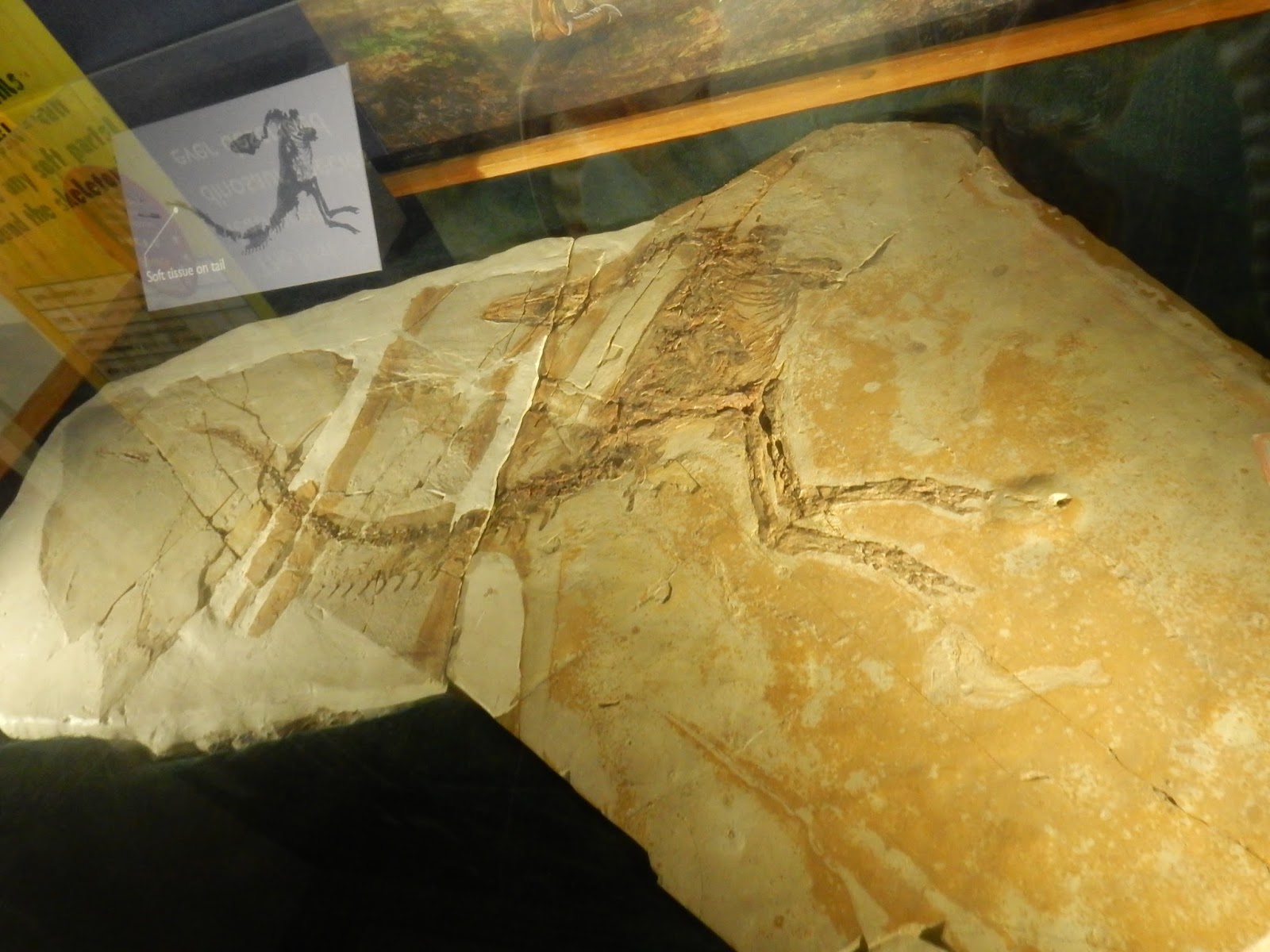
"Archaeoraptor" was exhibited alongside more complete specimens of its component taxa. Pictured here is possibly the highlight of the entire exhibition: an original specimen of the flying dromaeosaurid Microraptor. Though iconic, this specimen is not, in fact, the holotype of the genus Microraptor (which is far less impressive), but it is the holotype of the species Microraptor gui (which may or may not end up being the same as the type species M. zhaoianus). Microraptor contributed the tail of the "Archaeoraptor" hoax.

"Archaeoraptor"'s better half is the Cretaceous euornithine Yanornis, which contributed its head and upper body.

Yanornis had a foldable tail fan like modern birds, a feature not present in non-euornithine theropods (contrary to many popular depictions).

A cast of the holotype of Sinornithosaurus, a close relative of Microraptor.

A cast of the holotype of the feathered tyrannosauroid Dilong. (This specimen did not preserve feathers.)

A cast of the holotype of the enantiornithine Protopteryx.

An original specimen of Confuciusornis.

The final section of the fossil exhibit drew attention to other Mesozoic archosaurs that independently evolved flight from birds and their close kin. Representing pterosaurs is this cast of Wukongopterus.

This 3D print of the membrane-winged theropod Yi was somewhat subpar, preserving little of the original detail. However, as with the pronated hands on the mounts, this was but a minor imperfection compared to the quality of the exhibit as a whole.

Back in the museum's permanent exhibitions, visitors were reminded that the taxidermied birds represented extant dinosaurs. What was more striking to me though was the bleak narrative that accompanies one diorama.

Wollaton Hall is situated within a surprisingly large park in which wild deer roam. This red deer stag appeared to be content sitting out in the grass all day. Not pictured is the astonishingly large number of people who were getting stupidly close to it.

The abundant greenery and large lake at the park provided some decent birding opportunities after visiting the once-in-a-lifetime exhibit!