Showing posts with label London Zoo. Show all posts

Tuesday, October 29, 2019

TetZooCon 2019

As much as I enjoyed Australia, I couldn't stay for long, and one of the reasons I couldn't was that TetZooCon was being held the following weekend. Despite my reluctance to leave behind a land of rich biodiversity and unique Southern Hemisphere clades, TetZooCon is always a good time and I had no intention of missing it. Building on its successful run last year, this year's TetZooCon also spanned two days, boasting events such as panel discussions (on archosaur paleontology and natural history filmmaking), parallel sessions, and more. With this year, we came ever closer to assembling the former crew of TetZoo Time in one place, seeing as comic inker Rebecca Groom, comic colorist Gareth Monger, and myself were all in attendance.

I've never seen a bad presentation at TetZooCon, but if I had to pick favorites from this year, my personal highlights would include Mike Dickison's talk on what makes a "native" New Zealand bird, Dave Hone's talk on the importance of defining terms in dinosaur paleontology, Lauren McGough's talk on her experiences hunting with golden and crowned eagles, and Tim Haines's talk on popularizing paleontology using digital media (e.g.: Walking with Dinosaurs).

One of the new features this year was the art show, showcasing work by a range of accomplished paleoartists. I was especially thrilled to see several of Luis Rey's original paintings on display. I remember seeing many of them in early 2000s paleontology books and they left a strong impression on me at the time, introducing me to then-new and exciting finds being unveiled in dinosaur paleontology.

One of Rey's iconic depictions of the Jehol Biota, featuring a trio of Beipiaosaurus as the centerpiece.
This Quetzalcoatlus looked familiar, but I don't remember having seen it carrying anything in its beak!

I chose to attend the paleoart workshop this year (in part as a show of support for paleoartist friends who were speaking), though this meant missing out on the nature documentary panel. Joschua Knüppe, Rebecca Groom, Agata Stachowiak, and Jed Taylor gave brief talks on their respective artistic endeavors, and throughout the session we were encouraged to exercise our creativity using provided art supplies. Joschua was granted the honor of selecting a theme for the workshop, and he suggested depicting prehistoric life in art styles reflective of the nations in which they were found.

Not being particularly familiar with different art styles, let alone enough to attempt replicating them at short notice, I mainly defaulted to my standard drawing style. In my defense, I did try to venture a little outside of my comfort zone by having a go at restoring some fossil birds that I hadn't before, such as the stem-mousebird Celericolius and the stem-flamingo Palaelodus. Being on a My Little Pony: Friendship is Magic kick with the recent conclusion of the series, I also couldn't resist drawing a My Little Maniraptor. Besides, I rationalized, it counted as non-standard paleoart and would be encouraged. In spite of my unadventurous efforts, it had been so long since I'd seriously drawn with pencil and paper that I ran into some unexpected challenges, like not being able to revert mistakes with the "undo" button or not being able to put items on different "layers".

In my recent forays into drawing My Little Maniraptor, I've found that I quite enjoy drawing my maniraptor design for Fluttershy, which is ironic because I used to consider her one of the hardest to draw. Also shown are my attempts at restoring Celericolius, Longipteryx, and Palaelodus (only the head of which is visible here).

Well, I certainly wasn't winning any prizes with that, especially considering some of the impressive work produced by other workshop attendees. As usual, I performed better on the TetZooCon quiz. Although I didn't come in first place like I did last year, I did tie for second with Kelvin Britton (who has also won first place in previous years, in his case several times)!

The day after the conclusion of the main event, Darren led an informal field trip to the London Zoo, which I gladly joined. We saw the vast majority of the zoo, including some of the more rarely-seen species. To paraphrase Ville Sinkkonen, only in a crowd like this could one find so many people excited about seeing a caecilian's cloaca. My favorite sighting though was probably the baby narrow-striped boky (though it was too active and the lighting was too dark for me to photograph)! As ever, TetZooCon did not disappoint, and I look forward to seeing how it develops next year.

A blue tree monitor.
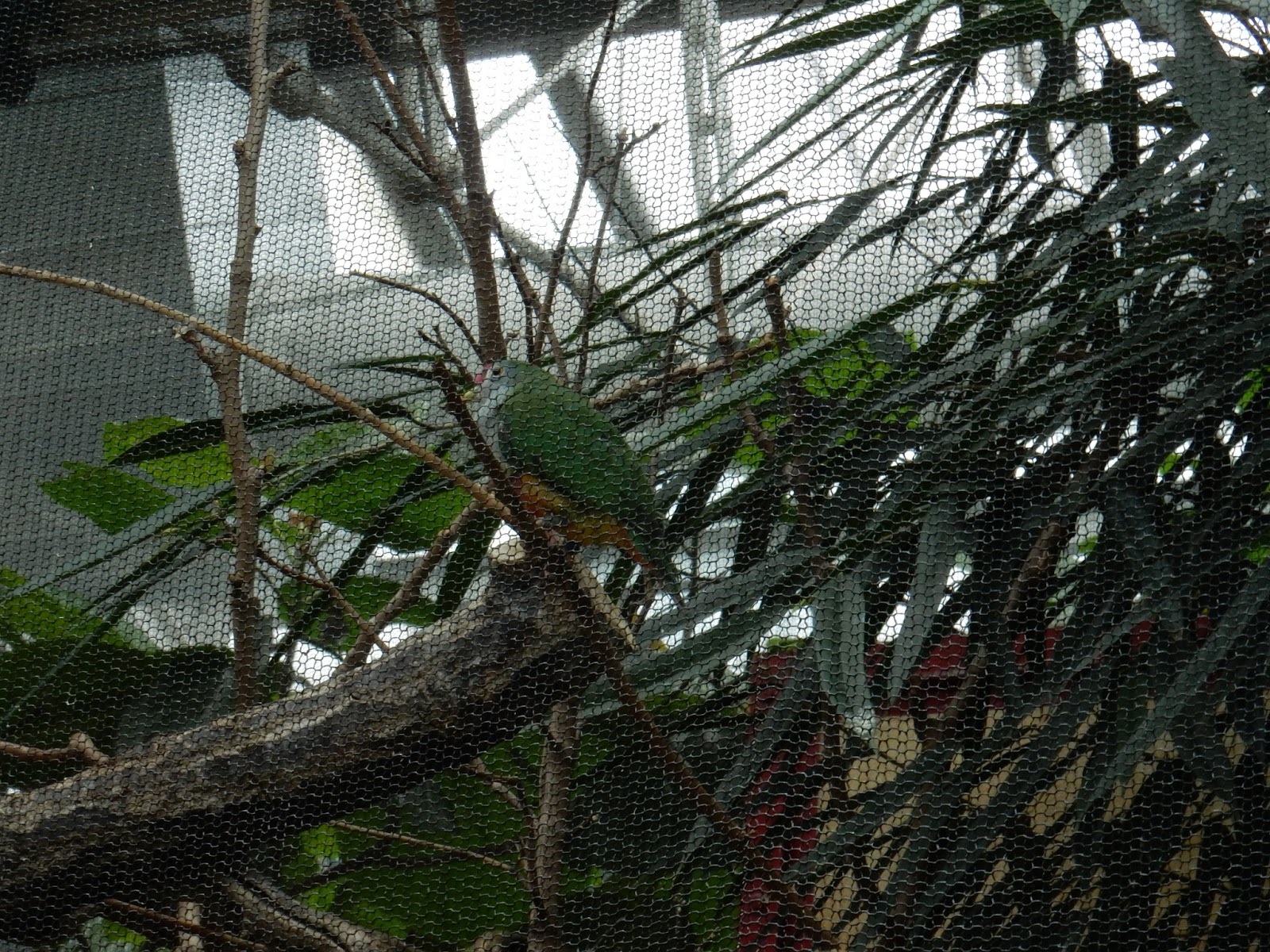
A black-naped fruit dove.
A southern tamandua scaling a wall.

Thursday, April 20, 2017

London Zoo Part V: Reptile House

The last set of my photos from London Zoo (for the time being) come from its reptile house. Here is a king cobra, one of the largest venomous snakes.

A yellow-headed water monitor.

The Annam leaf turtle exhibit had a very interesting design, a stark presentation of some of the threats that this species is facing.

An Utila spiny-tailed iguana, another reptile critically endangered by hunting.

A collared tree lizard.

A Rio Fuerte beaded lizard, formerly considered a subspecies of the Mexican beaded lizard.

A Fiji banded iguana, a species with a lovely color palette.

Some Feae's flying frogs. I imagine they don't get to showcase the "flying" part much in this exhibit.

"Jeff Corwin can hear it, and so can Sir David Attenborough..."

A Philippine crocodile.

A puff adder (the original, not just any species of Bitis).

A Jamaican boa.

A gidgee skink, a sociable Australian lizard, as indicated by the accompanying sigaage.

The White's tree frog exhibit is decorated to reflect one of the habitats wild specimens are commonly found in.

A Sardinian brook salamander.

A black mamba, widely considered to be the fastest snake in the world.

Monday, April 17, 2017

London Zoo Part IV: B.U.G.S.

I get the impression that the B.U.G.S. (Biodiversity Underpinning Global Survival) building is one of the most highly acclaimed exhibits at the London Zoo, and it's not difficult to see why. Many of its displays use quite novel methods to showcase its resident animals, most of which (as indicated by the building's acronym) are invertebrates.

The photo below shows one of these novel exhibits, their leaf-cutter ant display. The ants can march between several tanks, including one from which they can harvest leaves and another which houses their nest. The paths they use to get from tank to tank are exposed out in the open, providing no physical barrier between the ants and visitors.

A pile of leaves harvested by the ants.

A couple of giant house spiders living in a mock-up bathroom.

A fen raft spider, a large wetland spider that hunts on the water surface.

There is even a spider walkthrough exhibit. Shown here is the corner of the walkthrough where social spiders reside.

Some chocolate millipedes. (They are not actually made of chocolate.)

Some weaver ants with their woven nest, which is made out of leaves and larval silk.

Some shiny jewel wasps, a parasitic wasp species that lay their eggs on cockroaches.

Some sunburst diving beetles.

Some critically endangered giant magnolia snails.

Some African giant mosquitoes, one of the few mosquito species in which the females do not need to drink blood to reproduce. The larvae prey on the larvae of other mosquitoes. Accordingly, they are sometimes used as a means of biological pest control.

A medicinal leech.

Saturday, April 8, 2017

London Zoo Part III: Lions, Tigers, and Gorillas, But I was Distracted by Other Things

One row of aviaries at the London Zoo houses some large birds, such as this woolly-necked stork.

An African harrier hawk and its lunch. This species is known for its "double-jointed" ankle, which helps it to reach into crevices to capture prey.

A striated caracara, a scavenging falcon from the Tierra del Fuego archipelago.

The London Zoo houses two species of penguin: Humboldt and northern rockhopper. Both are visible in this photo, but the Humboldt might take some searching to spot.

I tried to get some good photos of the blue-throated macaws, a species I hadn't seen before, but was unsuccessful.

A vicuña, the wild ancestor of the alpaca.

A newly-opened exhibit at the zoo showcases their lions. It's a good exhibit, but not even the fact that they had the Asiatic subspecies of lion (which I'd already seen at the Bristol Zoo) was enough to draw me away from this magnificent Rüppell's griffon vulture.

The Blackburn Pavilion is home to many species of tropical birds. Much of this building appears to be a walkthrough aviary and was thus closed during my visit, but a number of displays near the entrance remained open for viewing. Among its residents is this superb fruit dove (which is actually the name of its species and not merely my own description of it, apt though it is).

A hooded pitta.

A beautiful fruit dove (again, the actual name of this species), marred somewhat by the fine wire mesh.

A Mindanao bleeding heart dove.

A male crested partridge. I've found that the coloration of this species blends well into the lighting of forested environments, which makes getting clear photos of them fairly difficult.

A male red-legged honeycreeper. Not a close relative of the famous Hawaiian honeycreepers (which are finches), but a tanager.

An orange-headed thrush.

The Casson Pavilion is home to a rather miscellaneous variety of animals, including this large hairy armadillo. Armadillos are surprisingly active when they're awake; it took me many tries to get a photo that wasn't (too) blurry.

The pavilion provides indoor retreats for some animals that also have outdoor exhibits, such as these Malayan tapirs.

Despite signs claiming that this exhibit was empty, this rock hyrax was present.

A yellow mongoose. In the wild, this species may share burrow systems with meerkats and Cape ground squirrels.

Just outside, the tiger exhibit is accompanied by some humorous signage.

Gorilla Forest displays gorillas, as you can guess, but it has many other species of primates as well. This is a white-naped mangabey.

More importantly, it also exhibits some African bird species, like this green woodhoopoe.

A northern helmeted curassow, which is... South American, not African. Hmm.