Monday, September 12, 2011

San Diego Zoo Part II: Children's Zoo

In the same general part of the San Diego Zoo (called the Discovery Outpost) as the Reptile House and Reptile Mesa is the Children's Zoo. It's probably called that because it has these easy-to-read signs and hosts various animal encounter programs (and probably others) throughout the day (and it also closes earlier than the other major exhibits at the zoo), but it has a varied collection of interesting animals, and is by no means just for kids.

I'd actually been to the Children's Zoo the first time I came here, but I wanted to check up on one particular individual animal.

One of the first animals I saw in the Children's Zoo, a Goeldi's marmoset.

A fennec fox. One of the few (minor) drawbacks of this zoo is that many of the smaller animals that are kept in outdoor exhibits have these wire mesh cages that... aren't conductive to photography.

This is the animal I wanted to check on. Victor the short-beaked echidna is the oldest resident mammal at the zoo. He's more than fifty years old! He was much the same the last time I saw him: half buried in the sand with his quills protruding. What an interesting species and individual. He really deserves more attention than I saw him get. Or not. He might appreciate an uninterrupted nap.

As would probably be expected, a number of other visitors misidentified Victor as a porcupine. Ironically, just nearby was an exhibit with an actual crested porcupine. It also appeared to enjoy sleeping in its den.

Here is a good demonstration of how even comparatively mundane species can make for interesting displays. This tank houses domesticated albino house mice. The most interesting part of the exhibit is that the mice are living inside a giant loaf of bread. It's an edible home for them.

Maniraptors at last! Here's a kea, an inquisitive omnivorous New Zealand parrot.

Some collared lories.

A naked mole rat.

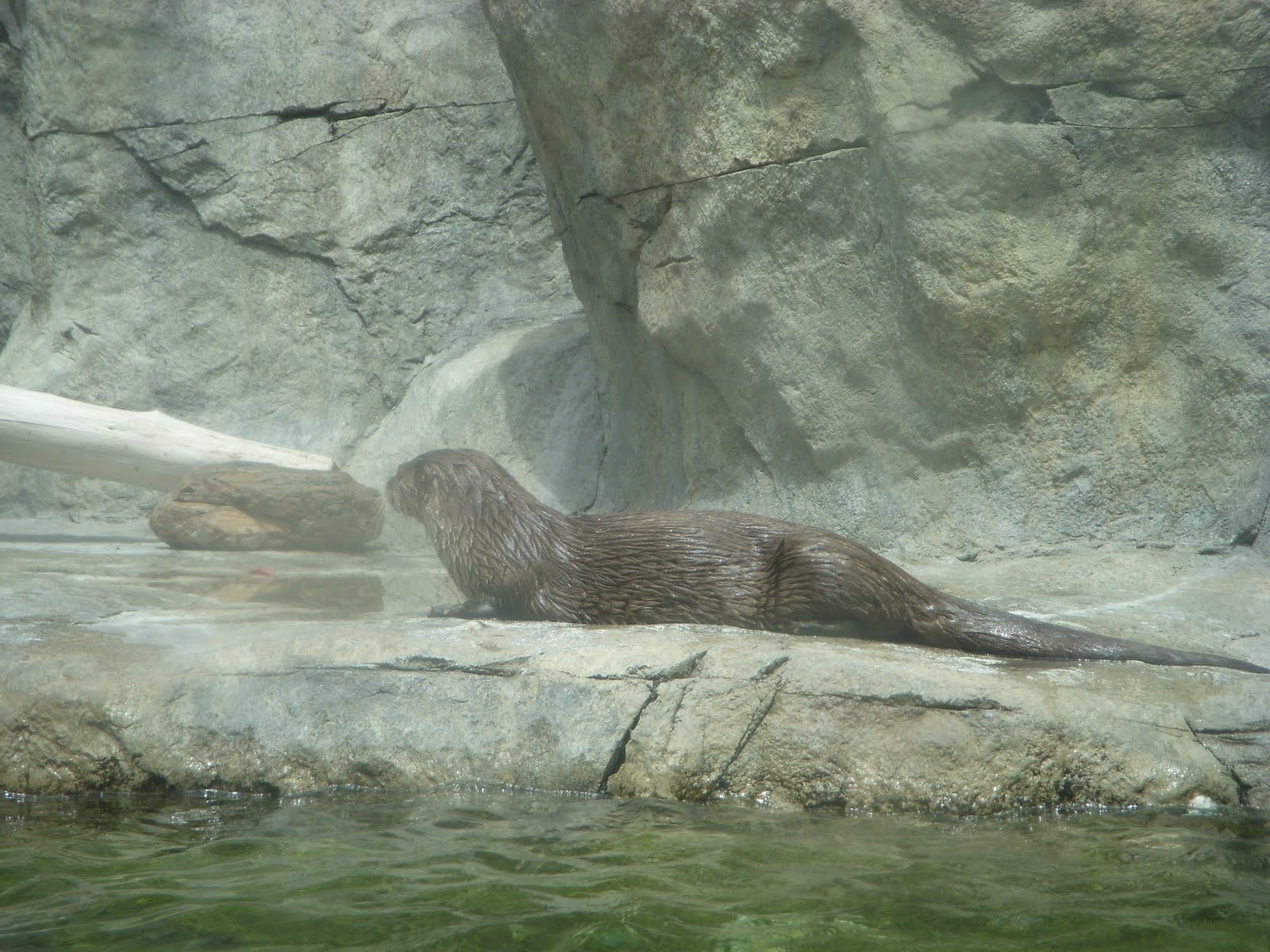
A river otter.
A thick-billed parrot, one of the few parrots that lived in the United States (but is now only found in the wild in Mexico).

A male Andean cock-of-the-rock.

A scarlet macaw.

A rock hyrax. My first hyrax! As it turns out, I found that there was no shortage of rock hyraxes at the zoo. I saw half a dozen exhibits with them scattered throughout the zoo. They're a little bigger than I expected (probably because we're always talking about how small hyraxes are compared to their closest terrestrial relatives the elephants).

Some meerkats. This is another species that is everywhere in this zoo.

Technically not part of the Children's Zoo, there's an easy-to-miss aviary nearby. Just outside of it were these mountain bamboo partridges.

And across from them is a green aracari. It has its back turned to the camera.

This was one of the many walk-through aviaries at the San Diego Zoo (and one of the smaller ones), and it also happened to be the only one I got to visit this time. Many tropical American birds lived inside, notably several hummingbird species (which I didn't get any photos of). Most conspicuous was this sunbittern.

I know I was trying to photograph something (a tanager, perhaps) here, but the foliage got in the way.

Sunday, September 11, 2011

Dinosaur Revolution: Evolution's Winners

Probably every dinosaur enthusiast has heard of this new show by now. The first two episodes aired in the US last week. Spoilers ahead.

The first episode ("Evolution's Winners") is a mishmash of various short stories, all to do with the reproductive behaviors of dinosaurs (and, in one story, a mosasaur). Just one maniraptor shows up in this episode, and is, in fact a main character. This is the giant oviraptorosaur Gigantoraptor. It gets one of the shorter and simpler stories in the episode: a male Gigantoraptor performs an extravagant courtship dance to attract a mate but collapses a mammal burrow and stumbles, while the family of Zalambdalestes living inside barely avoid being crushed. This is a segment that some may find goofy, and color scheme for the inflatable sac that the male Gigantoraptor uses as a visual display is something of a ripoff of the modern-day tragopans'. Regardless, few (if any) of the behaviors shown in this story I found particularly implausible, and (get this), the Gigantoraptor actually have actual pennaceous primary feathers, which most depictions routinely get wrong. The dances, sexual dimorphism, and inflatable sac are good demonstrations of the fact that behavior and soft tissues rarely fossilize and that they were likely as complex and elaborate in some extinct animals as they are in many modern ones. Also, as we're never shown anything beyond the speculative courtship of the Gigantoraptor, they don't get the less plausible reproductive behaviors postulated for some of the other theropods in the show. I can say I liked this segment more than the terrible mosasaur story (think lizards with extensive parental care and cetacean calls), the Eoraptor story with various strange bits (for example, some glaring cases of What Happened To The Mouse and Bloodless Carnage), and the afore-alluded Cryolophosaurus story (which does have some interesting Shout Outs to classic paleo art pieces). (No, it's not because it's great to see Gigantoraptor on screen... okay, perhaps that's one of the reasons!) Interestingly, my favorite story in the episode, however, was probably that of the basal sauropodomorph Glacialisaurus! Commendably, the show has a good number of rarely-featured or newly-discovered taxa.

I agree with what looks like the majority that the second episode ("The Watering Hole") is excellent and is overall better than the first (story wise, accuracy wise, and animation wise). However, I won't go into much detail here as there are no maniraptors at all in that episode (unless Ornitholestes turns out to be one). Unlike the first episode, this episode tells one long, continuous story about an Allosaurus in the Late Jurassic of Portugal (instead of the stock Morrison Formation).

According to various episode descriptions on the Internet, between the last two episodes (which will air this week; in fact it's reportedly airing in Canada as I type), there will be at least four deinonychosaur taxa featured (most of them in starring roles), so no shortage of maniraptors there. I'll probably have plenty to say about those once I get to watch them. It appears to be widely agreed that the first episode is the lowest point of the show and that the upcoming ones (especially the last) are excellent, so we'll see.

Some good, some bad about this show so far. It's a wonder that we're getting the amount of great stuff we've got, considering the insane levels of being Screwed By The Network that it has received. Had it been allowed to continue with the original plans for it, I have little doubt it could have been one of the best dinosaur shows ever to air. While marketed as a documentary, Dinosaur Revolution is really intended to be more of a story-driven show that uses the latest science. The animals actually feel like characters, not just completely arbitrary individuals. Original plans for the show had no narration and talking heads at all! (There was originally going to be a separate accompanying series that would detail the science and speculation that went into the show.) As it is, however, it ends up as a strange hybrid that it's not meant to be. The talking head segments, while featuring many of the top paleontologists and paleo artists out there, are (as usual for dinosaur shows) too brief for much of the science to be explained in detail. They also (particularly in the second episode) cut into the main storyline too much. The narration also interrupts too frequently, sometimes with useful background, but often stating the obvious. Another point of criticism is that some of the behaviors for the animals shown are a little too anthropomorphic, and in this respect I certainly concur. (One scene in the otherwise great second episode stands out to me in this respect. After a Dinheirosaurus and Allosaurus inadvertently work together to kill a Torvosaurus, they "acknowledge" one another in a rather... cheesy manner. It looks like something out of a Disney movie, instead of something real animals would do.) Nonetheless, I find the show worth watching. Who knows, maybe if it's successful they'll decide to finish up the two episodes that were cut from the show.

Fortunately, there may be some hope yet for the original format of the show actually seeing the light of day. Dun dun dun...

San Diego Zoo Part I: Reptile Mesa

I got to go on a sort-of vacation this summer, and one of the places I went to was the San Diego Zoo. I wanted to do one big post for this like I did for the Vancouver Aquarium, but I took so many pictures and got so infuriated with Blogger's glitchy unwieldy image upload system that I'll have to do this in parts.

This wasn't the first time I'd gone to the San Diego Zoo, but one of the things about the San Diego Zoo is that it's so large and there are so many little trails with exhibits in the most unexpected of places that even with the extended hours during summer it's probably good as impossible to see everything in just one day (and that's not counting the fact that it's not infrequent for certain animals to be taken off exhibit, often the very animals you're most excited to see, as I was to find out). My main goal on this time around was to visit all the areas that I hadn't gotten to go on my first trip there. That sounded simple enough, but one major thing had happened to the zoo that made this more complicated than I had thought it would be.

Never mind that for now though. On my first trip to this zoo I had gone to its Reptile House (which also happens to be the only major exhibition area at the San Diego Zoo that has an actual roof instead of being either netted or open air), but I had completely overlooked the vast area behind it, the Reptile Mesa. We're used to seeing most "reptiles" in glass terrariums, and while the Reptile House has plenty of those, a number of other "reptiles" (even some of the smaller species) get to enjoy large open-air enclosures at the Reptile Mesa, which was really nice to see.

For example, here's a European glass lizard in one of these larger enclosures.

It shares the exhibit with this European pond turtle.

And in the same exhibit is also this ocellated lizard. I quite like the fact that there are a lot of mixed-species exhibits at this zoo.

Here's a fourth species that was in that exhibit. It's some species of tortoise, but I wasn't able to find a sign for this guy.

The next exhibit was more of a desert habitat. I think these are a type of skink, but I've forgotten their exact identification. Lesson learned: remember to take pictures of the signs of animals you can't identify on sight. Also, don't procrastinate for a month when it comes to putting up photos of trips to zoos.

I can probably remember what species of tortoise this is if I try hard enough. Okay, maybe not. It lives in the same enclosure as those maybe-skinks.

Another one of those tortoises with a red-headed agama.

This one is a desert tortoise that lives in a separate exhibit. At least that's the way I remember it. I'm doing a pretty bad job so far.

Next came a positively huge exhibit filled with little lizards. Here's a sungazer on a rock. It was nice and sunny when I came, so all of the "reptiles" were out basking.

More red-headed agamas, this time even more vibrantly colored. It's worthy to note that they had these flowers growing in their exhibit that was attracting hummingbirds. By chance, I happened to see a wild hummingbird the last time I came to the zoo as well.

These are Galapagos tortoises. The zoo has several different subspecies, living side by side (though in separate exhibits).

An Exuma Island iguana, a critically endangered species.

An Anegada ground iguana, another critically endangered species.

And a Cuban iguana, another endangered island-dwelling iguana species!

One of the animals I really wanted to see was the gharial. I'd never seen one before. It had a huge pond with many different species of turtles living alongside. The exhibit was quite a sight to see, but with one problem. I didn't see any gharials no matter how long and hard I looked. There were no signs suggesting that they were off exhibit, but I assume that's what happened.

An Asian forest tortoise.

An African spurrred tortoise.

In spite of all the open-air exhibits here, the Reptile Mesa is not devoid of traditional glass terrariums for some of the other species, especially the amphibians. Here's a Dominican ameiva.

A Uroplatus species, or leaf-tailed gecko.

A golden frog.

A tomato frog. I always remember this species best for its unique defense mechanism. (It secretes a noxious sticky white liquid that can glue the jaws of a predator shut.)

A White's tree frog.

A chuckwalla, known for wedging itself into rock crevices to avoid predators.

A species of viper.

A king snake.

Uh, stumped again.

A rosy boa.

A rattlesnake in a tree on a piece of wood.

Okay, I'm really not certain what these guys are. For reasons unknown, they didn't come with a sign.

A type of monitor lizard.

A matamata turtle.

Finally, a Komodo dragon. This one is actually part of the Reptile House proper, not the Reptile Mesa, but it's still viewable from outside the House itself, so I was able to check it out as I left the area.

Thursday, July 7, 2011

Legend of the Guardians: The Owls of Ga'Hoole

Before this movie came out, I read some people online ridiculing the fact that it had owls as the main characters, as though owls are the least badass creatures one could come up with.

Three things. First, these people clearly haven't read the books based on this movie. We have owls tearing off the faces and slashing open the throats of other owls. We have owls beheading each other and slicing off each others' wings. We have owls getting shoved into fires and and getting their vertebral columns severed in two. We have owls getting their hearts torn out of their bodies. Secondly, there's another fictional work (which was also made into an even more infamous movie adaptation) that's probably the epitome of What Do You Mean It's Not For Kids and features rabbits of all things. And these aren't even rabbits that have superpowers or use weapons. Just normal rabbits. Although real rabbits can be quite tough at times, you don't get much more harmless than a rabbit when it comes to public perception.

Lastly:
Mild spoilers ahead. For the uninitiated, the book series that this movie is based on is essentially about World War II, but with owls. The movie is allegedly based on the first three books, and it deviates from them... quite a lot. However, it does keep the central plot points of each book (being captured and escaping from St. Aegolious, journeying to and settling down at the Great Ga'Hoole Tree, and rescuing Ezylryb, respectively). I was mildly surprised by the fact that I didn't mind the major deviations from the books so much, because I usually do.

One of the strange things about the movie is that the owls are from all over the place, but some of the other wildlife are distinctively Australian. This is not something from the books, which appear to take place in a fantasy land populated not only by owls from all over the world, but also things like bald eagles, polar bears, puffins, flying snakes, and even dire wolves. Somehow, I suspect that the author just threw in whatever species she thought were cool.

On the owls themselves in this film, I thought they were quite well done. They move like real owls, look like real owls, and, although I'm not familiar with bird calls, they reportedly even sound like real owls. Furthermore, no Feather Fingers in this movie at all! The one glaring error I picked up was that the female owls were noticeably smaller than their male counterparts, when it is usually the other way around in real life. (The presence of this inaccuracy is particularly strange, because this is something the books got right.)