Apologies if this is turning into the Maniraptor Media Review Blog. I tend to post these because they're easier to put together than other types of posts and there's a lot of material I can cover, so they're good filler when I don't have time (or, I'm sad to say, motivation) to finish more substantial stuff (which, as it turns out, is most of the time).
Earthflight is a recent BBC One documentary that premiered towards the end of 2011 and finished airing earlier this year. Focusing on flying birds from around the world, this documentary specializes in aerial shots of its subjects, utilizing various methods of filming, including cameras strapped to the backs of birds. The resulting footage is truly spectacular. Spoilers ahead!
Each episode of Earthflight covers birds from a different continent; the first being about North America. Three species of birds get much of the spotlight in this episode, snow geese, bald eagles, and brown pelicans. One of the overarching stories of the episode is the migration of the snow geese up to their breeding grounds in the Arctic, with individual groups of geese combining with each other along the way to form one giant flock. Whenever they stop to feed and rest, they are vulnerable to attack by bald eagles, but they are also shown to be very difficult to catch, as the sheer number of geese makes it difficult for the eagles to target single individuals. (The program even makes the assertion that snow geese are the favorite prey of bald eagles, but I'm not aware of any studies that support this.) Towards the end of the episode, an eagle finally manages to isolate a young snow goose from the flock. What ensues is awesome; I'll say that much.
Other bald eagle behaviors broadcast include both fishing and stealing fish from grizzly bears. Of special note to Mesozoic dinosaur enthusiasts is the mantling behavior displayed by one of the eagles, where the raptor spreads its wings around its food to hide it from competitors, as this is a behavior that has been suggested for dromaeosaurids. (That salmon it was feeding on looked really good, by the way.) Also potentially surprising is the sequence showing a group of bald eagles tossing a carcass around in what appears to be play.
Brown pelicans, on the other hand, are shown flying along the Pacific coast. They dive for fish out at sea as well as catch spawning grunion on beaches. The brown pelican sequences are also a good demonstration of the fact that even though Earthflight focuses primarily on birds, it also gives us an interesting look at the other animals the birds fly over. Most memorably, the pelicans pass over a group of leaping devil rays.
Scenes featuring other types of birds in the episode include red-tailed hawks hunting free-tailed bats, cowbirds traveling alongside American bison, egrets taking advantage of the strand-feeding behavior of bottlenose dolphins, California gulls catching brine flies, and turnstones and dunlin feeding on horseshoe crab eggs. Coots and mallards also show up, but mostly to serve as prey for bald eagles.
As mentioned previously, the footage in this show is nothing short of spectacular and many behaviors are rarely showcased. I've heard some complaints about the narration being "twee", perhaps due to the frequent use of metaphors and some anthropomorphism. Personally, however, I find it leagues better than some of the highly inane and sensationalist narration in certain other "documentaries", far from unbearable. If you don't mind the narration and like documentaries on birds, Earthflight is a must watch.
Incidentally, is this really the first dinosaur-centric blog to review this documentary, and more than a few months late at that? Jumping all over Dinosaur Revolution but shirking Earthflight? Shame on you, shame on you all. (I kid, of course.)
Monday, May 7, 2012


Sunday, April 1, 2012
Raptormaniacs Revamp
Well, this is embarrassing. Being a self-proclaimed maniraptor enthusiast I've always considered birds to be maniraptors and insisted on feathering maniraptor depictions, foolishly believing these to be the correct, mainstream view.
Having read the new paper Claw & Troll (2012) "The End of the Debate: Conclusive Evaluation of the Birds are DinosaursHypothesis Theory Using SRC, with Further Comments on 'Feathered Dinosaurs'", published in Nowhere (which you can read if you pay a really, really, really high fee), however, I have realized that the Birds Are Not Dinosaurs (BAND) hypothesis is clearly more parsimonious than its oft-touted alternative. Far from having no good evidence or research on the subject at their disposal, BANDits are in reality the oppressed minority who are brave enough to challenge the oppressive majority view.
To summarize, in their new paper Claw and Trolldemonstrate that they haven't read exhaustively review all pertinent literature on bird origins in the past two decades, providing the long-overdue 99999th first objective, unbiased look at the subject. Utilizing the extremely unscientific useful, universally applicable method SRC (Spewing Random Crap), they show that the actual ancestors of birds are thecodonts (monophyletic group™) crocodiles Longisquama pterosaurs anything as long as they're not dinosaurs. It's not like there are no better candidates than dinosaurs for which we can clearly trace the evolution of all avian traits through the fossil record. In any case, there just is absolutely no way in a zillion years that birds descended from dinosaurs, for lots and lots of good reasons Claw and Troll mention, which are all really complicated and make no sense so I won't discuss in depth here. Most of them involve poking massive holes in the fallacious birds are dinosaurs theory by pointing out the glaring lack of certain avian traits in theropod dinosaurs (the group of dinosaurs commonly and erroneously thought to have given rise to birds). The fact that all these traits are indeed known in non-avian dinosaurs is mostly ignored, but that's a mere minor setback. The BANDit view is still stronger by far. They also note that the possibility birds evolved from a tree-gliding ancestor indicates that birds can't have descended from dinosaurs because all dinosaurs lived only on the ground and would die immediately of spontaneous logic combustion if they left it even for a second, as is common knowledge for anyone well acquainted with 1970s children's books. There was also a complicated discussion on finger configuration that greatly supports the BANDit theory, but their reasoning appeared really flimsy sound to me so I'm running with it.
Furthermore, as a followup to their 2011 paper, Claw and Troll conclusively demonstrate that no actual feathered dinosaur fossils are known. Compsognathids only preserve long collagen fibers, which probably formed a basilisk-like ridge on the back, even though other animals found in the same deposits don't preserve "collagen fibers" and it's actually not that hard for professionals to distinguish between fossilized collagen and feathers. Oviraptorosaurs are obviously birds, not dinosaurs. Finally, Claw and Troll intentionally avoid discussing deinonychosaurs because deinonychosaurs are cool, which automatically excludes them from being feathered, fossils be damned. Beipiaosaurus and Dilong aren't mentioned, but whatever, they've already dismissed every taxon that matters anyway.
Given this highly convincing research, I have seen the light. This comic will have to go through a complete revamp.

References
Claw, A. & Troll, I. M. A. (2012) "The End of the Debate: Conclusive Evaluation of the Birds are DinosaursHypothesis Theory Using SRC, with Further Comments on 'Feathered Dinosaurs'". Nowhere 0 (0): 0. DOI: 42.15854/4095922.2012.15588802.
Having read the new paper Claw & Troll (2012) "The End of the Debate: Conclusive Evaluation of the Birds are Dinosaurs
To summarize, in their new paper Claw and Troll
Furthermore, as a followup to their 2011 paper, Claw and Troll conclusively demonstrate that no actual feathered dinosaur fossils are known. Compsognathids only preserve long collagen fibers, which probably formed a basilisk-like ridge on the back, even though other animals found in the same deposits don't preserve "collagen fibers" and it's actually not that hard for professionals to distinguish between fossilized collagen and feathers. Oviraptorosaurs are obviously birds, not dinosaurs. Finally, Claw and Troll intentionally avoid discussing deinonychosaurs because deinonychosaurs are cool, which automatically excludes them from being feathered, fossils be damned. Beipiaosaurus and Dilong aren't mentioned, but whatever, they've already dismissed every taxon that matters anyway.
Given this highly convincing research, I have seen the light. This comic will have to go through a complete revamp.

References
Claw, A. & Troll, I. M. A. (2012) "The End of the Debate: Conclusive Evaluation of the Birds are Dinosaurs
Tuesday, March 20, 2012
Happy World Sparrow Day!
March 20 has been designated World Sparrow Day, in recognition of one of the most common, most familiar, and most ubiquitous of all known maniraptors, Passer domesticus, the house sparrow. It is a true sparrow, a passerid, as opposed to American "sparrows", which are actually buntings.
It is the most widespread of all wild birds. Its native range covers much of Eurasia, and it has been introduced to all other continents besides Antarctica. It thrives in urban regions, but it's far from being bound to cities and can survive in any environment save for tundra and dense forests.
The house sparrow is frequently maligned, particularly as an introduced species, as it is an aggressive species that takes over the nesting cavities and feeding stations of native birds, and will even kill off the young (and sometimes the adults) of its competitors.
While often considered pests, endeavors to eradicate sparrows (in this case the Eurasian tree sparrow, not the house sparrow, though closely related and very similar) in China ironically led to massive destruction of crops. Although adult tree and house sparrows feed mainly on seeds, the young are fed a diet of insects (as is often the case for many birds), and grasshoppers, major devourers of crops, are their most abundant prey.
Perhaps surprisingly, for all its adaptability and ubiquity the house sparrow is declining in many parts of the world, especially within its native range. In fact, in the Netherlands it is an endangered species! In North America the house sparrow may be an invasive pest, but as the attempted eradication of Eurasian tree sparrows in China shows, in its native environments the species is as much a key part of the local ecosystems and as deserving of conservation as any other native bird.
I'm sure Dinky here agrees, don't you?
... Dinky?

...

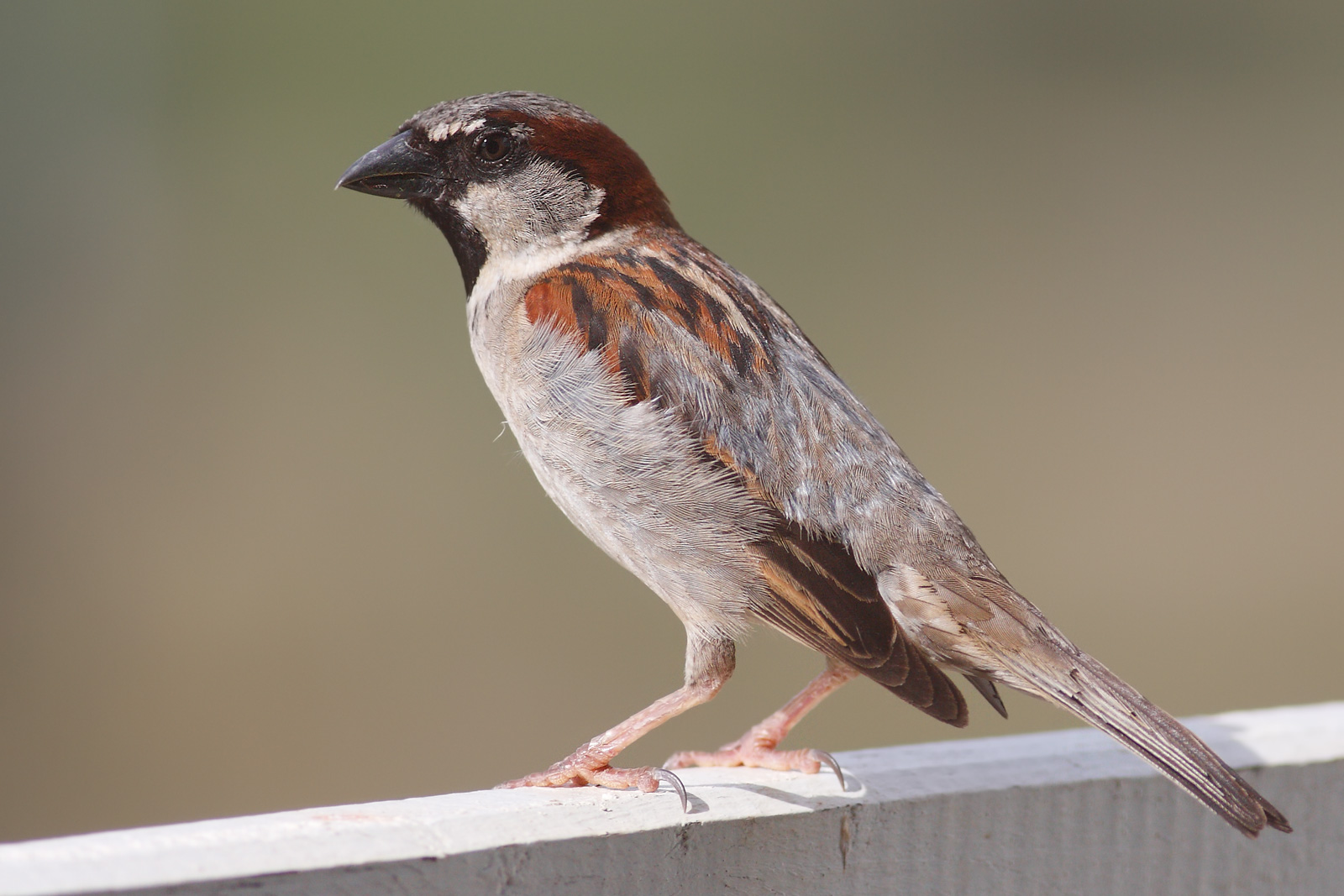 |
| Male Passer domesticus photographed by Fir0002, licensed. |
 |
| Female Passer domesticus photographed by Diliff, licensed. |
It is the most widespread of all wild birds. Its native range covers much of Eurasia, and it has been introduced to all other continents besides Antarctica. It thrives in urban regions, but it's far from being bound to cities and can survive in any environment save for tundra and dense forests.
The house sparrow is frequently maligned, particularly as an introduced species, as it is an aggressive species that takes over the nesting cavities and feeding stations of native birds, and will even kill off the young (and sometimes the adults) of its competitors.
While often considered pests, endeavors to eradicate sparrows (in this case the Eurasian tree sparrow, not the house sparrow, though closely related and very similar) in China ironically led to massive destruction of crops. Although adult tree and house sparrows feed mainly on seeds, the young are fed a diet of insects (as is often the case for many birds), and grasshoppers, major devourers of crops, are their most abundant prey.
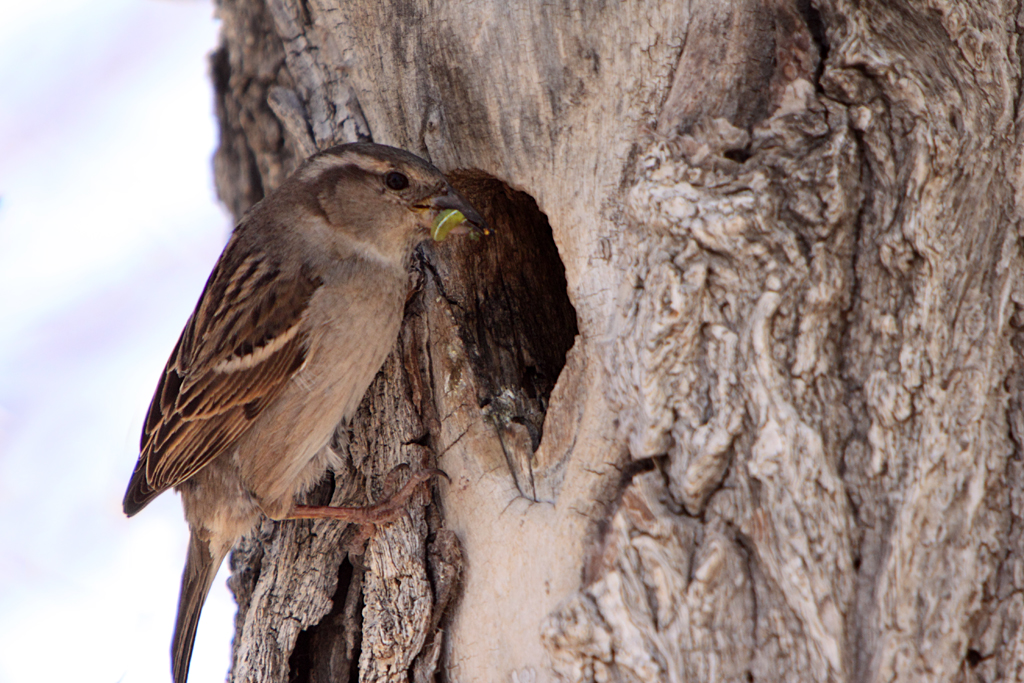 |
| Female Passer domesticus feeding young with a caterpillar photographed by Alan Vernon, licensed. |
Perhaps surprisingly, for all its adaptability and ubiquity the house sparrow is declining in many parts of the world, especially within its native range. In fact, in the Netherlands it is an endangered species! In North America the house sparrow may be an invasive pest, but as the attempted eradication of Eurasian tree sparrows in China shows, in its native environments the species is as much a key part of the local ecosystems and as deserving of conservation as any other native bird.
I'm sure Dinky here agrees, don't you?
... Dinky?

...

Tuesday, January 3, 2012
Favorite Maniraptor of 2010 Results
Last year I put up a poll on the blog for everyone's favorite newly-named maniraptor genus. Here's a pie chart showing the results.

Balaur won, what a surprise (by which I mean not a surprise at all). Fortunately, Haplocheirus came in second place, followed by Linheraptor. I was surprised to see that Xixianykus had gotten a (comparatively) decent amount of votes.
Now, the time has come for a new poll. I have tried to avoid taxa that are technically still in press and will probably be officially published later this year. We didn't get a double-killing-clawed dromaeosaurid last year, so this one looks somewhat more unpredictable. Let the voting begin!
Edit: Pamparaptor is misspelled on the poll. As I can no longer edit the poll, it'll be there for the rest of the year.

Balaur won, what a surprise (by which I mean not a surprise at all). Fortunately, Haplocheirus came in second place, followed by Linheraptor. I was surprised to see that Xixianykus had gotten a (comparatively) decent amount of votes.
Now, the time has come for a new poll. I have tried to avoid taxa that are technically still in press and will probably be officially published later this year. We didn't get a double-killing-clawed dromaeosaurid last year, so this one looks somewhat more unpredictable. Let the voting begin!
Edit: Pamparaptor is misspelled on the poll. As I can no longer edit the poll, it'll be there for the rest of the year.
Monday, December 19, 2011
Another Attempted Revolt Part II
The second half of the story.

Uh, yeah.
There's a perspective thing in the last panel that I didn't have room to fully establish. Ostrom is supposed to be in the extreme foreground, which is why he looks almost the same size as Ebeff.
Apologies for the frivolous nonsense. If it explains anything, this was originally intended for April Fools', but I managed to come up with something more sophisticated and decided to save this for later.

Uh, yeah.
There's a perspective thing in the last panel that I didn't have room to fully establish. Ostrom is supposed to be in the extreme foreground, which is why he looks almost the same size as Ebeff.
Apologies for the frivolous nonsense. If it explains anything, this was originally intended for April Fools', but I managed to come up with something more sophisticated and decided to save this for later.
Saturday, December 17, 2011

Saturday, December 3, 2011
I get fanart!
No, I didn't believe it either. But really! Imagine my surprise when I found this in my messages on Deviant Art, titled "Raptormaniacs doodles".

For a moment I thought that someone else might have come up with another maniraptor-related project titled "Raptormaniacs" independently of mine. But when I clicked in to take a closer look, sure enough, those were my characters and there was a link to this blog in the artist's comments.
The piece of fanart itself is courtesy of Scott Potter, who goes by bOBsHMINKLE on Deviant Art. Fantastic work if I may say so myself, and not just because it's the first Raptormaniacs fanart I've ever seen. How good is it? The characters are almost exactly how I'd imagine them if they were drawn by a competent artist (in this case Scott). I'd be stoked to see Scott's renditions of the rest of the Raptormaniacs cast as well if he plans on doing them. Thanks and good job once again, Scott! I was already quite excited on the day I found this because I'd recently received a huge packet of papers on feathered dinosaurs through e-mail, but this was the icing on the cake.
Speaking of my comics, I know I haven't done any new ones for months, but I did give fair warning. Don't worry though, they're coming...
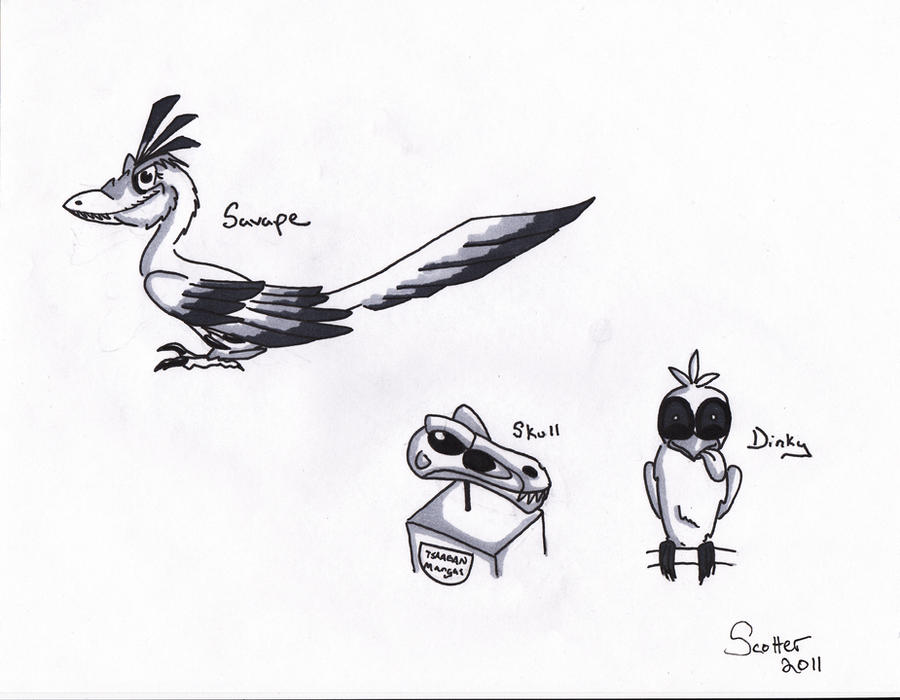
For a moment I thought that someone else might have come up with another maniraptor-related project titled "Raptormaniacs" independently of mine. But when I clicked in to take a closer look, sure enough, those were my characters and there was a link to this blog in the artist's comments.
The piece of fanart itself is courtesy of Scott Potter, who goes by bOBsHMINKLE on Deviant Art. Fantastic work if I may say so myself, and not just because it's the first Raptormaniacs fanart I've ever seen. How good is it? The characters are almost exactly how I'd imagine them if they were drawn by a competent artist (in this case Scott). I'd be stoked to see Scott's renditions of the rest of the Raptormaniacs cast as well if he plans on doing them. Thanks and good job once again, Scott! I was already quite excited on the day I found this because I'd recently received a huge packet of papers on feathered dinosaurs through e-mail, but this was the icing on the cake.
Speaking of my comics, I know I haven't done any new ones for months, but I did give fair warning. Don't worry though, they're coming...
Subscribe to:
Posts (Atom)


