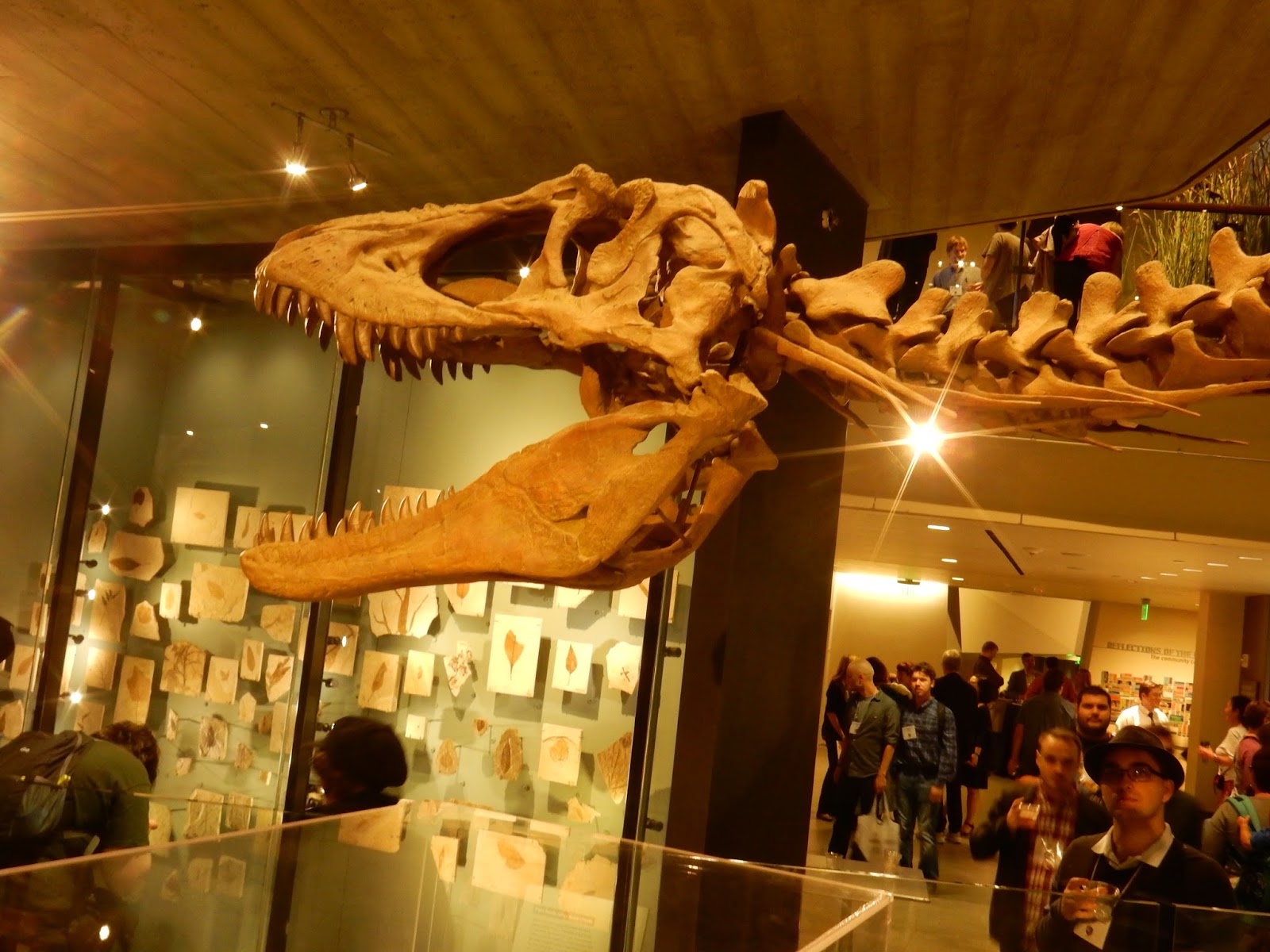
The welcome reception at this year's SVP took attendees to the Natural History Museum of Utah. The main fossil exhibits are arranged roughly in chronological order, with younger fossils exhibited higher up in the building and older ones closer to the ground floor, threaded throughout by a sloping boardwalk. I consider it to be among the most impressive fossil displays I've visited, in terms of both content and setup.
A juvenile Columbian mammoth.
Megalonyx says, "Hi."
Uintatherium, one of the bizarre mammals of the early Paleogene.
An apparently unnamed dromaeosaurid.
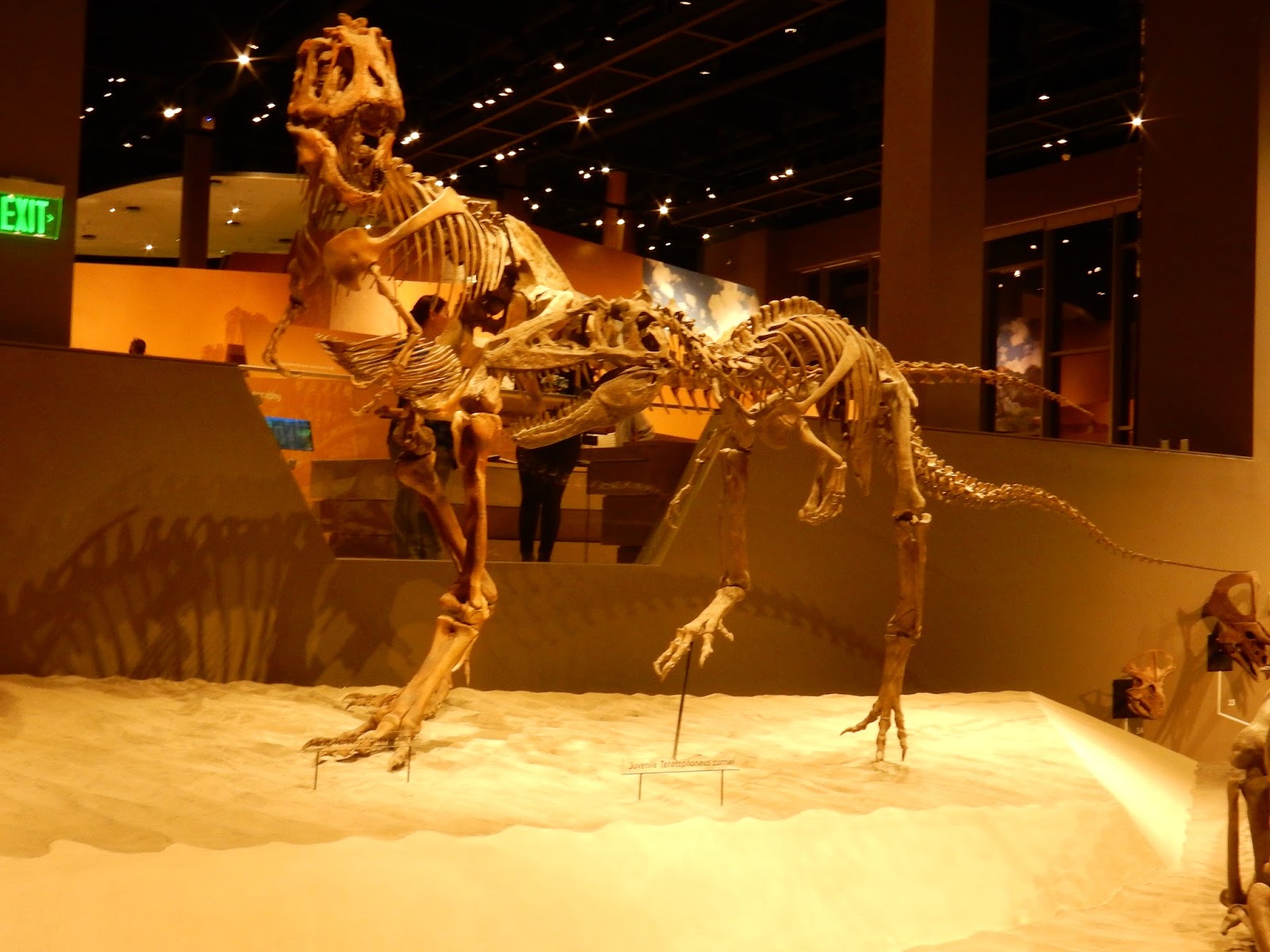
A couple of juvenile Teratophoneus.
The giant alligatoroid Deinosuchus.
A smaller alligatoroid, Brachychampsa.
The large oviraptorosaur Hagryphus, mainly based on Anzu.
The skull of the saurolophine hadrosaur Gryposaurus.
The skull of the lambeosaurine hadrosaur Parasaurolophus.
An ornithomimid referred to Ornithomimus. A sizeable animal considering that we're viewing it from an elevated walkway.
The famous wall of ceratopsians, arranged phylogenetically. From left to right: Styracosaurus, Centrosaurus, Einiosaurus, Pachyrhinosaurus, Achelousaurus, Nasutoceratops, Diabloceratops, Chasmosaurus, Kosmoceratops, Anchiceratops, Triceratops, and Coahuilaceratops.
Off to the side are Protoceratops and Zuniceratops.
Ceratosaurus and Marshosaurus have a disagreement over a Stegosaurus carcass.
The whiplash tail of a mired Barosaurus passes beneath the walkway and arcs high above the heads of visitors. The sauropod is beset by several daring Allosaurus, but somehow this was the only picture I took of the mount. Others have a more representative record.
Size variation in Allosaurus.
The skull of Tanycolagreus, one of the more obscure Morrison theropods.
It was nice to see mounts of Nothronychus and Falcarius, but for unknown reasons I didn't take many good pictures of their heads. Their skulls are largely unknown, in any case.
This model of a troodont with colors lifted directly from Anchiornis was somewhat eyebrow-raising.
A model and mount of Lythronax.
Various arthropods from the Green River Formation.
Crossopholis, a paddlefish from the Green River.
I'd only just gotten out of the fossil exhibit when I received a Facebook message from Meig Dickson telling me that she'd found something in the biology exhibit upstairs that I absolutely had to see. Upon reaching the exhibit, I encountered an interactive tree of life, incredible in its scope and presentation.
However, what Meig had wanted me to see was the image they were using to represent protorosaurs on the interactive phylogeny. Oh, no...
Playing around with the phylogeny some more, we uncovered a number of other oddities. Most unusual was its apparent contention that a genus of extant brown algae is an extinct group of synapsids. Oops.
Hiccups with the interactives aside, the museum was rather impressive in how up to date the displays were. The wall of hominid skulls even includes the recently described Homo naledi.
A phylogeny of corvids.
In the display area for the geologic history of Utah was some more paleo-goodness: Seitaad, a basal sauropodomorph.
I shall conclude this post with the humble Triops, used as an example of species specialized for life in ephemeral desert pools.
Tuesday, November 8, 2016
Saturday, November 5, 2016
SVP 2016
My first SVP last year was a fun time, but this year's (which took place in Salt Lake City) may have been even better. The star attraction, as everyone has likely already seen on social media by now, was a mount of Daspletosaurus holding an undescribed small ceratopsid in its jaws.
What of the presentations? My favorites this year include (in order of delivery):
-Elizabeth Jones's historical perspective on the field of molecular paleontology
-Mike Habib's talk on terrestrial takeoff in theropods
-Mikayla Struble's talk on the biomechanics of raptorial feet
-Daniel Ksepka's talk on penguin origins (killing off almost all extant penguins in a hypothetical nuclear war was very memorable)
-Justin Lemberg's talk on Tiktaalik feeding mechanics
-Daniel Field's talk on avian biogeography and the evolution of flight
-Haley O'Brien's talk on artiodactyl brain cooling as a prerequisite for foregut fermentation (this one quite possibly ranks among at least my top three favorite talks of this year; I was glad it ended up winning the Romer Prize)
-Victoria Arbour's talk on the evolution of tail weaponry
-Keegan Melstrom's talk on convergent evolution of herbivory in crocodyliforms (which reminded me of the same phenomenon in theropods)
-James Clark giving Alan Turner's talk on neosuchian phylogeny (with the presenter notes visible on-screen, many laughs were had)
-Tatsuya Hirasawa's talk on the origin of the mammalian diaphragm
-Corwin Sullivan's talk on the evolution of uncinate processes in archosaurs
-Casey Holliday's talk on the function of the supratemporal fenestra
-Tom Kaye's talk on Anchiornis soft tissues revealed by laser fluorescence
-Luke Muscutt's talk on plesiosaur swimming mechanics
-Shuo Wang's talk on the ontogeny of Limusaurus
-Jonah Choiniere's talk on two new alvarezsaurs!
-Thomas Holtz and Alex Dececchi's talks on cursorial adaptations in theropods (which were given back-to-back and complemented each other well)
The poster hall felt more packed than at last year's venue, so I wasn't able to talk in-depth with as many presenters as I'd have liked. However, the two posters that I worked on were both well received.
One of my posters, the one I actually presented myself, was based on my undergraduate senior thesis (the real one, not the April Fools' version). For my thesis, I looked for correlations between the diversity of non-hypercarnivorous theropods and ecological factors (e.g.: the diversity of other herbivorous vertebrates) through time and space. I recovered some interesting preliminary results, but, unfortunately, a recent paper strongly criticizes the residuals method that I used to account for sampling bias, so if I ever get the opportunity to revisit my work, I will certainly be rerunning the analysis using different methods. Thanks to everyone who stopped by, including David Button, Khai Button, Brian Engh, Christopher Hendrickx, Robert Katz, David Marjanović, Eric Morschhauser, Henry Tsai, Nathan Van Vranken, Lindsay Zanno, and more, many of whom offered helpful feedback. (Apologies if I didn't mention you by name, but, even if I had a perfect memory and was able to recall every last individual who visited, we'd be here all day! Please know that your attention and interest were appreciated regardless.)
The other poster I worked on was a collaboration between Meig Dickson, José Cortés, Austin Deans, Hayley Orlowski, Henry Thomas, Joan Turmelle, Jack Wood, Rebecca Groom, and myself, in which we surveyed the demographics of the paleo-blogging community on Tumblr and assessed the effectiveness of Tumblr as a tool for scientific communication. Considering the project was spearheaded by Meig, I'll leave it up to her to explain the results of our study*, but I'm personally quite pleased with how everything turned out. Meig and Austin (who I met in person for the first time at the conference) were the ones who presented the poster, whereas I only dropped by intermittently throughout the session to check on things. As far as I could tell, there was a great deal of interest and curiosity in our work!
*Edit: Meig has done a write-up of our findings here!
Unlike last year, I was unable to make any time to visit local attractions near the conference venue, but I did attend the SVP welcome reception at the Natural History Museum of Utah. Photos to come.
What of the presentations? My favorites this year include (in order of delivery):
-Elizabeth Jones's historical perspective on the field of molecular paleontology
-Mike Habib's talk on terrestrial takeoff in theropods
-Mikayla Struble's talk on the biomechanics of raptorial feet
-Daniel Ksepka's talk on penguin origins (killing off almost all extant penguins in a hypothetical nuclear war was very memorable)
-Justin Lemberg's talk on Tiktaalik feeding mechanics
-Daniel Field's talk on avian biogeography and the evolution of flight
-Haley O'Brien's talk on artiodactyl brain cooling as a prerequisite for foregut fermentation (this one quite possibly ranks among at least my top three favorite talks of this year; I was glad it ended up winning the Romer Prize)
-Victoria Arbour's talk on the evolution of tail weaponry
-Keegan Melstrom's talk on convergent evolution of herbivory in crocodyliforms (which reminded me of the same phenomenon in theropods)
-James Clark giving Alan Turner's talk on neosuchian phylogeny (with the presenter notes visible on-screen, many laughs were had)
-Tatsuya Hirasawa's talk on the origin of the mammalian diaphragm
-Corwin Sullivan's talk on the evolution of uncinate processes in archosaurs
-Casey Holliday's talk on the function of the supratemporal fenestra
-Tom Kaye's talk on Anchiornis soft tissues revealed by laser fluorescence
-Luke Muscutt's talk on plesiosaur swimming mechanics
-Shuo Wang's talk on the ontogeny of Limusaurus
-Jonah Choiniere's talk on two new alvarezsaurs!
-Thomas Holtz and Alex Dececchi's talks on cursorial adaptations in theropods (which were given back-to-back and complemented each other well)
The poster hall felt more packed than at last year's venue, so I wasn't able to talk in-depth with as many presenters as I'd have liked. However, the two posters that I worked on were both well received.
One of my posters, the one I actually presented myself, was based on my undergraduate senior thesis (the real one, not the April Fools' version). For my thesis, I looked for correlations between the diversity of non-hypercarnivorous theropods and ecological factors (e.g.: the diversity of other herbivorous vertebrates) through time and space. I recovered some interesting preliminary results, but, unfortunately, a recent paper strongly criticizes the residuals method that I used to account for sampling bias, so if I ever get the opportunity to revisit my work, I will certainly be rerunning the analysis using different methods. Thanks to everyone who stopped by, including David Button, Khai Button, Brian Engh, Christopher Hendrickx, Robert Katz, David Marjanović, Eric Morschhauser, Henry Tsai, Nathan Van Vranken, Lindsay Zanno, and more, many of whom offered helpful feedback. (Apologies if I didn't mention you by name, but, even if I had a perfect memory and was able to recall every last individual who visited, we'd be here all day! Please know that your attention and interest were appreciated regardless.)
![]() |
| A highly shrunk-down copy of my SVP poster. |
The other poster I worked on was a collaboration between Meig Dickson, José Cortés, Austin Deans, Hayley Orlowski, Henry Thomas, Joan Turmelle, Jack Wood, Rebecca Groom, and myself, in which we surveyed the demographics of the paleo-blogging community on Tumblr and assessed the effectiveness of Tumblr as a tool for scientific communication. Considering the project was spearheaded by Meig, I'll leave it up to her to explain the results of our study*, but I'm personally quite pleased with how everything turned out. Meig and Austin (who I met in person for the first time at the conference) were the ones who presented the poster, whereas I only dropped by intermittently throughout the session to check on things. As far as I could tell, there was a great deal of interest and curiosity in our work!
*Edit: Meig has done a write-up of our findings here!
Unlike last year, I was unable to make any time to visit local attractions near the conference venue, but I did attend the SVP welcome reception at the Natural History Museum of Utah. Photos to come.
Thursday, October 13, 2016
Bristol Zoo Part II: Reptile House
The reptile house is one of the Bristol Zoo's highlights. Not far outside it is the AmphiPod, not an exhibit for amphipod crustaceans, but a breeding facility for amphibians.
A rhinoceros iguana.
In the reptile house proper, an emerald tree monitor.
I was particularly taken with their collection of rare geckos. Here is a Standing's day gecko.
A much smaller and more colorful yellow-headed day gecko.
Not to be outdone, a male turquoise dwarf gecko displays its own vivid coloration. This view doesn't quite show off his blue, however.
A juvenile common chameleon.
A large frog, infamously known as the mountain chicken.
A Cuban boa.
An amethystine python.
A critically endangered Annam leaf turtle trying to climb a ledge.
It was unsuccessful. (Not to worry, it was able to right itself.)
The leaf turtle habitat was quite nice and also inhabited by frogs, fish, and even snails.
A blue tree monitor.
More critically endangered testudinians, some Egyptian tortoises.
Above the tortoises, an adult common chameleon.
A blue spiny lizard.
An immature African dwarf crocodile. It and its same-aged siblings have been temporarily separated from the main dwarf crocodile exhibit, as their mother had a new clutch of young and started behaving aggressively towards them.
Labels:
Bristol Zoo,
Shock horror a non maniraptor,
Trip
Wednesday, October 12, 2016
Bristol Zoo Part I: Entrance and Twilight World
One might think it would be easier and more convenient for me to visit the Bristol Museum, which is correct. However, I have only skimmed the museum galleries thus far and lack good photos from there, so I'm covering the Bristol Zoo first.
The Bristol Zoo is fairly small; one can tour the whole place in around two hours at a clip. Some have given it grief for devoting so much of its already limited space to play areas for children. In terms of species selection and overall aesthetics, however, I found a lot to like about it.
The zoo has an impressive primate collection. Take these drills, for instance.
Another feature of the Bristol Zoo is its many walkthrough exhibits. One near the entrance contains several species of shorebirds and waterbirds, including these pied avocets, common redshanks, and marbled teal.
These greater flamingos likely get most of the spotlight.
Some little egrets in a tree.
The lions here are Asiatic, not African. (They are not in a walkthrough exhibit, if that weren't clear...)
Further along past the lions is the entrance to Twilight World, the zoo's nocturnal house. The images I captured here are subpar, so bear with me. (Insert usual spiel about difficulties of taking pictures in the dark.) The first exhibit in the building is of a diurnal species though, this yellow mongoose.
I was unable to get even a marginally satisfactory photo of the Turkish spiny mice, but they are the rarest mammals at the zoo. The last line on this sign even says that hardly anything is known about the species (though they have successfully bred in captivity). These claims may or may not hold up. I tend to enjoy small rodents in any case, so I won't complain.
I was impressed by the large number of marsupials at the zoo that weren't koalas or macropods. Here is a kowari, a small predatory marsupial.
A ground cuscus, so called because it sleeps in burrows rather than in the trees like a typical possum. This one is not sleeping.
The last non-macropod marsupial at the zoo, which I was unable to get a picture of, was the eastern quoll, a medium-sized predatory marsupial.
That's only three species, I know. It still beats most non-Australian zoos that I know about.
Spot the Malagasy jumping rat. I've spent ages trying to get good photos of this species at the National Zoo, to no avail. They are monogamous and also really cute.
Worthy of mention was that there were some rare primates housed in Twilight World (lorises, mouse lemurs, and aye-ayes), though I do not have photos.
Right outside the exit is a walkthrough exhibit for Livingstone's fruit bats. Visitors are advised not to stand directly underneath them.
Labels:
Avialans,
Bristol Zoo,
Shock horror a non maniraptor,
Trip
Wednesday, October 5, 2016
TetZooCon 2016
One of the (many) perks of coming over to study in the UK is the opportunity to attend TetZooCon. Though I am a resident of the Tet Zoo Empire, there had always been considerable geographic distance separating me from the physical headquarters of Tetrapod Zoology until now. Naturally, I had no intention of missing such an opportunity, even if I had to catch a train at 5:30 in the morning to get there.
It was as grand as I'd imagined. Darren Naish himself has already ably summarized the main events of the day, so I won't attempt to do the same. My personal favorite presentations were John Hutchinson's fascinating exhibition of recent advances in kneecap research and Dave Unwin's charismatic talk on pterosaur reproductive biology, but all of the speakers were excellent.
Seeing Bob Nicholls's Psittacosaurus model in the flesh was a treat, and trying to make our own Psittacosaurus out of plasticine was great fun. One of my favorite results from that exercise was that someone had decided to make a model of the original fossil specimen instead of the living animal! (Unfortunately, I do not have a picture of that model and am unaware of who was responsible for its creation.*)
*Edit: Alexander Lovegrove has identified himself as the creator of the plasticine fossil, but also lacks a photo of it.
Per TetZooCon convention (heh heh), the official events of the day ended with a quiz. Though notoriously challenging in past years, I had a feeling while taking it that Darren had made it easier this time around, which he later confirmed. Nonetheless, to my surprise I earned second place in high scores (tied with Kai Casper) and the honor of picking from a selection of prizes. (I ended up walking away with a print of John's All Yesterdays Parasaurolophus.)
Following suit from last year's SVP, I included "Albertonykus" as part of my name tag to make myself more identifiable to others, but it turned out that at this gathering introducing myself as the co-creator of TetZoo Time earned even more recognition! In addition to finally meeting Darren Naish and John Conway in person, I had the pleasure of running into others who I'd previously only known online, including Juan Yu See, Jack Wood, Alexander Lovegrove, Niroot Puttapipat, Richard Nicklin ("Yodelling Cyclist"), and more. It's too bad none of the TetZoo Time crew could meet up this year, but here's hoping I'll still be in the area for next TetZooCon.
One regret I have is not bringing my copy of Tetrapod Zoology: Book One to the convention for Darren to sign. (I even have the "limited edition" in which the title is misspelled "Tetrapood Zoology" on the spine!) However, that wasn't something I'd thought ahead about while packing for grad school.
A few words should be said about the venue itself, the London Wetland Centre. Understandably, we didn't have much time to explore the place ourselves, but from what little I saw it was a wonderful haven for captive and wild animals alike, particularly waterfowl, excellently showcasing local avifauna such as rose-ringed parakeets and Egyptian geese. (For real though, there was plenty of native wildlife to see!) I did not have my good camera with me and thus don't have any pictures to share, but if I ever make a dedicated trip to the wetland centre (and I intend to) I will make certain to report back.
It was as grand as I'd imagined. Darren Naish himself has already ably summarized the main events of the day, so I won't attempt to do the same. My personal favorite presentations were John Hutchinson's fascinating exhibition of recent advances in kneecap research and Dave Unwin's charismatic talk on pterosaur reproductive biology, but all of the speakers were excellent.
Seeing Bob Nicholls's Psittacosaurus model in the flesh was a treat, and trying to make our own Psittacosaurus out of plasticine was great fun. One of my favorite results from that exercise was that someone had decided to make a model of the original fossil specimen instead of the living animal! (Unfortunately, I do not have a picture of that model and am unaware of who was responsible for its creation.*)
*Edit: Alexander Lovegrove has identified himself as the creator of the plasticine fossil, but also lacks a photo of it.
![]() |
| Nicholls's model (left) and mine (right). Obvious spitting images of each other. |
Per TetZooCon convention (heh heh), the official events of the day ended with a quiz. Though notoriously challenging in past years, I had a feeling while taking it that Darren had made it easier this time around, which he later confirmed. Nonetheless, to my surprise I earned second place in high scores (tied with Kai Casper) and the honor of picking from a selection of prizes. (I ended up walking away with a print of John's All Yesterdays Parasaurolophus.)
Following suit from last year's SVP, I included "Albertonykus" as part of my name tag to make myself more identifiable to others, but it turned out that at this gathering introducing myself as the co-creator of TetZoo Time earned even more recognition! In addition to finally meeting Darren Naish and John Conway in person, I had the pleasure of running into others who I'd previously only known online, including Juan Yu See, Jack Wood, Alexander Lovegrove, Niroot Puttapipat, Richard Nicklin ("Yodelling Cyclist"), and more. It's too bad none of the TetZoo Time crew could meet up this year, but here's hoping I'll still be in the area for next TetZooCon.
One regret I have is not bringing my copy of Tetrapod Zoology: Book One to the convention for Darren to sign. (I even have the "limited edition" in which the title is misspelled "Tetrapood Zoology" on the spine!) However, that wasn't something I'd thought ahead about while packing for grad school.
A few words should be said about the venue itself, the London Wetland Centre. Understandably, we didn't have much time to explore the place ourselves, but from what little I saw it was a wonderful haven for captive and wild animals alike, particularly waterfowl, excellently showcasing local avifauna such as rose-ringed parakeets and Egyptian geese. (For real though, there was plenty of native wildlife to see!) I did not have my good camera with me and thus don't have any pictures to share, but if I ever make a dedicated trip to the wetland centre (and I intend to) I will make certain to report back.
Subscribe to:
Posts (Atom)