Among the natural history museums I've been to, the Tyrrell is unusual in how it has a single main pathway that forces visitors to pass through most of the exhibits in a specific order, instead of having many disparate galleries spread apart that visitors can selectively visit as they wish. Upon first entering the exhibition halls, visitors are immersed in a depiction of life in the early Maastrichtian of Alberta. The main stars here are a group of Albertosaurus models representing different life stages, inspired by the Dry Island bonebed.

There are also some models of smaller animals for patient visitors to find, such as this Aspideretoides, a soft-shelled turtle. A Didelphodon (which I don't have pictures of) is depicted as an arboreal, opossum-like animal, a portrayal that has likely been outdated by findings of more complete specimens. Who should I talk to in order to get a model of Albertonykus added to the exhibit? :)

Following the diorama, the fossil displays proper begin. The first part of the exhibitions provides an introduction to the basic concepts and methods used in paleontology. It's also an excuse to give visitors a small taste of some of the museum's most impressive specimens in its collections. Here are 25 specimens of the gar Atractosteus preserved together.

A small wing off to the side (one of the few displays at the Tyrrell that it's possible to skip past, not that a first-time visitor should or would skip anything) showcases notable specimens that have recently been scientifically examined. Here is the skull of Regaliceratops.

A lovely specimen of Rhamphorhynchus with preserved wing membranes.

A Struthiomimus skull.

The skull of Latoplatecarpus in palatal view.

Back out along the main visitor pathway, an excellent specimen of Gorgosaurus. As part of the field trip, we were given behind-the-scenes tours of the museum collections, and I can say there's far more where this came from!

A cast of the Tyrannosaurus specimen nicknamed "Black Beauty".

The original skull of "Black Beauty".

A mounted skeleton of Dromaeosaurus.

After the introductory exhibits is "Grounds for Discovery", a newly-opened display featuring some of the museum's most exceptional specimens. This being the Royal Tyrrell, selecting the "most exceptional" specimens must have been an incredibly tough choice. However, I'll wager most everyone would agree that the holotype of the recently-named Borealopelta had this in the bag.


The skull and forelimb material of an unnamed pantodont mounted in life position.

Here is the lower jaw of Leptacodon, a lipotyphlan. I found this to be a creative way of exhibiting small mammal specimens.

This is Promioclaenus, a hyopsodontid.

The head and neck of Nichollssaura, an Early Cretaceous leptocleidid plesiosaur.

The rest of the museum is framed as a journey through time, with exhibits arranged in chronological order. Before visitors enter the "time tunnel", they can get a view from an elevated walkway of a mammoth being menaced by saber-toothed cats, giving them a glimpse of where they will end up.

I would be remiss if I didn't mention the Cambrian material on display, along with a diorama of Cambrian fauna at over ten times their actual size. However, neither the lighting nor the size of the specimens are conducive to obtaining good photographs.
Looking down to the floor below reveals the dinosaur hall, a tantalizing peek at what's to come. Here is a Camarasaurus, the sole sauropod at the museum.

The backside of Triceratops.

The obligatory Tyrannosaurus. Fans of the Tyrannosaur Chronicles blog (so... only me then?) will remember this as Traumador's mother.

However, there is much to go through first before one reaches the Mesozoic. Here is a depiction of a Devonian reef, which reminds me of the marine dioramas that used to be at the Smithsonian. A shame that they are not planned to return following the ongoing renovations of the paleontological displays there.

I thought the globes that accompanied each exhibit were a nice touch, showing how the Earth's landmasses have changed over time.

Easily missed next to the much larger Dimetrodon (not pictured here) is Mesenosaurus, a small varanopid synapsid.

Off to the side is the Cretaceous garden, mainly home to plants similar to those that were alive during the Cretaceous. If you're lucky, you may also spot some animals that inhabit the garden, such as this fire-bellied toad.

The animal residents are there to keep insect pests in check, but some of the plants themselves contribute to the effort as well. Here are some carnivorous pitcher plants.

A very large specimen of Shonisaurus gets an entire exhibition area to itself.

Then the main dinosaur hall comes into view. Here, visitors are no longer funneled along a single path and have more freedom to wander around the hall, and there is much to see. Starting out in the Jurassic, an Allosaurus is mounted finishing off a Camptosaurus.

Ornitholestes. Note the retractable second toes and lack of a nasal crest.

Stegosaurus needs no introduction.

Moving onward into the Cretaceous, one of the few specimens of Confuciusornis that can be seen outside of China.

To paraphrase one of my undergraduate instructors, Thomas Holtz, "one does not visit the Tyrrell to look at casts of Morrison dinosaurs" (or, for that matter, at that single Confuciusornis, as nice as it is). The stars of the show are the locals. Here, a Euoplocephalus defends itself from an Albertosaurus.

The skull of Edmontonia.

One corner of the dinosaur hall is devoted entirely to ceratopsians, which is unsurprising considering how many have been found in Alberta. Here is Chasmosaurus.

The horn-less, frill-less ceratopsian Psittacosaurus, another rare exception to the otherwise Canadian lineup.

The skull of Leptoceratops.

Pachyrhinosaurus.

Styracosaurus.

Centrosaurus.

Anchiceratops.

Albertaceratops.

Moving away (but not too far away) from the ceratopsians, a pair of Stegoceras.

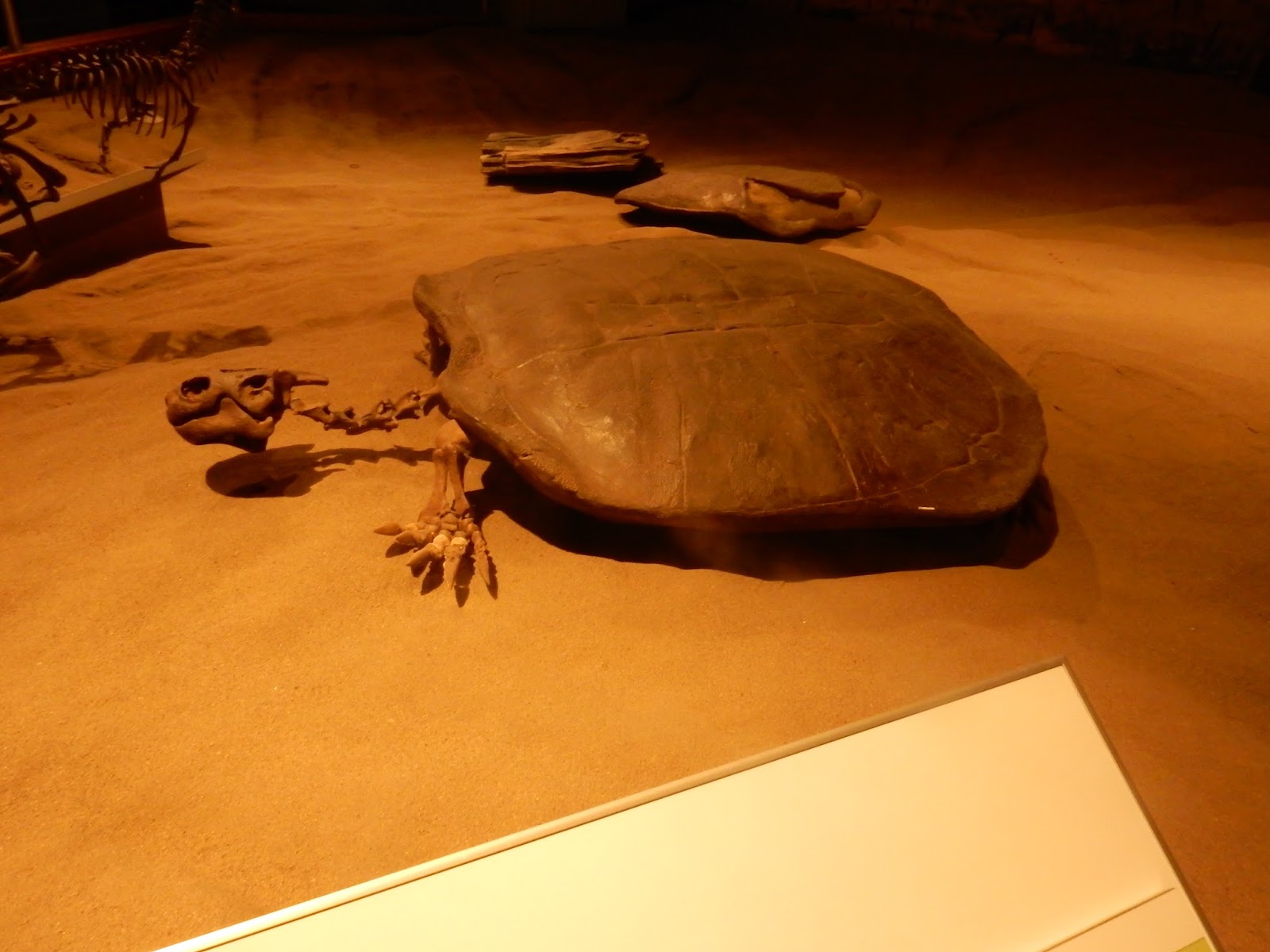
Basilemys, a large turtle.
Gorgosaurus looms over a Centrosaurus carcass.

Prosaurolophus hugs a tree.

Myledaphus, a Cretaceous freshwater guitarfish. Myledaphus teeth are commonly found, but fossils that preserve the rest of their bodies (such as this one) are far less so (which is unsurprising, given that they are cartilaginous fish).

The skull of the crocodylian Leidyosuchus.

The tibia of an azhdarchid pterosaur. The arrow is pointing to an embedded Saurornitholestes tooth.

The skull of Ankylosaurus.

The Cenozoic section of the museum returns to funneling guests down one path, but, after being mentally blown away by the dinosaur hall, most visitors are probably grateful for some order. Here is Simoedosaurus, a choristodere. At around this point in the gallery, there are also some live animals to look at (including a Florida soft-shelled turtle and some gar), though I was unable to get good photographs of them.

Even here, you haven't seen the last of the dinosaurs! This is an Eocene coraciiform.

A Gomphotherium.

As visitors near the exit, Glossotherium says, "Bye." Ground sloths really like waving. (I regret not taking a picture of the sign on this one, because it was almost impossible to find out which genus it was! Almost no one else on the internet had identified it as anything more specific than "ground sloth".)

I didn't take as many decent photos during the aforementioned tour of the collections as I'd have liked, but I at least got one of this iconic Dromiceiomimus/Ornithomimus specimen, currently not on display.
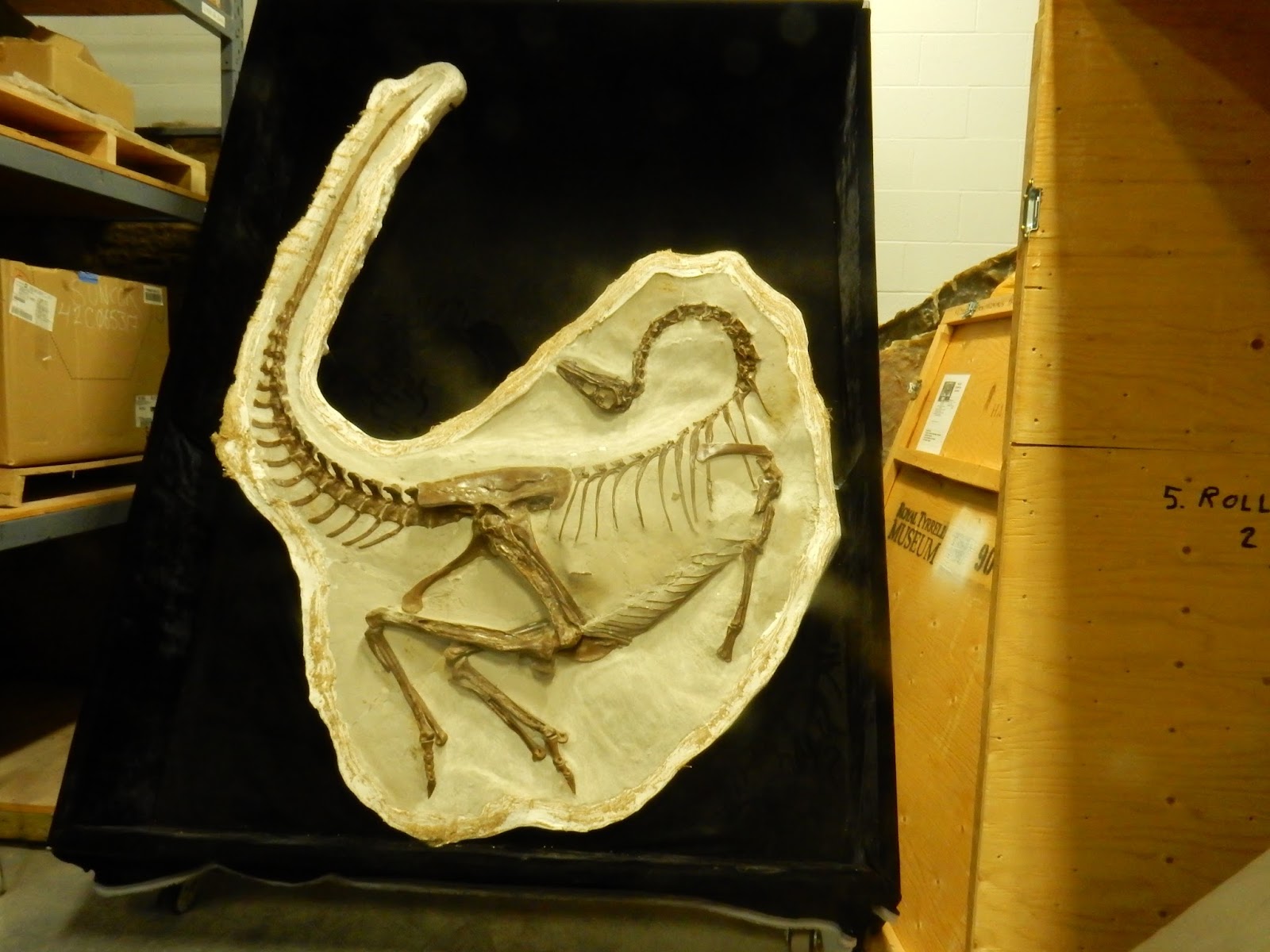
This specimen is notable not only for its well-preserved, articulated skeleton, but also for the fact that it preserves carbonized traces of forelimb feathers on the bones of its forearm where they once attached. See if you can spot them!

A specimen of Prosaurolophus with a patch of scales preserved.


A pond just outside the museum entrance, complete with a fountain and a leaping ichthyosaur.

I wouldn't be surprised if this pond was the most lushly-planted area here for miles around. Unsurprisingly, local wildlife, such as this cedar waxwing, was taking advantage.

Scenery more typical of the Albertan badlands.

Some marked trails near the museum provide the opportunity to experience the badlands more directly if one wishes. Trekking on one such trail, I spotted this vesper sparrow.

Ground squirrels were a common sight. This appears to be a Richardson's ground squirrel, though I may be wrong.

One of many Pachyrhinosaurus models surrounding the museum.

All in all, my first visit to the Royal Tyrrell did not disappoint. I hope that it is not my last. After all, there is still one thing that I haven't managed to accomplish on this trip, and that is seeing the original specimens of Albertonykus! I suppose that's going on the bucket list as a revised entry...