I just got back from a short trip to the Keihanshin region in Japan. Due to an oversight in scheduling, I did not get to visit the main zoo of the region, the Kobe Oji Zoo. Instead, I went to a different zoological institution, Kobe Animal Kingdom, which differs from a traditional zoo in its focus on getting visitors close to the exhibited animals and frequently encouraging interaction between them. Naturally, this raises ethical concerns.
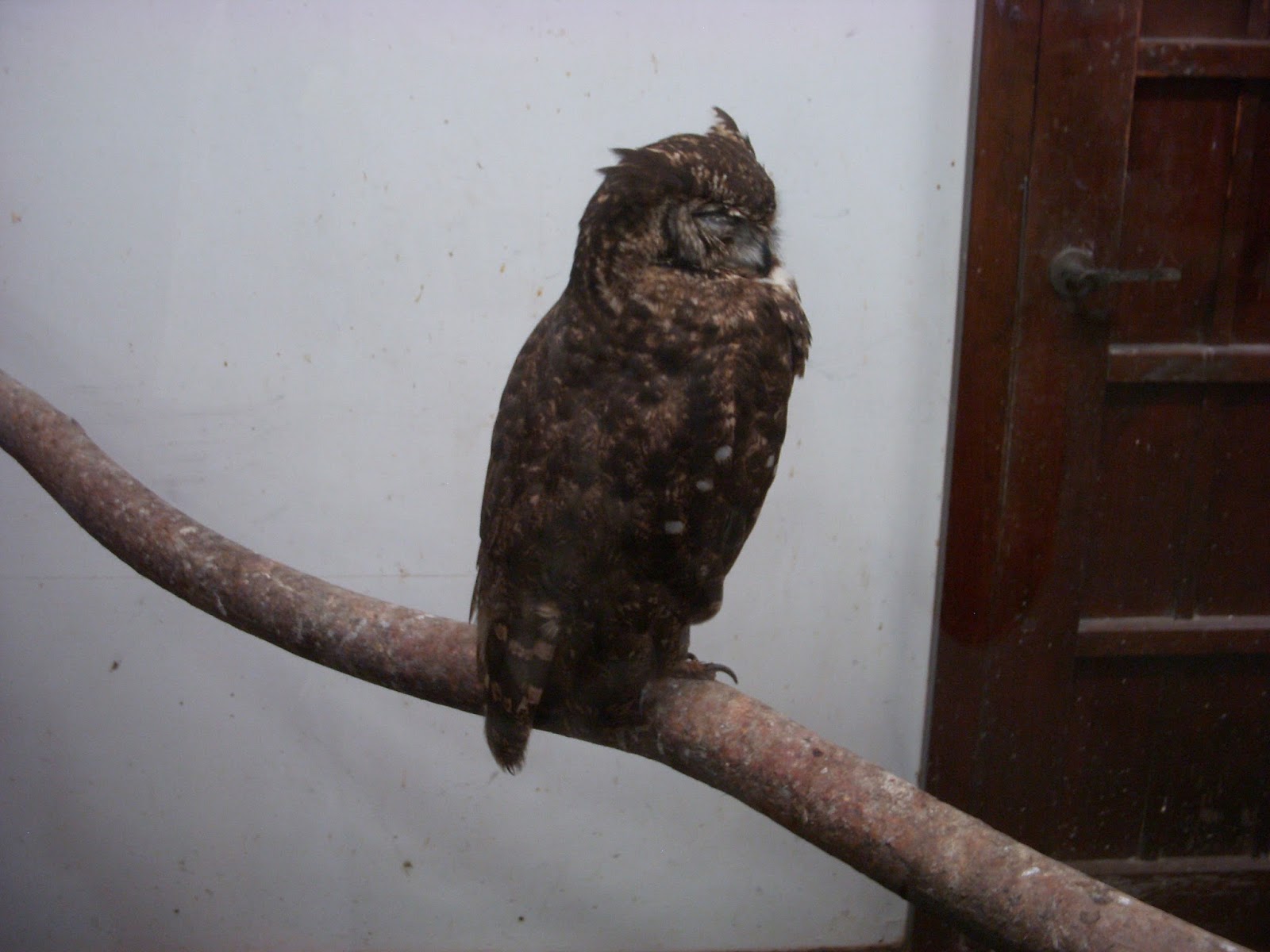
The sight of several owls chained to a log did not inspire confidence. Even though they were not open to visitor interaction, they were still kept in remarkably close proximity to guests and to one another (despite some of the owls being large enough to prey on the others). This is one of the smaller owls present, a tropical screech owl.
On the larger end of the spectrum, a Verreaux's eagle owl.
Most of the other animals, however, were kept in much better conditions. The main portion of the attraction is a large greenhouse divided into multiple large rooms where the animals are housed. There was ample space for the inhabitants and, as far as I could tell, most if not all of the birds were flight-capable. The entire facility is kept very clean and the animals generally looked healthy. At least some of the rooms had off-hours that gave them respite from visitor attention. One of the largest rooms contained a big pool with numerous waterbirds, including this African crowned crane.
The birds appeared to breed freely, as fenced-off areas next to the footpaths where nests had been built were not uncommon. Here's one such area containing juvenile black-winged stilts.
At the center of the pool was an island where ring-tailed lemurs and sitatunga were kept, though they were free to move around the rest of the room, as shown by this sitatunga taking a dip. (The lemurs, on the other hand, were able to leap to the sides of the pool via branches.)
Another room had a variety of tropical arboreal birds, such as these violet turacos.
A green turaco.
Toco toucans and a red-billed toucan sitting near the exhibit signs.
Kobe Animal Kingdom does have a few animals that are kept behind barriers, entirely out of reach of visitors. This is a juvenile tamandua. It was not clear to me why it was separated from its mother, but there were adult tamanaduas in an adjacent enclosure that are presumably its parents. Yes, that is a plush anteater it is lying on top of.
Coincidentally, it shares my birthday (May 10th).
Some two-toed sloths. Despite being out in the open, they were off-limits to visitors. They also had an alternate, enclosed exhibit next to the tamanduas.
The main interactive animals in the next room were maras and capybaras.
Fenced off to the side were American beavers.
There was also a South American fur seal.
An African wetland display housed this blacksmith plover.
The stars of the show, however, were the shoebills.
Their nesting platform.
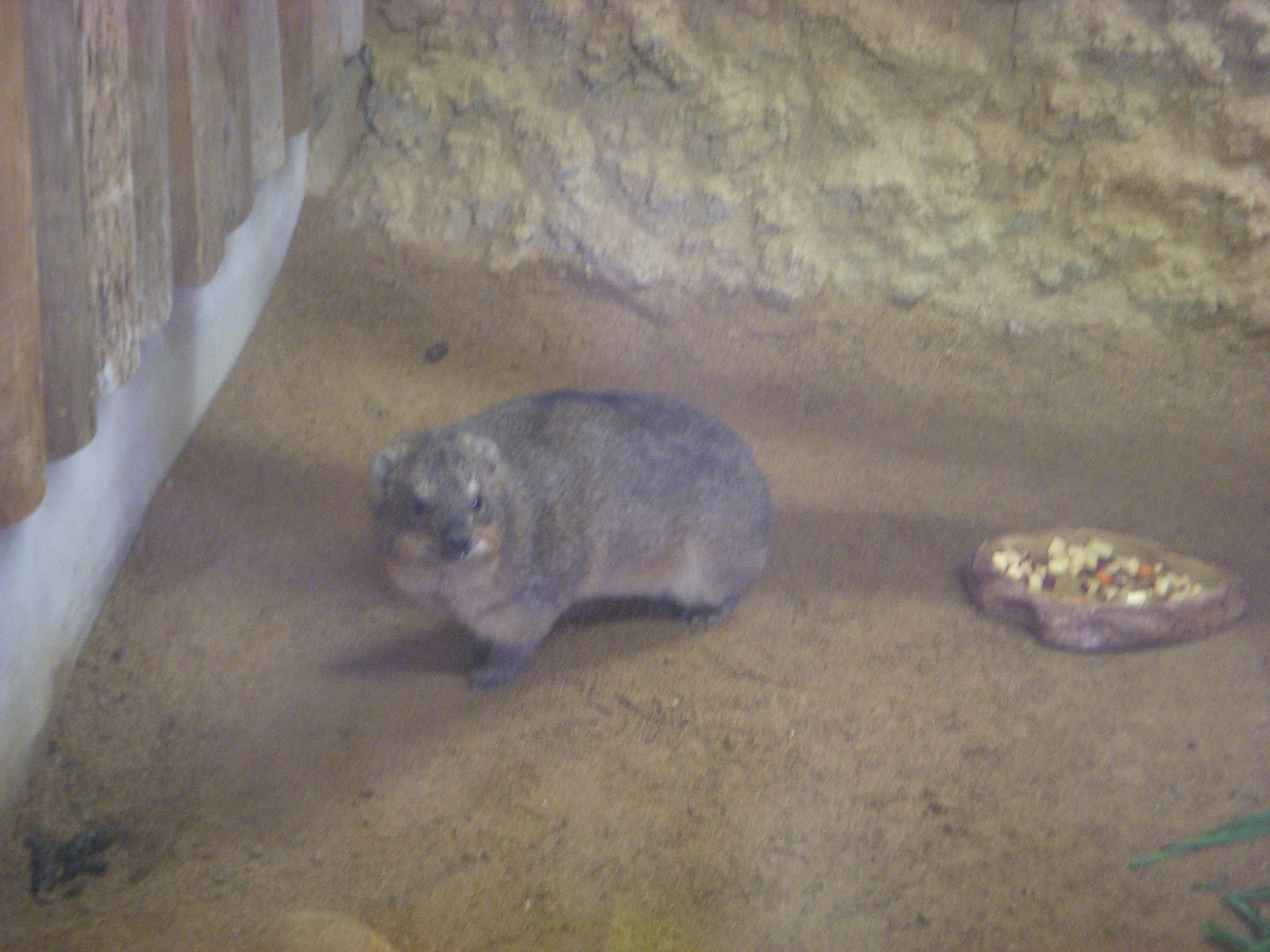
Some small African mammals were kept behind glass, including this rock hyrax. Note the prominent incisors, betraying its affinities with elephants and dugongs.
A fennec fox.
In the back of the facility were a number of exhibits for raptors and small carnivorans. I suspect the chained owls I saw early on usually live here. Out of all the enclosures here these were probably the most lackluster, both in terms of aesthetic design and animal welfare, most of them looking very cramped and bare. Here are a group of ring-tailed coatis.
A rufous-legged owl.
A great horned owl.
There's an outdoor section of Kobe Animal Kingdom as well. Domestic animals such as horses and sheep are kept there, but there is also a flock of African penguins.
The red kangaroo paddock provided many opportunities for close observation of their anatomy. Note fused digits II and III and greatly enlarged digit IV on the foot of this kangaroo.
As always with Japan, the merchandise is worth mentioning. Among the items for sale were these bookmarks featuring an incredibly large diversity of animals, some of them very obscure.
Alas, most of their prehistoric animals were not scientifically up to par. They have the colors of Sinosauropteryx correct, at least.
Plush shoebills!
A large plush wombat (and a smaller companion).
Models of several dinosaur skeletons (an unnamed dromaeosaurid, Fukuisaurus, and Fukuiraptor).
There were even shoebill crackers.
Wednesday, July 22, 2015
Monday, June 8, 2015
Bronx Zoo Part IV: Madagascar, Mouse House, and Congo Gorilla Forest
Alternative title: Everywhere Else I Went to But Did Not Take Enough Pictures Of.
The Madagascar exhibit at the Bronx Zoo is one of the best I have visited, even though my pictures may not demonstrate that adequately. Most of the enclosures were spacious and it did a good job of showcasing the varied environments that can be found on the island. (It is not just one big jungle!)
Here is a Coquerel's sifaka, well known for its distinctive leaping gait on the ground and hosting an educational children's show about animals.
A collared brown lemur.
A ring-tailed vontsira, one of the few live specimens you can see in North America! Once thought to be mongooses, vontsiras are now known to be part of a distinct Malagasy radiation of feliform carnivorans, the euplerids.
I passed by an Aldabra tortoise pen while walking to my next stop, but perhaps even more interesting than the inhabitants (to a paleontology enthusiast) was this sign with a sculpture of the Triassic stem-turtle Odontochelys.
My next stop was the Mouse House. The name of this building is not only a nominal shorthand for "small mammal", as it really does focus on rodents, and especially rats and mice. I appreciated that, for they are commonly neglected by many zoos (but not the Ueno Zoo, another similarity between these two geographically disparate institutions). This is despite rodents representing most of extant mammal species and frequently being very active and adorable (i.e.: potentially appealing to visitors). That is not to say the Mouse House only houses rodents; a memorable resident I saw was a very energetic spotted skunk. I was far less pleased to see a number of inconsiderate assholes shining their cellphones into the nocturnal exhibits.
Regrettably, fast-moving critters and dimly-lit habitats were not a good combination for my aging camera, so the only satisfactory picture I got out of the Mouse House was of this green acouchi. But should you ever find yourself visiting, remember to check out the Northern Luzon giant cloud rat!
My final stop was at the Congo Gorilla Forest, a series of quite impressive displays of African rainforest animals, culminating in (naturally) gorillas. This is another part of the zoo that requires you to pay extra and it was evidently a major attraction, because it was incredibly crowded when I visited. Due to this last factor in particular, I am once more unable to provide a representative sample of photos.
An okapi, the short-necked forest cousin of the giraffe.
A Nile monitor lizard.
An African lungfish.
A long-tailed hornbill.
The Madagascar exhibit at the Bronx Zoo is one of the best I have visited, even though my pictures may not demonstrate that adequately. Most of the enclosures were spacious and it did a good job of showcasing the varied environments that can be found on the island. (It is not just one big jungle!)
Here is a Coquerel's sifaka, well known for its distinctive leaping gait on the ground and hosting an educational children's show about animals.
A collared brown lemur.
A ring-tailed vontsira, one of the few live specimens you can see in North America! Once thought to be mongooses, vontsiras are now known to be part of a distinct Malagasy radiation of feliform carnivorans, the euplerids.
I passed by an Aldabra tortoise pen while walking to my next stop, but perhaps even more interesting than the inhabitants (to a paleontology enthusiast) was this sign with a sculpture of the Triassic stem-turtle Odontochelys.
My next stop was the Mouse House. The name of this building is not only a nominal shorthand for "small mammal", as it really does focus on rodents, and especially rats and mice. I appreciated that, for they are commonly neglected by many zoos (but not the Ueno Zoo, another similarity between these two geographically disparate institutions). This is despite rodents representing most of extant mammal species and frequently being very active and adorable (i.e.: potentially appealing to visitors). That is not to say the Mouse House only houses rodents; a memorable resident I saw was a very energetic spotted skunk. I was far less pleased to see a number of inconsiderate assholes shining their cellphones into the nocturnal exhibits.
Regrettably, fast-moving critters and dimly-lit habitats were not a good combination for my aging camera, so the only satisfactory picture I got out of the Mouse House was of this green acouchi. But should you ever find yourself visiting, remember to check out the Northern Luzon giant cloud rat!
My final stop was at the Congo Gorilla Forest, a series of quite impressive displays of African rainforest animals, culminating in (naturally) gorillas. This is another part of the zoo that requires you to pay extra and it was evidently a major attraction, because it was incredibly crowded when I visited. Due to this last factor in particular, I am once more unable to provide a representative sample of photos.
An okapi, the short-necked forest cousin of the giraffe.
A Nile monitor lizard.
An African lungfish.
A long-tailed hornbill.
Labels:
Avialans,
Bronx Zoo,
Shock horror a non maniraptor,
Trip
Sunday, June 7, 2015
Bronx Zoo Part III: Aquatic Birds and Birds of Prey
The Sea Bird Aviary at the Bronx Zoo is home to many species, but the most numerous are Magellanic penguins and these Inca terns, which have been given artificial cliffs for roosting and nesting on.
Nearby is the Aquatic Bird House. Despite its name, not all the birds exhibited here are waterbirds, but most of them are. This laughing kookaburra is one of the exceptions: although a kingfisher, it preys mainly on terrestrial animals.
A brown kiwi. This is a major milestone in my zoogoing experiences, as after multiple failures at the San Diego Zoo and National Zoo, I saw a kiwi at last!
Some tufted puffins.
A black oystercatcher and some common and/or Forster's terns (both species were present in the exhibit and I cannot tell from my picture which ones I have photographed).
A lot of little penguins.
A crested coua floofs. My pictures do not quite show the strikingly colored bare skin around the eyes.
A Storm's stork.
Outside were a series of fairly standard (design-wise) bird of prey enclosures. This is a cinereous vulture on its nest. Additional barriers had been put up in front of this exhibit, preventing visitors from getting too close and disturbing the nesting birds.
A golden eagle, one of the most badass extant theropods.
A king vulture feeding on what appears to be a chicken carcass.
Nearby is the Aquatic Bird House. Despite its name, not all the birds exhibited here are waterbirds, but most of them are. This laughing kookaburra is one of the exceptions: although a kingfisher, it preys mainly on terrestrial animals.
A brown kiwi. This is a major milestone in my zoogoing experiences, as after multiple failures at the San Diego Zoo and National Zoo, I saw a kiwi at last!
Some tufted puffins.
A black oystercatcher and some common and/or Forster's terns (both species were present in the exhibit and I cannot tell from my picture which ones I have photographed).
A lot of little penguins.
A crested coua floofs. My pictures do not quite show the strikingly colored bare skin around the eyes.
A Storm's stork.
Outside were a series of fairly standard (design-wise) bird of prey enclosures. This is a cinereous vulture on its nest. Additional barriers had been put up in front of this exhibit, preventing visitors from getting too close and disturbing the nesting birds.
A golden eagle, one of the most badass extant theropods.
A king vulture feeding on what appears to be a chicken carcass.
Bronx Zoo Part II: World of Birds
I was impressed by the bird collection at the Ueno Zoo, which I visited last year, but, to my delight, the one at the Bronx Zoo is at least as good on the whole, if not better. In fact, it had many of the same rare species I saw at the Ueno Zoo. I focused on taking pictures of species that I hadn't already seen, but rest assured that the selection is vastly greater than what I present here. Another interesting similarity with the Ueno Zoo was the style of exhibition in the bird house (known as World of Birds): many of the enclosures contain a large number of species and can be viewed from two different altitudes.
A blue dacnis, a slender-billed tanager.
A tawny frogmouth, a well-camouflaged nocturnal predatory bird from Australia.
A crimson-rumped toucanet.
A western capercaille, a large, impressive-looking grouse.
Some subpar shots of a common hoopoe.
Another rarely-seen Andean toucan, the plate-billed mountain toucan.
A white-tailed trogon (foreground) and Venezuelan troupial (background).
Some blue-headed macaws and a hyacinth macaw.
A calfbird, a strange-looking cotinga.
World of Birds on its own likely would have satisfied me with the Bronx's avian collection, but it was far from the only bird-heavy area of the zoo. Coming up next...
A blue dacnis, a slender-billed tanager.
A tawny frogmouth, a well-camouflaged nocturnal predatory bird from Australia.
A crimson-rumped toucanet.
A western capercaille, a large, impressive-looking grouse.
Some subpar shots of a common hoopoe.
Another rarely-seen Andean toucan, the plate-billed mountain toucan.
A white-tailed trogon (foreground) and Venezuelan troupial (background).
Some blue-headed macaws and a hyacinth macaw.
A calfbird, a strange-looking cotinga.
World of Birds on its own likely would have satisfied me with the Bronx's avian collection, but it was far from the only bird-heavy area of the zoo. Coming up next...
Thursday, June 4, 2015
Bronx Zoo Part I: JungleWorld
A notable feature of the Bronx Zoo is that it charges extra for several of its exhibits. As a result, getting its full experience entails some significant spending, which makes me ever more thankful that the National Zoo is free to visit. Regardless, the Bronx Zoo is widely considered to be one of the top zoos of the country, so there is some justification for the steep admission.
One of exhibits here that requires additional spending is JungleWorld, an immersive indoor display simulating a tropical rainforest environment. Many of the animals here, mainly belonging to species native to Southeast Asia, are separated from each other and the visitors by "naturalistic" barriers such as steep surfaces and moats, though the numerous flying species have more freedom to roam than the others.
Thanks to a combination of factors, I used my camera sparingly on this trip. My camera battery has been getting loose, rendering it unreliable, and, with the knowledge that the zoo was a large one, I was also consciously trying to conserve the battery. Readers who are interested in getting a more comprehensive idea of what the zoo looks like are encouraged to plan their own trips or to check out the abundant photographs taken by others available elsewhere online.
A Matschie's tree kangaroo. An endemic of New Guinea, this species would be part of a very distinct fauna in the wild from the rest of the inhabitants here, despite being geographically close.
A few animals at JungleWorld do live behind traditional glass windows, such as this Indonesian sailfin lizard. Like the New World basilisk lizards, sailfin lizards are capable of running on the surface of water for short distances, but do not get as much airtime in nature documentaries.
Falcated ducks (left pair) and Philippine ducks (right pair).
A pair of Malayan tapirs.
A frilled lizard, rendered in terribly altered colors by my camera.
A colony of fruit bats and a painted stork.
Some stretches of the Bronx Zoo involve a lot of walking without seeing any exhibits along the way. Auspiciously, the zoo is well planted and the paths are thus well shaded from the heat of summer. Upon leaving JungleWorld, the next exhibit I came across was home to a number of African species, including these African crowned cranes.
Other inhabitants included a marabou stork and some nyala. The lion enclosure is visible at the far back of this display (but not in my photos), providing the illusion that the lions are kept in the same space as their potential prey.
A wild eastern chipmunk foraging on the side of the path.
One of exhibits here that requires additional spending is JungleWorld, an immersive indoor display simulating a tropical rainforest environment. Many of the animals here, mainly belonging to species native to Southeast Asia, are separated from each other and the visitors by "naturalistic" barriers such as steep surfaces and moats, though the numerous flying species have more freedom to roam than the others.
Thanks to a combination of factors, I used my camera sparingly on this trip. My camera battery has been getting loose, rendering it unreliable, and, with the knowledge that the zoo was a large one, I was also consciously trying to conserve the battery. Readers who are interested in getting a more comprehensive idea of what the zoo looks like are encouraged to plan their own trips or to check out the abundant photographs taken by others available elsewhere online.
A Matschie's tree kangaroo. An endemic of New Guinea, this species would be part of a very distinct fauna in the wild from the rest of the inhabitants here, despite being geographically close.
A few animals at JungleWorld do live behind traditional glass windows, such as this Indonesian sailfin lizard. Like the New World basilisk lizards, sailfin lizards are capable of running on the surface of water for short distances, but do not get as much airtime in nature documentaries.
Falcated ducks (left pair) and Philippine ducks (right pair).
A pair of Malayan tapirs.
A frilled lizard, rendered in terribly altered colors by my camera.
A colony of fruit bats and a painted stork.
Some stretches of the Bronx Zoo involve a lot of walking without seeing any exhibits along the way. Auspiciously, the zoo is well planted and the paths are thus well shaded from the heat of summer. Upon leaving JungleWorld, the next exhibit I came across was home to a number of African species, including these African crowned cranes.
Other inhabitants included a marabou stork and some nyala. The lion enclosure is visible at the far back of this display (but not in my photos), providing the illusion that the lions are kept in the same space as their potential prey.
A wild eastern chipmunk foraging on the side of the path.
Labels:
Avialans,
Bronx Zoo,
Shock horror a non maniraptor,
Trip
Wednesday, April 1, 2015
A sneak peek at what I've been up to
In between writing scripts for TetZoo Time, grading weekly quizzes, and wondering why there aren't more phylogenetic analyses of xenarthrans with more than craniodental characters, I've been busy. Most importantly, I have been busy co-authoring a revolutionary new paper... or what would be a revolutionary new paper if, in acts of blatant scientific censorship, all the legitimate scientific journals we submitted to had not rejected the manuscript.
Thus, for the time being, I have chosen to reveal some of the most important results of our study on my blog. This is at the tremendous risk of having this information scooped by other researchers, but I believe it is more important to publicize it as soon as possible, in hopes ofmisleading illuminating passing readers.
It's another phylogenetic analysis of Volantia, but in addition to being the largest analysis of this group to date, we also used this opportunity to test dogmatically popular hypotheses such as the theropod origin of birds. We were able to falsify these hypotheses by a priori reasoning, a truly devastating blow to textbook wisdom. However, mainstream science is loath to update textbooks, a primarily motivator behind the organized movement to bar our study from publication. The joke's on you, ivory tower suckers! Ha ha!
We also discovered that it's easy to recover the clades you want if you count a single character as 23 out of a total of 131. Likely this has been the case for analyses purporting to support birds as theropods, but almost no one else has ever caught this because phylogenetic matrices are well designed to blur the vision of anyone trying to evaluate what data was input into them.
Emily, Scott Reid, and Adam Schmoetzer provided helpful discussion that greatly improved this manuscript, though evidently not enough to get it published in a high-profile journal.
Thus, for the time being, I have chosen to reveal some of the most important results of our study on my blog. This is at the tremendous risk of having this information scooped by other researchers, but I believe it is more important to publicize it as soon as possible, in hopes of
| Results of phylogenetic analysis of Volantia, with identified synapomorphies labeled. |
It's another phylogenetic analysis of Volantia, but in addition to being the largest analysis of this group to date, we also used this opportunity to test dogmatically popular hypotheses such as the theropod origin of birds. We were able to falsify these hypotheses by a priori reasoning, a truly devastating blow to textbook wisdom. However, mainstream science is loath to update textbooks, a primarily motivator behind the organized movement to bar our study from publication. The joke's on you, ivory tower suckers! Ha ha!
We also discovered that it's easy to recover the clades you want if you count a single character as 23 out of a total of 131. Likely this has been the case for analyses purporting to support birds as theropods, but almost no one else has ever caught this because phylogenetic matrices are well designed to blur the vision of anyone trying to evaluate what data was input into them.
Emily, Scott Reid, and Adam Schmoetzer provided helpful discussion that greatly improved this manuscript, though evidently not enough to get it published in a high-profile journal.
Subscribe to:
Posts (Atom)