Living in the shadow of the much larger and admission-free National Zoo, it's easy to see why the Maryland Zoo in Baltimore is frequently overlooked. Having had the chance at last to visit it, however, I can confirm that it contains a few gems and has sufficiently little overlap with the National Zoo to make it at least worth considering as a travel destination.
For reasons unknown to me, the bulk of the zoo's exhibits are found some distance away from the entrance and need to be reached either on foot or via shuttle. One of the few displays that can be found near the entrance is a well-populated black-tailed prairie dog enclosure. A good choice for first impressions, as the ground squirrels were quite delightful, particularly the juveniles.
Another nearby display houses African birds, among them this obliging Abyssinian ground hornbill. The real dinosauroid.
The main portion of the zoo is divided into three loop trails. The shortest of these trails has a focus on arctic animals, including polar bears and ravens. Most memorably, it took some time for me to get even a halfway decent shot of this arctic fox.
My friend Ben found this wild brown snake on our way to the next loop trail.
The second loop trail featured local Maryland wildlife, including an aviary with many native bird species. Here is a green heron.
Diving ducks are always charming, and these ruddy ducks were no exception. As a bonus, we got to see the males in their breeding colors, an unlikely prospect in the wild considering they only winter here.
One of the ruddy ducks feeding alongside a pair of wood ducks.
A little blue heron.
A sandhill crane.
A turkey vulture.
Wild snakes were out in force that day, as we saw three northern water snakes (one not pictured) chilling in the aviary.
Not one of the wild snakes we saw, but a captive copperhead.
Some box turtles had a surprisingly spacious exhibit (which is not evident from my photo).
A pair of trumpeter swans.
The final and longest loop trail is devoted to Africa. Likely the best exhibits in the zoo are found here, including a nice display housing sitatunga and these African crowned cranes.
We observed these chimpanzees using sticks to pull surrounding leaves and bamboo shoots into their enclosure for consumption.
I was surprised to see okapis at this zoo. They share a giraffid house with giraffes, though their exhibits are unfortunately quite plain.
More aesthetically pleasing was this grassy habitat for addra gazelles and saddle-billed storks.
An African aviary nearby contained blue-bellied rollers that were more than willing to show off their acrobatic flying style.
A pair of Von der Decken's hornbills.
A pair of African pygmy geese, among the smallest waterfowl in the world. According to exhibit signs, there is also a blue duiker living in the aviary that decided to be a no-show. The omnivorous tendencies of duikers make me wonder how safe it is to keep one with birds.
A wild spotted sandpiper hanging out in the rhinoceros exhibit. (It probably says something about me that I took a picture of a common bird but not of the rhino...)
A small, easily-missed display is home to some very delicate-looking Kirk's dik-diks.
Living alongside the lap-sized antelope are demoiselle cranes.
The centerpiece of the zoo is a large pool for black-footed penguins. Also present is a volant species of diving bird that lives in the same region in the wild, the white-breasted cormorant.
We passed by the penguin pool just in time to see them being fed. A wild herring gull hung around nearby in hopes of getting some scraps.
Thursday, June 2, 2016
Thursday, April 7, 2016
Tumblr Roundup 4/7/2016 (Dinosaur March Madness Edition)
Over the past month, Meg Dickson's A Dinosaur A Day has been hosting Dinosaur March Madness to figure out the most popular dinosaurs among her readership. I took the chance to come out of hibernation intermittently to answer questions and have the Raptormaniacs characters comment on the proceedings. The commentary is included in the links below.
-Commentary on Game One.
-Commentary on Game Two.
-Commentary on Game Three.
-Commentary on Game Thirty-One.
-What does Savape's mother think of her cruelty?
-Where are all the non-theropod dinosaurs?
-What tourist destinations are there in the city?
-Does the museum have a Spinosaurus?
-Skull comments on Palaeofail's choice of favorite dromaeosaurid.
-Commentary on results of Round Three.
-Does Zahavi have a power origin story?
-Thoughts on Utahraptor.
-Does the museum have a Yutyrannus?
-Thoughts on Hyracotherium.
-Is there a Microraptor in the museum?
-Commentary on overall results of Dinosaur March Madness.
-Commentary on Game One.
-Commentary on Game Two.
-Commentary on Game Three.
-Commentary on Game Thirty-One.
-What does Savape's mother think of her cruelty?
-Where are all the non-theropod dinosaurs?
-What tourist destinations are there in the city?
-Does the museum have a Spinosaurus?
-Skull comments on Palaeofail's choice of favorite dromaeosaurid.
-Commentary on results of Round Three.
-Does Zahavi have a power origin story?
-Thoughts on Utahraptor.
-Does the museum have a Yutyrannus?
-Thoughts on Hyracotherium.
-Is there a Microraptor in the museum?
-Commentary on overall results of Dinosaur March Madness.
Labels:
Dinky,
Ebeff,
Ostrom,
Oviraptorosaurs,
Remex,
Savape,
Shock horror a non maniraptor,
Skull,
Special presentation,
Troodontids,
Tumblr,
Zahavi
Friday, April 1, 2016
What Did Mesozoic Maniraptors Eat? Results from My Senior Thesis
I don't neglect this blog just because I can. At last, it is time to unveil what has been eating up most of my time: my senior thesis research. Contrary to some of my previously-expressed concerns, there is no risk in releasing my findings in this fashion because everyone knows that blogs are entirely worthless for any form of scientific discourse. When I get around to submitting my thesis as a manuscript, those journals will have no idea that I've already publicized this information, because what proper academic (including editors of scientific journals) ever reads or writes blogs?
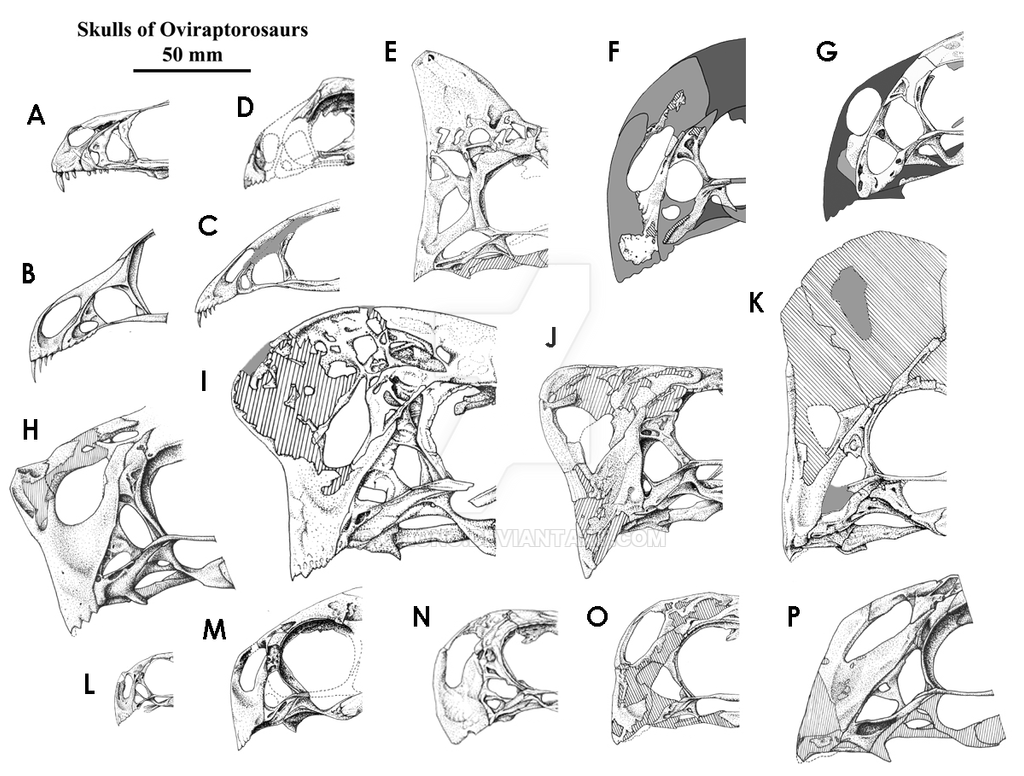
There has been much debate and speculation on the diets of Mesozoic maniraptors, in part due to their diverse skull morphology that frequently deviates from what is expected of "typical" theropods. In recent years, it has been popular to argue on morphological and biomechanical grounds that herbivory and omnivory were widespread in Mesozoic maniraptors.
However, the existence of fruit-eating alligators and meat-eating ruminants demonstrate that morphological inference of animal diets is unreliable at best. Direct observations are what count. For my senior thesis, I looked at direct evidence of maniraptor diets (gut contents and feeding traces) throughout the Mesozoic. The results can be seen in the graph below.
The trend is clear: for most of the Mesozoic, most maniraptors were eating absolutely nothing! This is at great odds to the popular interpretation of widespread herbivory in these dinosaurs, but it makes a good amount of sense. After all, if these animals were not eating anything, their skull morphology would not be at all constrained by diet and would be free to take on other functions such as sexual display and species recognition. This revelation brilliantly explains the diversity of skull shapes in maniraptors.
Another finding of interest is the spike in hypercarnivorous maniraptor species during the Campanian. The most parsimonious explanation for this observation is that, considering the evolution of all organisms is driven by the aesthetic preferences of a single Holocene primate species (66 million years away from the last non-neornithine maniraptors), this was an attempt by the maniraptors to become more awesome, because feeding on fish or plants is lame. (And fish is not meat, what are you talking about?) Unfortunately for maniraptors, all carnivorous species died out prior to the Maastrichtian, likely because that ecospace was already dominated by other types of theropods.
What of the increase in rock-eating species during the Aptian? The great abundance of fossil species and specimens found dating to the Aptian is reflective of an increase in the generation of sedimentary rock during this time period. Evidently, a number of maniraptor species became adapted to take advantage of this resource.
References
Awesomebro, I. 2013. Y animulz musth b kewl enuff 4 me. Annals of Awesomebro 95: 26-910. doi: x8615/asum.2399
Blank, D.A. 2003. On the carnivorism and feces eating of Gazella dorcas Linnaeus, 1758 and other ungulates. Mammalia 674: 579-585.
Lautenschlager, S. 2013. Cranial myology and bite force performance of Erlikosaurus andrewsi: a novel approach for digital muscle reconstructions. Journal of Anatomy 222: 260-272. doi: 10.1111/joa.12000
Lautenschlager, S., L.M. Witmer, A. Perle, L.E. Zanno, and E.J. Rayfield. 2014. Cranial anatomy of Erlikosaurus andrewsi (Dinosauria, Therizinosauria): new insights based on digital reconstruction. Journal of Vertebrate Paleontology 34: 1263-1291. doi: 10.1080/02724634.2014.874529
O'Connor, J.K. and L.M. Chiappe. 2011. A revision of enantiornithine (Aves: Ornithothoraces) skull morphology. Journal of Systematic Palaeontology 9: 135-157. doi: 10.1080/14772019.2010.526639
Platt, S.G., R.M. Elsey, H. Liu, T.R. Rainwater, J.C. Nifong, A.E. Rosenblatt, M.R. Heithaus, and F.J. Mazzotti. 2013. Frugivory and seed dispersal by crocodilians: an overlooked form of saurochory? Journal of Zoology 291: 87-99. doi: 10.1111/jzo.12052
Zanno, L.E. and P.J. Makovicky. 2011. Herbivorous ecomorphology and specialization patterns in theropod dinosaur evolution. Proceedings of the National Academy of Sciences, USA 108: 232-237. doi: 10.1073/pnas.1011924108
There has been much debate and speculation on the diets of Mesozoic maniraptors, in part due to their diverse skull morphology that frequently deviates from what is expected of "typical" theropods. In recent years, it has been popular to argue on morphological and biomechanical grounds that herbivory and omnivory were widespread in Mesozoic maniraptors.
![]() |
| A digital reconstruction of the skull of the therizinosaur Erlikosaurus in multiple views, from Lautenschlager et al., 2014. |
| A selection of oviraptorosaur snouts, drawn by Jaime Headden, licensed. |
![]() |
| A selection of enantiornithine skulls, from O'Connor and Chiappe, 2011. |
However, the existence of fruit-eating alligators and meat-eating ruminants demonstrate that morphological inference of animal diets is unreliable at best. Direct observations are what count. For my senior thesis, I looked at direct evidence of maniraptor diets (gut contents and feeding traces) throughout the Mesozoic. The results can be seen in the graph below.
The trend is clear: for most of the Mesozoic, most maniraptors were eating absolutely nothing! This is at great odds to the popular interpretation of widespread herbivory in these dinosaurs, but it makes a good amount of sense. After all, if these animals were not eating anything, their skull morphology would not be at all constrained by diet and would be free to take on other functions such as sexual display and species recognition. This revelation brilliantly explains the diversity of skull shapes in maniraptors.
Another finding of interest is the spike in hypercarnivorous maniraptor species during the Campanian. The most parsimonious explanation for this observation is that, considering the evolution of all organisms is driven by the aesthetic preferences of a single Holocene primate species (66 million years away from the last non-neornithine maniraptors), this was an attempt by the maniraptors to become more awesome, because feeding on fish or plants is lame. (And fish is not meat, what are you talking about?) Unfortunately for maniraptors, all carnivorous species died out prior to the Maastrichtian, likely because that ecospace was already dominated by other types of theropods.
What of the increase in rock-eating species during the Aptian? The great abundance of fossil species and specimens found dating to the Aptian is reflective of an increase in the generation of sedimentary rock during this time period. Evidently, a number of maniraptor species became adapted to take advantage of this resource.
References
Awesomebro, I. 2013. Y animulz musth b kewl enuff 4 me. Annals of Awesomebro 95: 26-910. doi: x8615/asum.2399
Blank, D.A. 2003. On the carnivorism and feces eating of Gazella dorcas Linnaeus, 1758 and other ungulates. Mammalia 674: 579-585.
Lautenschlager, S. 2013. Cranial myology and bite force performance of Erlikosaurus andrewsi: a novel approach for digital muscle reconstructions. Journal of Anatomy 222: 260-272. doi: 10.1111/joa.12000
Lautenschlager, S., L.M. Witmer, A. Perle, L.E. Zanno, and E.J. Rayfield. 2014. Cranial anatomy of Erlikosaurus andrewsi (Dinosauria, Therizinosauria): new insights based on digital reconstruction. Journal of Vertebrate Paleontology 34: 1263-1291. doi: 10.1080/02724634.2014.874529
O'Connor, J.K. and L.M. Chiappe. 2011. A revision of enantiornithine (Aves: Ornithothoraces) skull morphology. Journal of Systematic Palaeontology 9: 135-157. doi: 10.1080/14772019.2010.526639
Platt, S.G., R.M. Elsey, H. Liu, T.R. Rainwater, J.C. Nifong, A.E. Rosenblatt, M.R. Heithaus, and F.J. Mazzotti. 2013. Frugivory and seed dispersal by crocodilians: an overlooked form of saurochory? Journal of Zoology 291: 87-99. doi: 10.1111/jzo.12052
Zanno, L.E. and P.J. Makovicky. 2011. Herbivorous ecomorphology and specialization patterns in theropod dinosaur evolution. Proceedings of the National Academy of Sciences, USA 108: 232-237. doi: 10.1073/pnas.1011924108
Tuesday, January 5, 2016
Favorite Maniraptor of 2014 Results
Much as I predicted, Anzu took this one by a landslide. Changyuraptor came in second, to be expected for a well-preserved dromaeosaurid. I appear to have been the only one who voted for Eopengornis, but come on, check out that fossil. Not to mention the interesting implications for rectricial evolution in avialans (possibly confirmed by the publication of Chiappeavis last year).
![]() |
| Holotype of Eopengornis, from Wang et al., 2014. |
As for this year's poll? We have two dromaeosaurids as strong contenders, the giant Dakotaraptor and the excellently-preserved Zhenyuanlong (both of which, coincidentally, preserve evidence that wings were retained in flightless dromaeosaurids), but I imagine the unexpectedly bizarre Yi will be tough to beat.
Friday, January 1, 2016
Review of 2015
It was a busy year and the Tumblr suffered for it, but, considering that I didn't end up blogging significantly less than I did last year, I'm reasonably satisfied with what I did on here. Jurassic World came out this year, causing much discussion in the paleontological community. I have nothing to add about the film that has not already been said, but its release did give me the prompt to finish up another story arc for the comic. My travel destinations this year included New York, Osaka, and Dallas, the last of which hosted the first SVP conference I've attended. Additionally, I indulged in some frivolous nonsense, including a Twitter meme and the obligatory April Fools' post.
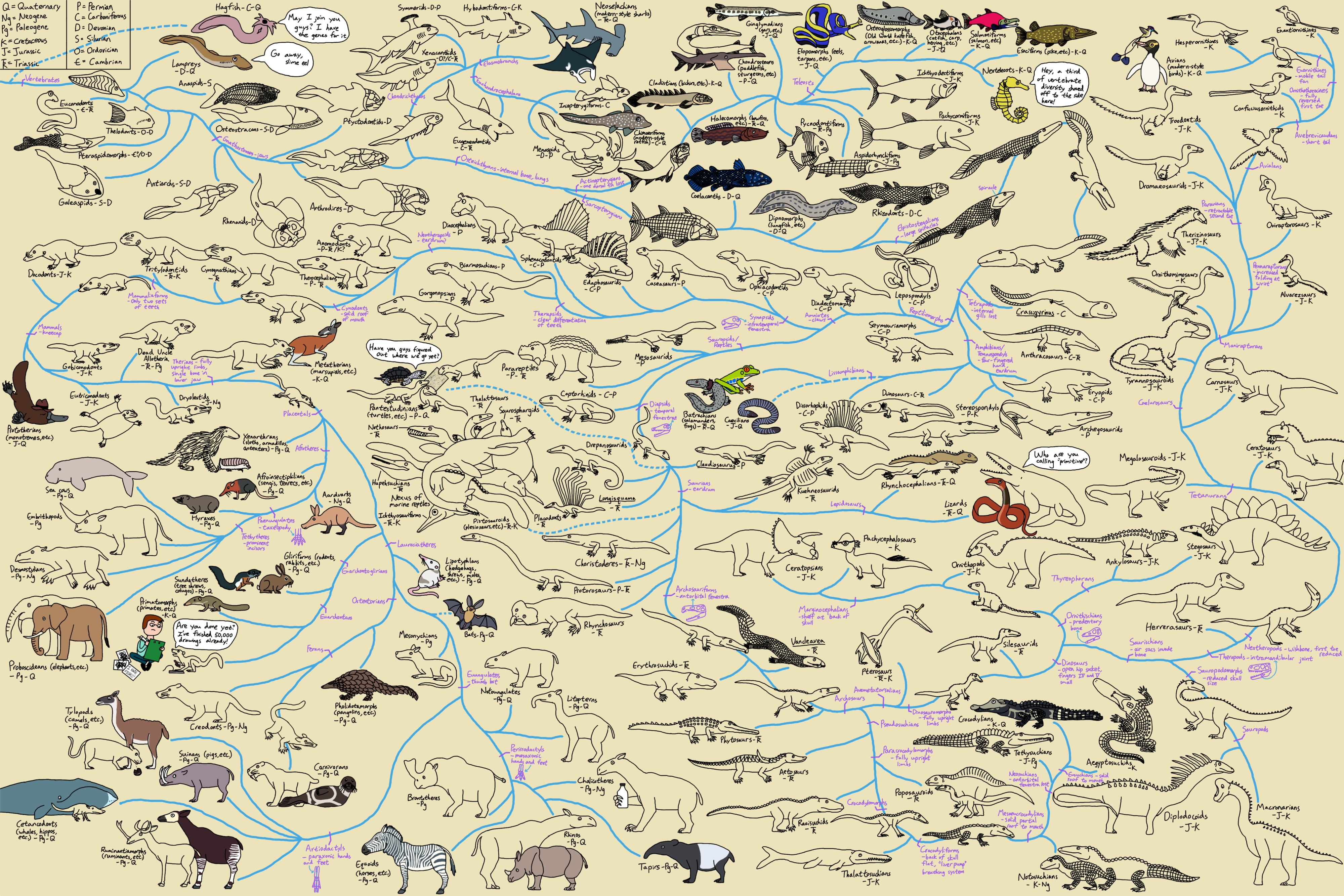
Though not directly related to the blog, the unexpected stardom of my Cartoon Guide to Vertebrate Evolution, which I drew this past summer, is worth a mention. It is by far my most popular work on DeviantArt (in terms of number of favorites and comments), has been made available on merchandise by popular request, earned me interviews with Terp Magazine and the National Center of Science Education, and has reportedly been used in presentations at academic conferences. Wow.
Onward to new maniraptor discoveries of the past year. In January, newborn chickens were found to mentally map numbers the same way humans do. New material of Caenagnathus and Elmisaurus was described. Linheraptor was argued to represent a separate taxon from Tsaagaan. New studies came out on emberizoid phylogeny and seed dispersal by emus. Newly-named maniraptors included the Eocene trogon-like avialan Foshanornis songi and the enantiornithine Houornis caudatus (formerly a species of Cathayornis).
In February, altruistic behavior among northern bald ibises flying in V-formation was reported. The genomes of Darwin's finches were sequenced. Caenagnathasia was reported from the Iren Dabasu Formation for the first time. Male peafowl were discovered to use infrasonic signals during courtship. A trade-off was found between sexual attractiveness and parental effort among male grassquits. The postcranial anatomy of Gansus was described. New studies came out on the phylogeny of Todiramphus kingfishers and harriers, the body mass of Mesozoic avialans, the barb geometry of asymmetric feathers in Mesozoic paravians, the loss of taste in penguins, the mechanics of avian feet during perching and grasping, the craniocervical myology of Falcarius and Nothronychus, and the evolution of gastralia and sterna in paravians. Newly-named maniraptors included the Miocene heron Nyctisoma robusta.
In March, purportedly distinct redpoll species were found to have largely undifferentiated genomes. The blue-bearded helmetcrest, once thought extinct, was rediscovered alive. Natural selection and sexual selection were discovered to operate on different axes of variation in avian plumage color. New studies came out on the origin of crown passerines and the phylogenetic position of the mandanga and the São Tomé shorttail. Newly-named maniraptors included the enantiornithines Dunhuangia cuii and Yuanjiawaornis viriosus, the Cretaceous euornithine Juehuaornis zhangi, the phorusrhacid Llallawavis scagliai, and the Perijá tapaculo (Scytalopus perijanus).
In April, new ecological information for the black tinamou was reported. A new specimen of Longipteryx was described. Transoceanic migration in blackpoll warblers was documented. New studies came out on the size of the gastral basket in Mesozoic paravians and the ontogeny of Deinonychus. Newly-named maniraptors included the scansoriopterygid Yi qi, which preserved evidence of membranous wings, a contender for the most unexpected dinosaur discovery of at least the past decade.
In May, evidence of nest site fidelity in troodonts was described. Contagious yawning in budgerigars was reported. The trace fossil Wupus agilis was argued to represent a large avian footprint. New studies came out on the function of the alula in flight, the development of the avian snout and hallux, the phylogeny of hesperornithines, the evolution of sexual dimorphism in wood warblers, differences in exploration behavior of carrion crows and common ravens, and the safekeeping of tools by New Caledonian crows. Newly-named maniraptors included the dromaeosaurid Saurornitholestes sullivani, the Cretaceous euornithine Archaeornithura meemannae, and the Sichuan bush warbler (Locustella chengi).
In June, the osteology of Nothronychus was described in detail. Rapid head rotation was found to help lovebirds maneuver quickly. Correlation was found between avian altriciality and toe orientation. The pelvic limb musculature of the ostrich was modeled. New specimens of Masillapodargus and Tonsala were described. Brown thornbills were discovered to mimic a chorus of alarm calls to dissuade nest predators. An egg once thought to belong to a ceratopsian was reevaluated as an enantiornithine egg. Several purported stem parrots were reconsidered and found to have been stem passerines. New studies came out on the phylogenetic position of Balaur, the bone histology of Aepyornis, convergence in feather crests of domestic doves, the evolution of sternal ossification in ornithothoracines, ontogenetic shape change in the chicken brain, and mimicry in female cuckoo finches. Newly-named maniraptors included the enantiornithines Cratoavis cearensis, Holbotia ponomarenkoi (a longtime nomen nudum), and Parapengornis eurycaudatus.
In July, roosters were found to crow in sequence based on their social rank. The genome of the North Island brown kiwi was sequenced. The helmeted woodpecker, once thought to belong to Dryocopus, was found to be a species of Celeus. Newly-named maniraptors included the oviraptorosaur Huanansaurus ganzhouensis, the dromaeosaurid Zhenyuanlong suni, and the Miocene condor Kuntur cardenasi.
In August, hummingbird tongues were reported to function as micropumps. Canaries were discovered to be flexible in the timing of learning songs. Blue-footed boobies were found to use behaviorally-induced camouflage to hide their eggs. New studies came out on chemical defense in common cuckoo chicks, opisthotonic head displacement in chickens, the endocranial anatomy of Eocene stem penguins, the ultrastructure of Anchiornis feathers (supporting identification of preserved microbodies in the fossil feathers as melanosomes), the diversification of avians across the K-Pg boundary, and inference by exclusion in Goffin's cockatoos. Newly-named maniraptors included the enantiornithine Pterygornis dapingfangensis.
In September, king penguins were found to be able to distinguish odors of conspecifics. Zebra finches were discovered to pick mates based on behavioral compatibility. Black-chinned hummingbirds were reported to nest in association with Accipiter hawks to increase breeding success. Mated pairs of southern rockhopper penguins were found to winter in separate locations. Brown-headed cowbirds were shown to select hosts in response to reproductive success. American crows were discovered to gather around dead conspecifics as a means of learning about danger. New studies came out on bone histology of penguins, the emergence of social rank in monk parakeets, and the function of colored beak spots in king penguins. Newly-named maniraptors included the Pleistocene barn owl Tyto cravesae and the flightless Pleistocene duck Shiriyanetta hasegawai.
In October, a well-preserved enantiornithine wing was described. Recent advances in research on bird origins was reviewed. Kleptoparasitism in gentoo penguins was reported. New studies came out on cooperation in common ravens, the evolution of body mass in pan-alcids and wing shape in avians, the phylogeny of neornithines, the morphology of penguin feathers, and the relationship between skeletal and total body mass in birds. Newly-named maniraptors included the Miocene shorebird Hakawai melvillei and the large dromaeosaurid Dakotaraptor steini.
In November, a supergene was found to be responsible for divergent male morphs in ruffs. Blue-capped cordon bleus were reported to use a tap-dancing courtship display. Pigeons were discovered to assume leadership based on speed. Zebra finches were observed negotiating vocally over parental care. Cerebavis was reevaluated and found to be a euornithine. New studies came out on the function of hindlimb feathers in Mesozoic paravians, the evolution of avian brain modularity, the hindlimb myology of moa, the social network dynamics of New Caledonian crows, and the foraging behavior of great tits. Newly-named maniraptors included the hesperornithine Fumicollis hoffmani, the plotopterid Stemec suntokum, and Paragallinula, a new genus for the lesser moorhen.
In December, spontaneous tool use in greater vasa parrots was reported. Asymmetric limb control during bipedal locomotion in guineafowl was described. New studies came out on heat dissipation in calliope hummingbirds, locomotion in large ground birds, hook tool use in New Caledonian crows, cervical pneumatization in ostriches, structural color in Eurasian jay feathers, and the diversification of neornithines. Newly-named maniraptors included the possible dromaeosaurid Boreonykus certekorum, the enantiornithines Feitianius paradisi and Chiappeavis magnapremaxillo, the Eocene possible suliform Mangystania humilicristata, and the extinct Holocene rails Rallus adolfocaesaris, Rallus carvaoensis, Rallus lowei, "Rallus minutus" (preoccupied), and Rallus montivagorum.
![]() |
| Cover image for the "Triassic Park" storyline. |
Though not directly related to the blog, the unexpected stardom of my Cartoon Guide to Vertebrate Evolution, which I drew this past summer, is worth a mention. It is by far my most popular work on DeviantArt (in terms of number of favorites and comments), has been made available on merchandise by popular request, earned me interviews with Terp Magazine and the National Center of Science Education, and has reportedly been used in presentations at academic conferences. Wow.
| The Cartoon Guide to Vertebrate Evolution. |
Onward to new maniraptor discoveries of the past year. In January, newborn chickens were found to mentally map numbers the same way humans do. New material of Caenagnathus and Elmisaurus was described. Linheraptor was argued to represent a separate taxon from Tsaagaan. New studies came out on emberizoid phylogeny and seed dispersal by emus. Newly-named maniraptors included the Eocene trogon-like avialan Foshanornis songi and the enantiornithine Houornis caudatus (formerly a species of Cathayornis).
In February, altruistic behavior among northern bald ibises flying in V-formation was reported. The genomes of Darwin's finches were sequenced. Caenagnathasia was reported from the Iren Dabasu Formation for the first time. Male peafowl were discovered to use infrasonic signals during courtship. A trade-off was found between sexual attractiveness and parental effort among male grassquits. The postcranial anatomy of Gansus was described. New studies came out on the phylogeny of Todiramphus kingfishers and harriers, the body mass of Mesozoic avialans, the barb geometry of asymmetric feathers in Mesozoic paravians, the loss of taste in penguins, the mechanics of avian feet during perching and grasping, the craniocervical myology of Falcarius and Nothronychus, and the evolution of gastralia and sterna in paravians. Newly-named maniraptors included the Miocene heron Nyctisoma robusta.
| Male Indian peafowl displaying, photographed by Nihal Jabin, licensed. |
In March, purportedly distinct redpoll species were found to have largely undifferentiated genomes. The blue-bearded helmetcrest, once thought extinct, was rediscovered alive. Natural selection and sexual selection were discovered to operate on different axes of variation in avian plumage color. New studies came out on the origin of crown passerines and the phylogenetic position of the mandanga and the São Tomé shorttail. Newly-named maniraptors included the enantiornithines Dunhuangia cuii and Yuanjiawaornis viriosus, the Cretaceous euornithine Juehuaornis zhangi, the phorusrhacid Llallawavis scagliai, and the Perijá tapaculo (Scytalopus perijanus).
![]() |
| Phylogeny of motacillids showing the mandanga and the São Tomé shorttail as members of the clade, from Alström et al., 2015. |
In April, new ecological information for the black tinamou was reported. A new specimen of Longipteryx was described. Transoceanic migration in blackpoll warblers was documented. New studies came out on the size of the gastral basket in Mesozoic paravians and the ontogeny of Deinonychus. Newly-named maniraptors included the scansoriopterygid Yi qi, which preserved evidence of membranous wings, a contender for the most unexpected dinosaur discovery of at least the past decade.
![]() |
| Holotype of Yi qi, from Xu et al., 2015. |
In May, evidence of nest site fidelity in troodonts was described. Contagious yawning in budgerigars was reported. The trace fossil Wupus agilis was argued to represent a large avian footprint. New studies came out on the function of the alula in flight, the development of the avian snout and hallux, the phylogeny of hesperornithines, the evolution of sexual dimorphism in wood warblers, differences in exploration behavior of carrion crows and common ravens, and the safekeeping of tools by New Caledonian crows. Newly-named maniraptors included the dromaeosaurid Saurornitholestes sullivani, the Cretaceous euornithine Archaeornithura meemannae, and the Sichuan bush warbler (Locustella chengi).
![]() |
| Chicken experimentally induced to develop snout morphology similar to the ancestral amniote condition, compared to a typical chicken ("control") and an alligator, from Bhullar et al., 2015. |
In June, the osteology of Nothronychus was described in detail. Rapid head rotation was found to help lovebirds maneuver quickly. Correlation was found between avian altriciality and toe orientation. The pelvic limb musculature of the ostrich was modeled. New specimens of Masillapodargus and Tonsala were described. Brown thornbills were discovered to mimic a chorus of alarm calls to dissuade nest predators. An egg once thought to belong to a ceratopsian was reevaluated as an enantiornithine egg. Several purported stem parrots were reconsidered and found to have been stem passerines. New studies came out on the phylogenetic position of Balaur, the bone histology of Aepyornis, convergence in feather crests of domestic doves, the evolution of sternal ossification in ornithothoracines, ontogenetic shape change in the chicken brain, and mimicry in female cuckoo finches. Newly-named maniraptors included the enantiornithines Cratoavis cearensis, Holbotia ponomarenkoi (a longtime nomen nudum), and Parapengornis eurycaudatus.
| Brown thornbill, photographed by J.J. Harrison, licensed. |
In July, roosters were found to crow in sequence based on their social rank. The genome of the North Island brown kiwi was sequenced. The helmeted woodpecker, once thought to belong to Dryocopus, was found to be a species of Celeus. Newly-named maniraptors included the oviraptorosaur Huanansaurus ganzhouensis, the dromaeosaurid Zhenyuanlong suni, and the Miocene condor Kuntur cardenasi.
![]() |
| Holotype of Zhenyuanlong suni, from Lü and Brusatte, 2015. |
In August, hummingbird tongues were reported to function as micropumps. Canaries were discovered to be flexible in the timing of learning songs. Blue-footed boobies were found to use behaviorally-induced camouflage to hide their eggs. New studies came out on chemical defense in common cuckoo chicks, opisthotonic head displacement in chickens, the endocranial anatomy of Eocene stem penguins, the ultrastructure of Anchiornis feathers (supporting identification of preserved microbodies in the fossil feathers as melanosomes), the diversification of avians across the K-Pg boundary, and inference by exclusion in Goffin's cockatoos. Newly-named maniraptors included the enantiornithine Pterygornis dapingfangensis.
![]() |
| Amazilia hummingbird tongue filling with (dyed) nectar, from Rico-Guevara et al., 2015. |
In September, king penguins were found to be able to distinguish odors of conspecifics. Zebra finches were discovered to pick mates based on behavioral compatibility. Black-chinned hummingbirds were reported to nest in association with Accipiter hawks to increase breeding success. Mated pairs of southern rockhopper penguins were found to winter in separate locations. Brown-headed cowbirds were shown to select hosts in response to reproductive success. American crows were discovered to gather around dead conspecifics as a means of learning about danger. New studies came out on bone histology of penguins, the emergence of social rank in monk parakeets, and the function of colored beak spots in king penguins. Newly-named maniraptors included the Pleistocene barn owl Tyto cravesae and the flightless Pleistocene duck Shiriyanetta hasegawai.
| Southern rockhopper penguin, photographed by Stan Shebs, licensed. |
In October, a well-preserved enantiornithine wing was described. Recent advances in research on bird origins was reviewed. Kleptoparasitism in gentoo penguins was reported. New studies came out on cooperation in common ravens, the evolution of body mass in pan-alcids and wing shape in avians, the phylogeny of neornithines, the morphology of penguin feathers, and the relationship between skeletal and total body mass in birds. Newly-named maniraptors included the Miocene shorebird Hakawai melvillei and the large dromaeosaurid Dakotaraptor steini.
![]() |
| Phylogeny of neornithines, from Prum et al., 2015. |
In November, a supergene was found to be responsible for divergent male morphs in ruffs. Blue-capped cordon bleus were reported to use a tap-dancing courtship display. Pigeons were discovered to assume leadership based on speed. Zebra finches were observed negotiating vocally over parental care. Cerebavis was reevaluated and found to be a euornithine. New studies came out on the function of hindlimb feathers in Mesozoic paravians, the evolution of avian brain modularity, the hindlimb myology of moa, the social network dynamics of New Caledonian crows, and the foraging behavior of great tits. Newly-named maniraptors included the hesperornithine Fumicollis hoffmani, the plotopterid Stemec suntokum, and Paragallinula, a new genus for the lesser moorhen.
| Male ruffs in breeding plumage, photographed by Arjan Haverkamp, licensed. |
In December, spontaneous tool use in greater vasa parrots was reported. Asymmetric limb control during bipedal locomotion in guineafowl was described. New studies came out on heat dissipation in calliope hummingbirds, locomotion in large ground birds, hook tool use in New Caledonian crows, cervical pneumatization in ostriches, structural color in Eurasian jay feathers, and the diversification of neornithines. Newly-named maniraptors included the possible dromaeosaurid Boreonykus certekorum, the enantiornithines Feitianius paradisi and Chiappeavis magnapremaxillo, the Eocene possible suliform Mangystania humilicristata, and the extinct Holocene rails Rallus adolfocaesaris, Rallus carvaoensis, Rallus lowei, "Rallus minutus" (preoccupied), and Rallus montivagorum.
| Greater vasa parrot, photographed by AEM, licensed. |
Thursday, December 31, 2015
Tumblr Roundup 12/31/2015
I really dropped the ball on linking back to the Tumblr here. I've been answering questions sporadically this year and have been waiting for enough posts to accumulate before making a roundup post, but I swear I didn't plan for the waiting to go on until the end of the year.
-Have the characters met any ichthyornithines?
-Thoughts on gorgonopsids.
-Are there any retrosaurs in the museum?
-Dinky is dared to catch an insect in front of Savape.
-Can Zahavi reduce his forelimbs into a vestigial form?
-Does the museum have a Yi yet?
-What does Remex think Godzilla would be if the kaiju was a real creature?
-What does Savape do when she's bored, aside from killing?
-What are the characters' favorite "pokemans"?
-Thoughts on TetZoo Time.
-What does it feel like to be turned into a fossil?
-Thoughts on lions, tigers, and jaguars.
-Does Savape think of herself as evil?
-Does Skull have a soul?
-Who would win in a fight between Ebeff and a clone of Ebeff?
-Has Savape ever taken on a megalodon?
-Thoughts on the new Spinosaurus restoration.
-Can Zahavi ride a giant Phidippus audax while herding mealworm beetles while talking with telepathy while Savape destroys army ants?
-Thoughts on gorillas.
-Any word on Velociraptor?
-Have the characters met any ichthyornithines?
-Thoughts on gorgonopsids.
-Are there any retrosaurs in the museum?
-Dinky is dared to catch an insect in front of Savape.
-Can Zahavi reduce his forelimbs into a vestigial form?
-Does the museum have a Yi yet?
-What does Remex think Godzilla would be if the kaiju was a real creature?
-What does Savape do when she's bored, aside from killing?
-What are the characters' favorite "pokemans"?
-Thoughts on TetZoo Time.
-What does it feel like to be turned into a fossil?
-Thoughts on lions, tigers, and jaguars.
-Does Savape think of herself as evil?
-Does Skull have a soul?
-Who would win in a fight between Ebeff and a clone of Ebeff?
-Has Savape ever taken on a megalodon?
-Thoughts on the new Spinosaurus restoration.
-Can Zahavi ride a giant Phidippus audax while herding mealworm beetles while talking with telepathy while Savape destroys army ants?
-Thoughts on gorillas.
-Any word on Velociraptor?
Subscribe to:
Posts (Atom)