Upon learning the American Museum of Natural History was opening a temporary exhibition on bird origins, my first instinct was that I had to go. Fortunately, Maryland is in close enough proximity to New York that I was able to make that a reality.
A fair amount of space is devoted to the evolution of avian reproduction, including characteristics shared with their closest living relatives (crocodylians) as well as our understanding of reproduction in Mesozoic theropods. Here is the oviraptorosaur embryo "Baby Louie".
A model of a giant oviraptorosaur nest with a restoration of the probable parent, Gigantoraptor. The dinosaur restorations at this exhibit are (thankfully and expectedly) above average, but a few pennaraptors still suffer from primary-eating feather mites. It's time to stop, please.
The famous "Big Mama", a Citipati preserved brooding on its nest.
An oviraptorosaur with unlaid eggs still in its body cavity! The paired eggs indicate that non-avialan theropods still had two functional ovaries, unlike the single one in modern birds.
A gallery of bird eggs, including both extant and extinct species.
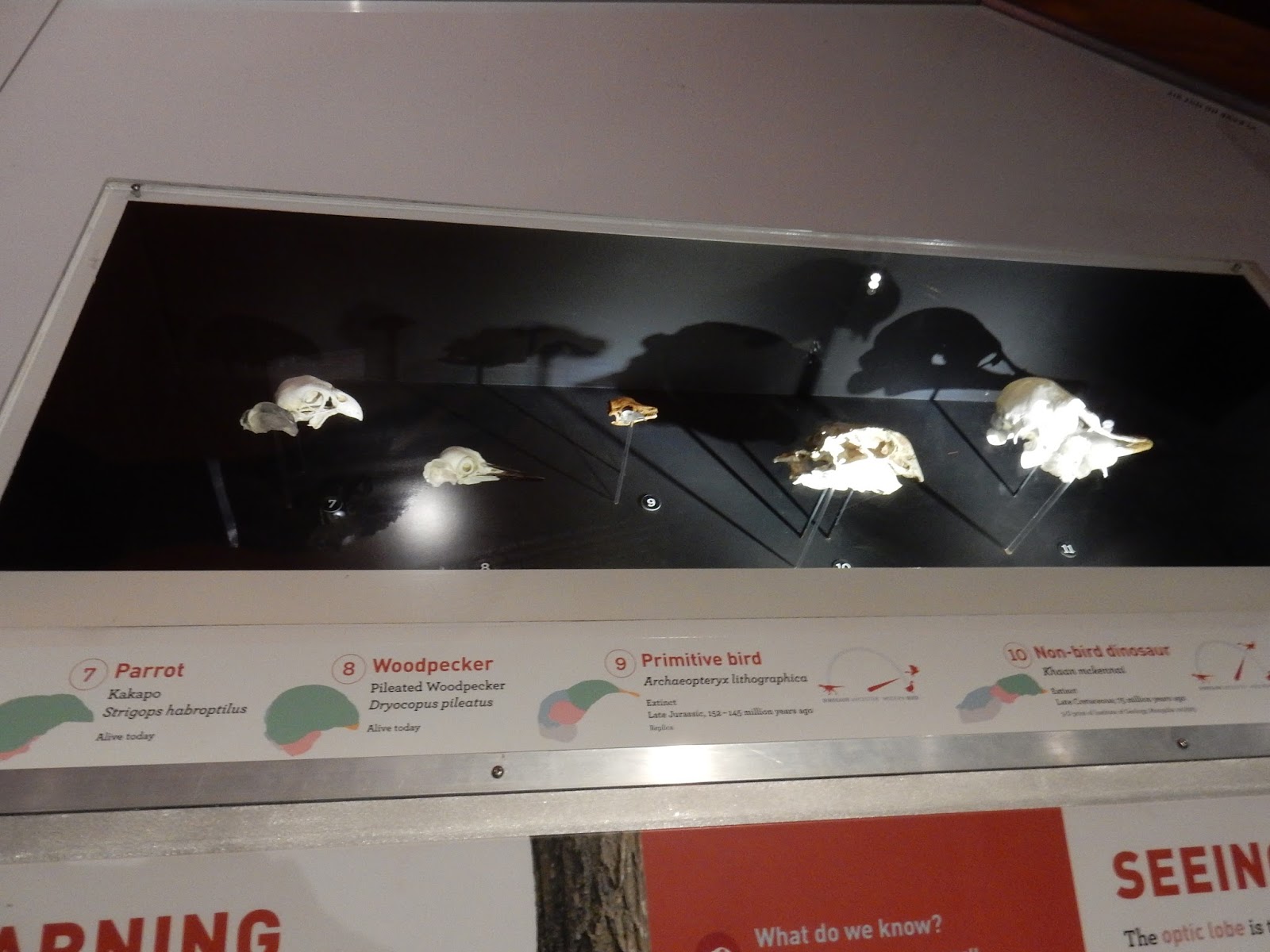
A gallery of pennaraptor skulls and endocasts, showing the evolution of the avian brain. I was glad to see Dr. Eugenia Gold as one of the talking heads on a nearby video screen, considering that her recent research has focused on avian endocranial anatomy. Notice the "bird-o-meter" next to the labels of the fossil dinosaurs, indicating how closely related each one is to modern birds.
A wonderfully-preserved pair of Khaan that were found in close proximity to one another. The wording on the signage was sensibly cautious about interpreting them as a male and female. (Hint: dimorphism cannot be demonstrated with a sample size of two...)
Another excellent fossil, this time of Velociraptor. This may be the "sleeping" Velociraptor specimen I've heard rumors about.
A gallery of furculae. The largest one belongs to Tyrannosaurus.
I was impressed by how up to date some of the displayed information was. Here, recent discoveries of one-way breathing in crocodylians, monitor lizards, and iguanas are used to explain the evolution of the avian respiratory system.
There were a number of life-sized models of representative feathered dinosaurs, including this Beipiaosaurus.
In fact, a virtual parade of life-sized models and partial mounts made up the centerpiece of the exhibit. Here is a fairly nice Velociraptor. (Additionally, I overheard more than a few expressions of surprise from other visitors who were learning that non-avialan dinosaurs had feathers, both a reminder that this fact is not common knowledge outside of the paleontology community as well as real-time demonstration of the value of exhibitions like this one.)
As the largest dinosaurs with direct preservation of feathers, Yutyrannus stole the show.
A fossil cast of Yutyrannus in all its glory.
Some interesting speculation on the presence of feathers in large dinosaurs.
Fluffy ornithischian Tianyulong. Shame about the pronated hands.
An Archaeopteryx that looks like a real animal and not a half-lizard freak. Good job.
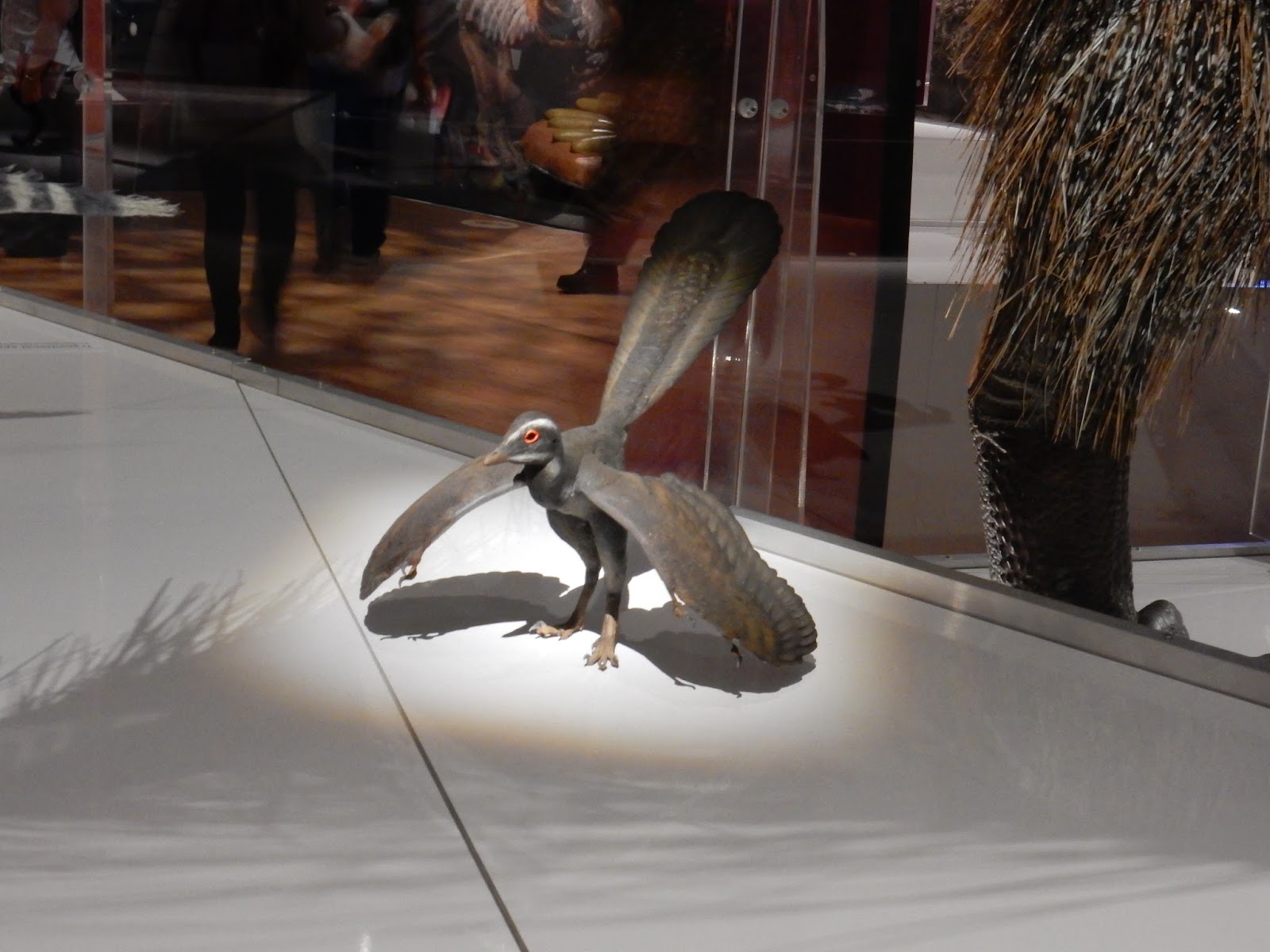
A cast of the Berlin Archaeopteryx and the original holotype feather.
An oviraptorid with young. The oviraptorids (there are others not pictured here) were the best models on display, in my opinion. I should have taken more pictures of them.
On the origin of flight, here is an Anchiornis performing wing-assisted incline running.
A cast of "Dave" the (possible) Sinornithosaurus.
A cast of Caudipteryx.
A cast of Tianyulong.
Feathers did not evolve in an aerodynamic context.
This... is one of the few parts of the exhibition that I had issue with. It's fair enough to point out that the developmental homologs of feathers originated long before the evolution of birds, but it does not thus follow that feathers themselves arose at the base of Archosauria (as implied by the accompanying restoration). On top of that, picking Effigia, a pseudosuchian that happens to have several other convergently bird-like characteristics, to clothe in feathers may come across as more than a little misleading. It would be cool if crocodylians were ancestrally feathered. However, we do not have the data to claim they were as of yet.
A lithornithid with fossilized feathers (and Effigia skull at top left).
A cast of Anchiornis. Are we seeing some of the original color pattern on those wings?
Juravenator shows that feathers and scales are not mutually exclusive.
Microraptor represents early experimentation with aerial locomotion in paravians.
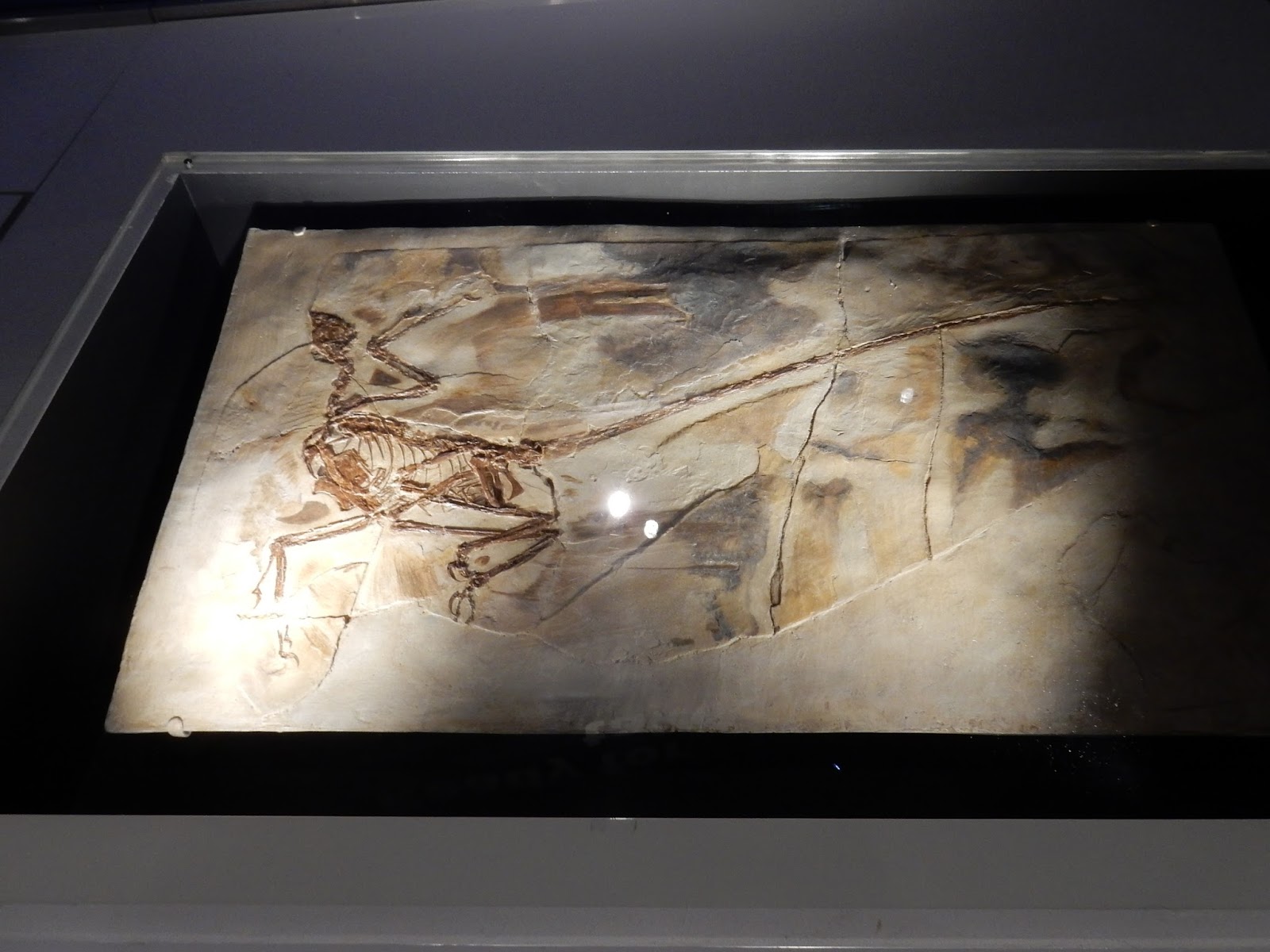
Confuciusornis (left) and Xiaotingia (right) may have also had varying degrees of flying ability.
Look, it's Yi!
Jeholornis shows that feathers can function in display, too.
I liked the fact that some space is dedicated to Cenozoic birds as well. Here is another lithornithid.
That's stem-roller Paracoracias on the left and... another lithornithid on the right? My memory fails me on this one.
The skull of Gastornis.
A comparison of flying vertebrates.
An entire wall showing the stepwise acquisition of "avian" traits and the nebulousness of the term "bird". Unfortunately, some workers were repairing the interactive "test how well each dinosaur can fly" game, so I could neither get a better picture of the wall nor observe how the game worked.
The final display case contained a currently unnamed troodont, reportedly soon to be described.
A small gift shop directly followed the exhibition. One of the creatures on this shirt is not a dinosaur. (Surely, it would have made a better tie-in to the exhibit if they had included at least one bird on the shirt?)
Half of these titles belongs. The other half... doesn't.
Despite some minor quibbles about life restorations and feathered pseudosuchians, I found "Dinosaurs Among Us" to be excellent. It presents our understanding of avian origins in an incredibly current and multifaceted manner, and there is little I would add or change if I were in charge of making such decisions. Check it out if you have the chance! (It is open until January 2nd of next year.) It was well worth the long train ride to and from New York, and that's a trip I wouldn't make again in a hurry.
... What do you mean, there is also a pseudosuchian exhibit now?
Friday, June 3, 2016
Thursday, June 2, 2016
Maryland Zoo in Baltimore
Living in the shadow of the much larger and admission-free National Zoo, it's easy to see why the Maryland Zoo in Baltimore is frequently overlooked. Having had the chance at last to visit it, however, I can confirm that it contains a few gems and has sufficiently little overlap with the National Zoo to make it at least worth considering as a travel destination.
For reasons unknown to me, the bulk of the zoo's exhibits are found some distance away from the entrance and need to be reached either on foot or via shuttle. One of the few displays that can be found near the entrance is a well-populated black-tailed prairie dog enclosure. A good choice for first impressions, as the ground squirrels were quite delightful, particularly the juveniles.
Another nearby display houses African birds, among them this obliging Abyssinian ground hornbill. The real dinosauroid.
The main portion of the zoo is divided into three loop trails. The shortest of these trails has a focus on arctic animals, including polar bears and ravens. Most memorably, it took some time for me to get even a halfway decent shot of this arctic fox.
My friend Ben found this wild brown snake on our way to the next loop trail.
The second loop trail featured local Maryland wildlife, including an aviary with many native bird species. Here is a green heron.
Diving ducks are always charming, and these ruddy ducks were no exception. As a bonus, we got to see the males in their breeding colors, an unlikely prospect in the wild considering they only winter here.
One of the ruddy ducks feeding alongside a pair of wood ducks.
A little blue heron.
A sandhill crane.
A turkey vulture.
Wild snakes were out in force that day, as we saw three northern water snakes (one not pictured) chilling in the aviary.
Not one of the wild snakes we saw, but a captive copperhead.
Some box turtles had a surprisingly spacious exhibit (which is not evident from my photo).
A pair of trumpeter swans.
The final and longest loop trail is devoted to Africa. Likely the best exhibits in the zoo are found here, including a nice display housing sitatunga and these African crowned cranes.
We observed these chimpanzees using sticks to pull surrounding leaves and bamboo shoots into their enclosure for consumption.
I was surprised to see okapis at this zoo. They share a giraffid house with giraffes, though their exhibits are unfortunately quite plain.
More aesthetically pleasing was this grassy habitat for addra gazelles and saddle-billed storks.
An African aviary nearby contained blue-bellied rollers that were more than willing to show off their acrobatic flying style.
A pair of Von der Decken's hornbills.
A pair of African pygmy geese, among the smallest waterfowl in the world. According to exhibit signs, there is also a blue duiker living in the aviary that decided to be a no-show. The omnivorous tendencies of duikers make me wonder how safe it is to keep one with birds.
A wild spotted sandpiper hanging out in the rhinoceros exhibit. (It probably says something about me that I took a picture of a common bird but not of the rhino...)
A small, easily-missed display is home to some very delicate-looking Kirk's dik-diks.
Living alongside the lap-sized antelope are demoiselle cranes.
The centerpiece of the zoo is a large pool for black-footed penguins. Also present is a volant species of diving bird that lives in the same region in the wild, the white-breasted cormorant.
We passed by the penguin pool just in time to see them being fed. A wild herring gull hung around nearby in hopes of getting some scraps.
Thursday, April 7, 2016
Tumblr Roundup 4/7/2016 (Dinosaur March Madness Edition)
Over the past month, Meg Dickson's A Dinosaur A Day has been hosting Dinosaur March Madness to figure out the most popular dinosaurs among her readership. I took the chance to come out of hibernation intermittently to answer questions and have the Raptormaniacs characters comment on the proceedings. The commentary is included in the links below.
-Commentary on Game One.
-Commentary on Game Two.
-Commentary on Game Three.
-Commentary on Game Thirty-One.
-What does Savape's mother think of her cruelty?
-Where are all the non-theropod dinosaurs?
-What tourist destinations are there in the city?
-Does the museum have a Spinosaurus?
-Skull comments on Palaeofail's choice of favorite dromaeosaurid.
-Commentary on results of Round Three.
-Does Zahavi have a power origin story?
-Thoughts on Utahraptor.
-Does the museum have a Yutyrannus?
-Thoughts on Hyracotherium.
-Is there a Microraptor in the museum?
-Commentary on overall results of Dinosaur March Madness.
Labels:
Dinky,
Ebeff,
Ostrom,
Oviraptorosaurs,
Remex,
Savape,
Shock horror a non maniraptor,
Skull,
Special presentation,
Troodontids,
Tumblr,
Zahavi
Friday, April 1, 2016
What Did Mesozoic Maniraptors Eat? Results from My Senior Thesis
I don't neglect this blog just because I can. At last, it is time to unveil what has been eating up most of my time: my senior thesis research. Contrary to some of my previously-expressed concerns, there is no risk in releasing my findings in this fashion because everyone knows that blogs are entirely worthless for any form of scientific discourse. When I get around to submitting my thesis as a manuscript, those journals will have no idea that I've already publicized this information, because what proper academic (including editors of scientific journals) ever reads or writes blogs?
There has been much debate and speculation on the diets of Mesozoic maniraptors, in part due to their diverse skull morphology that frequently deviates from what is expected of "typical" theropods. In recent years, it has been popular to argue on morphological and biomechanical grounds that herbivory and omnivory were widespread in Mesozoic maniraptors.
However, the existence of fruit-eating alligators and meat-eating ruminants demonstrate that morphological inference of animal diets is unreliable at best. Direct observations are what count. For my senior thesis, I looked at direct evidence of maniraptor diets (gut contents and feeding traces) throughout the Mesozoic. The results can be seen in the graph below.
The trend is clear: for most of the Mesozoic, most maniraptors were eating absolutely nothing! This is at great odds to the popular interpretation of widespread herbivory in these dinosaurs, but it makes a good amount of sense. After all, if these animals were not eating anything, their skull morphology would not be at all constrained by diet and would be free to take on other functions such as sexual display and species recognition. This revelation brilliantly explains the diversity of skull shapes in maniraptors.
Another finding of interest is the spike in hypercarnivorous maniraptor species during the Campanian. The most parsimonious explanation for this observation is that, considering the evolution of all organisms is driven by the aesthetic preferences of a single Holocene primate species (66 million years away from the last non-neornithine maniraptors), this was an attempt by the maniraptors to become more awesome, because feeding on fish or plants is lame. (And fish is not meat, what are you talking about?) Unfortunately for maniraptors, all carnivorous species died out prior to the Maastrichtian, likely because that ecospace was already dominated by other types of theropods.
What of the increase in rock-eating species during the Aptian? The great abundance of fossil species and specimens found dating to the Aptian is reflective of an increase in the generation of sedimentary rock during this time period. Evidently, a number of maniraptor species became adapted to take advantage of this resource.
References
Awesomebro, I. 2013. Y animulz musth b kewl enuff 4 me. Annals of Awesomebro 95: 26-910. doi: x8615/asum.2399
Blank, D.A. 2003. On the carnivorism and feces eating of Gazella dorcas Linnaeus, 1758 and other ungulates. Mammalia 674: 579-585.
Lautenschlager, S. 2013. Cranial myology and bite force performance of Erlikosaurus andrewsi: a novel approach for digital muscle reconstructions. Journal of Anatomy 222: 260-272. doi: 10.1111/joa.12000
Lautenschlager, S., L.M. Witmer, A. Perle, L.E. Zanno, and E.J. Rayfield. 2014. Cranial anatomy of Erlikosaurus andrewsi (Dinosauria, Therizinosauria): new insights based on digital reconstruction. Journal of Vertebrate Paleontology 34: 1263-1291. doi: 10.1080/02724634.2014.874529
O'Connor, J.K. and L.M. Chiappe. 2011. A revision of enantiornithine (Aves: Ornithothoraces) skull morphology. Journal of Systematic Palaeontology 9: 135-157. doi: 10.1080/14772019.2010.526639
Platt, S.G., R.M. Elsey, H. Liu, T.R. Rainwater, J.C. Nifong, A.E. Rosenblatt, M.R. Heithaus, and F.J. Mazzotti. 2013. Frugivory and seed dispersal by crocodilians: an overlooked form of saurochory? Journal of Zoology 291: 87-99. doi: 10.1111/jzo.12052
Zanno, L.E. and P.J. Makovicky. 2011. Herbivorous ecomorphology and specialization patterns in theropod dinosaur evolution. Proceedings of the National Academy of Sciences, USA 108: 232-237. doi: 10.1073/pnas.1011924108
There has been much debate and speculation on the diets of Mesozoic maniraptors, in part due to their diverse skull morphology that frequently deviates from what is expected of "typical" theropods. In recent years, it has been popular to argue on morphological and biomechanical grounds that herbivory and omnivory were widespread in Mesozoic maniraptors.
![]() |
| A digital reconstruction of the skull of the therizinosaur Erlikosaurus in multiple views, from Lautenschlager et al., 2014. |
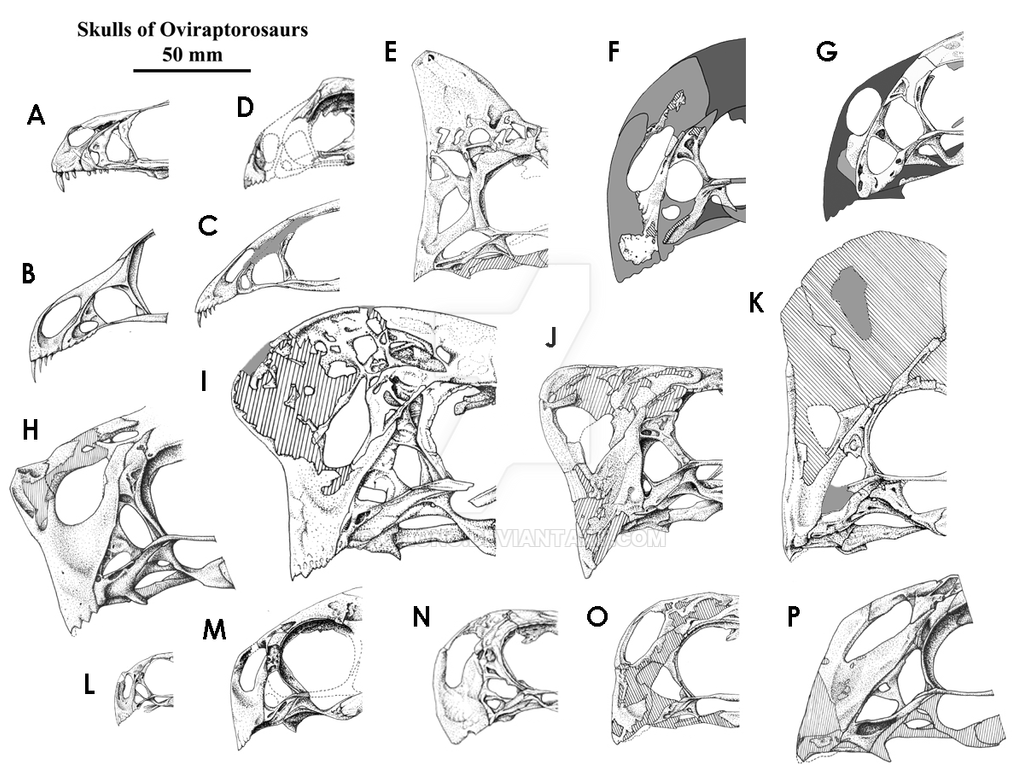
| A selection of oviraptorosaur snouts, drawn by Jaime Headden, licensed. |
![]() |
| A selection of enantiornithine skulls, from O'Connor and Chiappe, 2011. |
However, the existence of fruit-eating alligators and meat-eating ruminants demonstrate that morphological inference of animal diets is unreliable at best. Direct observations are what count. For my senior thesis, I looked at direct evidence of maniraptor diets (gut contents and feeding traces) throughout the Mesozoic. The results can be seen in the graph below.
The trend is clear: for most of the Mesozoic, most maniraptors were eating absolutely nothing! This is at great odds to the popular interpretation of widespread herbivory in these dinosaurs, but it makes a good amount of sense. After all, if these animals were not eating anything, their skull morphology would not be at all constrained by diet and would be free to take on other functions such as sexual display and species recognition. This revelation brilliantly explains the diversity of skull shapes in maniraptors.
Another finding of interest is the spike in hypercarnivorous maniraptor species during the Campanian. The most parsimonious explanation for this observation is that, considering the evolution of all organisms is driven by the aesthetic preferences of a single Holocene primate species (66 million years away from the last non-neornithine maniraptors), this was an attempt by the maniraptors to become more awesome, because feeding on fish or plants is lame. (And fish is not meat, what are you talking about?) Unfortunately for maniraptors, all carnivorous species died out prior to the Maastrichtian, likely because that ecospace was already dominated by other types of theropods.
What of the increase in rock-eating species during the Aptian? The great abundance of fossil species and specimens found dating to the Aptian is reflective of an increase in the generation of sedimentary rock during this time period. Evidently, a number of maniraptor species became adapted to take advantage of this resource.
References
Awesomebro, I. 2013. Y animulz musth b kewl enuff 4 me. Annals of Awesomebro 95: 26-910. doi: x8615/asum.2399
Blank, D.A. 2003. On the carnivorism and feces eating of Gazella dorcas Linnaeus, 1758 and other ungulates. Mammalia 674: 579-585.
Lautenschlager, S. 2013. Cranial myology and bite force performance of Erlikosaurus andrewsi: a novel approach for digital muscle reconstructions. Journal of Anatomy 222: 260-272. doi: 10.1111/joa.12000
Lautenschlager, S., L.M. Witmer, A. Perle, L.E. Zanno, and E.J. Rayfield. 2014. Cranial anatomy of Erlikosaurus andrewsi (Dinosauria, Therizinosauria): new insights based on digital reconstruction. Journal of Vertebrate Paleontology 34: 1263-1291. doi: 10.1080/02724634.2014.874529
O'Connor, J.K. and L.M. Chiappe. 2011. A revision of enantiornithine (Aves: Ornithothoraces) skull morphology. Journal of Systematic Palaeontology 9: 135-157. doi: 10.1080/14772019.2010.526639
Platt, S.G., R.M. Elsey, H. Liu, T.R. Rainwater, J.C. Nifong, A.E. Rosenblatt, M.R. Heithaus, and F.J. Mazzotti. 2013. Frugivory and seed dispersal by crocodilians: an overlooked form of saurochory? Journal of Zoology 291: 87-99. doi: 10.1111/jzo.12052
Zanno, L.E. and P.J. Makovicky. 2011. Herbivorous ecomorphology and specialization patterns in theropod dinosaur evolution. Proceedings of the National Academy of Sciences, USA 108: 232-237. doi: 10.1073/pnas.1011924108
Subscribe to:
Posts (Atom)