Tuesday, November 15, 2016

Bristol Museum

It would have been foolish of me to come study here without making a post on the Bristol Museum, considering it is next door to where most of my classes take place. It has a notable collection of Mesozoic marine reptiles. Here is a well-preserved specimen of Temnodontosaurus.

Excalibosaurus, an ichthyosaur with a very elongate rostrum.

A large specimen of Leptonectes.

An outdated presentation of plesiosaur biology.

There are also a few Mesozoic dinosaurs on display, including this Plateosaurus mounted in a rearing posture.

Perhaps surprisingly, the most highly-celebrated dinosaur here is the small sauropodomorph Thecodontosaurus, lauded due to it being a local and historically interesting fossil discovery. Here is a model of the beast by Bob Nicholls.

The reconstructed forelimbs of Thecodontosaurus.

A mostly complete specimen of Scelidosaurus.

A model of Scelidosaurus that has been quote-mined (see the words near its feet).

A more recently extinct dinosaur, an eastern moa.

I quite enjoy the taxidermy displays at this museum, as the specimens are mounted in evocatively lifelike poses. Here is an edible dormouse, as part of a gallery of British wildlife.

An impressively large monkfish, shown luring a small flatfish to its death.

They went to some lengths to get the correct eyes for these stuffed specimens, as is particularly noticeable with this great cormorant.

A hoopoe. I would love to add this species to my life list someday. Based on the blurb though, there's little chance of that happening here.

A diorama of nesting sand martins. (We Americans call them bank swallows.)

There are some more exotic species on display as well, such as this lesser Egyptian jerboa.

A long-tailed pangolin, one of the highly arboreal pangolin species.

I was excited to see this Potamogale, or giant otter shrew, a semi-aquatic tenrec.

An African brush-tailed porcupine.

An ivory-billed woodpecker, almost certainly extinct.

I wouldn't get my hopes up too much.

An eastern ground parrot.

A gray peacock pheasant. Galliforms are crazy.

Speaking of crazy extravagance, an entire display case of birds of paradise.

A regal-looking king vulture.

Tadpoles of the paradoxical frog, which become shorter as they age.

Various hummingbirds.

A resplendent quetzal, the most magnificent of trogons, and a plum-throated cotinga.

Some silky anteaters, the smallest and most adorable anteaters.

A thylacine!

A southern (or double-wattled) cassowary.

A platypus.

The skeleton of a potto, a strange nocturnal primate that uses the elongate neural spines on its neck as weapons.

A model of a dodo. (Not a taxidermied dodo; those, unfortunately, do not exist.)

A scaly-headed Archaeopteryx model. It... could be worse.

A cast of the London Archaeopteryx. I should visit the home institution of the original at some point.

Fragmentary Iguanodon (or more likely Mantellisaurus?) fossils.

Oh, it's that Oligokyphus model.

In addition to being a natural history museum, the Bristol Museum is also an art gallery. However, I will leave it up to the true art connoisseurs to tackle that side of things.

Sunday, November 13, 2016

Birds of Stone

It's a good year in the book department for aficionados of fossil birds, as at least two major volumes on the subject have been released. In this post I will review the first of these two, saving the other for a later date.

Birds of Stone, authored by renowned paleornithologists Luis Chiappe and Meng Qingjin, focuses on the diverse and fantastically-preserved avifauna of the Early Cretaceous Jehol Group in China.


The book is, in part, intended to be a photographic gallery featuring the numerous fossil bird specimens that have been unearthed from the Jehol, and in this it excels. Page after page for the first two-thirds of the book, readers are treated to high-resolution images of Jeholornis, Sapeornis, Confuciusornis, Yanornis, Longipteryx, Zhouornis, unnamed enantiornithines in abundance, and more. Take note: we now have high-res photographs of Xinghaiornis! An interesting tidbit is that one enantiornithine specimen figured, preserved with rectrices almost twice the length of its body, is labeled "Junornis houi", a name thus far unpublished in technical literature.

Many of the photographs are given single- or double-page spreads. Close-ups of teeth, claws, feathers, gut contents, and embryos are all presented in incredible detail. Specimens shown under ultraviolet light reveal foot scales and wing patagia. Considering that many Jehol fossils have only been perfunctorily described and figured in the literature despite their scientific importance, the images in this book should be valuable not only for their aesthetic appeal, but also for their potential as references (particularly for paleoartists).

Continuous text descriptions of the fossils accompany the gallery, putting the pretty pictures in context. Information is provided on what we know about the anatomy and paleobiology of Jehol birds, but it is the last third of the book where the text takes center stage. Here, the book gives a broader overview of avialan evolution, covering topics such as the diversity of Mesozoic birds, the origins of avian flight, and the scientific significance of the Jehol Group. There are fewer full-page photographic spreads in this section, though it is nonetheless well-illustrated with images featuring, in addition to more bird fossils, non-dinosaurian specimens from the Jehol and fossils of feathered non-avialan dinosaurs. The text shines in its clear writing that uses minimal technical language to explain its concepts, which should make the book fairly accessible to interested laypeople. (One minor lapse: at one point a screamer is used as a reference for size with no explanation. I would not expect most laypeople to be familiar with screamers.)

As a summary of the state of the art, Birds of Stone does well. The most recently-named taxon mentioned in the text is Chiappeavis, making the book up to date through the end of 2015. Possibly of interest is that the authors speculate about the possibility that Sapeornis used its large talons to apprehend animal prey, while acknowledging that known gut contents of this bird consist of seeds. Interestingly, the authors express support for synonymizing Iteravis and Gansus zheni, an idea that has been suggested by Mickey Mortimer but has yet to appear in scientific literature. (Though unlike Mortimer, they retain the taxon in question as part of the genus Gansus.)

Did I find any fault with the book? The text is somewhat repetitive at times. For instance, the potential scientific significance and controversial phylogenetic position of Zhongornis (a short-tailed bird that lacks a pygostyle) is explained at least three separate times (not merely mentioned or referenced, but given an entire paragraph in each instance), and the same is true of various other subjects covered. There were a few moments while I was reading when I stopped and checked that I hadn't mistakenly flipped to an earlier part of the book that I'd already read.

As far as nitpicky details go, the outdated term "Tertiary" is used. The pterosaur Jeholopterus and the mammal Juramaia are incorrectly said to be part of the Jehol biota. (Both are instead from the Late Jurassic Tiaojishan Formation.) It is implied that all ornithomimosaurs, therizinosaurs, and oviraptorosaurs possessed pygostyles, even though this is not the case. (A pygostyle is only known in Deinocheirus among ornithomimosaurs and in Beipiaosaurus among therizinosaurs. It is more widespread in oviraptorosaurs, but not universal.)

Despite my quibbles, the photographs contained in this volume are worth the price of admission on their own, and I would recommend Birds of Stone to anyone interested in paleornithology. The informative and layperson-friendly writing is icing on the cake. Just make certain to keep tabs on what page you are on, because you may find some difficulty doing so by the text alone.

Saturday, November 12, 2016

Bristol Zoo Part V: Islands and Aviaries

The center of the Bristol Zoo is a large lake with several islands, upon which live various primates, such as these agile gibbons.

The lake also feeds into a pool for North American river otters.

A walkthrough aviary found near the lake is the Forest of Birds, mostly featuring tropical birds from Southeast Asia. This is a Mindanao bleeding heart dove. The lighting in the aviary is rather poor, though, to be fair, that is appropriate for a tropical forest setting.

A closely related species, the Luzon bleeding heart dove.

Pied imperial pigeons, Asian glossy starlings, and Java sparrows.

Not one of the captive birds in the aviary, but a wild European robin found on zoo grounds. Though a common sight here, this is a lifer for me.

Some maras, which are what happen when a rodent tries to be a hare.

A Palawan peacock pheasant.

A Sumatran laughing thrush.

These macaw plushies in the gift store have correctly zygodactyl feet.

Friday, November 11, 2016

Bristol Zoo Part IV: Seal and Penguin Coasts and Zona Brazil

Onward through the Bristol Zoo is Monkey Jungle. I think it has monkeys or something, but I was distracted looking at the xenarthrans. Here a six-banded armadillo tucks in to some salad.

Seal and Penguin Coasts is also self-explanatory. For obvious reasons, the titular animals are not kept in the same enclosures. The penguins (of the black-footed variety) are up first.

Tubes are available to them as nesting sites.

The penguins live in a walk-in aviary with some other seabirds, including these common eiders.

There is also a flock of Inca terns.

Next up are the South American fur seals. Here is one chilling on a rock.

Two others having an argument.

The path slopes downward at this point, taking visitors to underwater viewing areas for the fur seals and penguins. Additionally, there are some small aquariums set along the path in this area. Here is one with pot-bellied seahorses.

A fellow syngnathiform, a greater pipefish.

Zona Brazil houses a variety of South American species. Many of the usual suspects are present, including this capybara.

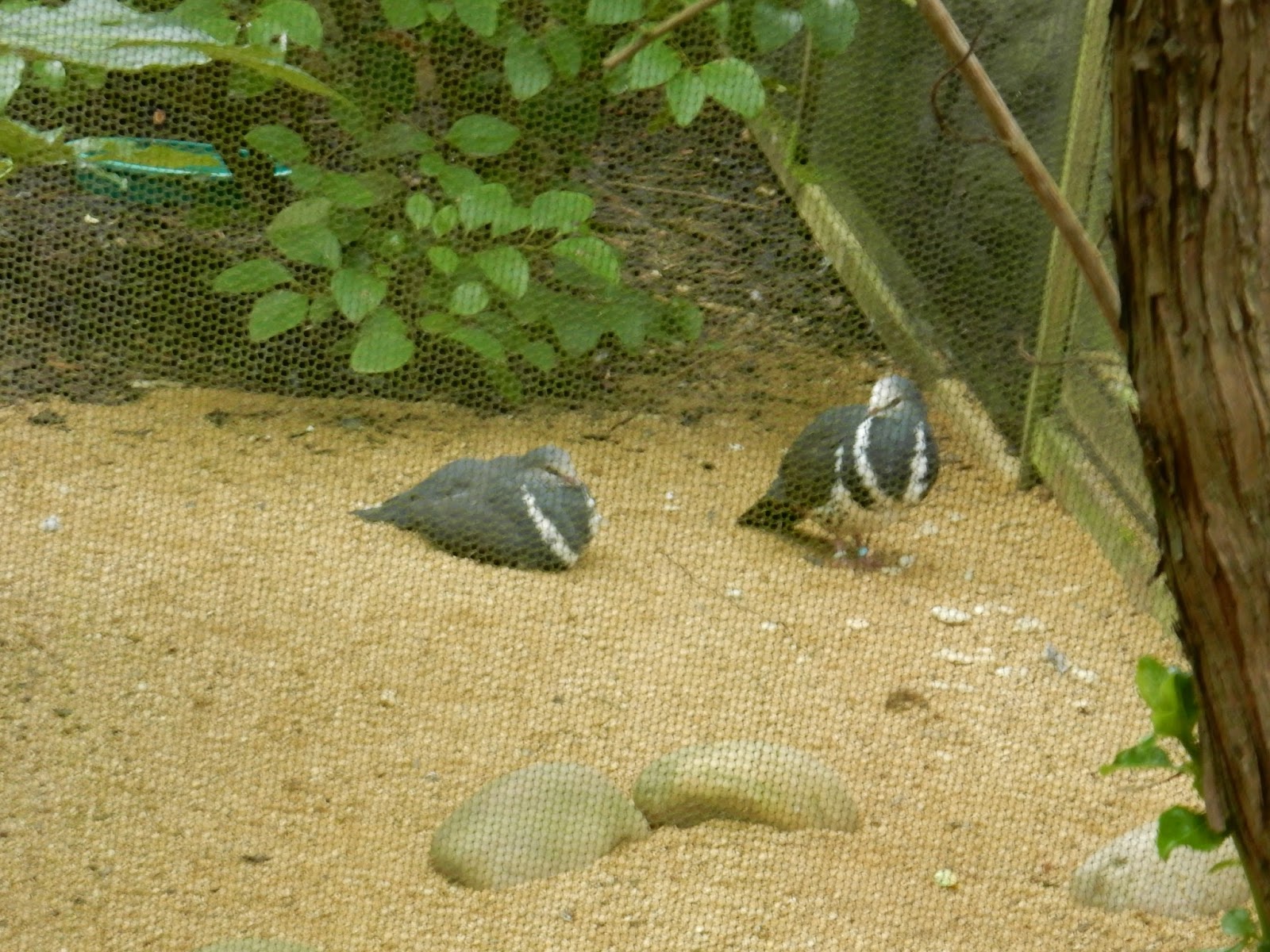
Some wonga pigeons, which are Australian rather than South American.

Wednesday, November 9, 2016

Bristol Zoo Part III: Aquarium and Bug World

So a certain thing happened and now we're all fucked.

Now have some pictures of fish and arthropods.

The entrance of the Bristol Zoo's aquarium highlights their work in the conservation of the white-clawed crayfish, a British native currently threatened by invasive crayfish species.

Some mudskippers.

A shotsilk goby. Really a dartfish, not a goby.

The insect house, Bug World, is one of the zoo's highlights. It is likely one of the best insect displays I've ever seen. For starters, the insects are given quite spacious enclosures that put them in the context of their environment, as opposed to simple set-ups that look like those one could have obtained from any pet store.

For another, some quite unusual species were exhibited. Looking at these at a glance, I would have assumed they were stick insects. They are, in fact, horse-headed grasshoppers!

Placed on plaques throughout Bug World are poems dedicated to the exhibit's inhabitants.

The subject of the previously shown poem, somewhat out of focus.

A variety of colorful beetles, including ornate sun beetles, lesser goliath beetles, and horned flower beetles.

A purple jewel beetle living up to its name.

Part of a comic describing conservation efforts on Partula snails. The bottom panel shows a surprisingly graphic cartoon of an invasive giant African snail crushing an invasive carnivorous snail while Bristol Zoo flies in to rescue the Partula.

A shrimp with an unusual name.

A poem for a coral.

A domino cockroach. In appearance it mimics ground beetles that are capable of spraying noxious chemicals.

It's hard to see in this picture, but this is a Lord Howe Island stick insect (sometimes called a tree lobster), one of the rarest insects in the world.